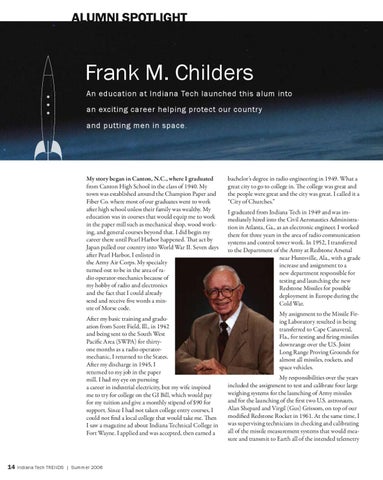
Frank M. Childers An education at Indiana Tech launched this alum into an exciting career helping protect our country and putting men in space.
My story began in Canton, N.C., where I graduated from Canton High School in the class of 1940. My town was established around the Champion Paper and Fiber Co. where most of our graduates went to work after high school unless their family was wealthy. My education was in courses that would equip me to work in the paper mill such as mechanical shop, wood working, and general courses beyond that. I did begin my career there until Pearl Harbor happened. That act by Japan pulled our country into World War II. Seven days after Pearl Harbor, I enlisted in the Army Air Corps. My specialty turned out to be in the area of radio operator-mechanics because of my hobby of radio and electronics and the fact that I could already send and receive five words a minute of Morse code. After my basic training and graduation from Scott Field, Ill., in 1942 and being sent to the South West Pacific Area (SWPA) for thirtyone months as a radio operatormechanic, I returned to the States. After my discharge in 1945, I returned to my job in the paper mill. I had my eye on pursuing a career in industrial electricity, but my wife inspired me to try for college on the GI Bill, which would pay for my tuition and give a monthly stipend of $90 for support. Since I had not taken college entry courses, I could not find a local college that would take me. Then I saw a magazine ad about Indiana Technical College in Fort Wayne. I applied and was accepted, then earned a
14
Indiana Tech TRENDS | Summer 2006
bachelor’s degree in radio engineering in 1949. What a great city to go to college in. The college was great and the people were great and the city was great. I called it a “City of Churches.” I graduated from Indiana Tech in 1949 and was immediately hired into the Civil Aeronautics Administration in Atlanta, Ga., as an electronic engineer. I worked there for three years in the area of radio communication systems and control tower work. In 1952, I transferred to the Department of the Army at Redstone Arsenal near Huntsville, Ala., with a grade increase and assignment to a new department responsible for testing and launching the new Redstone Missiles for possible deployment in Europe during the Cold War. My assignment to the Missile Firing Laboratory resulted in being transferred to Cape Canaveral, Fla., for testing and firing missiles downrange over the U.S. Joint Long Range Proving Grounds for almost all missiles, rockets, and space vehicles. My responsibilities over the years included the assignment to test and calibrate four large weighing systems for the launching of Army missiles and for the launching of the first two U.S. astronauts, Alan Shepard and Virgil (Gus) Grissom, on top of our modified Redstone Rocket in 1961. At the same time, I was supervising technicians in checking and calibrating all of the missile measurement systems that would measure and transmit to Earth all of the intended telemetry