THE THREE WAVES OF DESIGN I divide the shift that I have witnessed over the fiftyyear period that I have practised design into three waves of change: • From Design Person … Design originated in handcraft and the decorative arts, where traditionally, and continuing today, a single person invents, designs, and makes the artefact. Most people still think of design as the product of a single, miraculously gifted “design person.” In Berlin in 1906, AEG hired Peter Behrens, a German architect, as the first corporate design director in the modern sense. His job was to design all of AEG’s products, advertising, factories, business offices, and workers’ housing. Behrens called himself AEG’s “court artist.” • ... over Design Policy … In the 1950s, inspired by the AEG example, Thomas J. Watson Jr., chairman of IBM, named architect Elliott Noyes as the computer industry’s first “design person”. Noyes established IBM’s total design identity, including products, architecture, and graphic identity, even assembling the company’s art collection. As IBM grew, Noyes recognised the need for the control of design to evolve from a single individual to internal functional departments. Initiating the transition from “design person” to “design policy”, Noyes set up design centres across the corporation, while retaining overall control of design strategy as a centralised corporate function. Throughout the 1960s, 70s and 80s, as American and European corporations sought to manage rapid growth, decentralisation, and internationalisation, many followed the model of IBM. “Design policy” supplanted the “design person”, and corporate designers wrote design manuals and guidelines to be used by engineers and marketers to ensure uniform and consistent product and brand identities. • … to Design Process: Policies are more effective for implementing ideas that already exist than for creating new ideas amid disruptive change. For this reason, in the 1980s, many companies, like Sony, Apple, Nike, Philips, NCR, Xerox, and Unisys, began to move away from bureaucratic “design policy” towards a third wave: embedded “design process.”
methodology in which the disciplines of design, strategy, engineering, and marketing collaborate as an integrated multidisciplinary team throughout the product life cycle from initial identification of opportunity, through research, product definition, and detailed design to execution. Although these practices may seem axiomatic to most designers and educators today, they were far from widespread twenty-five years ago. Five major forces of change brought about a heightened understanding of design by business and the emergence of New Design:
1. Digital Technology: When the semiconductor transistor and integrated circuit emerged in the 1960s, few people foresaw a universe of smart mobs internetworked over mobile picture cell phones, PCs, PDAs, and messagers - all talking to each other all the time. The central problem of design has moved far beyond the unitary, freestanding artefact. New Design is about crafting the interactions, behaviours, and experiences of softwaredriven systems comprised of humans, atoms, and bits. Everything has programmable intelligence and lives on global networks. Much of what we think of as a product may not even by physically tangible. Often the “real” product is streams of bits that momentarily aggregate as sounds, images, text, or tactile sensations. Designing for such a world has necessitated broad and deep change in understanding what it means to design and how to go about it.
2. Silicon Valley: Along the southern shores of San Francisco Bay in the 1980s we witnessed the seismic birth of a completely new entrepreneurial culture whose ethos was not stabilisation and control, but disruptive innovation and unpredictable change. New Design was needed to keep pace where everything was being invented new every day - knowledge, technology, organisational structures, and work practices. California became a magnet for designers from the American East Coast and Midwest, as well as from Britain, France, Germany, and Japan. Exported worldwide, the culture of New Design was, paradoxically, both Californian and intensely international.
By “design process” I mean the methodology of New Design; that is: Design based on research to gain insight into the tacit and latent needs and wants of users in target markets; Strategic scenarios to develop foresight about the forces that are going to create change in the future; Anticipating products ahead of engineering development; Future product innovation shaped as much by design as by technology. Above all, “design process” refers to a robust innovation
8
The third major force of change that gave rise to “design process” was the emergence of Japan as a dominant competitive actor in the world economy. By the 1980s, “Japan Incorporated” had targeted and dominated one American industry after another: Integrated circuitry, cameras, motorcycles, consumer electronics, and office equipment. One out of every three cars sold in the U.S. was Japanese. No longer was Japan copying the West but originating inventions, for that matter creating entire new product
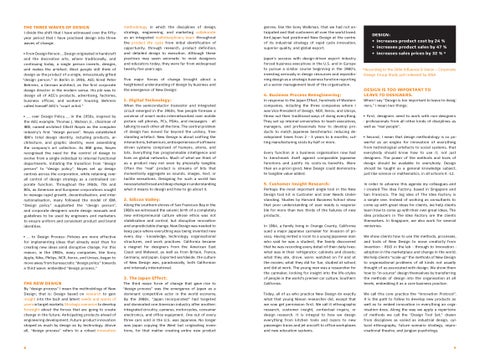
DESIGN: • increases product cost by 24 % • increases product sales by 47 % • increases sales prices by 32 % *
Japan’s success with design-driven export industry forced business executives in the U.S. and in Europe to pursue a similar course beginning in the 1980’s, investing seriously in design resources and repositioning design as a strategic business function reporting at a senior management level of the organisation.
4. Business Process Reengineering:
3. The Japan Effect: THE NEW DESIGN
genres, like the Sony Walkman, that we had not anticipated and that customers all over the world loved. And Japan had positioned New Design at the centre of its industrial strategy of rapid cycle innovation, superior quality, and global export.
In response to the Japan Effect, hundreds of Western companies, including the three companies where I was Vice President of Design, NCR, Xerox, and Unisys, threw out their traditional ways of doing everything. They set up internal universities to teach executives, managers, and professionals how to develop products to match Japanese benchmarks: reducing development times from 2 - 3 years to 6 months; cutting manufacturing costs by half or more. Every function in a business organisation now had to benchmark itself against comparable Japanese functions and justify its costs-vs.-benefits. More than an a-priori good, New Design could demonstrate tangible value added.
5. Customer Insight Research: Perhaps the most important single tool in the New Design tool kit is Customer and User Needs Understanding. Studies by Harvard Business School show that poor understanding of user needs is responsible for more than two thirds of the failures of new products. In 1984, a family living in Orange County, California sued a major Japanese carmaker for invasion of privacy. Having rented a room to a young Japanese man who said he was a student, the family discovered that he was recording every detail of their daily lives: what was in their refrigerator, cabinets and closets; what they ate, drove, wore; watched on TV and at the movies; what they did for fun, studied at school, and did at work. The young man was a researcher for the carmaker, looking for insight into the life-styles of people in the world’s premier car culture, Southern California. Today, all of us who practice New Design do exactly what that young Nissan researcher did, except that we now get permission first. We call it ethnographic research, customer insight, contextual inquiry, or design research. It is integral to how we design everything from kitchen tools and razors to new passenger trains and jet aircraft to office workplaces and new education systems.
*According to the 2004 Influence & Vision – Corporate Design Group Study just released by IDSA
DESIGN IS TOO IMPORTANT TO LEAVE TO DESIGNERS. When I say “Design is too important to leave to designers,” I mean two things: • First, designers need to work with non-designers - professionals from all other kinds of disciplines as well as “real people”. • Second, I mean that design methodology is so powerful as an engine for innovation of everything from technological artefacts to social systems, that everybody should know how to use it, not just designers. The power of the methods and tools of design should be available to everybody. Design should be taught as a general knowledge subject, just like science or mathematics, in all schools K -12. In order to advance this agenda my colleagues and I created The Idea Factory, based in Singapore and San Francisco. The big idea of The Idea Factory is a simple one. Instead of working as consultants to come up with great ideas for clients, we help clients learn how to come up with their own great ideas. The idea producers in The Idea Factory are the clients themselves. In Singapore, we also work for several ministries. We show clients how to use the methods, processes, and tools of New Design to move creativity from Invention - R&D in the lab - through to Innovation adoption in the marketplace and change in the world. We help clients “scale up” the methods of New Design to organisational problems of all kinds not usually thought of as associated with design. We show them how to “in-source” design themselves by transferring the methods of design into the organisation at all levels, embedding it as a core business practice. We call this core practice the “Innovation Protocol”. It is the path to follow to develop new products as well as to embed innovation in everything an organisation does. Along the way we apply a repertoire of methods we call the “Design Tool Set,” drawn from disciplines as varied as industrial design, cultural ethnography, future scenario strategy, improvisational theatre, and Jungian psychology.
9