IL0215_027
- 27
2015-01-28T11:02:27+11:00
J AN / FE B 2 0 1 5
27
I N FO L I N K - B P N
SUSTAINABILITY
Such figures explain why agencies involved in health, aged care, pensions, retirement, superannuation, etc, are galvanising into action. But what of the architectural profession? Is it doing all it can to future proof our buildings? Certainly the Building Code of Australia does address the issue with their Disability Access Provisions. But even the Australian Building Codes Board (ABCD) acknowledge that “There have been many successful DDA [Disability Discrimination Act] complaints about buildings which were BCA compliant,” observing that in a case against the Brisbane Convention Centre, the cost of rectification was in the order of $300,000. How then to proactively avoid such issues? By thoughtful, responsible design. The ABCD again: “Good design is not just about providing some access. It is about ensuring, as far as possible, that people with disability can use buildings independently and with dignity.” And importantly, recognising that, “Good access has benefits for a much wider group of people than those who currently have a disability. For example, those of us who will have a disability in the future, families with small children, older Australians and anyone delivering or picking up goods.”
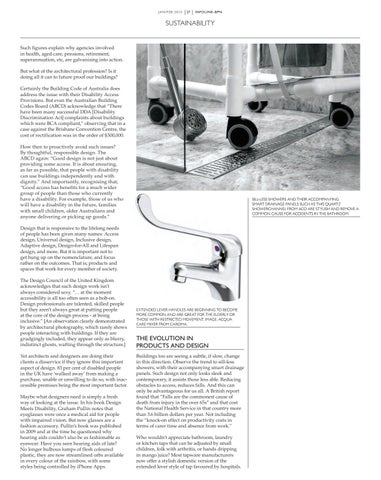
SILL-LESS SHOWERS AND THEIR ACCOMPANYING SMART DRAINAGE PANELS SUCH AS THIS QUARTZ SHOWERCHANNEL FROM ACO ARE STYLISH AND REMOVE A COMMON CAUSE FOR ACCIDENTS IN THE BATHROOM.
Design that is responsive to the lifelong needs of people has been given many names: Access design, Universal design, Inclusive design, Adaptive design, Design-for-All and Lifespan design, and more. But it is important not to get hung up on the nomenclature, and focus rather on the outcomes. That is; products and spaces that work for every member of society. The Design Council of the United Kingdom acknowledges that such design work isn’t always considered sexy. “… at the moment accessibility is all too often seen as a bolt-on. Design professionals are talented, skilled people but they aren’t always great at putting people at the core of the design process - at being inclusive.” [An observation clearly demonstrated by architectural photography, which rarely shows people interacting with buildings. If they are grudgingly included, they appear only as blurry, indistinct ghosts, wafting through the structure.] Yet architects and designers are doing their clients a disservice if they ignore this important aspect of design. 83 per cent of disabled people in the UK have ‘walked away’ from making a purchase, unable or unwilling to do so, with inaccessible premises being the most important factor. Maybe what designers need is simply a fresh way of looking at the issue. In his book Design Meets Disability, Graham Pullin notes that eyeglasses were once a medical aid for people with impaired vision. But now glasses are a fashion accessory. Pullin’s book was published in 2009 and at the time he questioned why hearing aids couldn’t also be as fashionable as eyewear. Have you seen hearing aids of late? No longer bulbous lumps of flesh coloured plastic, they are now streamlined orbs available in every colour of the rainbow, with some styles being controlled by iPhone Apps.
EXTENDED LEVER HANDLES ARE BEGINNING TO BECOME MORE COMMON AND ARE GREAT FOR THE ELDERLY OR THOSE WITH RESTRICTED MOVEMENT. IMAGE: ACQUA CARE MIXER FROM CAROMA.
THE EVOLUTION IN PRODUCTS AND DESIGN Buildings too are seeing a subtle, if slow, change in this direction. Observe the trend to sill-less showers, with their accompanying smart drainage panels. Such design not only looks sleek and contemporary, it assists those less able. Reducing obstacles to access, reduces falls. And this can only be advantageous for us all. A British report found that “Falls are the commonest cause of death from injury in the over 65s” and that cost the National Health Service in that country more than 3.6 billion dollars per year. Not including the “knock-on effect on productivity costs in terms of carer time and absence from work.” Who wouldn’t appreciate bathroom, laundry or kitchen taps that can be adjusted by small children, folk with arthritis, or hands dripping in mango juice? Most tapware manufacturers now offer a stylish domestic version of the extended lever style of tap favoured by hospitals.