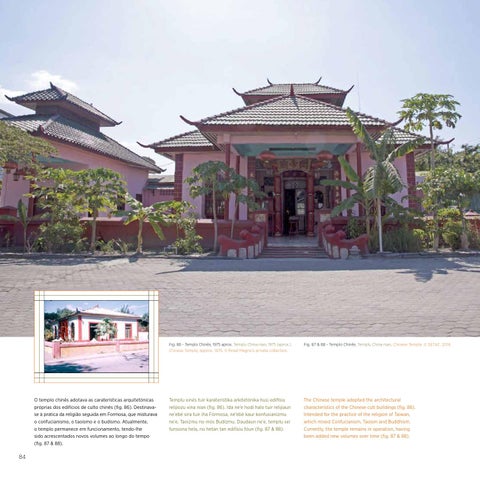
O templo chinês adotava as caraterísticas arquitetónicas próprias dos edifícios de culto chinês (fig. 86). Destinavase à pratica da religião seguida em Formosa, que misturava o confucianismo, o taoismo e o budismo. Atualmente, o templo permanece em funcionamento, tendo-lhe sido acrescentados novos volumes ao longo do tempo (fig. 87 & 88).
84
Fig. 86 - Templo Chinês, 1975 aprox. Templu China nian, 1975 (aprox.). Chinese Temple, approx. 1975. © Rosel Magno’s private collection.
Fig. 87 & 88 - Templo Chinês. Templu China nian. Chinese Temple. © SETAC, 2014.
Templu xinés tuir karaterístika arkitetónika husi edifísiu relijiozu xina nian (fig. 86). Ida ne’e hodi halo tuir relijiaun ne’ebé sira tuir iha Fórmosa, ne’ebé kaur konfusianizmu ne’e, Taoizmu no mós Budizmu. Daudaun ne’e, templu sei funsiona hela, no hetan tan edifisiu fóun (fig. 87 & 88).
The Chinese temple adopted the architectural characteristics of the Chinese cult buildings (fig. 86). Intended for the practice of the religion of Taiwan, which mixed Confucianism, Taoism and Buddhism. Currently, the temple remains in operation, having been added new volumes over time (fig. 87 & 88).