Área urbana Área urbana Urban Area Bairro Central Ruas comerciais Rua Komersiál sira Commercial streets
Iha dékada 50 no 60 funsaun komersiál iha Bairro Centrál implika atuasaun husi proprietáriu privadu ba sira ne’ebé impoin substituisaun ba estabelesimentu husi edifísiu ne’ebé tuir regulamentu komisaun munisipál Díli.
Fig. 72 – Casa Comercial, 1958. Loja, 1958. Commercial Building. 1958. In Relatório nº 2. Estudo descritivo e Critico do urbanismo e arquitetura em Dili. © ICCT.
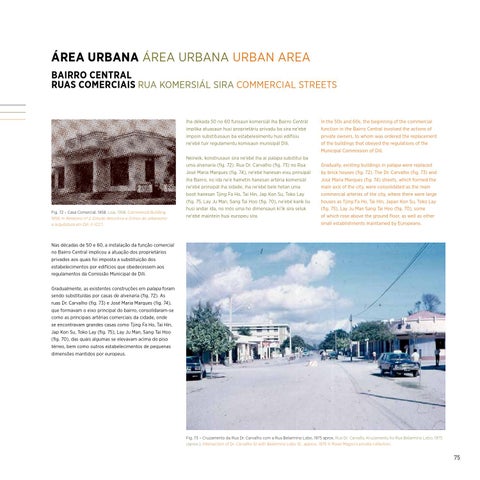
Neineik, konstrusaun sira ne’ebé iha ai palapa substitui ba uma alvenaria (fig. 72). Rua Dr. Carvalho (fig. 73) no Rua José Maria Marques (fig. 74), ne’ebé hanesan eixu prinsipál iha Bairro, no ida ne’e hametin hanesan artéria komersiál ne’ebé prinsipál iha sidade, iha ne’ebé bele hetan uma boot hanesan Tjing Fa Ho, Tai Hin, Jap Kon Su, Toko Lay (fig. 75, Lay Ju Man, Sang Tai Hoo (fig. 70), ne’ebé karik liu husi andar ida, no mós uma ho dimensaun ki’ik sira seluk ne’ebé maintein husi europeu sira.
In the 50s and 60s, the beginning of the commercial function in the Bairro Central involved the actions of private owners, to whom was ordered the replacement of the buildings that obeyed the regulations of the Municipal Commission of Dili. Gradually, existing buildings in palapa were replaced by brick houses (fig. 72). The Dr. Carvalho (fig. 73) and José Maria Marques (fig. 74) streets, which formed the main axis of the city, were consolidated as the main commercial arteries of the city, where there were large houses as Tjing Fa Ho, Tai Hin, Japan Kon Su, Toko Lay (fig. 75), Lay Ju Man Sang Tai Hoo (fig. 70), some of which rose above the ground floor, as well as other small establishments maintained by Europeans.
Nas décadas de 50 e 60, a instalação da função comercial no Bairro Central implicou a atuação dos proprietários privados aos quais foi imposta a substituição dos estabelecimentos por edifícios que obedecessem aos regulamentos da Comissão Municipal de Díli. Gradualmente, as existentes construções em palapa foram sendo substituídas por casas de alvenaria (fig. 72). As ruas Dr. Carvalho (fig. 73) e José Maria Marques (fig. 74), que formavam o eixo principal do bairro, consolidaram-se como as principais artérias comerciais da cidade, onde se encontravam grandes casas como Tjing Fa Ho, Tai Hin, Jap Kon Su, Toko Lay (fig. 75), Lay Ju Man, Sang Tai Hoo (fig. 70), das quais algumas se elevavam acima do piso térreo, bem como outros estabelecimentos de pequenas dimensões mantidos por europeus.
Fig. 73 – Cruzamento da Rua Dr. Carvalho com a Rua Belarmino Lobo, 1975 aprox. Rua Dr. Carvallo, Kruzamentu ho Rua Belarmino Lobo, 1975 (aprox.). Intersection of Dr. Carvalho St with Belarmino Lobo St., approx. 1975 © Rosel Magno’s private collection.
75