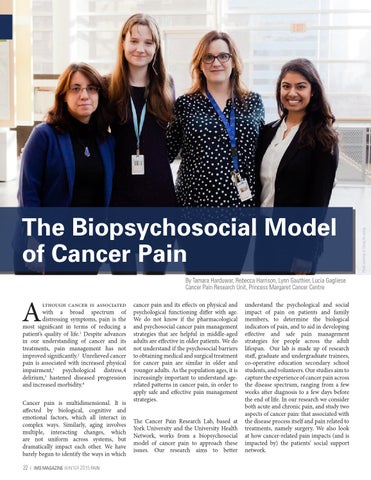
By Tamara Harduwar, Rebecca Harrison, Lynn Gauthier, Lucia Gagliese Cancer Pain Research Unit, Princess Margaret Cancer Centre
A
lthough cancer is associated with a broad spectrum of distressing symptoms, pain is the most significant in terms of reducing a patient’s quality of life.1 Despite advances in our understanding of cancer and its treatments, pain management has not improved significantly.2 Unrelieved cancer pain is associated with increased physical impairment,3 psychological distress,4 delirium,5 hastened diseased progression and increased morbidity.6 Cancer pain is multidimensional. It is affected by biological, cognitive and emotional factors, which all interact in complex ways. Similarly, aging involves multiple, interacting changes, which are not uniform across systems, but dramatically impact each other. We have barely begun to identify the ways in which 22 | IMS MAGAZINE WINTER 2015 PAIN
cancer pain and its effects on physical and psychological functioning differ with age. We do not know if the pharmacological and psychosocial cancer pain management strategies that are helpful in middle-aged adults are effective in older patients. We do not understand if the psychosocial barriers to obtaining medical and surgical treatment for cancer pain are similar in older and younger adults. As the population ages, it is increasingly important to understand agerelated patterns in cancer pain, in order to apply safe and effective pain management strategies. The Cancer Pain Research Lab, based at York University and the University Health Network, works from a biopsychosocial model of cancer pain to approach these issues. Our research aims to better
understand the psychological and social impact of pain on patients and family members, to determine the biological indicators of pain, and to aid in developing effective and safe pain management strategies for people across the adult lifespan. Our lab is made up of research staff, graduate and undergraduate trainees, co-operative education secondary school students, and volunteers. Our studies aim to capture the experience of cancer pain across the disease spectrum, ranging from a few weeks after diagnosis to a few days before the end of life. In our research we consider both acute and chronic pain, and study two aspects of cancer pain: that associated with the disease process itself and pain related to treatments, namely surgery. We also look at how cancer-related pain impacts (and is impacted by) the patients’ social support network.
Photo courtesy of Chung Ho Leung
The Biopsychosocial Model of Cancer Pain