MEDICAL BIOSCIENCES
M WHAT YOU’LL STUDY
Our study programme allows you to explore the science behind medicine. You’ll understand how it’s applied in research, policy and industry, and investigate critical challenges facing human health – like cancer, neurological diseases, obesity and diabetes – from different perspectives. You’ll take on a high level of laboratory work in our ‘Lab Pods’, practical learning environments that run like real research laboratories and encourage you to think and develop the skills of a scientist. This is complemented by workshops on topics including ethics, creativity, entrepreneurship, publishing, science communication and public engagement. In your third year you’ll choose specialist modules, each examining a global health problem. You’ll also take on a third year project with the option to complete an intensive research project of your choice, a non-laboratory placement, or a dissertation on a medical biosciences topic. Placement possibilities may include industry, publishing houses, museums, charities and government agencies.
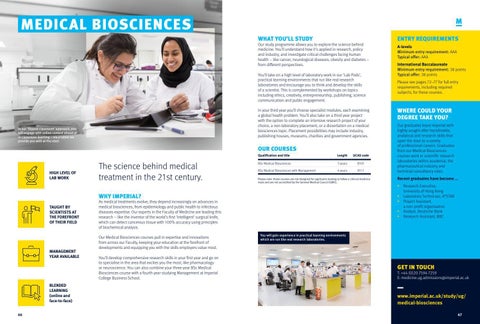
In our ‘flipped classroom’ approach, you will engage with online content ahead of in-classroom learning – via a tablet we provide you with at the start.
OUR COURSES
HIGH LEVEL OF LAB WORK
The science behind medical treatment in the 21st century.
Qualification and title
Length
UCAS code
BSc Medical Biosciences
3 years
B101
BSc Medical Biosciences with Management
4 years
B111
Please note: these courses are not designed for applicants looking to follow a clinical medicine route and are not accredited by the General Medical Council (GMC).
WHY IMPERIAL?
TAUGHT BY SCIENTISTS AT THE FOREFRONT OF THEIR FIELD
MANAGEMENT YEAR AVAILABLE
BLENDED LEARNING (online and face-to-face) 66
As medical treatments evolve, they depend increasingly on advances in medical biosciences, from epidemiology and public health to infectious diseases expertise. Our experts in the Faculty of Medicine are leading this research – like the inventor of the world’s first ‘intelligent’ surgical knife, which can detect cancerous tissue with 100% accuracy using principles of biochemical analysis. Our Medical Biosciences courses pull in expertise and innovations from across our Faculty, keeping your education at the forefront of developments and equipping you with the skills employers value most. You’ll develop comprehensive research skills in your first year and go on to specialise in the area that excites you the most, like pharmacology or neuroscience. You can also combine your three-year BSc Medical Biosciences course with a fourth year studying Management at Imperial College Business School.
ENTRY REQUIREMENTS A-levels Minimum entry requirement: AAA Typical offer: AAA International Baccalaureate Minimum entry requirement: 38 points Typical offer: 38 points Please see pages 72–77 for full entry requirements, including required subjects, for these courses.
WHERE COULD YOUR DEGREE TAKE YOU? Our graduates leave Imperial with highly sought-after transferable, analytical and research skills that open the door to a variety of professional careers. Graduates from our Medical Biosciences courses work in scientific research laboratories within academia, the pharmaceutical industry and technical consultancy roles. Recent graduates have become ... • Research Executive, University of Hong Kong • Laboratory Technician, A*STAR • Project Assistant, a non-profit organisation • Analyst, Deutsche Bank • Research Assistant, BBC
You will gain experience in practical learning environments which are run like real research laboratories.
GET IN TOUCH
T: +44 (0)20 7594 7259 E: medicine.ug.admissions@imperial.ac.uk
www.imperial.ac.uk/study/ug/ medical-biosciences 67