Intermediate Phase Grade 6 • Study Guide
English Home Language CAPS IEB English Home Language
home classroom college workplace
Study Guide
2206-E-EHL-SG01
6
English Home Language Study guide
CAPS aligned
O Barendse J Mansfield
2206-E-EHL-SG01
Í6&È-E-EHL-SG01FÎ
Grade 6
Study Guide G06 ~ English Home Language
Contents
Lesson elements....................................................................................................................................................... 11 Preface......................................................................................................................................................................... 12 Year plan..................................................................................................................................................................... 13 UNIT 1: Week 1 – 2...................................................................................................................................................14 Lesson 1: It’s news!....................................................................................................................................................................... 14 SECTION 1: LISTENING AND SPEAKING..........................................................................................15 Activity 1: Talk about it........................................................................................................................................... 15 Activity 2: Listen for information and give a summary............................................................................. 16 SECTION 2: READING AND VIEWING...............................................................................................19 Activity 3: Read newspaper headlines............................................................................................................. 19 Activity 4: Read a news report............................................................................................................................. 21 Activity 5: Read a newspaper article................................................................................................................. 23 Activity 6: Look at language.................................................................................................................................. 25 Activity 7: Read independently........................................................................................................................... 27 SECTION 3: WRITING AND PRESENTING........................................................................................28 Activity 8: Revise the writing process.............................................................................................................. 28 Activity 9: Plan and write newspaper headlines......................................................................................... 29 Activity 10: Write a newspaper article............................................................................................................. 30 Activity 11: Write a first draft.............................................................................................................................. 30 Activity 12: Revise, edit and proofread the article...................................................................................... 31 Activity 13: Present the article............................................................................................................................ 32 SECTION 4: LANGUAGE STRUCTURES AND CONVENTIONS......................................................32 Activity 14: Use punctuation correctly............................................................................................................. 32 Activity 15: Write in reported speech............................................................................................................... 33 UNIT 1: Week 3 – 4...................................................................................................................................................35 Lesson It’s a tale!............................................................................................................................................................................35 SECTION 1: LISTENING AND SPEAKING..........................................................................................36 Activity 16: Listen to a myth................................................................................................................................. 36 Activity 17: Discuss and answer questions.................................................................................................... 39 SECTION 2: READING AND VIEWING...............................................................................................40 Activity 18: Read a folktale.................................................................................................................................... 40 Activity 19: Discuss the folktale.......................................................................................................................... 44 Activity 20: Intensive reading of a legend....................................................................................................... 45 Activity 21: Read aloud........................................................................................................................................... 48 Activity 22: Reflect on texts................................................................................................................................... 49 SECTION 3: WRITING AND PRESENTING........................................................................................50 Activity 23: Brainstorm ideas for a myth or legend.................................................................................... 50 Activity 24: Write a first draft.............................................................................................................................. 51 Activity 25: Revise, edit and proofread the myth or legend.................................................................... 51 Activity 26: Present a final version.................................................................................................................... 52 SECTION 4: LANGUAGE STRUCTURES AND CONVENTIONS......................................................52 Activity 27: Use a dictionary................................................................................................................................. 52 Activity 28: Match proverbs, idioms and meanings................................................................................... 53
3
© Optimi
Study Guide G06 ~ English Home Language
UNIT 1: Week 5 – 6...................................................................................................................................................56 Lesson 3: Advertising: are we being manipulated?......................................................................................................... 56 SECTION 1: LISTENING AND SPEAKING..........................................................................................57 Activity 29: Listen to an advertisement........................................................................................................... 57 Activity 30: Ask questions..................................................................................................................................... 58 SECTION 2: READING AND VIEWING...............................................................................................60 Activity 31: Read persuasive text....................................................................................................................... 60 Activity 32: Read opinions on advertisements............................................................................................. 62 Activity 33: Identify and evaluate opinions................................................................................................... 64 Activity 34: Look at humour in advertisements........................................................................................... 65 Activity 35: Read about persuasive writing techniques........................................................................... 66 SECTION 3: WRITING AND PRESENTING........................................................................................67 Activity 36: Write responses to advertisements.......................................................................................... 67 Activity 37: Write a persuasive speech............................................................................................................ 67 Activity 38: Write a first draft of the speech.................................................................................................. 68 Activity 39: Revise, edit and proofread the speech..................................................................................... 68 Activity 40: Present and deliver the speech................................................................................................... 69 SECTION 4: LANGUAGE STRUCTURES AND CONVENTIONS......................................................69 Activity 41: Identify simple and complex sentences.................................................................................. 69 Activity 42: Subordinating conjunctions......................................................................................................... 70 UNIT 1: Week 7 – 8...................................................................................................................................................72 Lesson 4: Talk about it................................................................................................................................................................. 72 SECTION 1: LISTENING AND SPEAKING..........................................................................................73 Activity 43: Talk about dialogues....................................................................................................................... 73 Activity 44: Listen to dialogues........................................................................................................................... 74 SECTION 2: READING AND VIEWING...............................................................................................75 Activity 45: Read a play........................................................................................................................................... 75 Activity 46: Read Act 2 of the play..................................................................................................................... 78 Activity 47: Read Act 3 of the play..................................................................................................................... 80 Activity 48: Complete a comprehension.......................................................................................................... 83 Activity 49: Use a dictionary................................................................................................................................. 84 Activity 50: Read independently and retell the story................................................................................ 85 SECTION 3: WRITING AND PRESENTING........................................................................................85 Activity 51: Plan a dialogue................................................................................................................................... 85 Activity 52: Write a first draft of the dialogue.............................................................................................. 87 Activity 53: Revise, edit and proofread the dialogue................................................................................. 87 Activity 54: Present a final version of the dialogue.................................................................................... 88 SECTION 4: LANGUAGE STRUCTURES AND CONVENTIONS......................................................88 Activity 55: Quotation marks............................................................................................................................... 88 Activity 56: Identify sentences............................................................................................................................ 89 UNIT 1: Week 9 – 10................................................................................................................................................91 Lesson 5: Rhyme, rhythm and rap..........................................................................................................................................91 SECTION 1: LISTENING AND SPEAKING..........................................................................................92 Activity 57: Listen to a poem................................................................................................................................ 92 Activity 58: Talk about a poem............................................................................................................................ 93 SECTION 2: READING AND VIEWING...............................................................................................94 Activity 59: Discuss features of poems............................................................................................................. 94 © Optimi
4
Study Guide G06 ~ English Home Language
Activity 60: Answer questions about the poems......................................................................................... 98 Activity 61: Read and perform a rap................................................................................................................. 98 Activity 62: Use a dictionary and read independently............................................................................100 SECTION 3: WRITING AND PRESENTING..................................................................................... 101 Activity 63: Plan a poem or rap.........................................................................................................................101 Activity 64: Write a first draft............................................................................................................................102 Activity 65: Revise, edit and proofread the poem or rap........................................................................102 Activity 66: Write a neat, final version of the poem or rap...................................................................102 SECTION 4: LANGUAGE STRUCTURES AND CONVENTIONS................................................... 103 Activity 67: Identify types of sentences.........................................................................................................103 Activity 68: Use prepositions.............................................................................................................................104
UNIT 2: Week 1 – 2 ............................................................................................................................................... 106 Lesson 6: What’s cooking?.......................................................................................................................................................106 SECTION 1: LISTENING AND SPEAKING....................................................................................... 107 Activity 69: Give and listen to directions.......................................................................................................107 Activity 70: Follow instructions........................................................................................................................107 SECTION 2: READING AND VIEWING............................................................................................ 108 Activity 71: Read a poem and a recipe...........................................................................................................108 Activity 72: Answer questions about the recipe........................................................................................112 Activity 73: Unjumble instructions..................................................................................................................112 Activity 74: Read a different type of recipe..................................................................................................114 Activity 75: Read independently.......................................................................................................................116 SECTION 3: WRITING AND PRESENTING..................................................................................... 117 Activity 76: Watch a show and write a report.............................................................................................117 Activity 77: Write instructions..........................................................................................................................118 Activity 78: Write the first draft........................................................................................................................118 Activity 79: Revise, edit and proofread the instructions........................................................................118 Activity 80: Present the instructions..............................................................................................................119 SECTION 4: LANGUAGE STRUCTURES AND CONVENTIONS................................................... 119 Activity 81: Identify subject and object.........................................................................................................119 Activity 82: Roots, prefixes and suffixes .......................................................................................................122 UNIT 2: Week 3 – 4 ............................................................................................................................................... 124 Lesson 7: It’s adventure time!................................................................................................................................................124 SECTION 1: LISTENING AND SPEAKING....................................................................................... 125 Activity 83: Listen to an extract from a novel..............................................................................................125 Activity 84: Take part in a discussion.............................................................................................................127 SECTION 2: READING AND VIEWING............................................................................................ 130 Activity 85: Look at a novel.................................................................................................................................130 Activity 86: Look at the structure of a novel................................................................................................133 Activity 87: Read an extract from a novel.....................................................................................................136 Activity 88: Answer questions on the extract.............................................................................................142 Activity 89: Read a book review........................................................................................................................143 Activity 90: Read aloud.........................................................................................................................................144 SECTION 3: WRITING AND PRESENTING..................................................................................... 144 Activity 91: Plan a book review.........................................................................................................................144 Activity 92: Write a first draft............................................................................................................................145 Activity 93: Revise, edit and proofread the review...................................................................................145
5
© Optimi
Study Guide G06 ~ English Home Language
Activity 94: Present the review.........................................................................................................................146 SECTION 4: LANGUAGE STRUCTURES AND CONVENTIONS................................................... 146 Activity 95: Continuous tense ...........................................................................................................................146 Activity 96: Identify finite verbs and infinitives.........................................................................................147
UNIT 2: Week 5 – 6 ............................................................................................................................................... 148 Lesson 8: Be the best you can be ..........................................................................................................................................148 SECTION 1: LISTENING AND SPEAKING....................................................................................... 149 Activity 97: Listen to and discuss a story......................................................................................................149 Activity 98: Tell a story.........................................................................................................................................150 SECTION 2: READING AND VIEWING............................................................................................ 151 Activity 99: Read a story.......................................................................................................................................151 Activity 100: Read intensively............................................................................................................................153 Activity 101: Enjoy a story...................................................................................................................................154 Activity 102: Look at the structure of a story..............................................................................................159 Activity 103: Read independently and write a summary.......................................................................160 SECTION 3: WRITING AND PRESENTING..................................................................................... 160 Activity 104: Brainstorm and plan a story...................................................................................................160 Activity 105: Write a first draft..........................................................................................................................161 Activity 106: Revise, edit and proofread the story....................................................................................161 Activity 107: Present a final version of the story.......................................................................................162 SECTION 4: LANGUAGE STRUCTURES AND CONVENTIONS................................................... 162 Activity 108: Match the idioms to their meanings....................................................................................162 Activity 109: Present perfect tense..................................................................................................................168 UNIT 2: Week 7 – 8............................................................................................................................................... 171 Lesson 9: Being a TV presenter............................................................................................................................................ 171 SECTION 1: LISTENING AND SPEAKING....................................................................................... 172 Activity 110: Listen to a weather report.......................................................................................................172 Activity 111: Present a weather report..........................................................................................................173 SECTION 2: READING AND VIEWING............................................................................................ 173 Activity 112: Unjumble weather words.........................................................................................................173 Activity 113: Research and design a graph..................................................................................................174 Activity 114: Study a weather map..................................................................................................................174 Activity 115: Read an interview........................................................................................................................175 Activity 116: Read independently....................................................................................................................178 SECTION 3: WRITING AND PRESENTING..................................................................................... 178 Activity 117: Write a weather report..............................................................................................................178 Activity 118: Write a first draft of the report..............................................................................................178 Activity 119: Revise, edit and proofread the report.................................................................................178 Activity 120: Present the report........................................................................................................................179 SECTION 4: LANGUAGE STRUCTURES AND CONVENTIONS................................................... 179 Activity 121: Adjectives........................................................................................................................................179 Activity 122: Past tense.........................................................................................................................................180 UNIT 3: Week 1 – 2................................................................................................................................................ 182 Lesson 10: It’s a novel idea......................................................................................................................................................182 SECTION 1: LISTENING AND SPEAKING....................................................................................... 183 Activity 123: Listen to an extract from a novel...........................................................................................183 SECTION 1:
© Optimi
6
Study Guide G06 ~ English Home Language
Activity 124: Discuss novels and use a dictionary....................................................................................184 SECTION 2: READING AND VIEWING............................................................................................ 185 Activity 125: Read an extract from a novel...................................................................................................185 Activity 126: Talk about a novel........................................................................................................................189 Activity 127: Answer comprehension questions.......................................................................................190 Activity 128: Talk about reviews......................................................................................................................191 Activity 129: Read independently....................................................................................................................192 SECTION 3: WRITING AND PRESENTING..................................................................................... 193 Activity 130: Plan a book review......................................................................................................................193 Activity 131: Write a first draft..........................................................................................................................194 Activity 132: Revise, edit and proofread the review................................................................................194 Activity 133: Present the book review...........................................................................................................194 SECTION 4: LANGUAGE STRUCTURES AND CONVENTIONS................................................... 195 Activity 134: Pronouns.........................................................................................................................................195 Activity 135: Past, present and future tense................................................................................................195 SECTION 2:
SECTION 3:
SECTION 4:
UNIT 3: Week 3 – 4................................................................................................................................................ 197 Lesson 11: It’s a myth .............................................................................................................................................................. 197 SECTION 1: LISTENING AND SPEAKING....................................................................................... 198 Activity 136: Listen to a folktale.......................................................................................................................198 Activity 137: Discuss the folktale.....................................................................................................................198 SECTION 2: READING AND VIEWING............................................................................................ 199 Activity 138: Read a fable....................................................................................................................................199 Activity 139: Answer questions on the fable...............................................................................................202 Activity 140: Language assessment.................................................................................................................203 Activity 141: Identify the characters and read aloud..............................................................................204 Activity 142: Compare myths.............................................................................................................................207 SECTION 3: WRITING AND PRESENTING..................................................................................... 208 Activity 143: Plan character sketches for a story......................................................................................208 Activity 144: Write a first draft of the story.................................................................................................209 Activity 145: Revise and edit the story..........................................................................................................209 Activity 146: Present the final version ..........................................................................................................210 SECTION 4: LANGUAGE STRUCTURES AND CONVENTIONS................................................... 210 Activity 147: Commas............................................................................................................................................210 Activity 148: Future perfect tense....................................................................................................................211 SECTION 1:
SECTION 2:
SECTION 3:
SECTION 4:
UNIT 3: Week 5 – 6 ............................................................................................................................................... 212 Lesson 12: It’s a story!...............................................................................................................................................................212 SECTION 1: LISTENING AND SPEAKING....................................................................................... 213 Activity 149: Listen to a rhyming story..........................................................................................................213 Activity 150: Discuss the story and the characters...................................................................................214 SECTION 2: READING AND VIEWING............................................................................................ 214 Activity 151: Read a short story........................................................................................................................214 Activity 152: Continue reading the story......................................................................................................218 Activity 153: Answer questions on the story..............................................................................................220 Activity 154: Read the diary entries................................................................................................................221 Activity 155: Read independently....................................................................................................................223 SECTION 3: WRITING AND PRESENTING..................................................................................... 223 Activity 156: The structure of a letter............................................................................................................223 SECTION 1:
SECTION 2:
SECTION 3:
7
© Optimi
Study Guide G06 ~ English Home Language
Activity 157: Plan a letter.....................................................................................................................................224 Activity 158: Draft a letter...................................................................................................................................225 Activity 159: Revise, edit and proofread the letter...................................................................................225 Activity 160: Present a final version of the letter......................................................................................225 SECTION 4: LANGUAGE STRUCTURES AND CONVENTIONS................................................... 225 Activity 161: Tenses...............................................................................................................................................225 Activity 162: Look up adjectives in the dictionary....................................................................................226 SECTION 4:
UNIT 3: Week 7 – 8 ............................................................................................................................................... 227 Lesson 13: A funny thing happened .................................................................................................................................. 227 SECTION 1: LISTENING AND SPEAKING....................................................................................... 228 Activity 163: Look at a comic strip..................................................................................................................228 Activity 164: Watch some gags..........................................................................................................................229 SECTION 2: READING AND VIEWING............................................................................................ 229 Activity 165: Study a graph.................................................................................................................................229 Activity 166: Read a comic strip.......................................................................................................................231 Activity 167: Complete the comic strip..........................................................................................................233 Activity 168: Read and match riddles and answers ................................................................................234 Activity 169: Read independently....................................................................................................................236 SECTION 3: WRITING AND PRESENTING..................................................................................... 237 Activity 170: Make a comic strip.......................................................................................................................237 Activity 171: Draft a comic strip.......................................................................................................................237 Activity 172: Revise, edit and proofread the comic strip.......................................................................237 Activity 173: Draw the final version of the comic strip..........................................................................238 SECTION 4: LANGUAGE STRUCTURES AND CONVENTIONS................................................... 238 Activity 174: Active and passive voice............................................................................................................238 Activity 175: Adverbs............................................................................................................................................239 SECTION 1:
SECTION 2:
SECTION 3:
SECTION 4:
UNIT 3: Weeks 9 – 10 .......................................................................................................................................... 241 Lesson 14: It’s play time!......................................................................................................................................................... 241 SECTION 1: LISTENING AND SPEAKING....................................................................................... 242 Activity 176: Listen to a play..............................................................................................................................242 Activity 177: Develop and present a play......................................................................................................243 SECTION 2: READING AND VIEWING............................................................................................ 243 Activity 178: Read a play......................................................................................................................................243 Activity 179: Look at the features of a play..................................................................................................246 Activity 180: Answer content questions.......................................................................................................249 Activity 181: Answer language questions.....................................................................................................250 Activity 182: Read a review of a play..............................................................................................................251 Activity 183: Read independently....................................................................................................................252 SECTION 3: WRITING AND PRESENTING..................................................................................... 253 Activity 184: Write a play script........................................................................................................................253 Activity 185: Write the first draft.....................................................................................................................253 Activity 186: Revise, edit and proofread the play......................................................................................253 Activity 187: Present the final version ..........................................................................................................254 SECTION 4: LANGUAGE STRUCTURES AND CONVENTIONS................................................... 254 Activity 188: Prefixes and suffixes...................................................................................................................254 Activity 189: Quotation marks...........................................................................................................................255 SECTION 1:
SECTION 2:
SECTION 3:
SECTION 4:
© Optimi
8
Study Guide G06 ~ English Home Language
UNIT 4: Week 1 – 2 ............................................................................................................................................... 257 Lesson 15: Be informed.......................................................................................................................................................... 257 SECTION 1: LISTENING AND SPEAKING....................................................................................... 258 Activity 190: Listen to an interview................................................................................................................258 Activity 191: Role play an interview...............................................................................................................259 SECTION 2: READING AND VIEWING............................................................................................ 260 Activity 192: Tips for giving interviews.........................................................................................................260 Activity 193: Answer questions on top tips.................................................................................................263 Activity 194: Read a profile ................................................................................................................................264 Activity 195: Comprehension activity............................................................................................................265 Activity 196: Read independently ...................................................................................................................266 SECTION 3: WRITING AND PRESENTING..................................................................................... 266 Activity 197: Plan a profile..................................................................................................................................266 Activity 198: Draft a profile.................................................................................................................................267 Activity 199: Revise, edit and proofread a profile.....................................................................................267 Activity 200: Present a final version of a profile........................................................................................268 SECTION 4: LANGUAGE STRUCTURES AND CONVENTIONS................................................... 268 Activity 201: The meaning of sentences........................................................................................................268 Activity 202: Adverbs ...........................................................................................................................................270 SECTION 1:
SECTION 2:
SECTION 3:
SECTION 4:
UNIT 4: Week 3 – 4................................................................................................................................................ 271 Lesson 16: It’s magic!................................................................................................................................................................ 271 SECTION 1: LISTENING AND SPEAKING....................................................................................... 272 Activity 203: Listen to an instructional text.................................................................................................272 Activity 204: Give instructions..........................................................................................................................272 SECTION 2: READING AND VIEWING............................................................................................ 273 Activity 205: Unjumble the instructions ......................................................................................................273 Activity 206: Read instructions for a magic trick......................................................................................275 Activity 207: Read a recipe..................................................................................................................................276 Activity 208: Answer content and language questions...........................................................................279 Activity 209: Read aloud......................................................................................................................................280 Activity 210: Compare two texts.......................................................................................................................281 SECTION 3: WRITING AND PRESENTING..................................................................................... 281 Activity 211: Plan a set of instructions..........................................................................................................281 Activity 212: Write a first draft for instructions........................................................................................282 Activity 213: Revise, edit and proofread the instructions.....................................................................282 Activity 214: Write a final version of the instructions............................................................................282 SECTION 4: LANGUAGE STRUCTURES AND CONVENTIONS................................................... 283 Activity 215: Adverbs............................................................................................................................................283 Activity 216: Types of sentences......................................................................................................................285 SECTION 1:
SECTION 2:
SECTION 3:
SECTION 4:
UNIT 4: Week 5 – 6 ............................................................................................................................................... 287 Lesson 17: The art of listening.............................................................................................................................................. 287 SECTION 1: LISTENING AND SPEAKING....................................................................................... 288 Activity 217: Listen to a story............................................................................................................................288 Activity 218: Recall the story.............................................................................................................................289 SECTION 2: READING AND VIEWING............................................................................................ 291 Activity 219: Read part 1 of a story.................................................................................................................291 Activity 220: Read part 2 of a story.................................................................................................................294 SECTION 1:
SECTION 2:
9
© Optimi
Study Guide G06 ~ English Home Language
Activity 221: Read a book review.....................................................................................................................296 Activity 222: Read a summary ..........................................................................................................................298 Activity 223: Read independently....................................................................................................................299 SECTION 3: WRITING AND PRESENTING..................................................................................... 300 Activity 224: Plan a summary............................................................................................................................300 Activity 225: Write a first draft of the summary........................................................................................300 Activity 226: Revise, edit and proofread the summary ..........................................................................300 Activity 227: Present a final version of the summary..............................................................................301 SECTION 4: LANGUAGE STRUCTURES AND CONVENTIONS................................................... 301 Activity 228: Identify types of phrases and clauses.................................................................................301 Activity 229: Phrasal verbs ................................................................................................................................302 SECTION 3:
SECTION 4:
UNIT 4: Week 7 – 8 ............................................................................................................................................... 304 Lesson 18: Poems come in all shapes and sizes ............................................................................................................304 SECTION 1: LISTENING AND SPEAKING....................................................................................... 305 Activity 230: Listen to a poem...........................................................................................................................305 Activity 231: Enjoy a poem..................................................................................................................................306 SECTION 2: READING AND VIEWING............................................................................................ 307 Activity 232: Read and discuss a poem..........................................................................................................307 Activity 233: Read and talk about a poem....................................................................................................309 Activity 234: Complete a comprehension on the poem..........................................................................310 Activity 235: Read some humorous poems .................................................................................................311 Activity 236: Read independently....................................................................................................................312 SECTION 3: WRITING AND PRESENTING..................................................................................... 313 Activity 237: Write an acrostic poem.............................................................................................................313 Activity 238: Edit and present an acrostic poem.......................................................................................314 Activity 239: Brainstorm and draft limericks.............................................................................................314 Activity 240: Edit and present limericks.......................................................................................................315 SECTION 4: LANGUAGE STRUCTURES AND CONVENTIONS................................................... 316 Activity 241: Identify subject, verb and object...........................................................................................316 Activity 242: Revise language............................................................................................................................317 SECTION 2:
SECTION 3:
SECTION 4:
Addendum A: Rubrics: Unit 1............................................................................................................................319 Bibliography............................................................................................................................................................329 Permissions.............................................................................................................................................................336
© Optimi
10
Study Guide G06 ~ English Home Language
Lesson elements
VOCABULARY The meaning of new words to fully understand the text/content.
IMPORTANT
Aspects to take note of to better understand the content. Additional information to enhance understanding of concepts or content covered in the lesson.
TIPS
Information in addition to the content to guide the learner through the learning process.
CORE CONTENT
Reinforcementof core content, in-depth explanation of a specific section of the lesson.
ACTIVITY Core content and questions to test the learner’s knowledge.
11
© Optimi
Preface
Study Guide G06 ~ English Home Language
RECOMMENDED BOOKS Here is a short list of age-appropriate books: • All children’s books by Michael Morpurgo, such as Dolphin Boy, Running Wild, An Elephant in the Garden • Laura Marlin Series by Lauren St John, such as Dead Man’s Cove, Kidnap in the Caribbean • Pig City by Louis Sachar • Percy Jackson Series by Rick Riordan, such as The Lightning Thief • The Harry Potter Series by J. K. Rowling • The Lion, the Witch and the Wardrobe by C. S. Lewis • The Charlie Bone Series by Jenny Nimmo • Matilda by Roald Dahl
INTRODUCTION
The study guide has been organised into four units and 18 lessons. Each lesson is taught over two weeks. • • • • •
Unit 1 has five themed lessons. Unit 2 has four themed lessons and a mid-year examination. Unit 3 has five themed lessons. Unit 4 has four themed lessons and a year-end examination. At the end of Units 2 and 4, learners complete these examinations.
Each lesson consists of four sections: • Listening and Speaking • Reading and Viewing • Writing and Presenting • Language Structures and Conventions
Each of these sections contains activities. At the beginning of each lesson is a list of the things to be covered in that lesson. There are remedial and extension activities at the end of each lesson. Learners may complete these activities if time allows.
Each lesson is also divided into activities. Addendum A at the back of the study guide has the rubrics that will be used to assess these activities.
© Optimi
12
Study Guide G06 ~ English Home Language
UNIT
Year plan DATE STARTED
LESSON
DATE COMPLETED
LESSON 1: It’s news! 1
LESSON 2: It’s a tale!
LESSON 3: Advertising: are we being manipulated? LESSON 4: Talk about it
LESSON 5: Rhyme, rhythm and rap LESSON 6: What’s cooking? 2
LESSON 7: It’s adventure time!
LESSON 8: Be the best you can be LESSON 9: Being a TV presenter LESSON 10: It’s a novel idea
3
LESSON 11: It’s a myth
LESSON 12: It’s a story!
LESSON 13: A funny thing happened … LESSON 14: It’s play time! LESSON 15: Be informed
4
LESSON 16: It’s magic
LESSON 17: The art of listening
LESSON 18: Poems come in all shapes and sizes
13
© Optimi
Unit
1
Study Guide G06 ~ English Home Language
UNIT 1: Week 1 – 2
Lesson 1: It’s news!
In this lesson you will: • listen to a radio news report • watch a television programme • do a listening comprehension on stereotypes: formal assessment • write a summary: formal assessment • read newspaper headlines • read a news report • read a newspaper article • write a newspaper article using the writing process • revise punctuation • write reported speech
“No one has ever become poor from giving.” Anne Frank
© Optimi
14
Study Guide G06 ~ English Home Language
SECTION 1
Unit
1
LISTENING AND SPEAKING
Activity 1: Talk about it
Vocabulary in context stereotype: a widely held image or idea of a particular type of person or thing without any real justification. Let’s look at radio, television and newspaper reports with the focus on current issues in the news. 1. 2. 3. 4.
5.
Talk about the different ways people access news reports and articles. Share how you listen to, watch or read the news and why you like your method. Read the meaning of the word stereotype in the vocabulary box. Give some examples of stereotypes. Answer these questions. a) How do you think stereotypes are formed? b) Why do you think we form stereotypes? c) Do you think stereotypes are positive or negative? d) How do you think stereotypes fall into a theme about news? Read the tip in the tip box. Take notes only when you listen to a listening comprehension a second time. Do not write long notes, only jot down the important points.
Listen to the radio programme your facilitator plays. Listen carefully to get an overview of what is discussed. 7. Listen a second time, this time listening for specific details. Jot down important points. 8. Discuss the main idea of the programme and specific details with your facilitator. 9. Now listen to the television programme or news report that your facilitator plays to you. Follow the same process as for the radio programme. 10. How do you know if the information you listened to/watched can be trusted? Is it from a reliable source? How do you know? What can you do if you think the information may not be correct? 11. Bring a newspaper article that deals with a current issue to the next lesson. Read it carefully beforehand and prepare a short talk on the current issue it addresses. This talk will be used as part of your formal assessment. 6.
15
© Optimi
Unit
1
Study Guide G06 ~ English Home Language
Activity 2: Listen for information and give a summary
Vocabulary in context prejudice: a feeling of like or dislike for someone or something especially when it is not reasonable or logical blog: frequently updated diary on a website intended for public viewing bizarre: amusingly odd platitude: an empty, pointless comment or statement made as though it were important or helpful boisterous: noisy, energetic and rowdy, often wild assumption: something taken for granted; something believed to be true without proof abandoned: (in this context) given up; stopped using Let’s revise tenses and subject-verb agreement. Tenses There are three main tenses: present tense, past tense and future tense.
Present tense: the action is happening now or it happens regularly. We add -s or -es depending on whether the subject is singular or plural. For example: Naledi goes to town. He watches the television news broadcast. The sun sets in the west. Past tense: the action took place in the past. To change a verb to the simple past add -ed to the verb or change the verb form. For example: Naledi went to town. He watched the television news broadcast. The sun set in the west. Future tense: the action will take place in the future. We use shall or will for the future tense. We use shall for I/we (first person) and will for the other persons (you, he, she, they). In modern use, however, will is used more than shall. Shall is used mainly with I and we to make an offer or suggestion, or to ask for advice. For example: I will watch the television news broadcast. I shall tell you what we want you to do. She will go to town. They will go to town. First person is the person speaking. Second person is the person spoken to. Third person is the person spoken about.
Now give one sentence in each of the three tenses. © Optimi
16
Study Guide G06 ~ English Home Language
Unit
1
Subject-verb agreement Subject-verb agreement means that the subject and verb have to agree with each other. If the subject is singular, then the verb should be singular. If the subject is plural, the verb should also be plural, for example: Naledi watches the television programme. Naledi and his friends watch the television programme. Give four sentences making sure the subject-verb agreement is correct. 1. 2. 3. 4. 5. 6. 7. 8.
Discuss the meaning of the words in the vocabulary box. Your facilitator will read the headline of a newspaper article to you. Try to predict what the article will be about. Listen as your facilitator reads the article to you. Ask questions about any of the aspects of the article of which you are unsure. Jot down notes as your facilitator reads the article a second time. Read the questions in the study guide before your facilitator reads the article to you a third time. Answer the questions in your exercise book. Write only the number and the letter of the answer, for example 6f. Your facilitator will give you the answers, allowing you to mark your own work.
Content questions
1. 2. 3. 4. 5. 6.
7.
The heading tells me the article will be about: a) Racial stereotypes b) Gender stereotypes
c) General stereotypes
Where did Laura Bates (the writer) see the comment that made her write her blog? a) Facebook b) Instagram c) Twitter What age was the child who was asked to do research on a scientist or inventor? a) Seven b) Six c) Ten Choose the two words that made the blogger think this homework was sexist? a) He, they b) He, family c) He, wife
(1) (1)
In what way is this stereotyping? The question assumes the inventor or scientist is: a) Female b) Male c) Either one of the two sexes? What do you think the parent’s tweet to Twitter looked like? a) Can you name any female inventors or scientists? b) Can you name any male inventors or scientists? c) Can you name any inventors or scientists?
(1)
(1) (1)
(1)
Does the study published by the National Bureau of Economic Research suggest that gender bias in primary school: a) Has no effect on children as they are growing up b) Has a long-term effect on children as they grow up c) Only has an effect on girls? (1) 17
© Optimi
Unit
8.
9.
1
Study Guide G06 ~ English Home Language
When the maths tests were marked without the markers knowing the names of the learners: a) The boys outperformed the girls b) The girls outperformed the boys c) The results were the same in both (1) Which of these does the blogger blame for influencing stereotypes? a) Books b) Television c) Conversations i) a and c ii) a and b iii) all of them
10. Is the blogger optimistic that change is taking place? a) Yes b) No
c) Undecided.
(1)
(1) Subtotal: [10]
Language and general questions Discuss these language questions with your facilitator.
a) Acronyms are words formed from initials, for example RAM – Random Access Memory. Did you find an acronym in the text? What is it? b) Write the word that two of the letters stand for. c) In literal language the words mean exactly what they say, for example spill the beans means that we drop some beans. In figurative language the words have a deeper meaning and do not mean what the words literally say, for example spill the beans means to tell someone some secret information. Do you think jumped out at me is literal or figurative? d) Break the word stereotypes into syllables. e) Give the following sentence in the past tense. Each individual incident is easily dismissed as harmless. f) What is wrong with this sentence? A parent have shared a photograph of her six-year-old child’s homework. g) What do you think of gender stereotyping? h) Do you think gender stereotypes are found frequently in your circle of friends? If so, state in which ways; if not, give reasons why you think so. i) Do you think that the information from this source is valid? Give reasons for your answer. j) How do you think people can be encouraged to discard and not continue stereotypes? Write a summary of no longer than 90 – 110 words of the passage on gender stereotypes that your facilitator read to you in rough. Use the words in the box to help you write your summary. You do not have to use all the words. Study the rubric at the back of your study guide so that you know how you will be assessed. Read the summary to your facilitator. Subtotal: [10] Total: [20] blog, gender, stereotypes, parents, Twitter, types of questions, reinforce, boys, portrayed, inventors, scientist, mathematics, sciences, girls, Tests, not necessarily, passed on, media, advertisements, television programmes, conversations, author, challenge stereotypes, change, children, stand up, gender stereotyping
© Optimi
18
Study Guide G06 ~ English Home Language
SECTION 2
Unit
1
READING AND VIEWING
Activity 3: Read newspaper headlines
Vocabulary in context obesity: being overweight ban: forbid something volunteer: somebody who works without being paid bogus: fake, fraudulent (intended to deceive)
Read about figures of speech. Figures of speech
Pun: a play on words; a use of words that involves a word or phrase that has more than one possible meaning, for example: pilot loses wings, goose downs man
Alliteration: the use of several words that begin with the same letters, for example: Angry Argument Augers Badly for Summit
Listen as your facilitator reads a selection of newspaper headlines to you. Discuss the following: • From the headline, what do you think each article may be about? • What makes a good headline? • List the features of a good newspaper headline. Some facts about headlines • They are the titles or headings of newspaper articles • They usually contain few words • Their purpose is to attract the interest of readers • They are usually in bold and in larger font than the article • They make use of figures of speech such as puns and alliteration
19
© Optimi
Unit
1
Study Guide G06 ~ English Home Language
Read these newspaper headlines. Can you find a pun and alliteration in any of them? If so, in which ones?
Match each headline to the summary of one of the newspaper articles below. A. B. C.
D. E. F.
Colleges that have not been registered with the Department of Education have been shut down in an effort to protect students paying high fees for inferior education. The city’s fire and rescue services asked for aerial support after an extensive fire was reported in the early hours of the morning. Helicopters have been sent to water-bomb the fire. Volunteer Wildfire Services Fighters put their lives at risk fighting fires. They spend the day in intense heat. A new-born puppy rescued from a rubbish dump last week is making good progress. Sources say the puppy is a real cutie. The proposed new sugar tax will not cut obesity but it will fuel food inflation and hurt consumers. South Africa’s rhino poaching epidemic saw a record 1 215 rhino killed last year for their horn.
© Optimi
20
Study Guide G06 ~ English Home Language
G. H.
Unit
1
A dog saved a woman from a cobra which had come into her garage. He is a real hero. Rain and hail caused devastation in the city last night. Residents report that hailstones bigger than golf balls landed on broken tiles on roofs and smashed windows.
Discuss current news stories and make suggestions for headlines for these stories. Try to make some headlines using a pun.
Activity 4: Read a news report
Bring a newspaper or magazine article to the lesson. Discuss with your facilitator the type of news it covers. What is the difference between local, national and international news? What other types of news appear in newspapers and magazines? Match the news type to the explanation in the box below. Type of news articles 1. Local 2. National 3. International 4. Feature 5. Editorial 6. Column
Explanation a) What’s going on in the world b) “Soft” news such as news on a person doing volunteer work, movie reviews, etc. c) Gives the writer’s own opinion on current issues d) What’s going on in your country e) Written by same person on a regular basis f) What’s going on in your neighbourhood
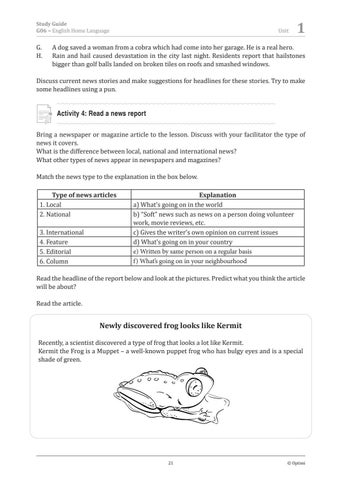
Read the headline of the report below and look at the pictures. Predict what you think the article will be about? Read the article.
Newly discovered frog looks like Kermit
Recently, a scientist discovered a type of frog that looks a lot like Kermit. Kermit the Frog is a Muppet – a well-known puppet frog who has bulgy eyes and is a special shade of green.
21
© Optimi
Unit
1
Study Guide G06 ~ English Home Language
The frog found in Costa Rica looks a lot like that. It has big google-eyes with black pupils that sit on the top of its head, and it is a uniform shade of bright lime green, similar to Kermit. Just about the only thing its missing is Kermit’s signature pointy collar. (And Kermit’s ability to speak, of course.)
The recently discovered frog is a type of glass frog. Part of the new frog’s Latin name includes Diana. It has been named after the mother of one of the scientists; whose middle name is Diane. The announcement of the new frog was made by the Costa Rican Amphibian Research Centre.
Glass frogs get their name from the way their tummy looks. Many of them – including this new frog – have translucent skin on their stomach, meaning that you can see through it. You can see some of the frog’s organs including the heart and liver. Scientists think that the glass frog developed a translucent tummy so that it would be hard to spot as it sits on a branch or leaf. That means that other animals that want to eat it would have a more difficult time finding it. Use these questions to guide a discussion on the article. 1. 2. 3.
Into which category of news do you think this article fits? Give a reason for your answer. Do you know where Costa Rica is? Use your atlas to look it up. What is the main idea of the article? a) A new type of glass frog has been discovered. b) The new type of glass frog looks like Kermit.
© Optimi
22
Study Guide G06 ~ English Home Language
Unit
c)
1
Scientists think glass frogs are see-through so that animals wanting to eat them can’t find them. 4. In which ways does the frog look like Kermit? 5. What obvious differences are there between Kermit and this new frog? 6. Who is the frog named after? 7. In your opinion, is this a compliment to Diane? 8. What type of frog is the newly discovered frog? 9. Why do you think this type of frog was given this name? 10. Do you think this type of tummy is an advantage? In which way?
Activity 5: Read a newspaper article
Look at the selection of newspaper articles your facilitator gives you and then, from what you see, discuss the features of newspaper articles Features of a newspaper article
Headline: the title of the article
Subheading: not all articles have subheadings but major headlines often do By-line: the name of the person who wrote the article
Introductory paragraph: sets the scene; answers these questions: Who is the article about? What happened? When did it happen? Where did it happen? Body: gives more details about the “who, what, when, where” from the introductory paragraph. It answers the questions: How did it happen? Why did it happen?
Columns: the article is written in paragraphs and set out in columns. A line is left between each paragraph.
Quotes: it usually includes something that a person has said. This will be in inverted commas. The important points to note are: What was said? Who said it? Photograph: an article may have a photograph to show the person involved or what was happening. Caption: tells you what the photograph is about.
Tense: it is written in the past tense as it has already happened. Language: sometimes uses emotive language.
Read the headline of the newspaper article and look at the photograph. What do you think the article will be about? Listen to the background information your facilitator reads to you.
23
© Optimi
Unit
1
Study Guide G06 ~ English Home Language
Read the newspaper article.
© Optimi
24
Study Guide G06 ~ English Home Language
Use these questions to guide a discussion on the newspaper article.
Unit
1
Skim means to read something quickly to get an overview, for example, skim newspaper headlines for the main news. Scan means to run one’s eye over the text to get specific details without reading every single word, for example, to find the name of the anonymous donor.
1.
Scan the article for the following information: a) The name of the boy who collected books b) The number of books collected c) On which radio channel he was interviewed d) His mother’s name e) The bookshop with whom they worked closely 2. What is the purpose of the article? 3. Does this article send a message to the youth of South Africa? 4. Does the library only have English books? Quote a sentence from the article to substantiate your answer. 5. What genre of books are available in the library? 6. Read the last paragraph. What, apart from the fact that Yonela has helped start a muchneeded library, is the main impact of what he did? 7. What is the name of the anonymous donor? 8. In your opinion, why did she come forward at the unveiling? 9. How did the learners welcome the visitors to the school at the unveiling of the library? 10. What does Yonela mean when he says, “Books can be your new friend”?
Activity 6: Look at language
Let’s read about nouns. Nouns
Noun: the name of a person, place or thing Common nouns name ordinary objects, for example, newspaper, book, donor, library.
Proper nouns name particular people, places or things, for example, Yonela, Bovet Primary School, and Johannesburg Public Library. Proper nouns always start with a capital letter.
Countable nouns are nouns that can be counted, for example, flower, book, library, and donor. They can be in the singular and the plural.
Uncountable nouns are nouns that cannot be counted, for example, sugar, water, sand, paper. (These can only be put into containers and the containers counted.) Give three common and three proper nouns.
25
© Optimi