TRAINING PLANS
Your First 25-Kilometre Trail Race Training Plan An effective plan for those wanting to hit the trails BY ANDIE PASK
ALLAN MCVICAR
Owner of Andie Pask Coaching, run and strength coach with Peak Endurance in Victoria, B.C. She has coached people of all ages and abilities and completed the UTMB 100M last year. ANDIEPASKCOACHING
ANDIE.PASK
T
rail running has exploded in popularity over the past number of years, and for good reason: you’re surrounded by nature, the soft and uneven surfaces are more forgiving than pavement on the body, and you don’t have to be fixated on maintaining a particular pace. The range in trail race distances—from 5-kilometres to over 100 miles—makes trail racing both accessible and challenging for all runners. If you are ready to challenge yourself to a new distance that’s moderate in length, then this 12-week plan is for you! Before beginning this training program, you should be comfortable running four days a week for at least one hour. The program is comprised of four days/week of running: two easy days (Tuesday/Sunday), a run workout (Wednesday) and a long trail run (Saturday). The terrain is a mix of road and trail, so there is the assumption that you will have access to trails throughout the week. There are also two cross-training days to achieve aerobic endurance, and give the running muscles a break. Cross-training also helps prevent overuse injuries that can occur from exclusively running. These cross-training days will also include strength training which further helps to prevent injury and makes your body stronger and more durable on the trails.
COACH’S TIPS: • • •
All runs should begin gently to warm up the muscular and cardiovascular systems. A 15 – 20 minute warm-up and cool down should also be included on every Wednesday workout. Trail shoes should be worn on the trails as they have better traction than road shoes.
60 I Running Issue 2026 I IMPACT MAGAZINE
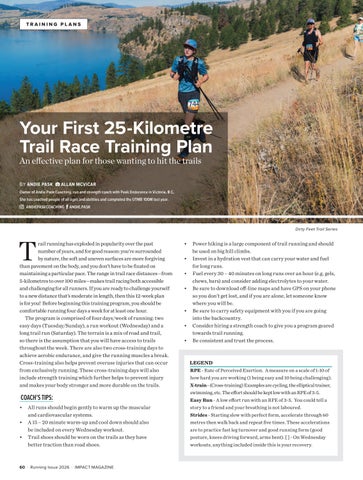
Dirty Feet Trail Series
• • • •
• • •
Power hiking is a large component of trail running and should be used on big hill climbs. Invest in a hydration vest that can carry your water and fuel for long runs. Fuel every 30 – 40 minutes on long runs over an hour (e.g. gels, chews, bars) and consider adding electrolytes to your water. Be sure to download off-line maps and have GPS on your phone so you don’t get lost, and if you are alone, let someone know where you will be. Be sure to carry safety equipment with you if you are going into the backcountry. Consider hiring a strength coach to give you a program geared towards trail running. Be consistent and trust the process.
LEGEND
RPE - Rate of Perceived Exertion. A measure on a scale of 1-10 of how hard you are working (1 being easy and 10 being challenging). X-train - (Cross-training) Examples are cycling, the elliptical trainer, swimming, etc. The effort should be kept low with an RPE of 3-5. Easy Run - A low effort run with an RPE of 3-5. You could tell a story to a friend and your breathing is not laboured. Strides - Starting slow with perfect form, accelerate through 60 metres then walk back and repeat five times. These accelerations are to practice fast leg turnover and good running form (good posture, knees driving forward, arms bent). [ ] - On Wednesday workouts, anything included inside this is your recovery.