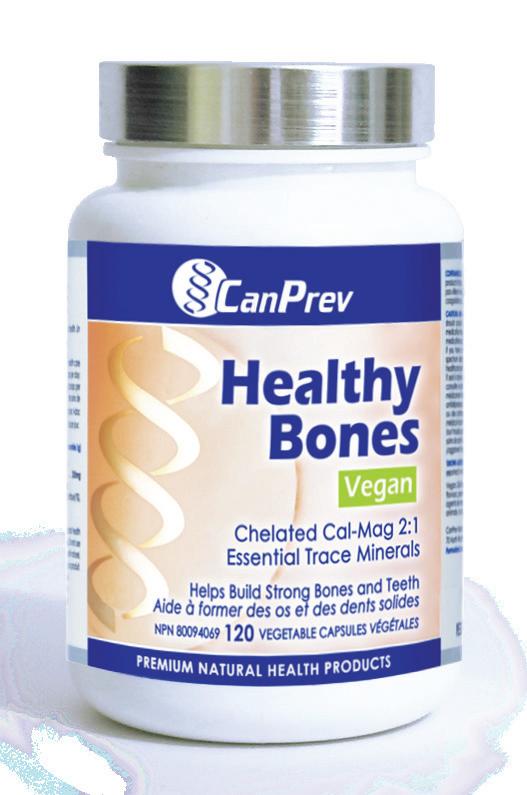
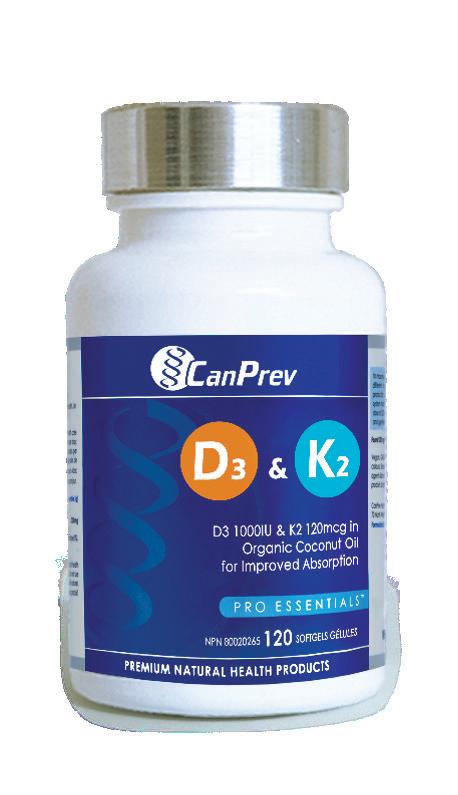
A life on the move starts with strong bones, working with muscles and joints to power strength and stability. Nutrients like calcium, magnesium, and vitamins D3 & K2 help support a durable bone matrix so you can move with confidence.
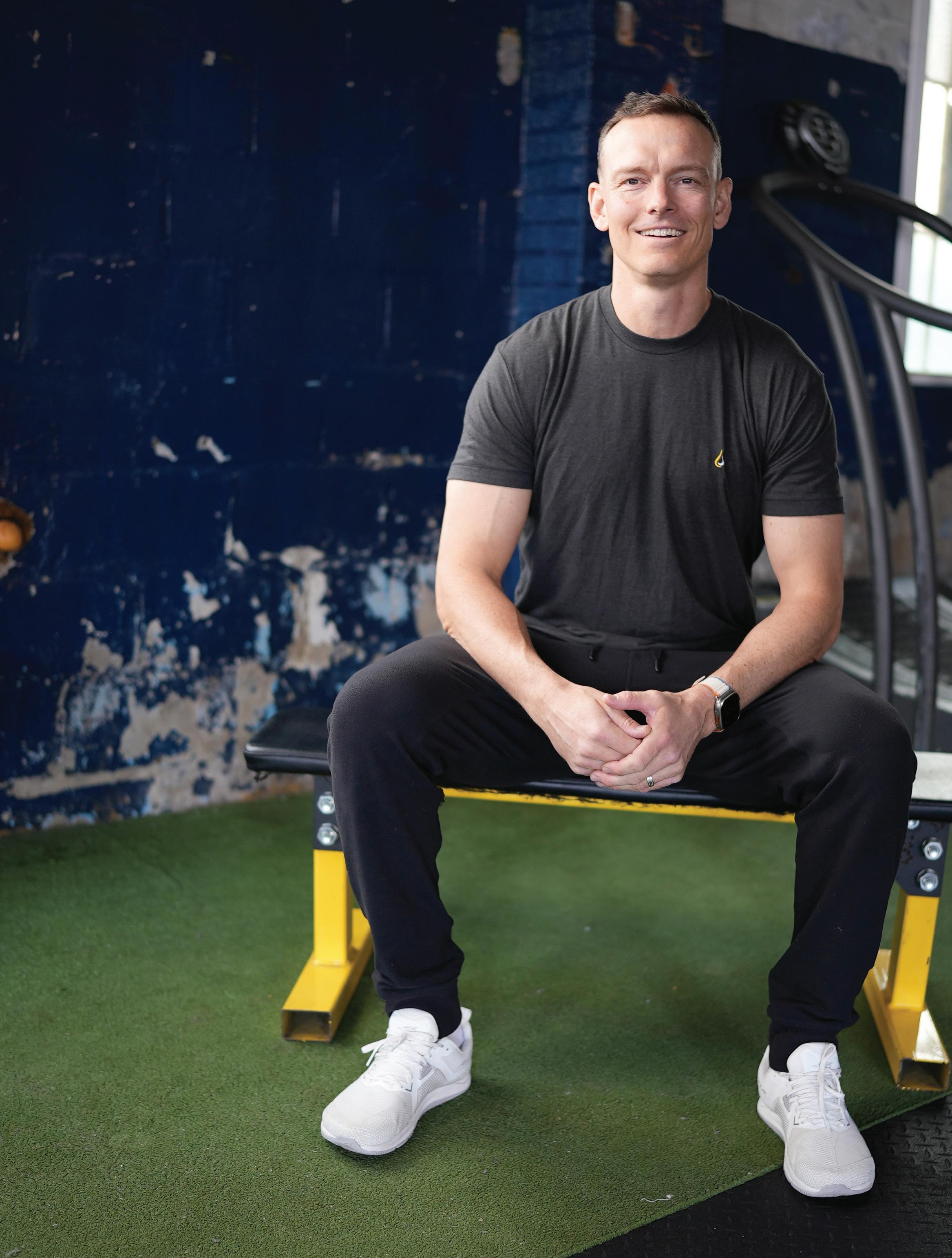
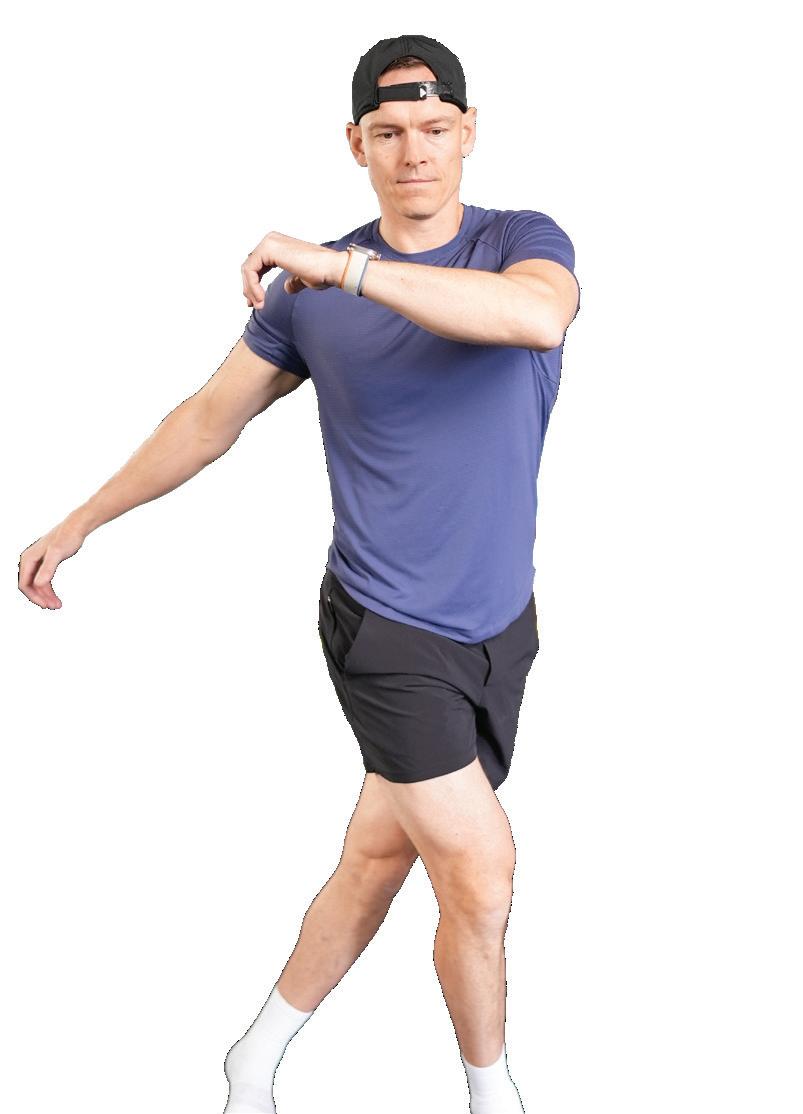
Jordan Bryden CanPrev Ambassador
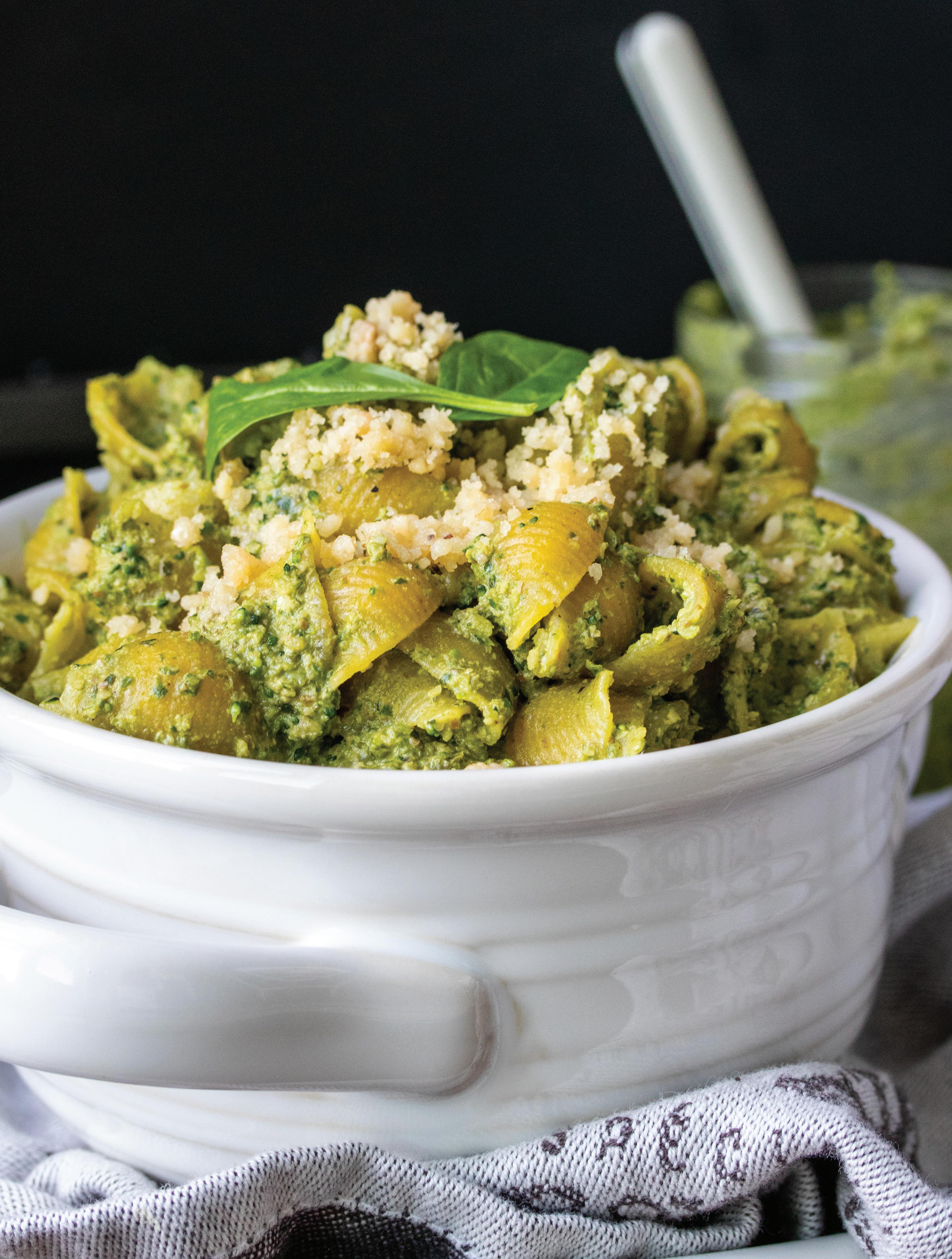
Ragu Bolognese
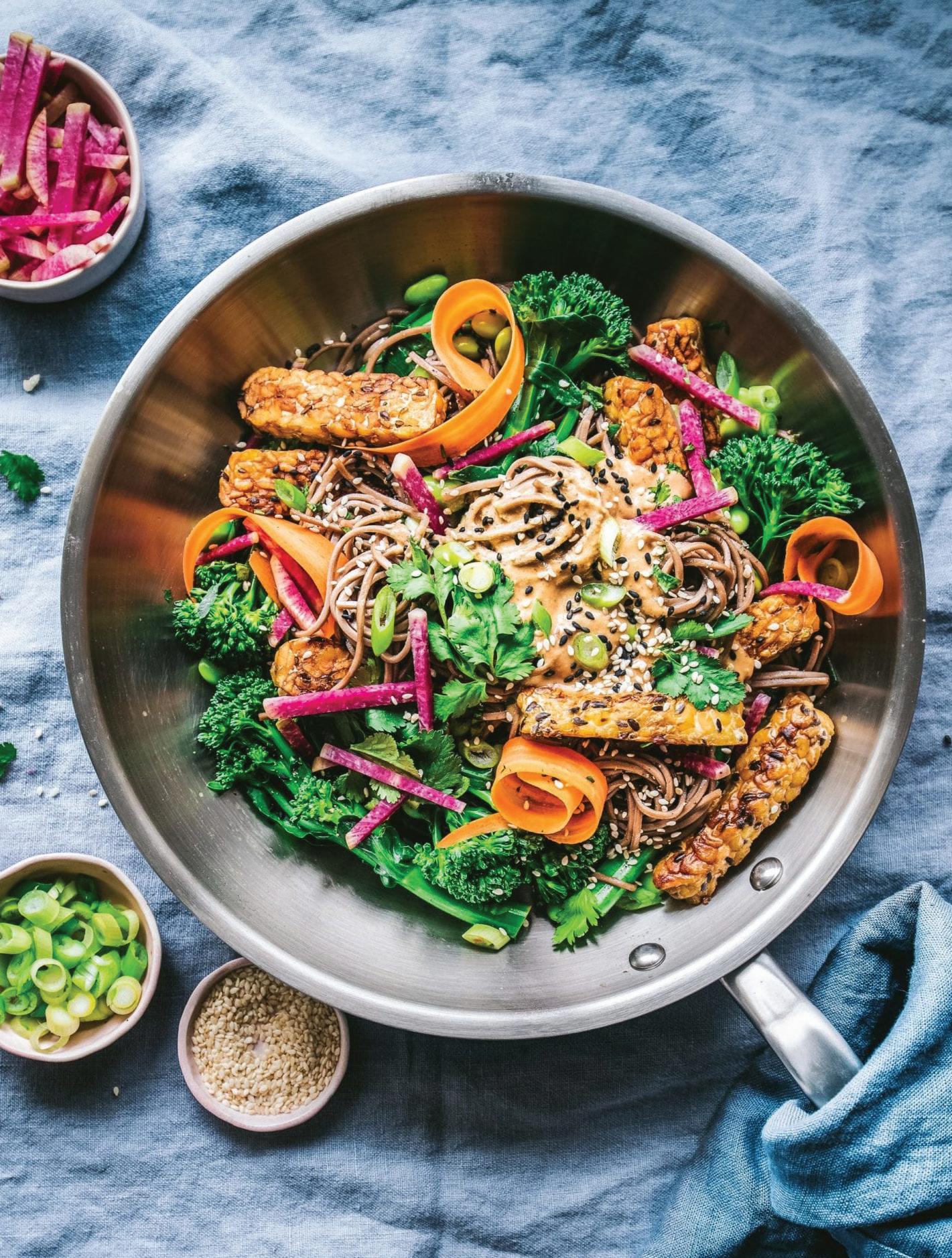
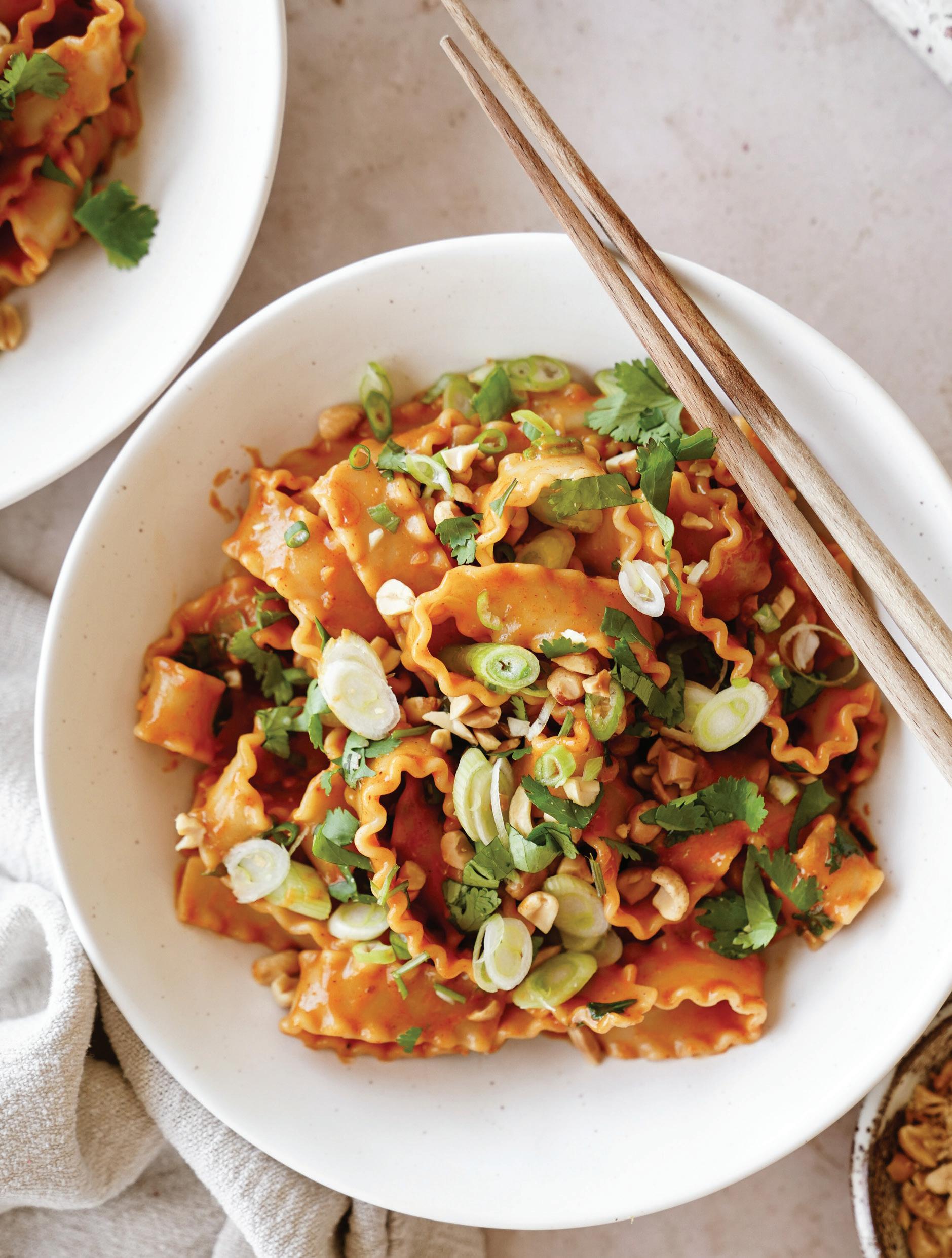
Spicy Noodles
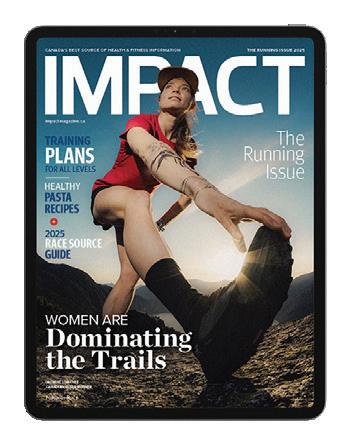
RUNNING ISSUE 2025
VOLUME 34, ISSUE 4
A leader in the industry for 34 years, IMPACT Magazine is committed to publishing content provided by the best experts in their fields for those who aspire to higher levels of health and fitness.
With a lifelong passion for movement and sport, Hannah became a physiotherapist to help others move past their injuries. With a Bachelor of Kinesiology from the University of Calgary and Masters of Physiotherapy from the University of Queensland, she provides staged injury rehab to fill the gap between acute injuries and return to sport. She is based in Calgary, AB.
HANPHYSIO HANPHYSIO HANPHYSIO
JASPER BLAKE
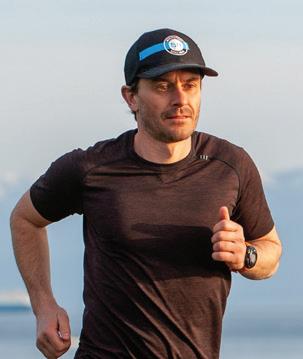
Jasper has a BSc Hons. in Human Kinetics from the University of Guelph, and is a NCCP Certified Coach in Triathlon, Athletics, Alpine Skiing, Tennis and Fundamental Movement Skills. An IRONMAN Champion, he is five-time Ontario Triathlete of the Year. He offers on-line and personalized coaching through his company B78 Coaching, based in Victoria, B.C.
B78COACHING B78COACHING B78COACHING
RUTH BURROWES
Ruth is a registered dietician with a MSc. in Food and Nutrition, a BSc. in Nutrition and Dietetics from Western University in London, Ontario, and a BA Hons. in Human Kinetics from the University of Ottawa. Based in Calgary, AB, she is passionate about sports nutrition and empowering people to make positive changes to their health.
RUTH-BURROWES
ERIC CARTER
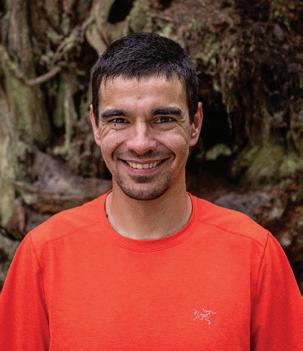
Eric is a co-founder—with Gary Robbins—of Ridgeline Athletics, in Squamish, B.C., offering one-on-one and customized coaching and ultramarathon training to over 65 athletes from all over the world. He holds a PhD in Exercise Physiology specializing in mountain running, alpine climbing, and ski mountaineering.
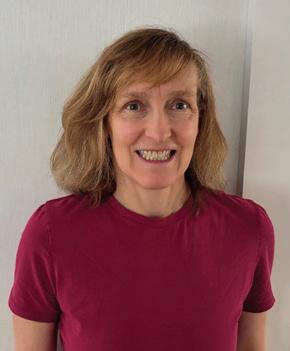
Lisa is a 1992 Olympian where she competed in the 10,000 metres. She is a three-time World Outdoor Track Team member and eight-time World Cross-Country Team member. She is a multiple Canadian medalist at distances from track and cross-country to the marathon and a Mile2Marathon run coach in Calgary, AB.
LISARUNSWIM
RYAN STUART
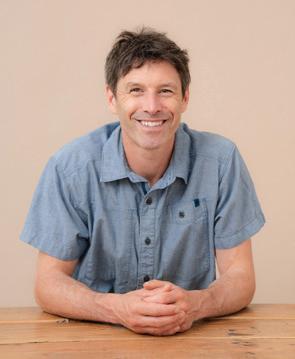
Award winning, professional freelance writer for magazines and websites including Ski Canada, Ryan is an avid trail runner, biker and skier from Courtenay, B.C. His next race is the Kusum Klimb on Vancouver Island where he hopes he won’t cramp!
WRITER-RYAN.BSKY.SOCIAL
CONTRIBUTORS Hannah Antony, Ed Bickley, Jasper Blake, Ruth Burrowes, Eric Carter, Scott Cruickshank, Sophia DeSantis, Pete Estabrooks, Zuzana Fajkusova, Mandy Gill, Emily Green, Lisa Harvey, Greg Hetherington, Louise Hodgson-Jones, Maria Koutsogiannis, Marnie Kunz, Dr. Amy MacKinnon, Caolan MacMahon, Emily Meyer, Lori Rasmussen, Heidi Richter, Carla Robbins, Gary Robbins, Amber Sayer, Jenn Sebestyen, Andrew Simmons, Ryan Stuart, Sean Sweeney, Lauren Toyota, Jessica Woollard, Josh Zilles.
PHOTOGRAPHY Matt Bolam, Brett Clarke, Andrea Cruz, Bank of America Chicago Marathon, Boston Marathon, Connor Burkesmith, Sophia DeSantis, Gabrielle de Rossi, Pam Doyle, Guy Fattal, FinisherPix, Flash-Sport, Ty Holton, Todd Fraser/Canada Running Series, London Marathon Events, Stephanie Lucile Photography, Maria Koutsogiannis, Trudie Lee , Jack Mason, Scott McDermott, Jana Miko, Connor Radley, Raven Eye Photography, Lori Rasmussen, Heidi Richter, Erich Saide, Jenn Sebestyen, Tokyo Marathon Foundation, TCS Sydney Marathon, Eugenia Zykova.
Every year, our annual Running Issue is one of the most anticipated editions of IMPACT Magazine. It’s a celebration of the sport that connects us all—whether we’re newcomers discovering the joy of the run, weekend warriors seeking personal bests, or elite competitors chasing new records. Running moves us, empowers us and can transform lives. And what makes this edition truly special is its ability to unite runners of all backgrounds.
There is more to running than just the miles. At IMPACT, we believe in the power of running to strengthen both individuals and communities. This issue of IMPACT is dedicated to those deeper truths we uncover one step at a time, and to the people who’ve inspired us when the road feels long.
As always, we’re thrilled to bring you the latest expert insights, effective training plans, and invaluable fitness and nutrition tips.
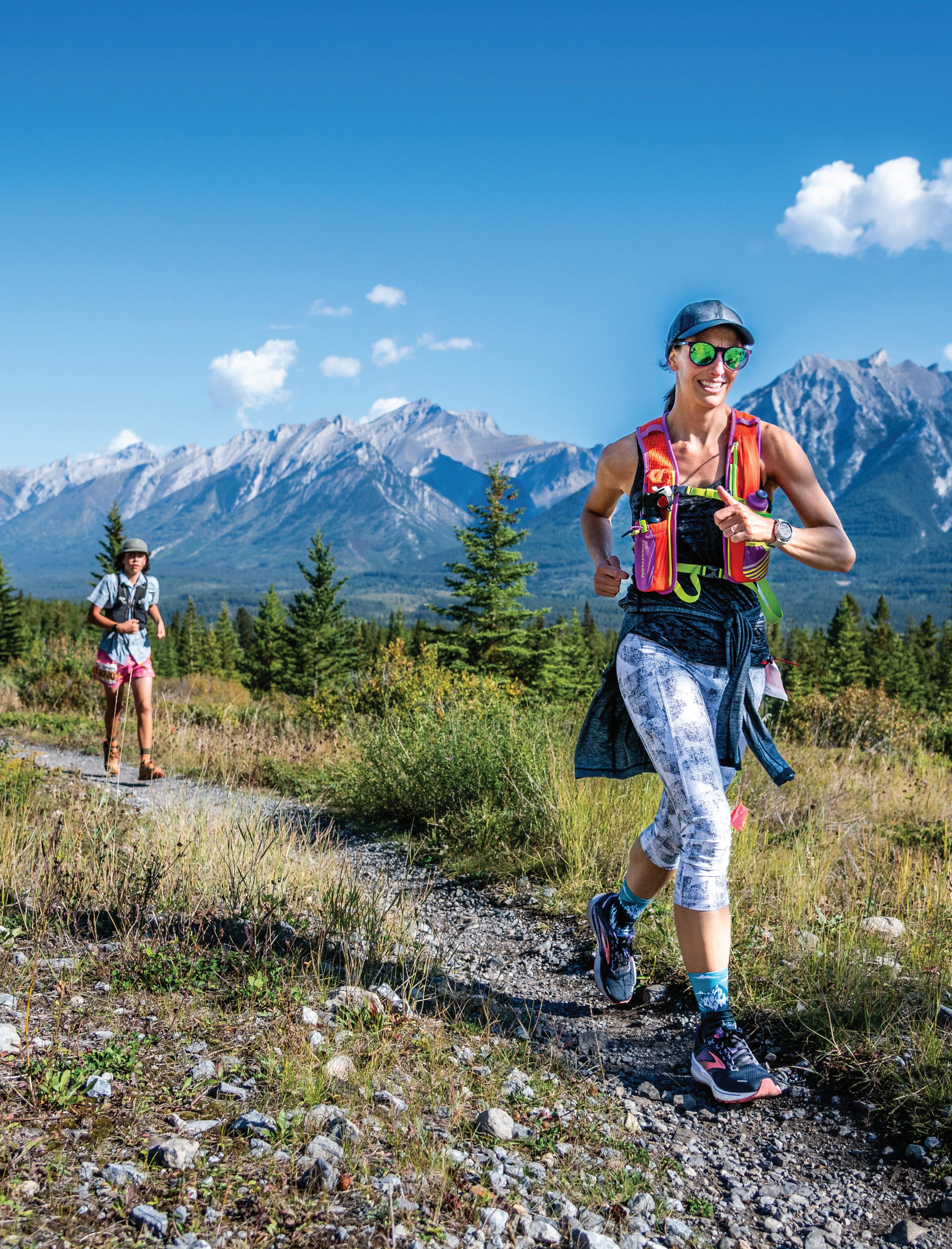
This issue features inspiring athlete profiles, including our cover story highlighting six of Canada’s top women trail runners. These remarkable women are not just pushing boundaries, they are also dominating races that see equal participation from both men and women.
In our Athletes with IMPACT, you will meet some exceptional human beings. Sandra Mikulic is redefining the face of running— breaking barriers and inspiring change. She is proof that passion and perseverance can reshape an entire sport (and as a fellow magazine publisher, I have to say, go Sandra)!
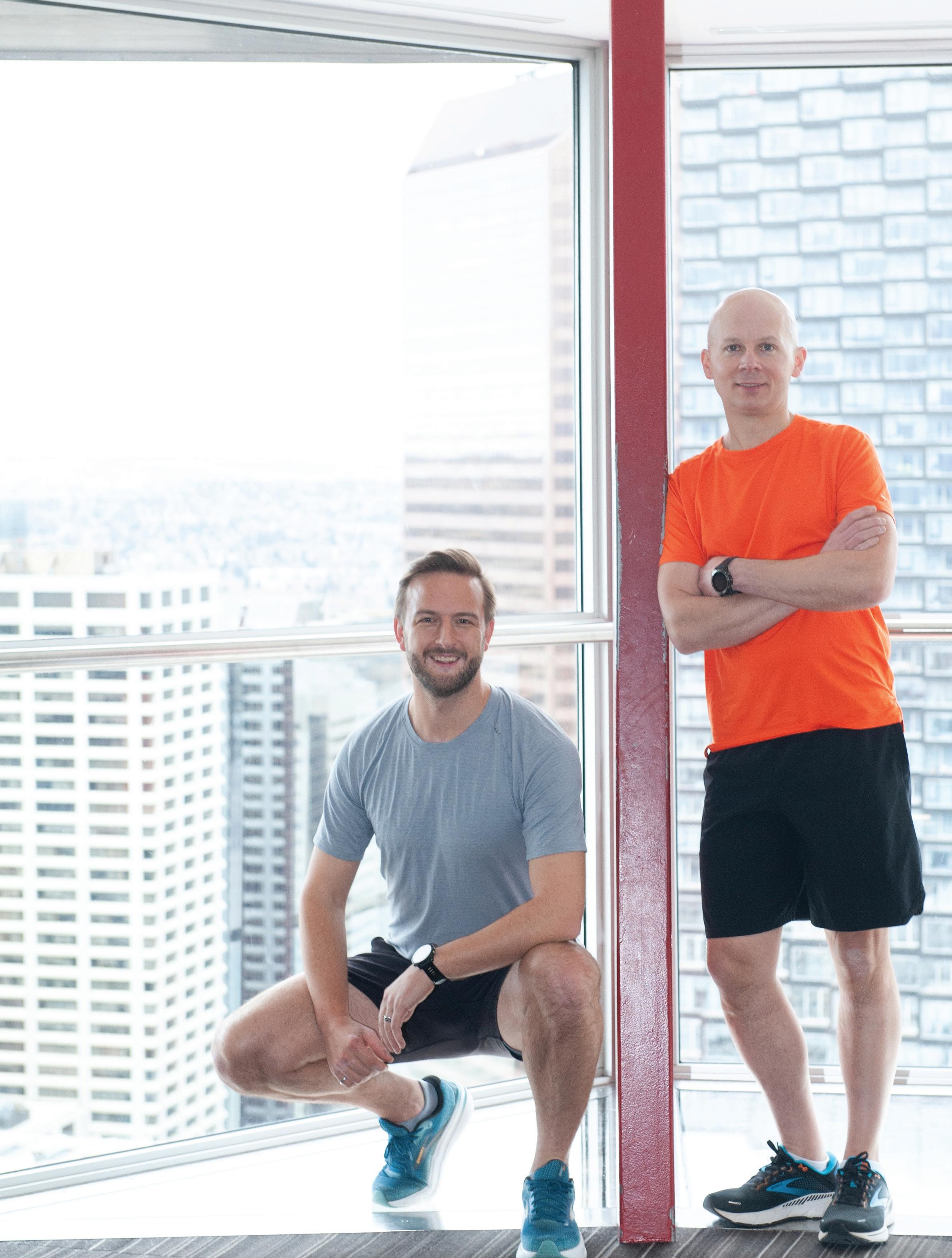
Then there is Mike Hanson and Dave Morin, two running friends who consider themselves ‘just regular guys’ but are taking on an extraordinary challenge: running 10 marathons in 10 days across 10 different provinces to raise funds and awareness for charity. What a testament to the power of determination, friendship and running for a cause.
DIGITAL EDITION
A highlight of this issue is our annual RACE SOURCE GUIDE, a comprehensive listing of must-run races across Canada. By supporting Canadian events, we not only celebrate the vibrant running culture in our country, but we also uplift local race organizers, volunteers, and the businesses that make these events possible. We are proud to champion Canadian brands that ensure that every step we take supports the community that drives this sport forward.
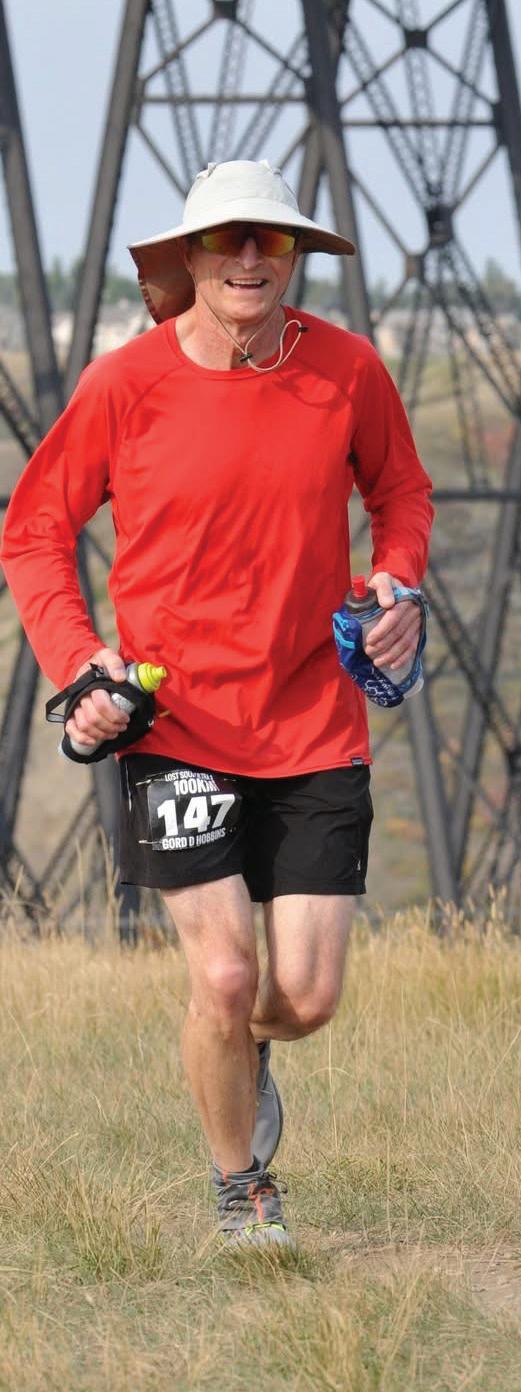
Our Final IMPACT pays tribute to a friend, colleague, and icon in the local and Canadian running community—Gord Hobbins, who we sadly lost recently. Gord was more than a legend in the running world, he was its heartbeat. Like so many, I ‘learned to run’ with Gord, and his generosity, wisdom, kindness and unwavering encouragement left an indelible mark on countless lives.
He eagerly advertised in my very first issue of IMPACT back in 1991 and continued to contribute expert training columns and support throughout the years. I’m profoundly grateful to have known him. His legacy will live on with every runner he inspired, and every finish line he helped someone cross. Thank you, Pete Estabrooks, for such a moving tribute.
To anyone who has ever run with a heavy heart, we’ve been there, and we run beside you. If you’re reading this and thinking of someone you’ve lost, dedicate your next run to them. Let your steps be your tribute.
As we completed this issue, we were reminded that every step counts. Every mile holds a story, and every finish line is a new beginning. We hope these pages fuel your motivation and inspire your next adventure.
From all of us at IMPACT, thank you for being part of this journey. We’re with you, every step of the way.
Didn’t get your hands on a favourite edition of IMPACT? Or maybe your best friend secretly borrowed it from you? No worries. Subscribe to our FREE newsletter and digital edition online at www.impactmagazine.ca
Marathon Running is Booming
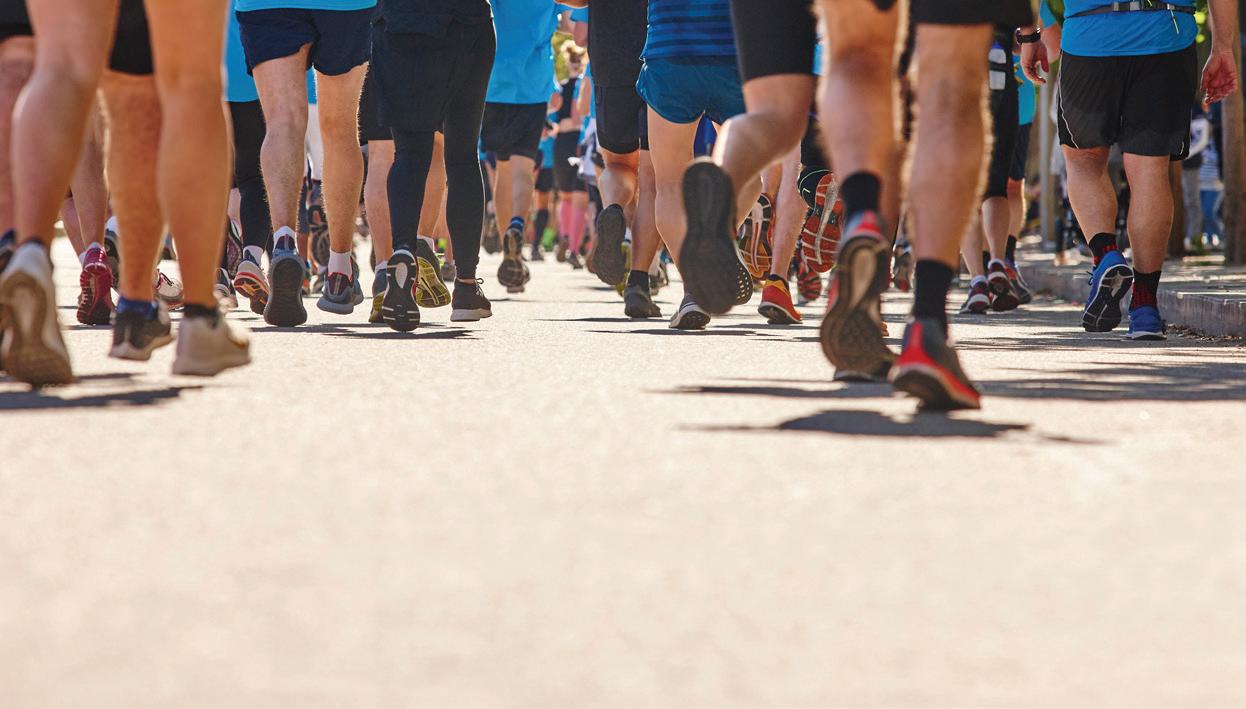
Marathon participation is on the increase with major marathons seeing a phenomenal rise in registrations.
In 2024 the Paris Marathon set a record of 54,175, which was surpassed by two of the Abbott majors a few months later—Berlin (54,280) and New York (55,646). London, not to be outdone, is predicting they will have over 56,000 when runners hit the streets on April 27. This would be 5,000 more than they had in 2024.
According to SportShoes.com’s recent running report this trend is likely to increase with many more 2025 races predicted to surpass previous totals. They list the world’s top 20 trending marathons from stats gathered from those either training or having participated. The top three are:
• Beijing, China – 386 per cent increase
• Shanghai, China - 126 per cent increase
• Nagoya Women’s, Japan – 104 per cent increase Spain has four marathons in the top 20, but surprisingly North America is represented by just one—Canada’s Ottawa Marathon in 15th place, with a predicted 52 per cent increase.
Largest Personal Bottles Program in Marathon History
After the successful inaugural run of the Marathon Project in 2020, it is returning in 2025 offering a weekend of events. Held at the Wild Horse Pass Resort in Chandler, Arizona, on Saturday December 20, the Gold Wave Marathon will feature 500 men and 500 women in a premier amateur event, followed by the professional event on the Sunday with 100 men and 100 women, hoping to set the fastest marathon times in the U.S.
The event will offer a personal water bottle service to all 1,200 runner participating in the the two marathons.
Gold Wave participants will be asked if they wish to participate in the program, and can drop off their labelled personal bottles at package pick up. (Professional participants have a separate drop off).
Bottles will be taken to the fluid tables on race day by volunteers.
Each athlete will receive bottles at six different times along the course, one per each 4.26-mile (6.85 kilometre) loop. There will be 125 tables on the course to accommodate the 1,000 runners in the Saturday marathon. Organizers say this will be the largest personal bottles program in marathon history.
For more information: www.themarathonproject.com.
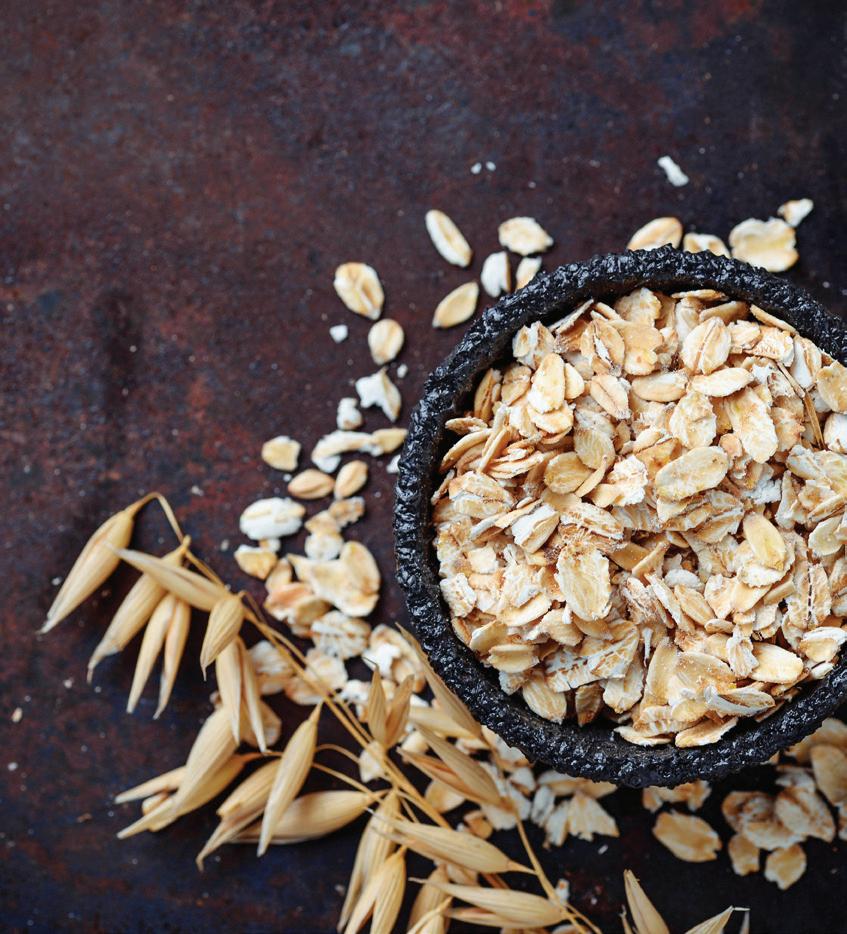
We all know the importance of fibre in our daily diet, if nothing else to keep us regular. A new study has analyzed why a moderate intake of fibre should be part of an athlete’s diet and administered daily. The research studied endurance athletes, some of whom ingested less than 20 g of daily fibre. It suggests fibre intake should be increased to ~ 30 g a day, which includes ~ 2 g of beta-glucan over a duration of six weeks. Beta-glucan is a watersoluble fibre found in oats and barley, and if taken in over two to four weeks could improve strength and endurance. It may also help reduce post-exercise inflammation, helping athlete recovery.
The study states that daily fibre intake should be accompanied by drinking fluids which helps speed up the ingestion through the digestive system, while reducing the chance of constipation. This is doubly important for athletes who can lose volumes of fluid during exercise.
Fibre also aids in feeding any bacteria in our system leading to the production of short-chain fatty acids (SCFAs) like butyrate. SCFAs help maintain a healthy gut avoiding gastrointestinal issues that can often plague athletes.
Source: Mancin, L., Burke, L.M. & Rollo, I. Fibre: The Forgotten Carbohydrate in Sports Nutrition Recommendations. Sports Med (2025).
" Well, I liked all
"Captain
CORE ESSENTIALS FOR RUNNING PERFORMANCE
Improve stability, strength, efficiency and prevent injuries
BY EMILY GREEN ERICH SAIDE
One of IMPACT Magazine’s Canada’s Top Fitness Instructors, 2023 and 2025 in Vancouver, B.C. EMGRRREEN
Running is a versatile and accessible sport, allowing athletes of every level to tailor their pace and distance to optimize performance and endurance. Every stride propels you forward on your journey—one step closer to the finish line, one step stronger in endurance.
But before you lace up those high-performance runners and hit the pavement, it’s essential to focus on the powerhouse of your stride—your core. A strong, stable core is the key to maintaining efficiency, power, and endurance with every step. Let’s dive into why it deserves as much attention as your training miles.
WHAT IS THE DIFFERENCE BETWEEN A STRONG CORE VS. A WEAK CORE FOR RUNNERS?
A strong core is the foundation of efficient running, stabilizing your torso, supporting your upper body and pelvis, and enhancing balance and control with every stride. It helps maintain proper posture, reduces unnecessary movement, and improves overall running efficiency.
1
THREAD THE NEEDLE
Challenge means change!
1 minute on each side
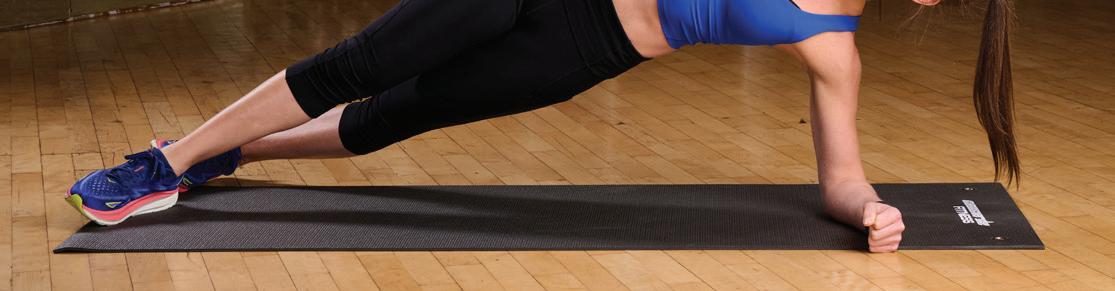
This is an active form of the side plank. It strengthens the obliques and with the rotation it makes it more stimulating and dynamic. It also shows great core control throughout the movement.
1. Take a side-plank pose with one hand or elbow on the ground, the other one extended towards the ceiling.
2. The spine is neutral, and one leg is in front of the other. Pull the extended arm down and through the hole under your body, rotating the hips but keeping the torso straight, then return to the starting position.
REVERSE LUNG CHOPS
2
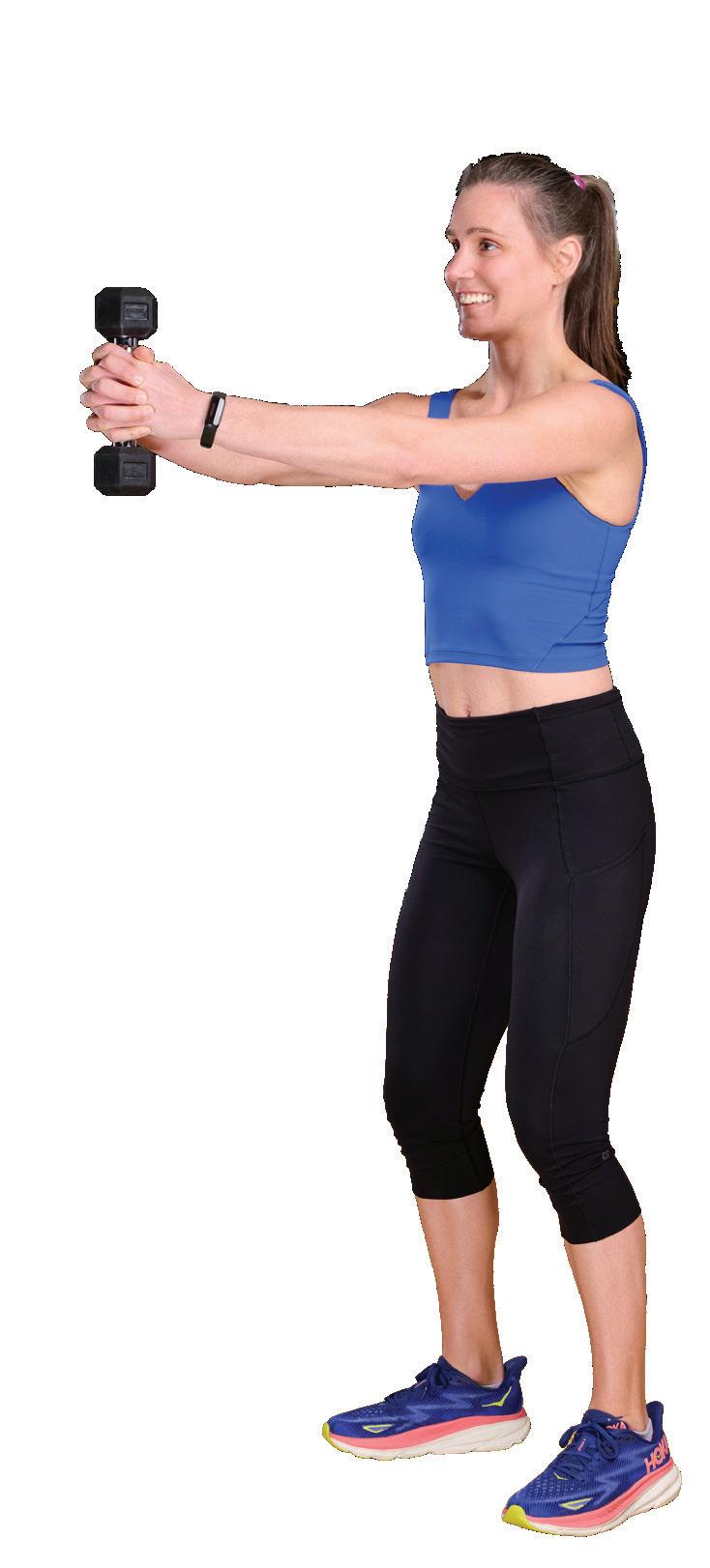
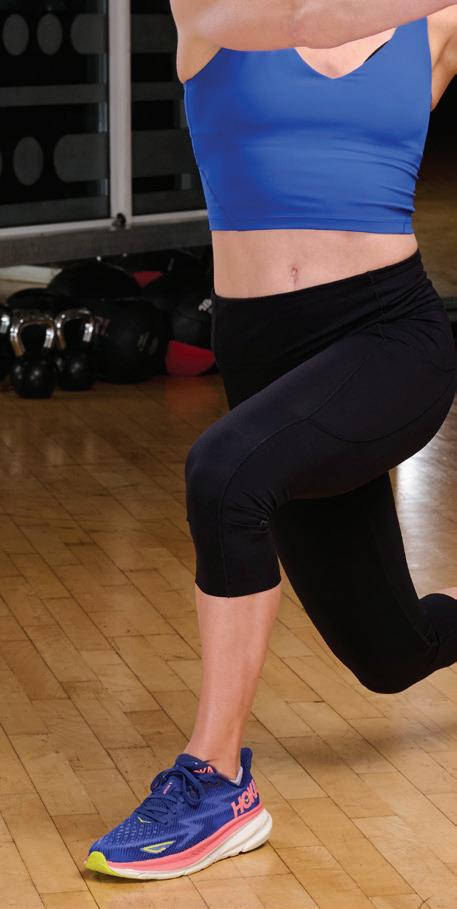
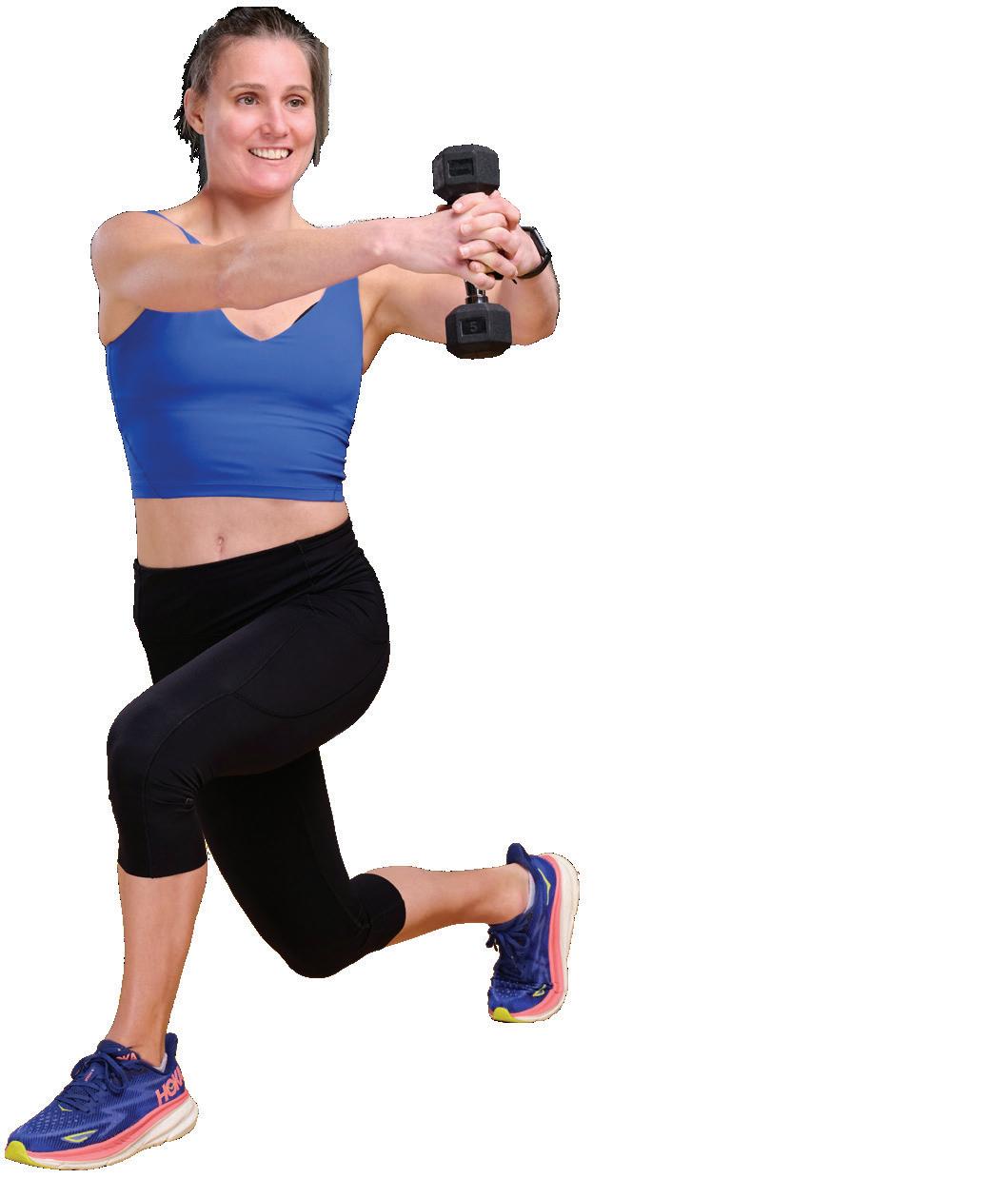
If it’s burning, then it’s building! 2 - 3 sets, 10 reps on each side You can do this movement with or without a weight. The reverse lunge improves balance and stability. It helps with hip mobility and flexibility. In addition to the goal of strengthening your core you are also strengthening your glutes and hamstrings which you use when running. Plant your left foot on the ground and step your right foot back into
As you step back bring your arms across your body from shoulder height
The chest remains square. Keep your core engaged and repeat the step back and forwards with the weight moving diagonally across your body It is important to be twisting with control, bringing your torso back to centre in
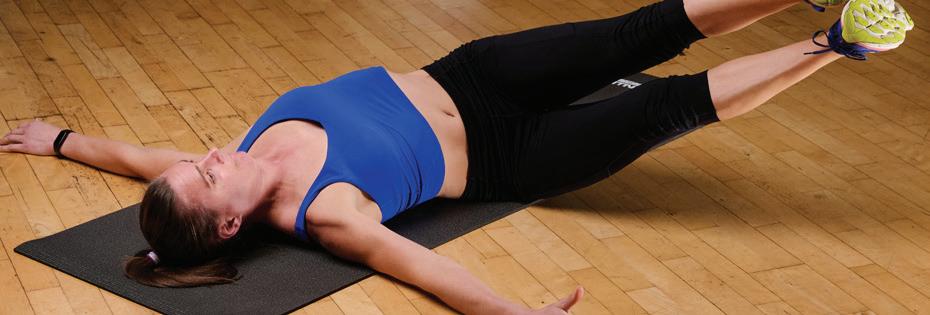
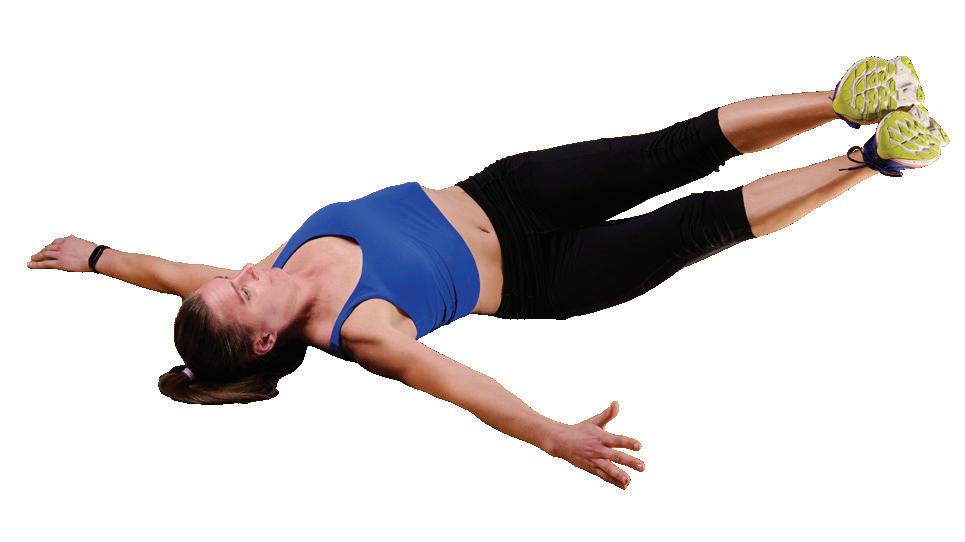
FLUTTER KICKS
Squeeze tight! Flutter hard! Victory!
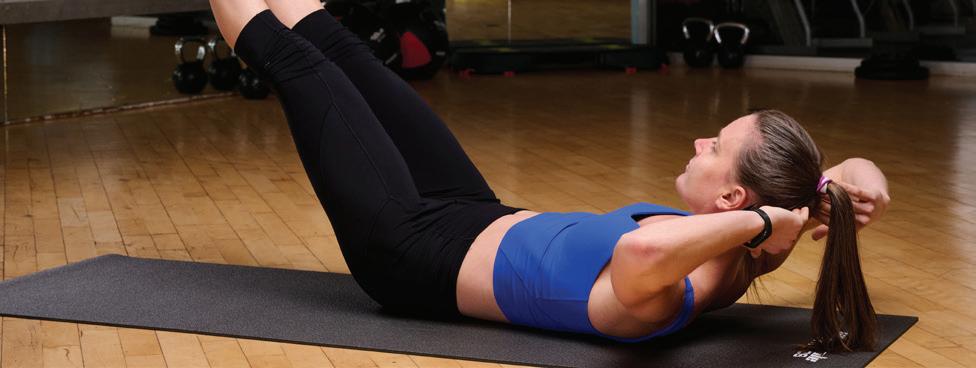
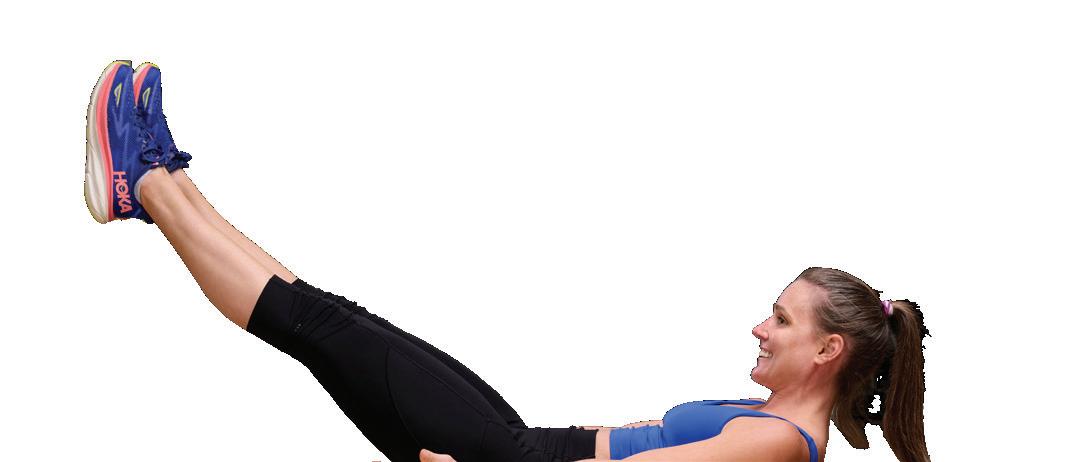
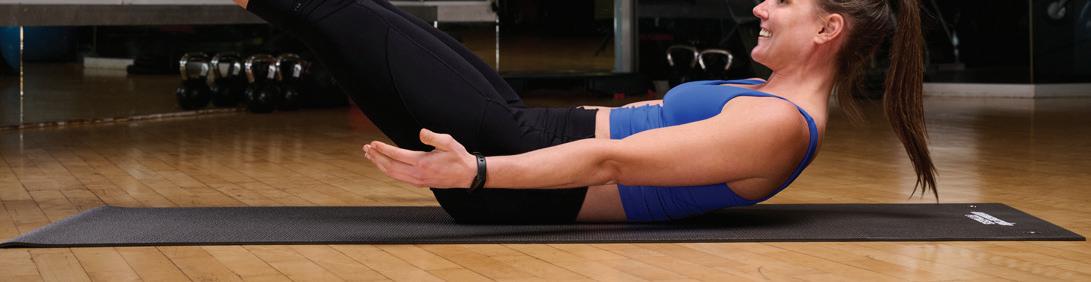
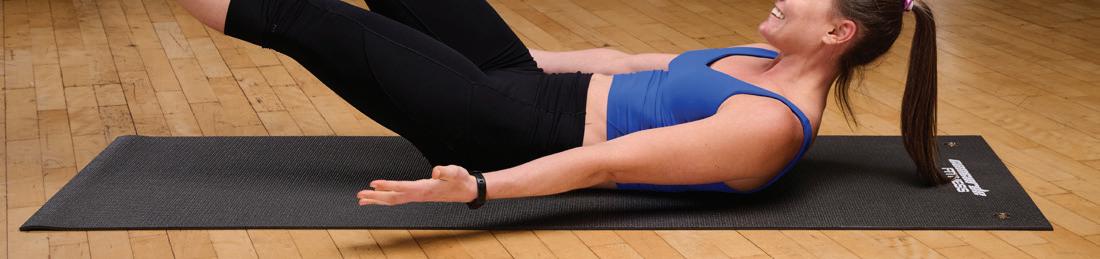
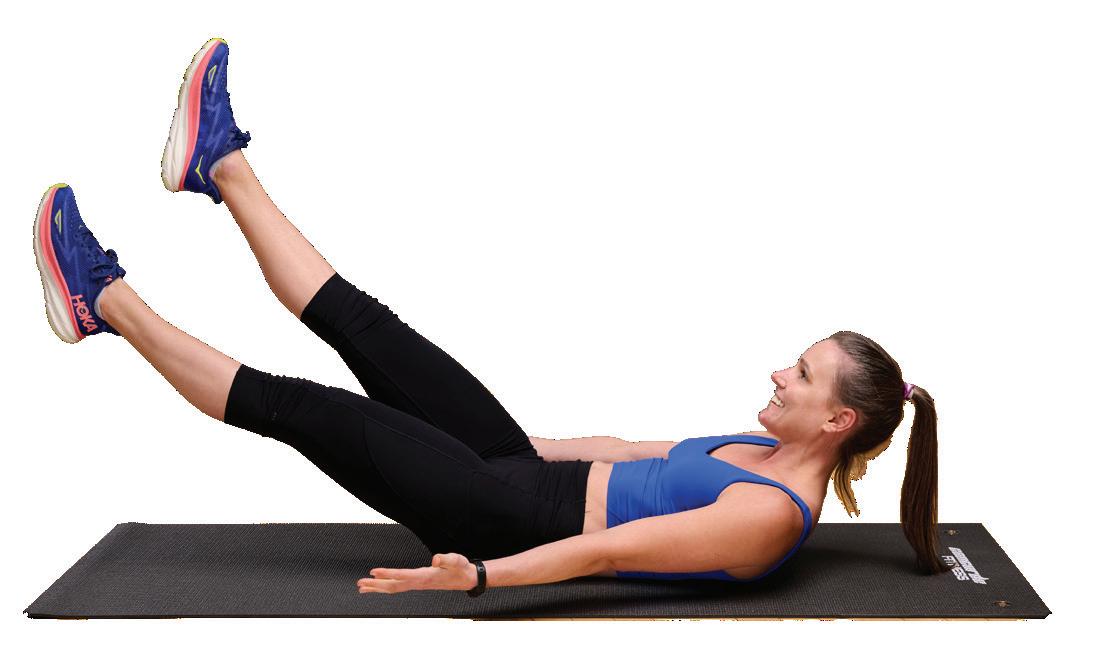
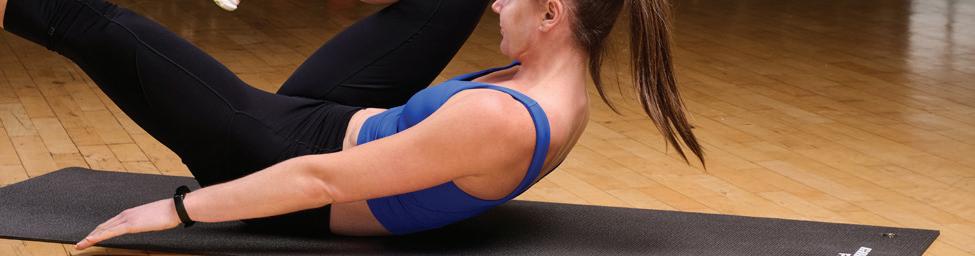
Interval training style: Hold the flutter kick for 30 seconds with a 15 second recovery x 4 sets. This totals 2 minutes of activated core work. Runners often have tight and weak hips, and flutter kicks are a great way to activate the hip flexors. While many core exercises involve crunching or twisting, flutter kicks challenge you to stay as flat as a board instead. This movement primarily targets and strengthens the lower-back and lowerabdominal muscles.
1. Lie on your back with your arms by your sides and your legs extended straight out in front of you.
2. While keeping a flat back on the mat lift your legs to hover over the floor with shoulders off the mat to maintain a hollow hold.
3. Alternate between lifting your left foot and right foot in a small kicking motion.
4. It is essential to keep your core tight and back flat to the ground.
4
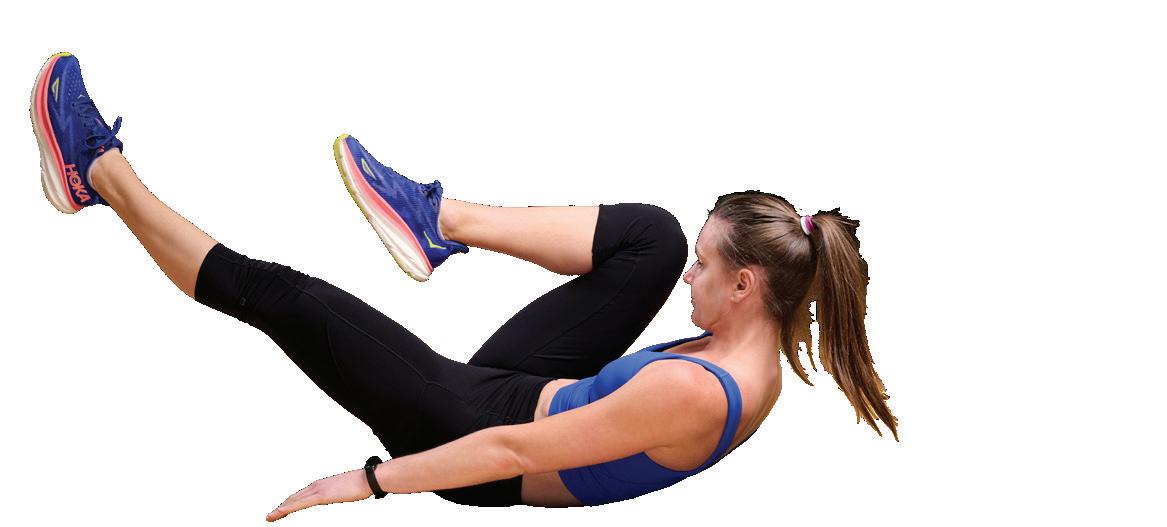
CRUNCH + KNEE DRIVE
Every rep counts because you make it count!
2-3 sets, 10 reps per side
This effective exercise engages your abdominal muscles to lift the weight of both your arms and legs while also improving coordination.
1. Lie on your back with your legs extended horizontally.
2. Lift your upper body off the floor as you crunch forwards and reach your hands forward to tap the mat, as one knee comes between your arms and towards your nose.
5
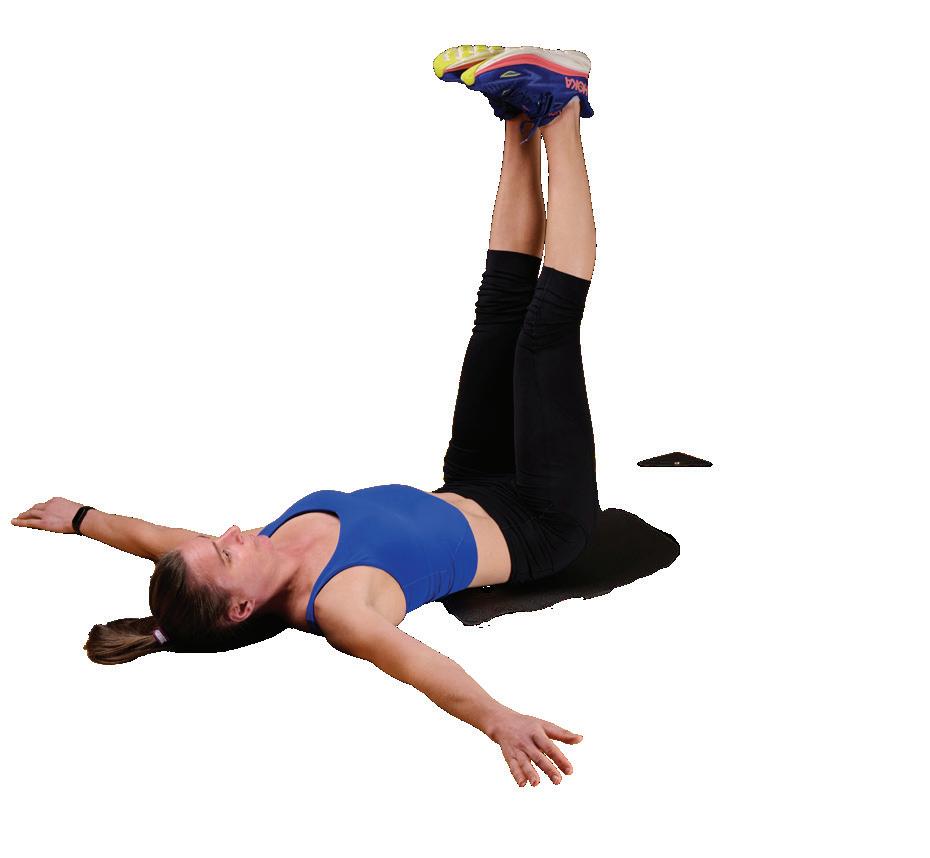
WINDSHIELD WIPER
One workout away from a better mood and a better run!
2-3 sets, 10 reps
This exercise targets the rectus abdominis and obliques, engages the hip flexors, and relies on glute support. To enhance your form and strengthen the mind-muscle connection, try adjusting the movement's tempo, switching between straight legs and bent knees, and incorporating a brief hold at each endpoint.
1. Lie on your back with your knees bent and feet flat on the floor.
2. Lift your knees until your calves form a 90-degree angle with your hamstrings.
3. Rotate your hips and lower your legs to the side.
4. Pause and hover before touching the ground.
5. Repeat on the other side.
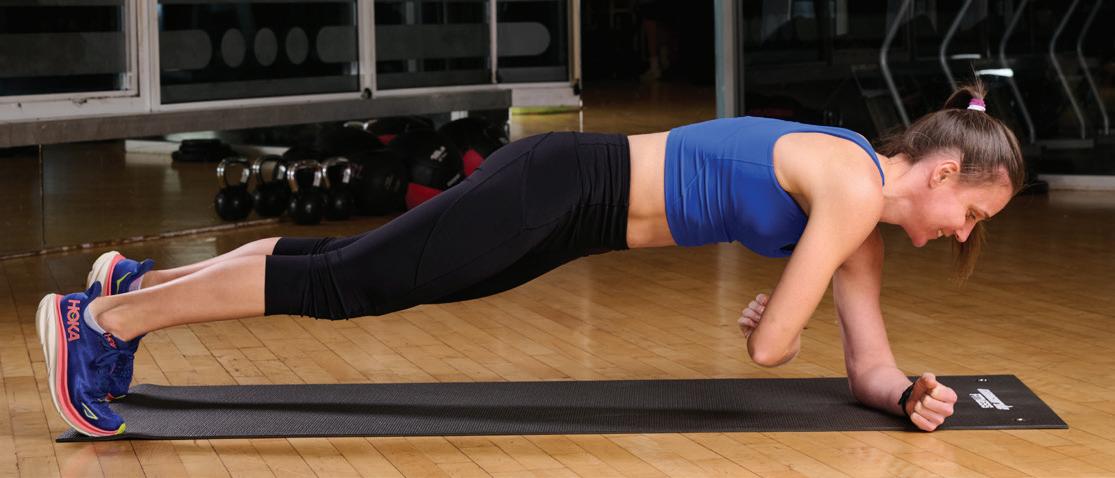
3. As you reach your hands forward one knee drives towards your nose, while the other leg remains frozen straight.
4. Release the crunch as you extend the knee back to the straight leg and then repeat on the other side, crunching tight and pulling the opposite knee towards your nose.
5. It is a similar motion and concept to Mountain Climbers but from your back!
IT BAND EXERCISES FOR RUNNERS
Strengthen the hips to prevent injuries
BY GREG HETHERINGTON JACK MASON
Fitness and wellness expert, and founder of Youthlete Academy and Fuel Training Club, Greg is one of IMPACT
Magazine’s Canada’s Top Fitness Trainers & Instructors 2019 and 2020 from Toronto, ON.
GREG.HETHERINGTON
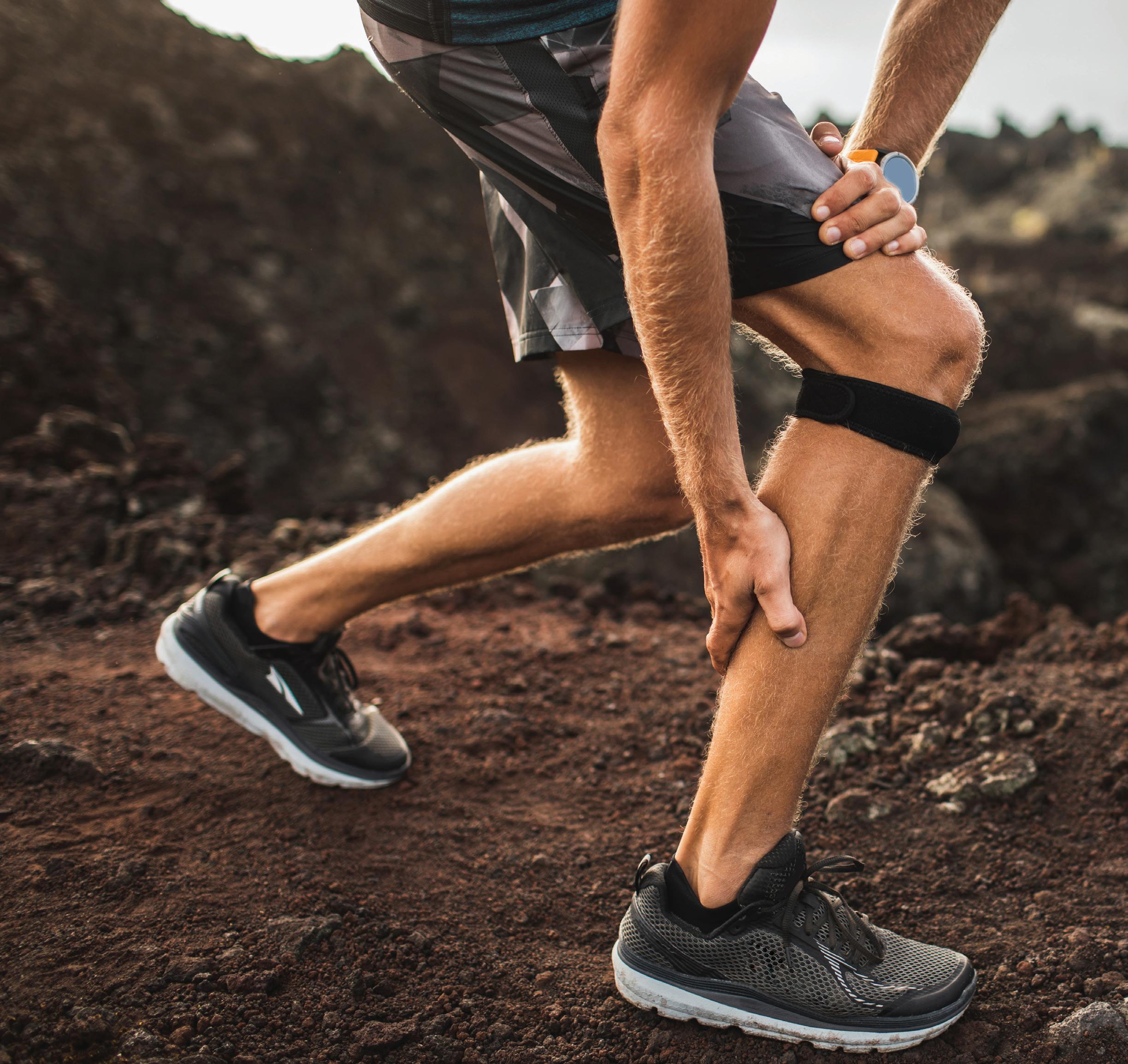
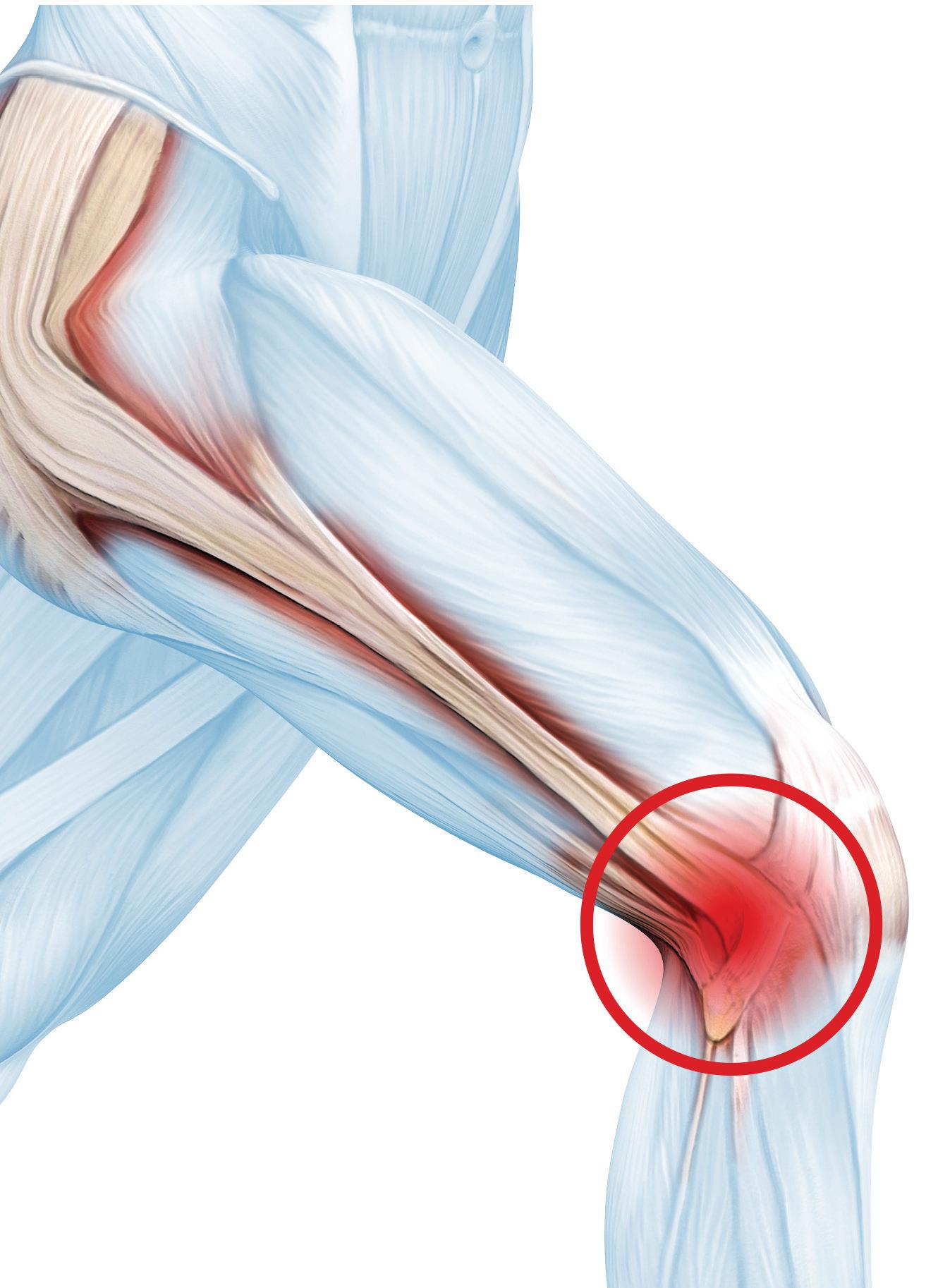
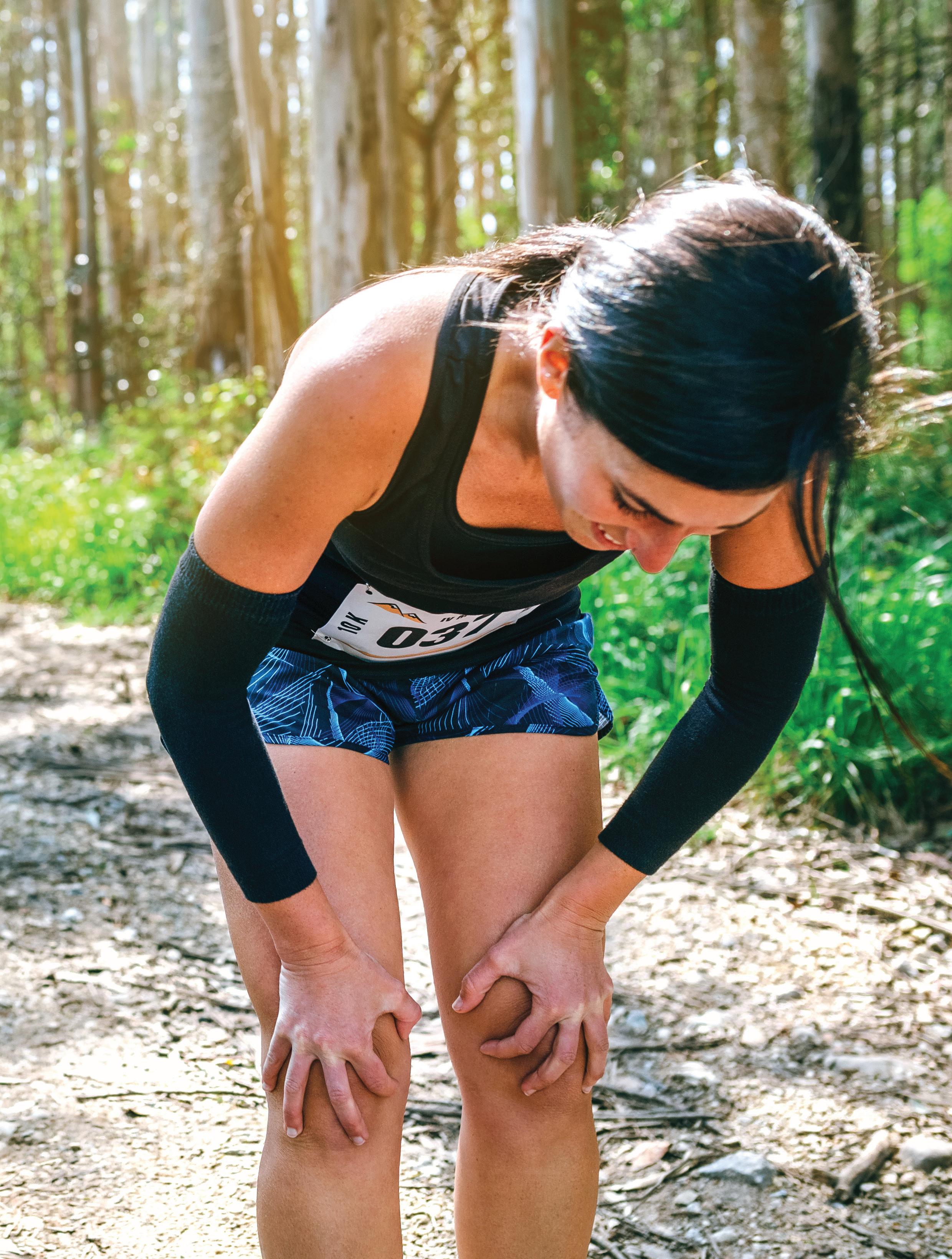
Spring running heralds the arrival of longer, warmer days. However, many runners, after a winter of reduced activity, often mistakenly resume their fall training volume, leading to a surge in overuse injuries, including IT band syndrome. When the IT band tightens, it can rub against the outside of the knee, causing friction and significant discomfort that can halt your running. Although the IT band itself isn't a muscle and can't be directly strengthened, maintaining its pliability, strengthening surrounding muscles, and employing good running technique are crucial for prevention. So, how can we proactively prevent IT band syndrome? Here are four exercises designed to not only minimize the risk of IT band issues but also strengthen your hip and knee stabilizers, maintain IT band pliability, and refine your foot strike, ultimately making you a stronger, faster, and more resilient runner. These four movements serve a dual purpose. They are a great training tool on their own for a strength or prehab session and are also great to add to your run warm-up. Do these on a track, sidewalk, closed road or any open space at a gym.
1
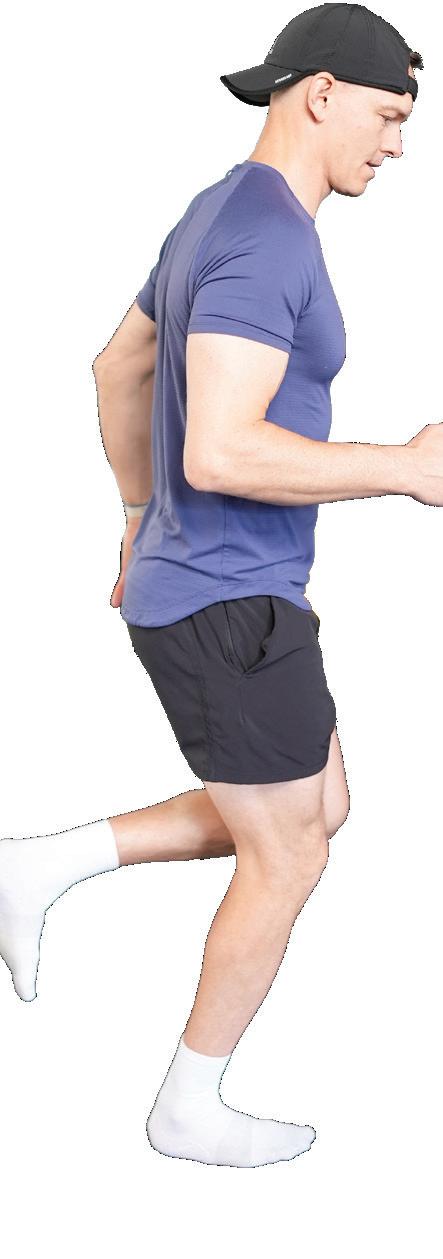
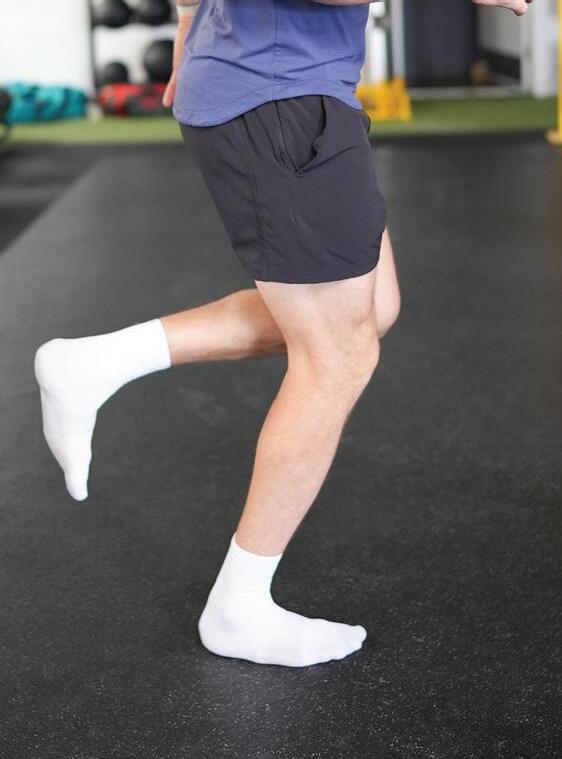
SKIPPING
Find a rhythm and perform for 100 metres (400 metres or 1 lap around the track for experienced runners)
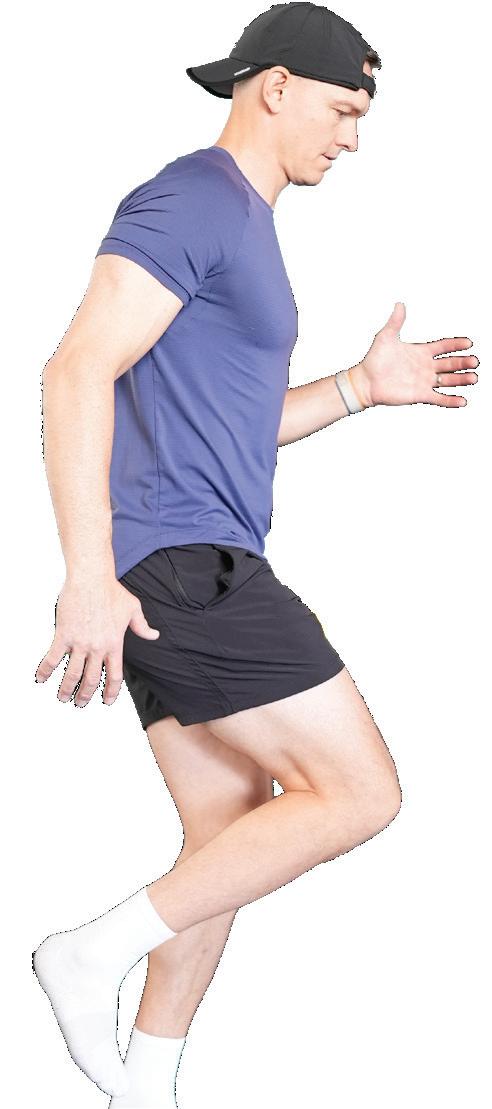
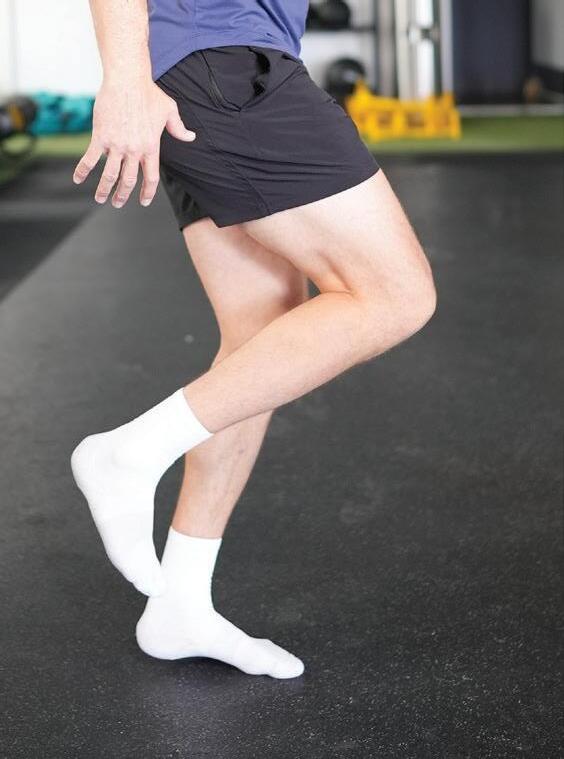
Skipping is foundational to running. This warm-up movement teaches the body to relax and contract while gradually increasing impact. Try to land flat-footed, the ball of your foot striking milliseconds before the heel and aim to not make any noise. Allow the arms to swing loosely and relax your neck and jaw. Proper run mechanics are paramount to keeping your IT band happy.
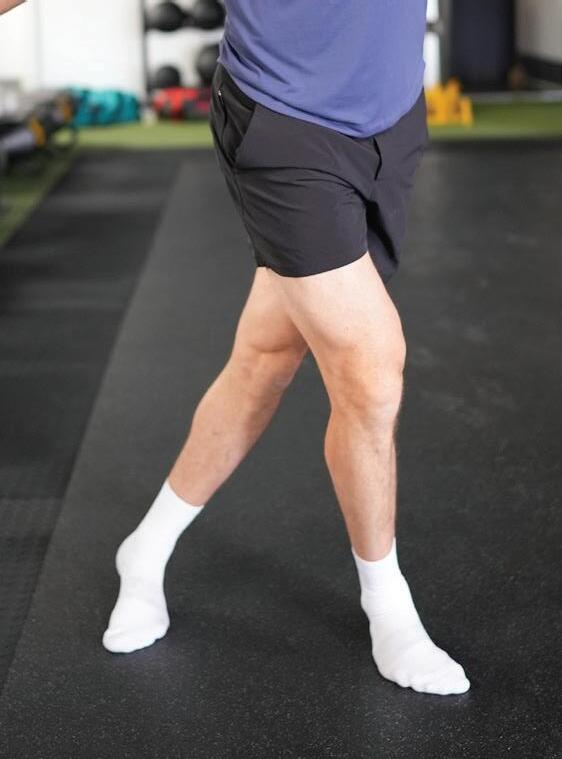
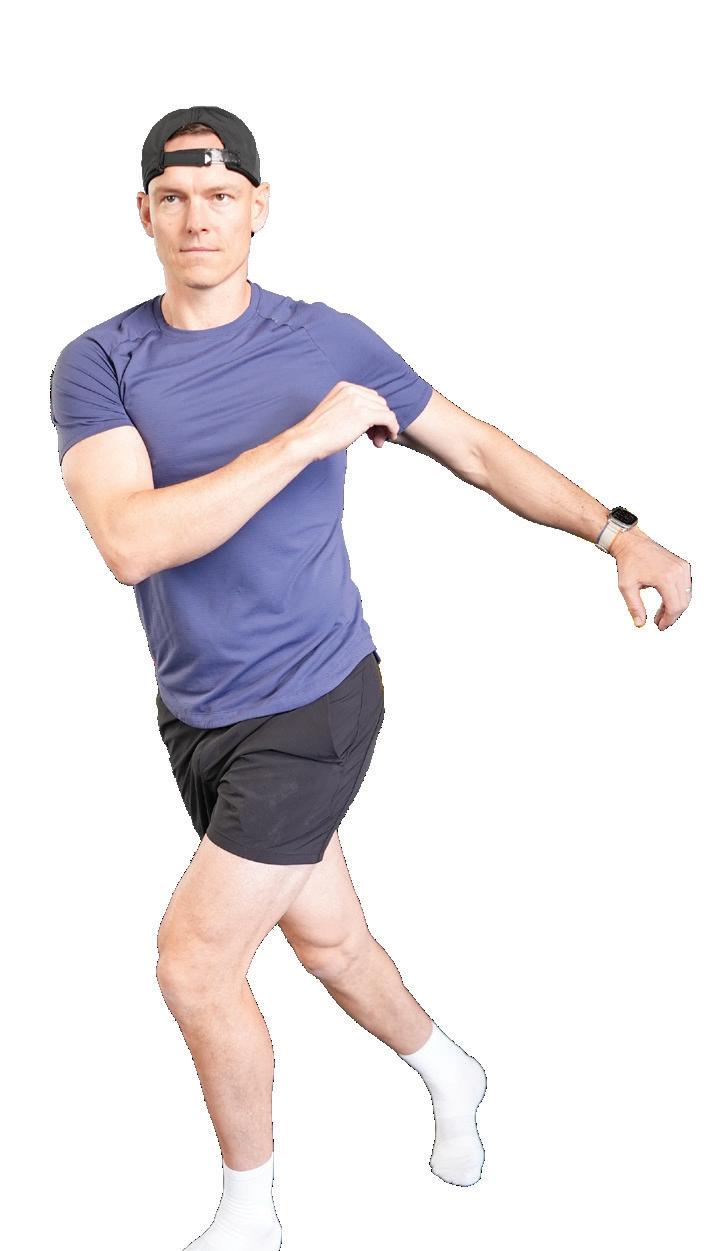
CARIOCA
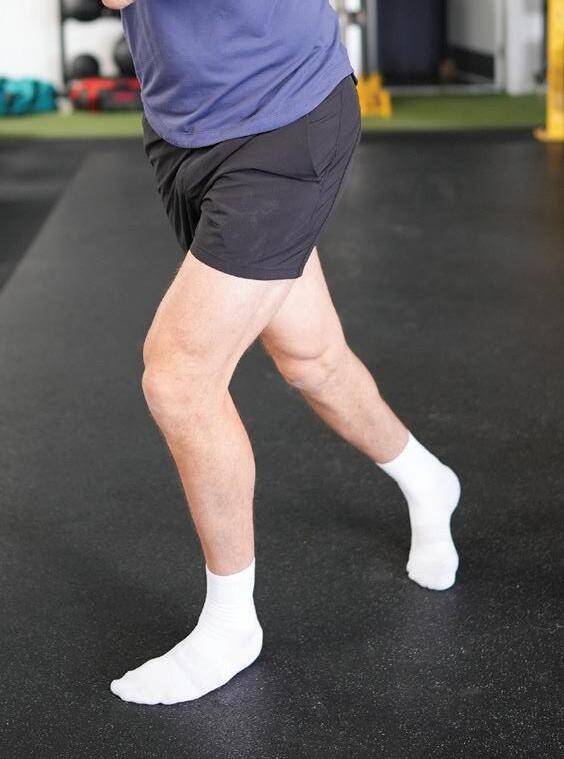
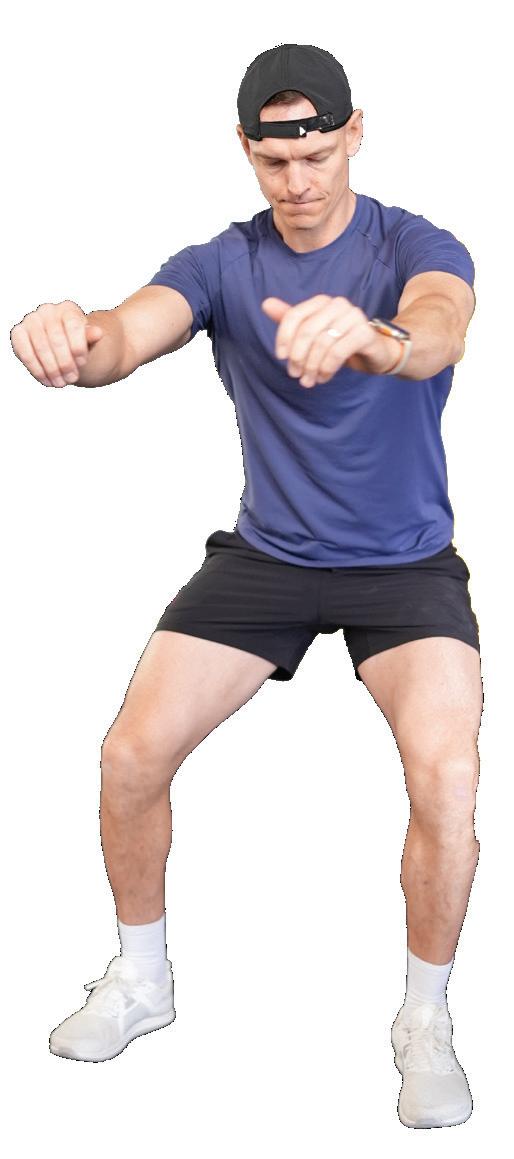
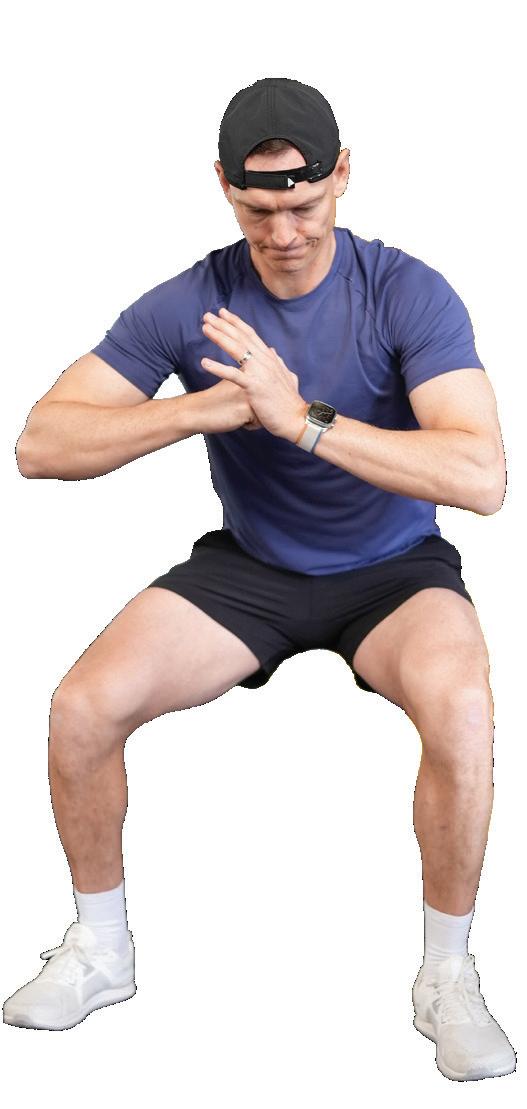
This exercise is about allowing your hips and spine to rotate more than they typically will while running. Unlocking the pelvis and spine allow for the natural movement of these segments to avoid restricting the IT band from gliding. Landing flat-footed again, cross over your front leg while keeping your belly button pointing forwards and then come back to neutral and cross over the same foot behind you on the next step, then back to neutral. •
ISOMETRIC LATERAL KNEE PRESS
Hold for 10 seconds, relax and repeat 4 sets per side
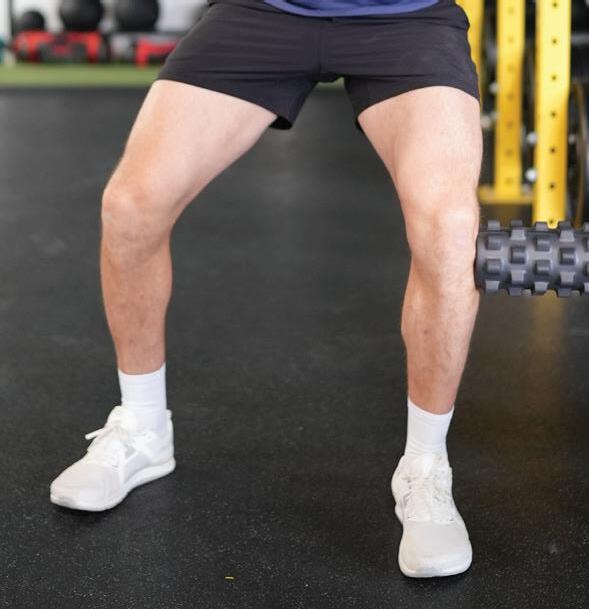
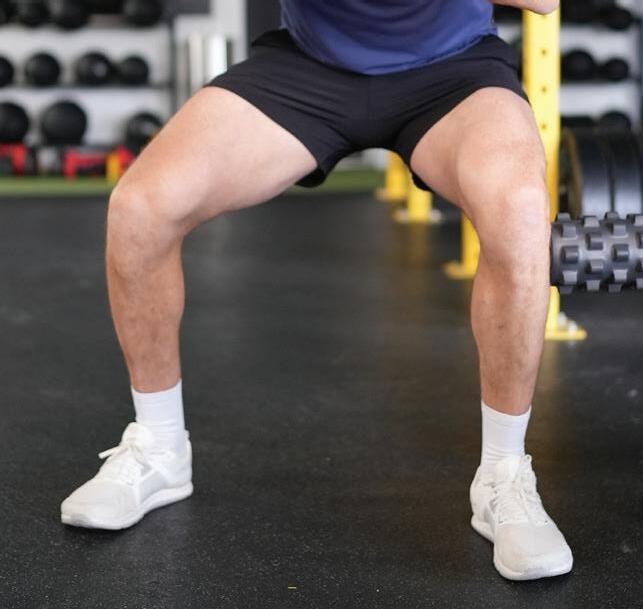
Activating the gluteus medius and lateral portion of the hips helps unlock the pelvis, "activate" musculature on the side of the hip and prepare the nervous system for running. This will allow the correct muscles to fire while allowing the IT band to glide. I'm using a foam roller here but so long as your knee is pushing against an immovable object, it can be in direct contact. Get into a semi-squat position, and create a tripod with the heel, big and little toe firmly planted into the ground.
4
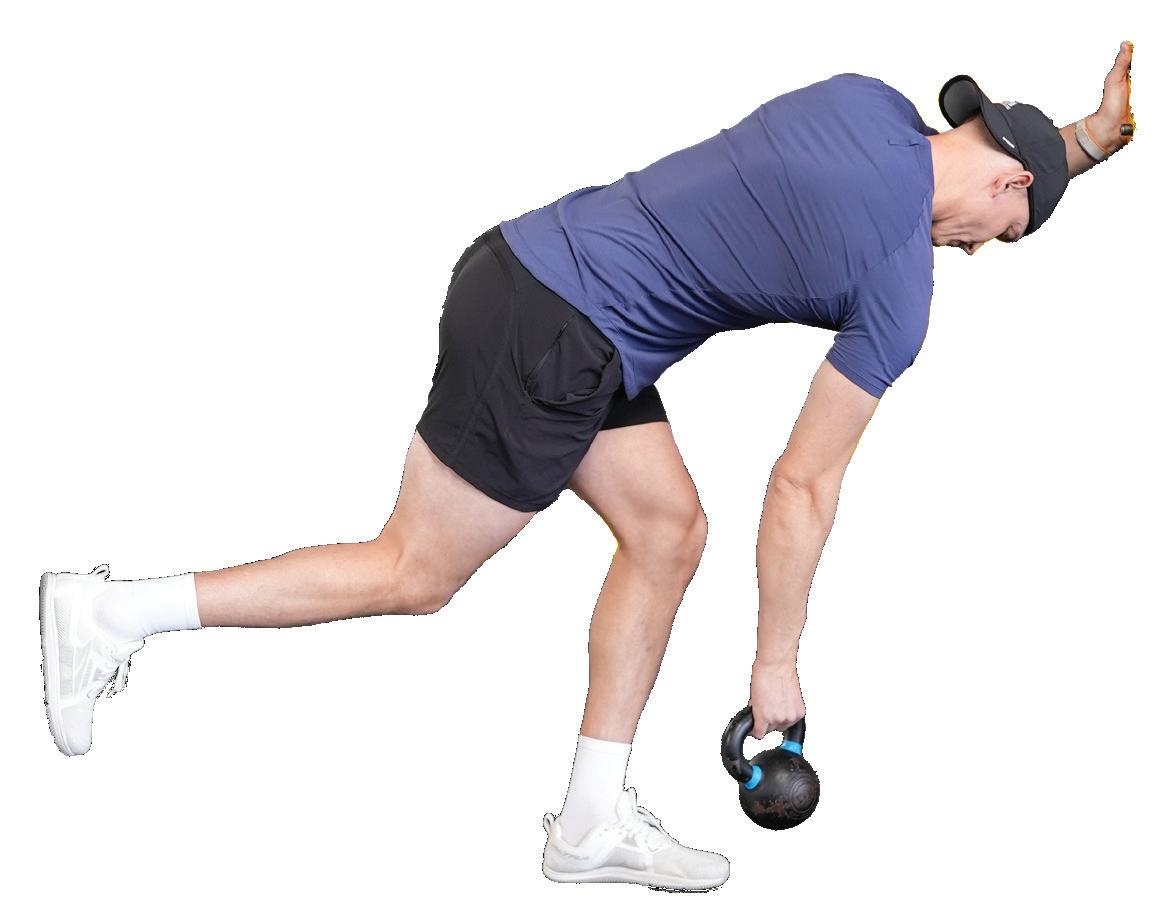
LOADED HIP AIRPLANE
12-15 reps per side at a controlled pace
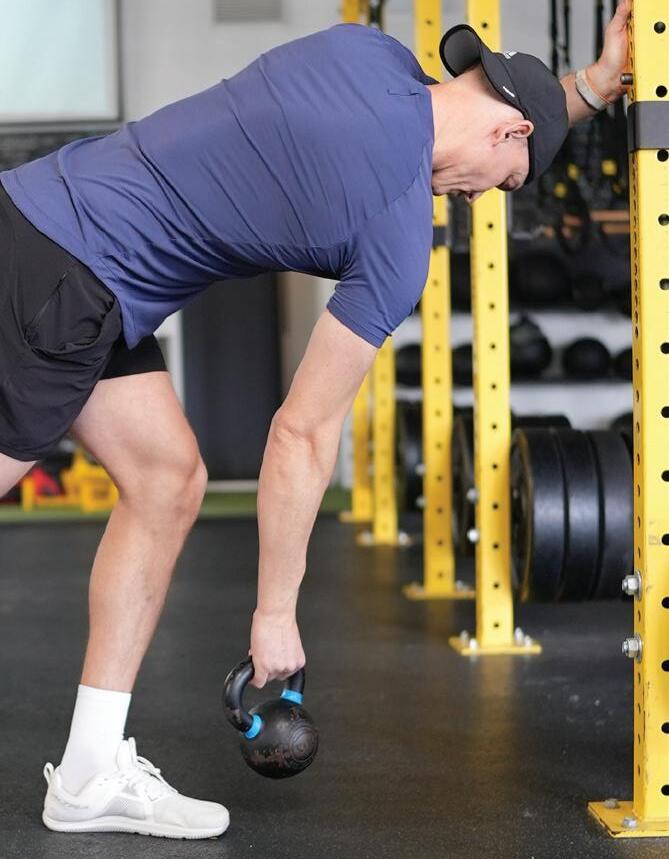
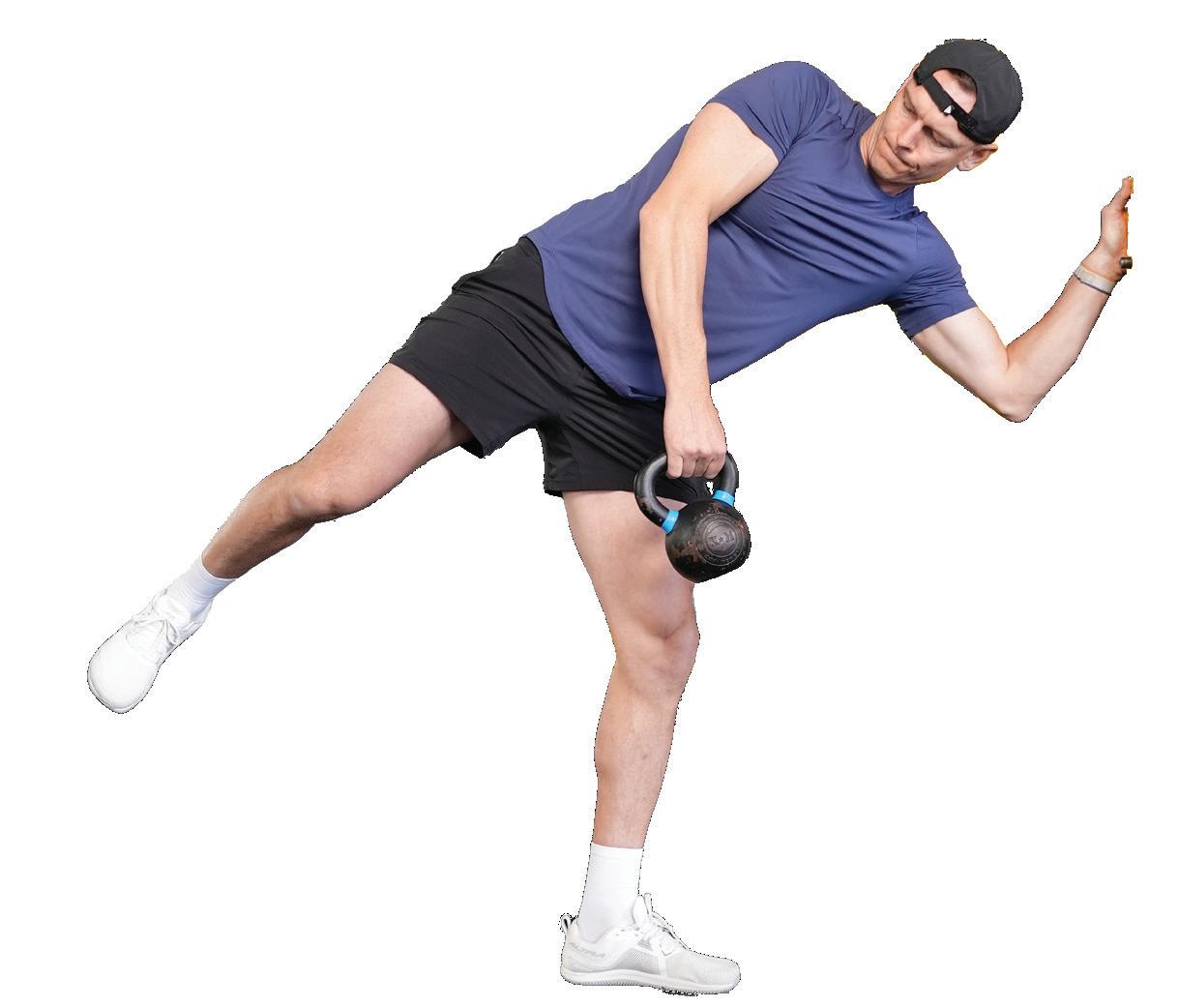
Now we want to load up the spine and pelvis while the hip is rotating to strengthen and improve mobility. Holding any weighted object, start light, 10 lbs until you get the feel for this. It's both a stretch and strengthening exercise. First load up the hip by fully rotating in a hinge with your hand towards the ground. Then rotate from the grounded hip to stack the top hip over it. It's important you feel the stretch on the side of your hips (gluteus medius) initially to fully load the movement, then fully stack your hips to activate the muscles. Maintain a flat spine throughout.
A Note on Bare Feet
To self-teach proper walk and run biomechanics, I'm a big believer in barefoot work. If you can, perform these movements in bare feet, socks or at the very least, a zero-drop, zero-cushion shoe. This trains the musculature of the foot how to absorb force at impact and provides direct feedback to the rest of your body on how to react naturally. Don't try running in barefoot shoes before walking and doing these drills, then build up in 400-metre-jog + 400-metre-walk intervals. It's ok to run races and volume work with cushioned shoes but don't neglect strengthening and mechanics exercises!
•
TRAIL BLAZERS
Canadian women ultra runners are becoming a force on the world trail stage
BY LOUISE HODGSON-JONES GABRIELLE DE ROSSI, CONNOR BURKESMITH,
MATT BOLAM, FLASH-SPORT
IMPACT guest editor, communications and event specialist in Victoria, B.C.
LOUISEHODGSONJONES LOUISEHODGSONJO
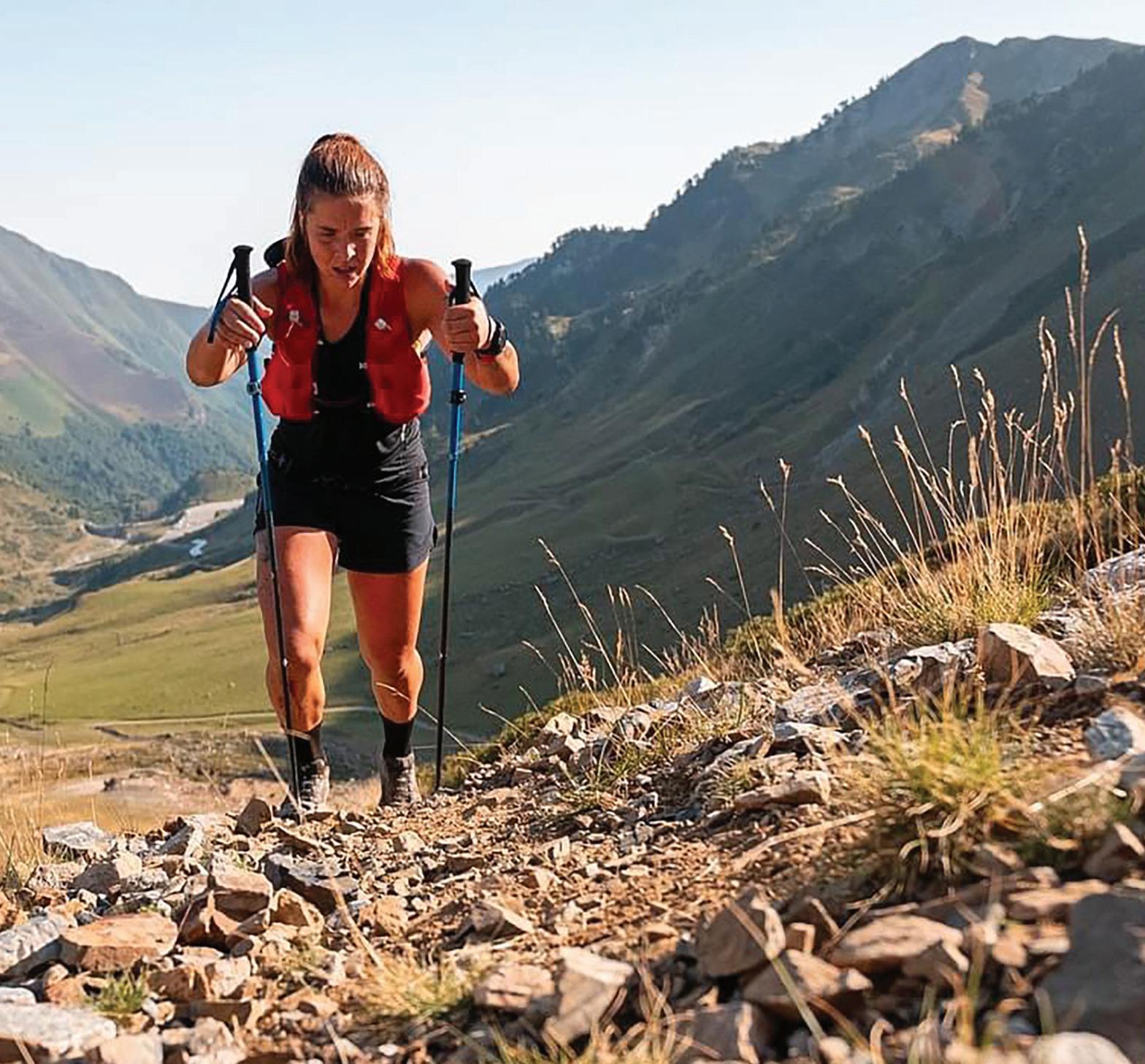
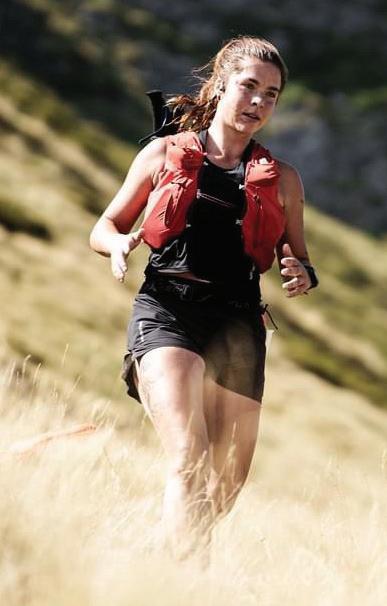
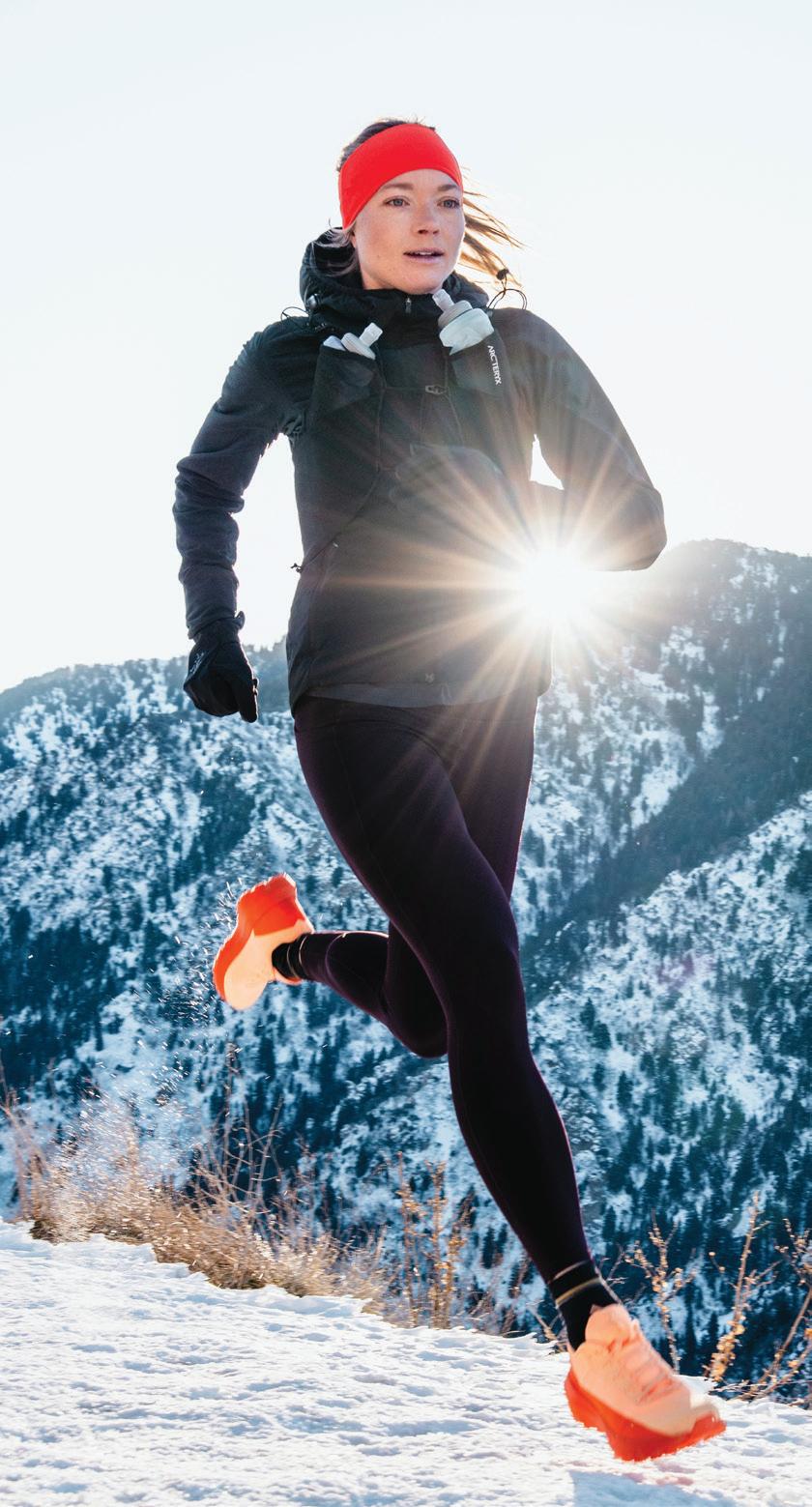
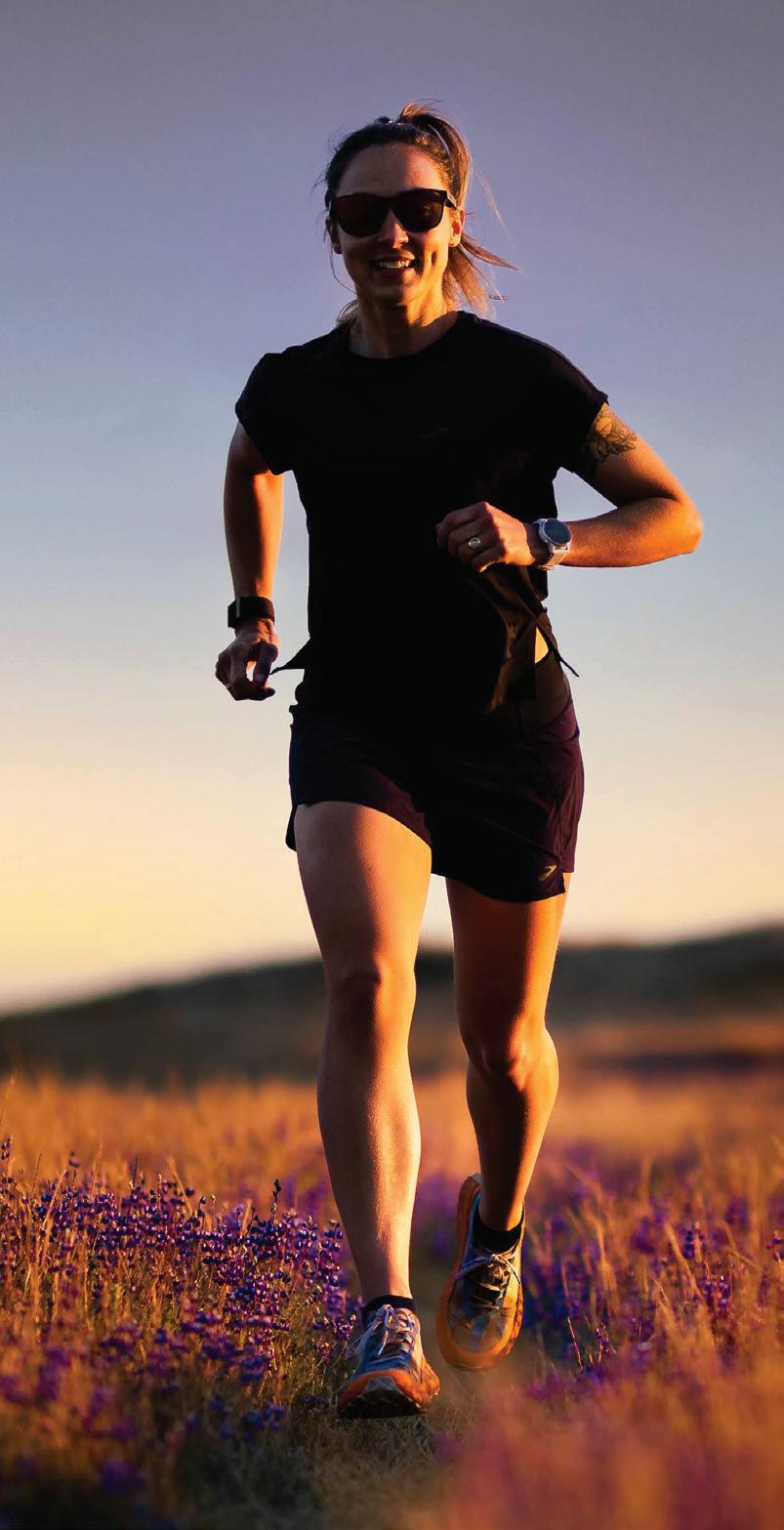
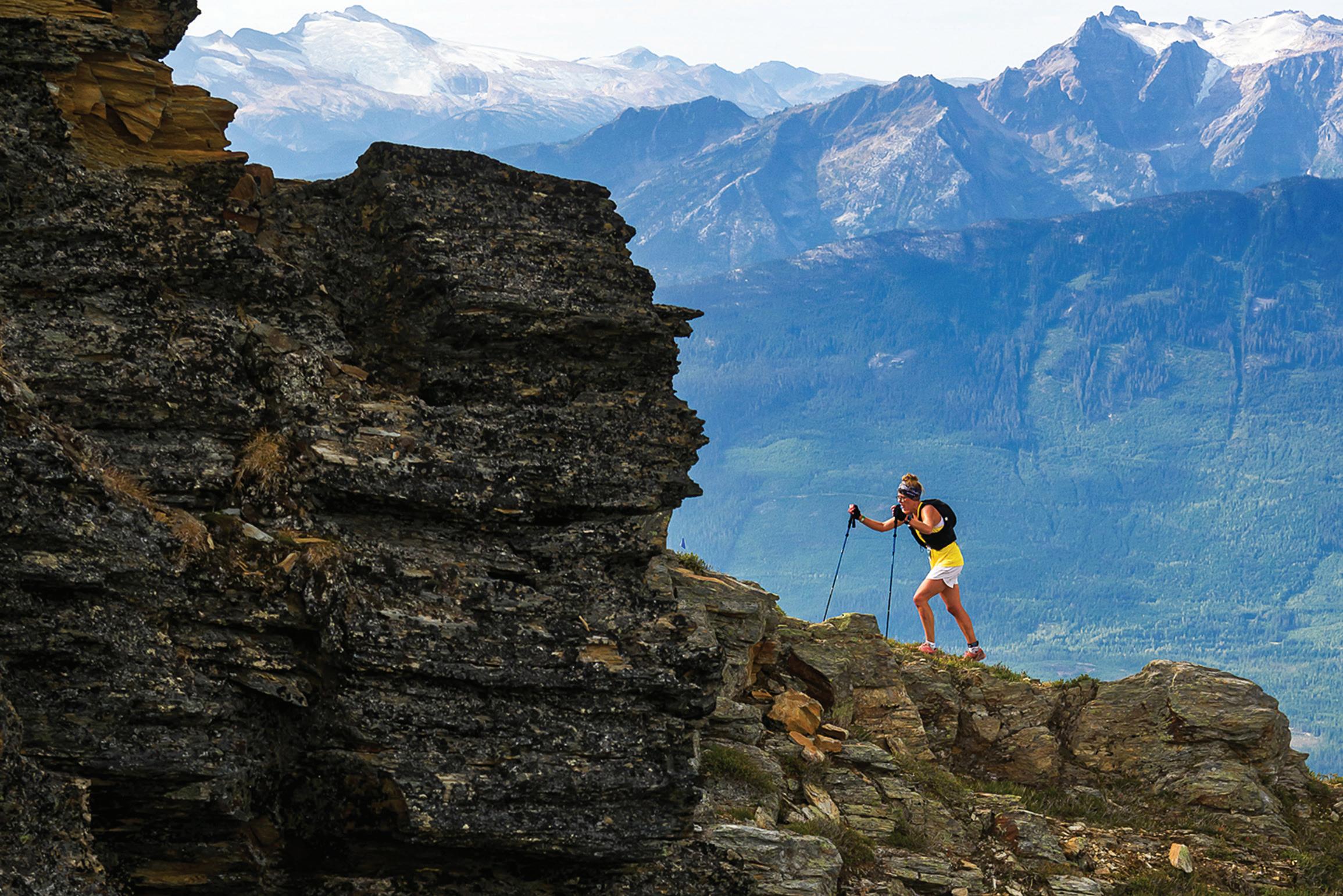
Women participating in ultra-trail running is on the rise, and with it the dominance of Canadians who are featuring on world ranking sites as never before. The 2024 World Trail Majors listed five Canadians in the top 15 (second was France with three and the U.S. with two).
All have recorded impressive results from 50-kilometre to 100-mile races, many in North America, but also in Europe and beyond where they have taken on tough opposition and challenging terrain and conditions. We talked to six of the best about their race experiences, their love of trail, what they eat and their future plans.
GENEVIÈVE ASSELIN-DEMERS
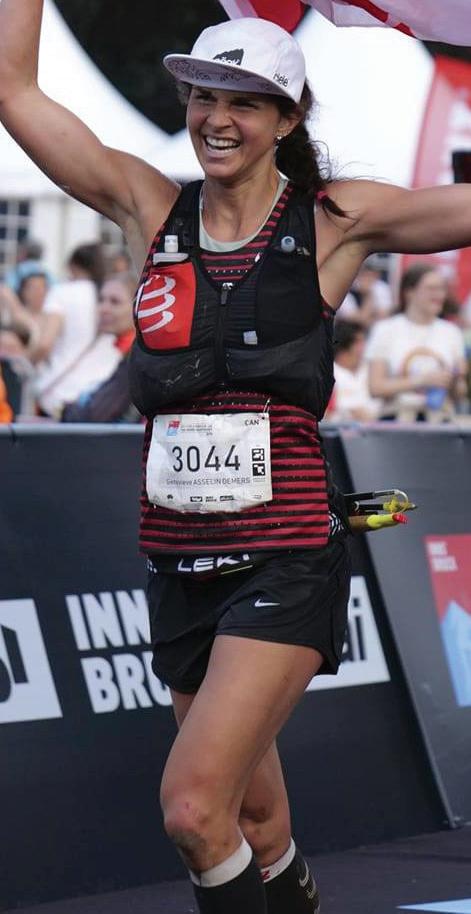
At 36-years-old Geneviève Asselin-Demers has only been running trail races for three years yet has had some prestigious wins. From Repentigny, Québec, she has won the Québec Méga Trail (QMT) 110, Ultra Trail Chic Chocs 40 (UTCC), Ultra Trail Harricana 125 (UTHC), Grand-duc 50 km and Puerto Vallarta by UTMB 100K. Her first venture into international racing was in the 2024 season, when she collected top 10 finishes including the Black Canyon Ultras100K, Madeira Island Ultra-Trail 115 and Ultra Trail Cape Town 100K (UTCT). These finishes projected her to eighth position in the 2024 World Trail Majors rankings.
Her proudest moment? “The QMT 80 with a course record because I was surrounded by my friends, my parents who had come to see me for the first time at a race were at the finish line, my race management, my food management … all the stars were aligned.”
The most memorable moment was at the final of UTCT100K in 2024. “The descent towards the finish, the landscape, my energy and the beauty of the race made me vibrate, and this feeling will be anchored in me and will serve as a lever in the more difficult moments of training or racing.”
Asselin-Demers feels at one with nature when she is on the trails. “It’s a moment with myself, reading the terrain and surpassing oneself. My body, my mind, my heart align when I set foot on the trail.”
This year she plans on running the Desert Rats 100K by UTMB in Colorado, Transvulcania in La Palma (73 km), Swiss Canyon Trail 111 km, QMT 135 and several races in Quebec. “There are so many races, adventures and trips on my bucket list.” She would also like to represent Canada at the next world championships. Favourite trail food/snack: Naäk products suit me and allow me to cross the finish line without too many gastric difficulties. My favourite product is the apricot hydration powder. Favourite place/trail to run: I love running on the national trail in Val St-Côme where my chalet is located, otherwise I love discovering new landscapes during my weeks of travel for competitions.
ANNE CHAMPAGNE
Anne Champagne hails from Lac-Beauport, Québec. The 30-year-old discovered trail running six years ago. “I fell in love with the sport and the possibilities to run super long distances and discover new places,” she says. Her background in triathlon and track—and tackling obstacle courses since she was 12—was a good pre-cursor for her to take on some gruelling ultra trail races.
Placing second at the 2024 World Trail Majors rankings is one of her proudest moments as was winning the Grand Raid des Pyrénées 168 km race. “I realized I had what it takes to achieve big scary things.”
But it is competing in her hometown that is the most memorable. “There's nothing like a finish line feeling and the Québec Méga Trail (QMT)100 miles in 2024 was one of my most memorable trail moments. Achieving my first 100 mile, being in my hometown, seeing all those faces clapping hands and screaming got me really emotional.”
Champagne plans on continuing her 100-mile streak. Last month she competed in the Chianti Ultra Trail UTMB, which is a ‘golden ticket’ for the Western States 2025 and UTMB 2026. Then she will run QMT 135 and the Diagonale des Fous 100 miles in October in the French protectorate, Réunion Island. “I dream really big; I'm working hard to achieve my goals.” Her other bucket-list races? “There is so much! I want to explore the world with running. Western States and Hardrock 100 are my dream races.”
Favourite trail food/snack: I've been having some stomach issues so right now I fuel with SIS's gels and Upika's sports drinks, bringing on all the carbs!
Favourite place/trail to run: Going back to the trails near my hometown. I really love Parc Régional de la Forêt Ouareau. It's where I started trail running and my passion started. •
MARIANNE HOGAN
KELSEY HOGAN
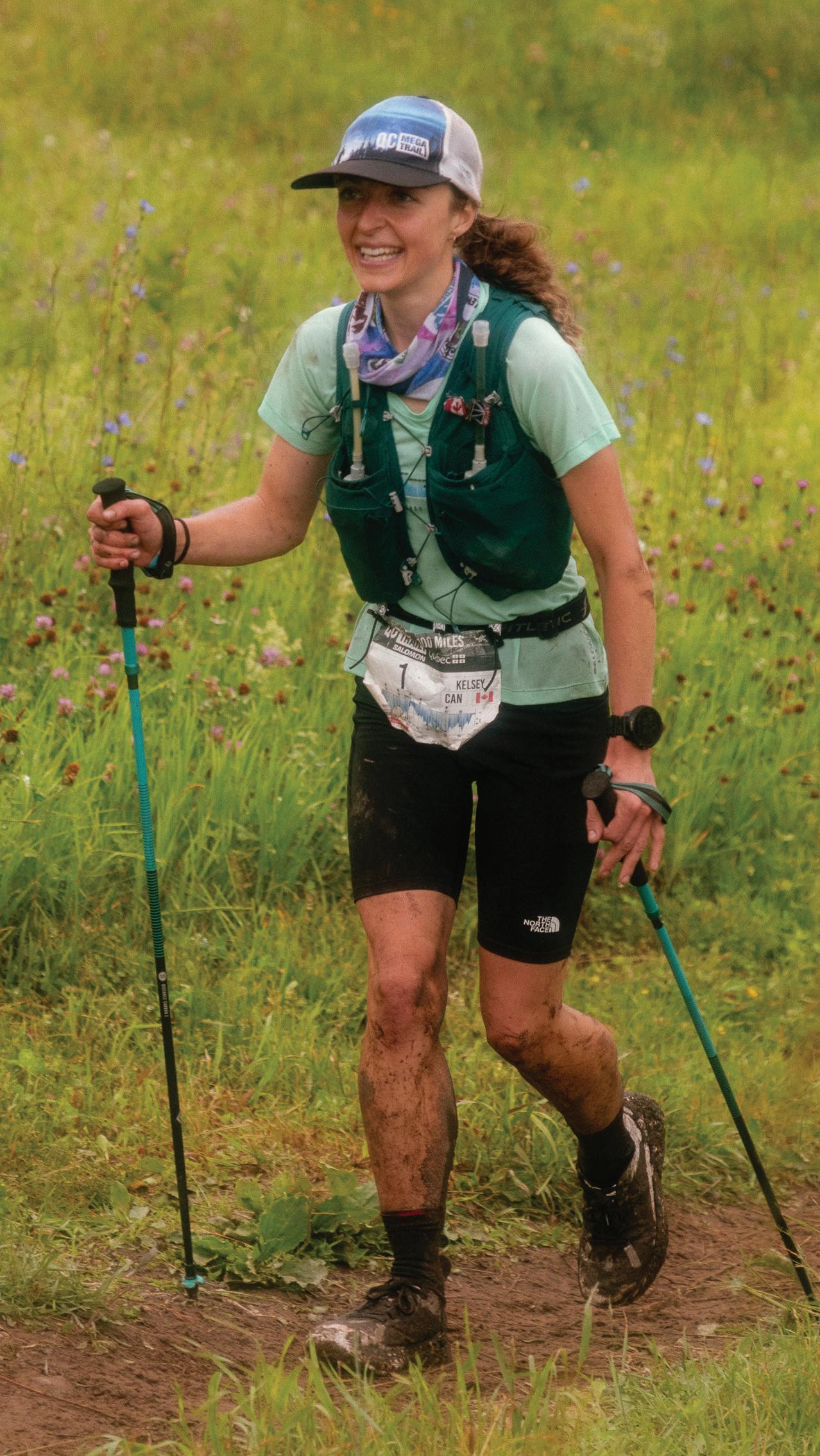
Kelsey Hogan’s fifth place in the 2024 World Trail Majors rankings was largely due to her second place in the Québec Mega Trail (QMT) 100 mile, a race she won in 2023 and 2022. The 29-year-old from Steady Brook, NL—who now calls Fredericton, NB home—is also a two-time finisher of the UTMB Mont Blanc 171 km race and a top 10 finisher in the Diagonale des Fous – 165 km. Closer to home she won the Rompin’ Rockwood 50 km, Saint John, NB in 2024 and was second in the Squamish 50 in 2023.
For Hogan, who started trail running in 2016, the exhilaration of the sport makes it a meditative and spiritual experience. “I am in awe of the natural world and the beautifully wild landscapes. Trail running is a place where I get to explore, to challenge myself, and to stay ever curious about the world around me.”
She will be back competing at Mont Banc again this year with a bigger goal: “putting more pieces of the puzzle together from lessons learned during my 2024 finish.” She also plans to do the QMT 80 kms Canadian Trail Championships in July, and some local races. But Hardrock 100 is the bucket list race. “I'd love to race in those mountains, and I'm intrigued by the energy and history of both Hardrock and the Western States Endurance Run.”
The overnight races are Hogan’s love: “After running all night, surrounded by darkness, I'm always tuned into the first signs of the world waking up: birds twittering, the silhouette of trees becoming defined against a glowing blue-morning sky, and the warmth and energy of a new day.”
Favourite trail food/snack: I crave anything frozen or cold during long races! Smoothies, slushies, ice cream, and popsicles are often top of my list (and tricky to get at aid stations, but my support crew is pretty crafty)!
Favourite place/trail to run: Steady Brook will always be my favourite place to run. I'm excited to run up by the waterfall to the top of Marble Mountain, make the traverse along twisty forested trails with views of the Humber Valley, or explore the trails in Gros Morne National Park.
Marianne Hogan has overcome some adversities in her nine years of trail running, but coming second in the 2022 UTMB 176K in Chamonix with a torn psoas takes the ticket. “The last 45 kilometres had been pure agony, every step a battle. The mix of emotions was overwhelming—disbelief, relief, pride, and sheer exhaustion. It was one of those moments that defined not just a race, but everything I love about this sport: resilience, pushing beyond limits, and finding strength even when there’s nothing left.” Her podium finish was the first for a Canadian woman at UTMB for 19 years.
The 34-year-old, originally from Bedford, Québec, had to take a break from competition when the injury developed into a stress fracture. She made a comeback last year in the same race finishing third, but a fall on the course resulted her completing it with a dislocated finger! (Despite this she placed 14th in the 2024 World Trail Majors rankings).
Hogan is hoping for a less eventful 2025. She is hoping to do Canyons 100K as a golden ticket to run Western States again. (She placed third in 2022, just two months before her UTMB race). And there is that “unfinished business” she says at UTMB.
Her long-term plans would like to include exploring Norway and Argentina. “The idea of weaving a race into a longer adventure there is definitely tempting.” In the meantime, she will continue to explore her love of the outdoors. “Trail running is a way of moving through life. It’s about finding joy in the simplest things: the rhythm of my breath, the crunch of dirt underfoot, the vastness of the mountains. Whether it’s a race, an adventure, or just a quiet solo run, every step is a reminder that we don’t need much to be happy—just a good trail, a bit of curiosity, and the willingness to keep moving forward.”
Favourite trail food/snack: I love the Naäk purees (apple cinnamon), they are so yummy and easy to digest.
Favourite place to run: Any coastal trail where mountains meet the water—that’s my kind of paradise. There’s something special about running with the contrast of rugged peaks and the endless horizon of the sea, especially on a warm summer day.
JENNY QUILTY
JAZMINE LOWTHER
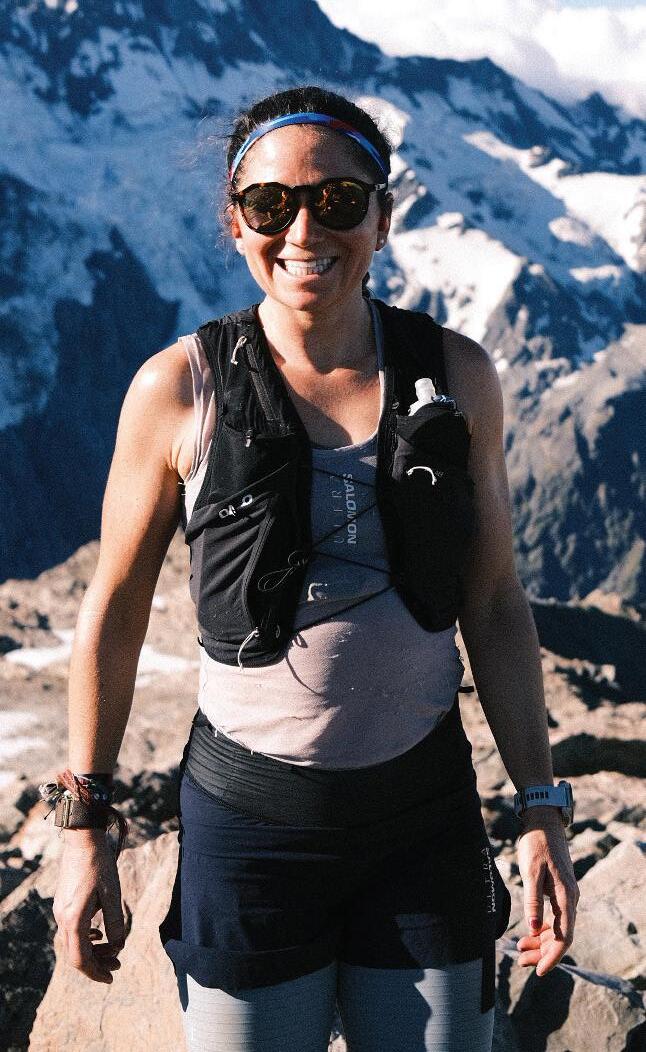
Jazmine Lowther discovered cross-country running when she was five years old and has since been running: “Very casually throughout my life.” Always physically active and competitive this ‘casual runner,’ from Nelson, B.C. turned into an ultra-trail runner six years ago, and now at 32 years is a dominant force in the sport. Her wins include the Ultra Trail Cape Town 100K and Speedgoat 50K, both in 2024, and the Canyon Endurance 100K in 2022, where she set a course record.
Her fourth-place finish in 2022 UTMB World Series Final CCC 100K is a particular highlight as is her podium-placing third at the 2023 TransGranCanaria Classic 128KM. Is there a memorable moment? She says there are a few but one stands out. “During my first 100 miler, it was the halfway point. I really wanted to quit. I felt awful. I was sick. I didn’t have a “why” to go on. My crew, all with their wide eyes, excitement and energy rallied me on to keep going. And thanks to them I finished the full 100 miles.”
Ultra-trail running takes a lot of mental strength, which is one of the reasons Lowther likes it so much. Her background in alpine climbing and back country skiing instilled a love of the outdoors and adventure—a natural fit for trail running. “Trail running means a lot to me. Its mental health, its meaning, its exploration, its challenge, its connection. It makes me a better human being.”
She has two major races in sight for 2025—Canyons Endurance 100K in Auburn, CA in April and the 100-mile UTMB in Chamonix, France in August. But says: “The race schedule is rolling out as it comes.” It could also include Western States, Speedgoat and the World Championships.
Favourite trail food/snack: Naak waffles on training days. They just make you smile like a kid again, always delicious.
Favourite place/trail to run: Everywhere. But if I had to pick one, Switzerland has been the most magical.
Jenny Quilty has experienced trail running from many perspectives—as an athlete competing in some of North America’s most challenging races, and as a coach supporting and helping others reach their goals. At 36-years-old she has 15 years of trail running under her belt, 10 as an ultra runner.
From Chilliwack, B.C. she placed first, setting a course record, at the 2021 UTHC 125 in Québec, second at the Canadian Death Race the same year, won the Squamish 50 and placed second in the Chuckanut 50k (Bellingham, WA) and the Mammoth Trail Fest 50K in 2022.
Her proudest moment was running her first 100-mile race, the Doi Inthanon in Thailand in 2022, where she was the first female. The race was a real stand-out for her particularly the 20 hours of running through the jungle. “I remember running into the night with my headlamp, just looking around the jungle, hearing the sounds, and thinking it was so incredible to be there, by myself. It was so incredible to get to follow flags through this place and have the support needed to be there safely, essentially wandering through the jungle for 100 miles.”
Quilty’s win enabled her to capture a golden ticket to the 2023 Western States 100-mile race. After placing 11th at that race, she has a goal: “I would love to go back and place top 10.” In 2024 she ran the Gorge Waterfalls 100K and the Black Canyon Ultras 60K. This year she has her sights on Diez Vista 50K (Port Moody, B.C.), QMT 50, and Pine to Palm 100 mile in Southern Oregon.
She says she has learnt a lot about trail running. “It has allowed me to learn about running and endurance, and all of the different components of successfully traveling pretty far by foot. I love how training for races brings up different speeds, terrain, and challenges. Trail running is sort of like 10 different sports in one, so I find there is always a new skill to develop or build upon.”
Favourite trail food/snack: I use gels. It's not the most exciting or glamorous but they are effective and chewing while running is just too hard!
Favourite place/trail to run: Where I live. We moved recently for access to the trails in the Chilliwack area, I truly wouldn't want to be anywhere else.
THE MULTIPLE MARATHON CHALLENGE
Mike Hanson and Dave Morin take on 10 marathons in 10 days for three charities
BY SCOTT CRUICKSHANK JANA MIKO
A Calgary, AB writer covering all levels of sport for websites, newspapers, and magazines all over Canada.
SCOTTCRUICKSHANK BYCRUICKSHANK
With the best of intentions, Mike Hanson and Dave Morin concocted an outrageous challenge.
The Calgary runners have announced plans to complete 10 marathons in 10 days in 10 provinces in May and, in the process, raise $1 million for Autism Aspergers Friendship Society, KidSport, and Big Brothers Big Sisters.
Despite the whopper of an undertaking, they are optimistic—yet modest.
"You don't have to be an elite athlete," says Hanson. "You just have to work hard and plan. We're just two regular guys."
Regular, in the case of these gents, is a relative term.
Hanson, 44, tugs on his sneakers nearly every day, hammering out 170 kilometres per week. With family and work commitments, he rises at 3:00 a.m. to fit trots into his busy routine. (The excursions are so early that Strava logs them as night runs.)
In September, for the heck of it, he whipped through marathon-length outings – 42.2 kilometres – on five consecutive days. Hanson says he could have made it through six, but he "didn’t feel the need to push any harder."
And Morin? Well, in the wee hours one day last summer, he decided to head to the neighbourhood track. There, he knocked out 250 laps—yes, 100 kilometres. And rather than rant about the monotony of the ordeal – in which he paced the same direction for all 16 hours – he smiles and talks about the "cool" experience of running while the sun was rising and still making strides when the sun started to set. "These different challenges appeal to me."
No kidding. During a recent six-month stay in New York City, Morin dashed down every street in Manhattan, an accomplishment that earned him a letter of recognition from Mayor Eric Adams.
"Running for me has always been a mix of adventure as well as the athletic side," says Morin, 33, a management consultant at McKinsey & Company. "I've enjoyed being able to dive into that."
So, it was no surprise when Hanson cooked up this 10-in10-in-10 escapade four years ago, that Morin instantly pledged his participation. "I joke that I don't think I actually finished the last sentence (of the pitch), and he was already in," says Hanson, laughing. "He's not scared to challenge himself."
Despite the concerns of others – especially when it's made clear that the mission is 10 marathons in 10 straight days – they remain wholeheartedly committed.
"Runners look at it like, 'That's really, really, really, really hard, but I could see it being done,'" says Hanson. But non-runners?
"My dad is worried that I could die. People are like, 'You can't physically do that. That's not humanly possible. That is insane.'"
Adds Morin: "It's ambitious and a little audacious and a little bit crazy, but within the realm of consideration. Both Mike and I get excited about big goals, about pushing ourselves, about seeing what's possible. And having the chance to pair that up with a big impact? It was an easy yes."
Applauding the charities for empowering youth through mentorship, inclusion and community, the buddies point out that the connections are personal.
When Hanson's twin sons, Tyler and Cole, now 14, were diagnosed with autism, he said they received a lot of support. Aware that others get left behind, he wants to pitch in.
"Autism Aspergers Friendship Society is such an amazing organization," says Hanson, director of field operations for Cenovus Energy. "I've seen the impact."
We fully expect to be in pain for a good portion of this...
Having grown up immersed in a wide range of athletic pursuits, they have soft spots for KidSport, which helps to reduce financial barriers for kids who are eager to play sports.
Morin, who volunteered for Big Brothers Big Sisters for nearly a decade, emphasizes the increasing reliance on these charities. He adds that the 10in10in10.ca website provides details for individual donations and corporate sponsorships.
"If we can help, that's more gratifying than finishing the 10 marathons, knowing that kids out there are getting access to these services,” says Hanson.
Meanwhile, the pavement awaits.
Logistics settled, charities notified, campaign established, training miles banked, the challenge kicks off May 16 in St. John's, N.L.
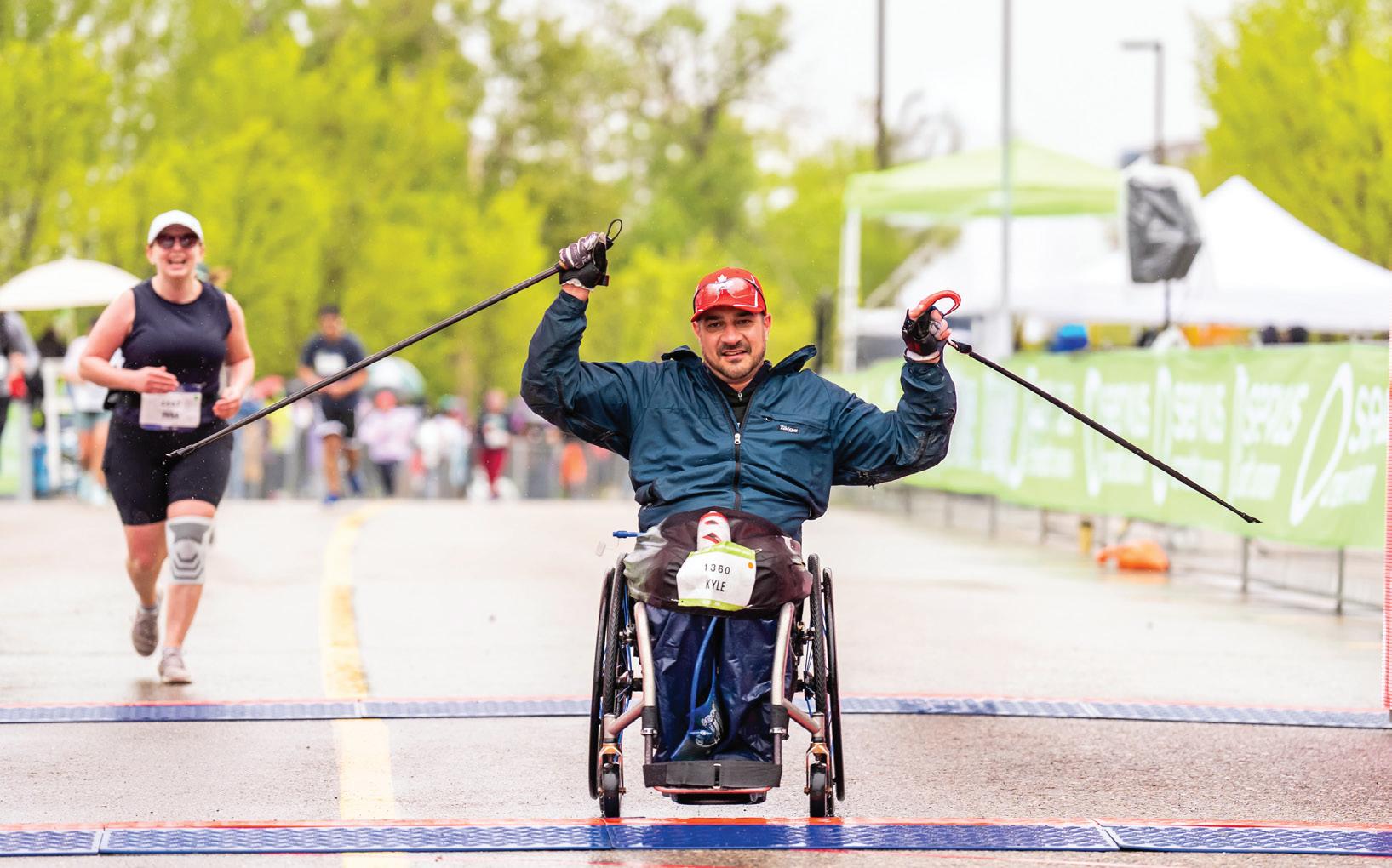
Then, via highway and air travel, they will drop into Halifax, Charlottetown, Fredericton, Montréal, Toronto, Winnipeg, Regina, Vancouver for do-it-yourself jaunts, before concluding May 25 at the Servus Calgary Marathon, the only sanctioned event of the tour.
They are aiming to run 4 hours 30 minutes for all the marathons, planning to start every day at 7:00 a.m. and, of course, finish together. Closely monitored will be nutrition, hydration, and rest. Medical practitioners are lined up in each city, so, if necessary, the sore-footed heroes can arrange same-day treatment.
"We fully expect to be in pain for a good portion of this," says Hanson. "I'm sure every step is going to hurt during the last several marathons, but it's not the first time we've run like that."
However, it's anticipation, not dread, that the friends are feeling in the lead-up to the venture. Energized by the difference-making potential, they are stoked.
"We're winging it," says Hanson, "so we're interested to see how this goes. This could get really big—we're hopeful it does."
TURNING CONFIDENCE INTO A SUPERPOWER
Ultramarathoner Sandra Mikulic is on a running streak with the ultimate goal of completing her first 100-mile race
BY JESSICA NATALE WOOLLARD STEPHANIE LUCILE PHOTOGRAPHY
An award-winning freelance writer and communications professional based in Victoria, B.C. JRWOOLLARD
On January 1, 2019, Sandra Mikulic took her first steps toward a new goal: running or walking five kilometres a day, every day. She vowed to maintain the streak as long as she could.
The 43-year-old from Kelowna, B.C., had started running two years before. The streak, announced to her 300 followers on Instagram, was a way to prove to herself that she could set an ambitious objective and achieve it.
“I was somebody who didn't finish anything like projects or my university education. I quit,” she reflects.
“I needed my own School of Hard Knocks, so I created it for myself.”
Today, more than 2,200 runs later, Mikulic’s streak continues, and with countless kilometres under her belt, her capacity has expanded exponentially. In 2024, she ran two 100-kilometre ultramarathons; this year, she is training for one at 100 miles.
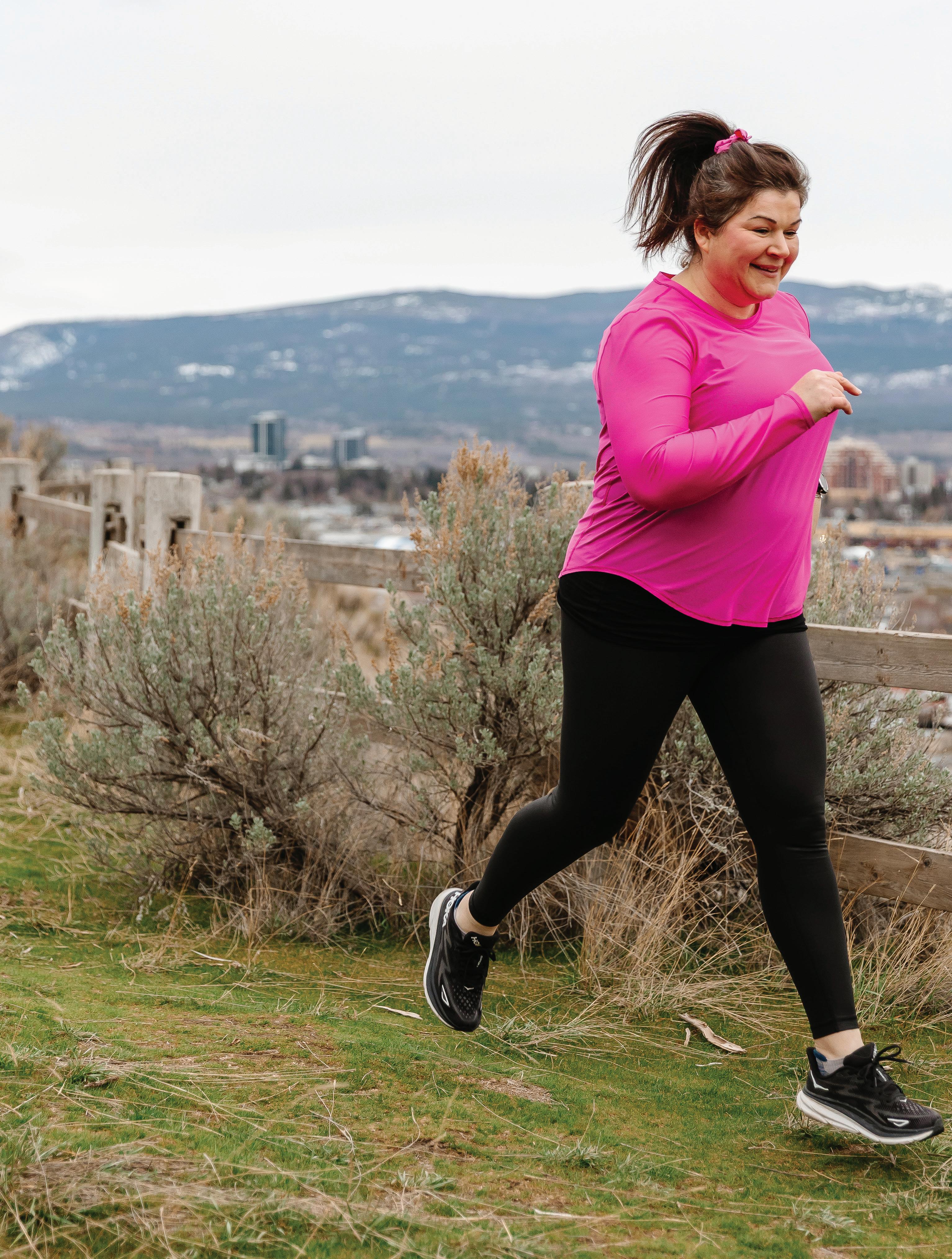
Commitment to the streak changed Mikulic’s life. Though she continues to work full-time as a financial advisor at a bank, her 300 Instagram followers ballooned to more than 100,000. She publishes a magazine, Run Your Life, for runners of all shapes, sizes and abilities. She hosts empowering travel retreats for women, designed for people who, according to the website, love to “hike a 5K and then indulge in a donut.”
“When you ask me why I do this, it's because I keep proving to myself that I can,” says Mikulic. “I can create a magazine. I can create life-changing retreats for women that women will love. I can complete a 100-kilometre race.”
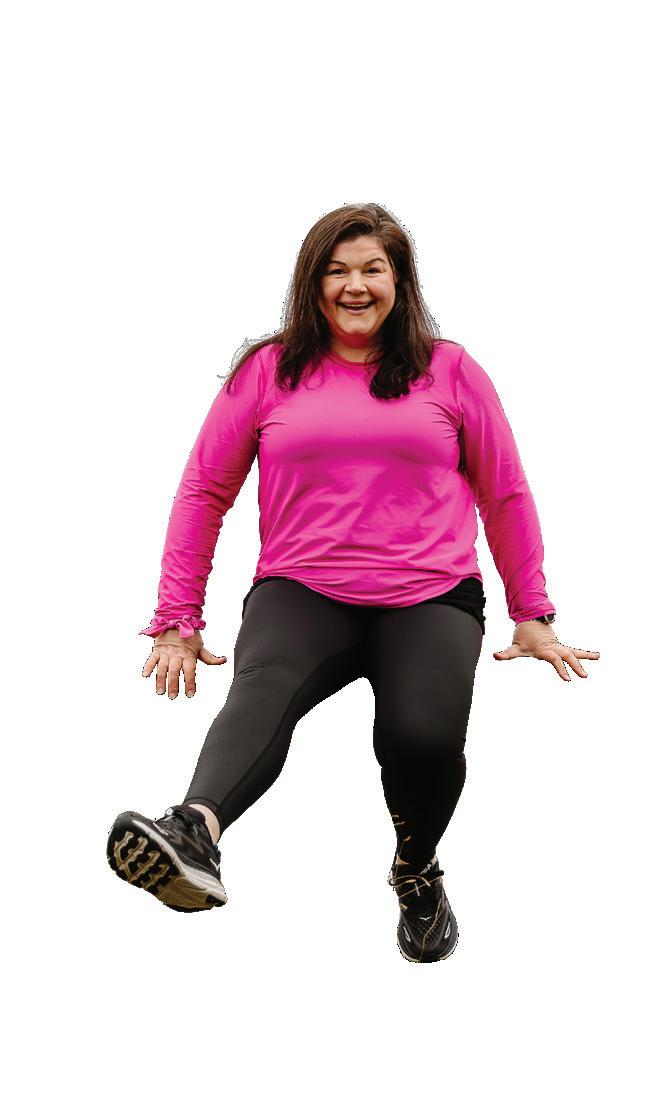
Often photographed in bright pink running gear with her long brown hair in a floppy bun atop her head, Mikulic says her perception of what a runner should look like has changed since she started logging kilometres every day. She celebrates what a body can do without aiming for thinness.
“Running is about enjoying the movement of your body,” she says.
Her focus on the body’s potential appeals to her followers, who are of diverse sizes—from 0 to 10 to 18 and beyond.
She is motivated by “the Sandras sitting in their living room, wondering ‘will I ever be able to do that? Will I ever be able to be on that start line and do I deserve to be? Do I deserve to cross the finish line?’
When you ask me why I do this, it's because
I keep proving to myself that I can.
What running hasn’t done is change Mikulic’s size—and that’s okay with her. At 5’11’’, the 50-year-old runner weighs in at 250 pounds. Unlike many people so strongly committed to fitness, Mikulic is not motivated by weight loss. She knows what she needs to do to lose the weight, but doing so isn’t her objective.
“Before, I thought I couldn't do any of these things, and I would walk around with these self-debilitating thoughts in my head that were so damaging,” she explains, noting she’s faced mental health challenges throughout her life—childhood trauma, postpartum depression and anxiety.
“Despite being 250 pounds, I've proven over and over again that you do not need to be small to complete things; you do not need to be smaller to finish an ultramarathon. You don't. It's just about consistency and building up muscle memory in your body so that your body knows, ‘we do this.’”
“Yes, you do!” she states definitively.
This year, Mikulic will host three Run Your Life retreats, including two in Croatia, where she lived before immigrating to Canada as a child with her family. Her four adult children will join her along with a sold-out group in Dubrovnik in April.
The North American retreat will take place in Arizona in October, the week before she runs the Javelina Jundred (pronounced “Havelina Hundred”), a 100-mile race through McDowell Mountain Regional Park, north of Phoenix. She’s scheduled a few recovery days between the retreat and the ultramarathon to prepare herself to face her longest distance yet.
The habits she formed and maintains through her streak have helped her complete lengthy and challenging training runs, some lasting 30 hours with rests in between.
“You are the only person who's going to get you through 100 miles while you're in the dark in the desert,” she explains.
What makes long-distance running particularly amazing to Mikulic is that she—a middle-aged, plus-size financial analyst— will run the same course as elite athletes.
“There's no other sport where you could actually cross paths by running a loop and see that person who's pacing for first place,” she says. “You cannot be on the same start line as an Olympic gymnast; you don't even get to the gymnasium. You can't be on the same start line as an Olympic 100-metre runner.”
“That's the beauty of this sport,” she continues. “I share the same dirt as the winners. Our sweat falls in the same dirt. There are still gatekeepers, but the gates are slowly falling down. Don't wait to start tomorrow. Start with what you have today.”
THE ABBOTT WORLD MARATHON MAJORS
A guide to your Six Star journey
BY EMILY MEYER BANK
OF AMERICA
CHICAGO MARATHON,BOSTON MARATHON, LONDON MARATHON EVENTS
Freelance writer, fitness and travel enthusiast in Calgary, AB. EMILY.MEYER.TRAVELTALES EMILYMEYER287
Known as the most prestigious marathons in the world, the Abbott World Marathon Majors represent the ultimate bucket list challenge—earning the Six Star Medal. Since its inception in 2006—with founding marathons London, Boston, Berlin, Chicago and New York City—over 20,000 runners have completed all six major marathons to receive their prized Six Star Medal. In 2013 Tokyo was added and this year, there is something special. A new race has entered the ranks—Sydney Marathon.
Even with the addition of a seventh race, the Six Star Medal remains unchanged. The plan? Two more races will be introduced in the coming years—potentially Cape Town and Shanghai— setting the stage for an even more formidable challenge—the Nine Star Medal. But until then, let’s explore the Abbott World Marathon Majors as they stand in 2025.
LONDON, ENGLAND | APRIL
LONDON MARATHON EVENTS
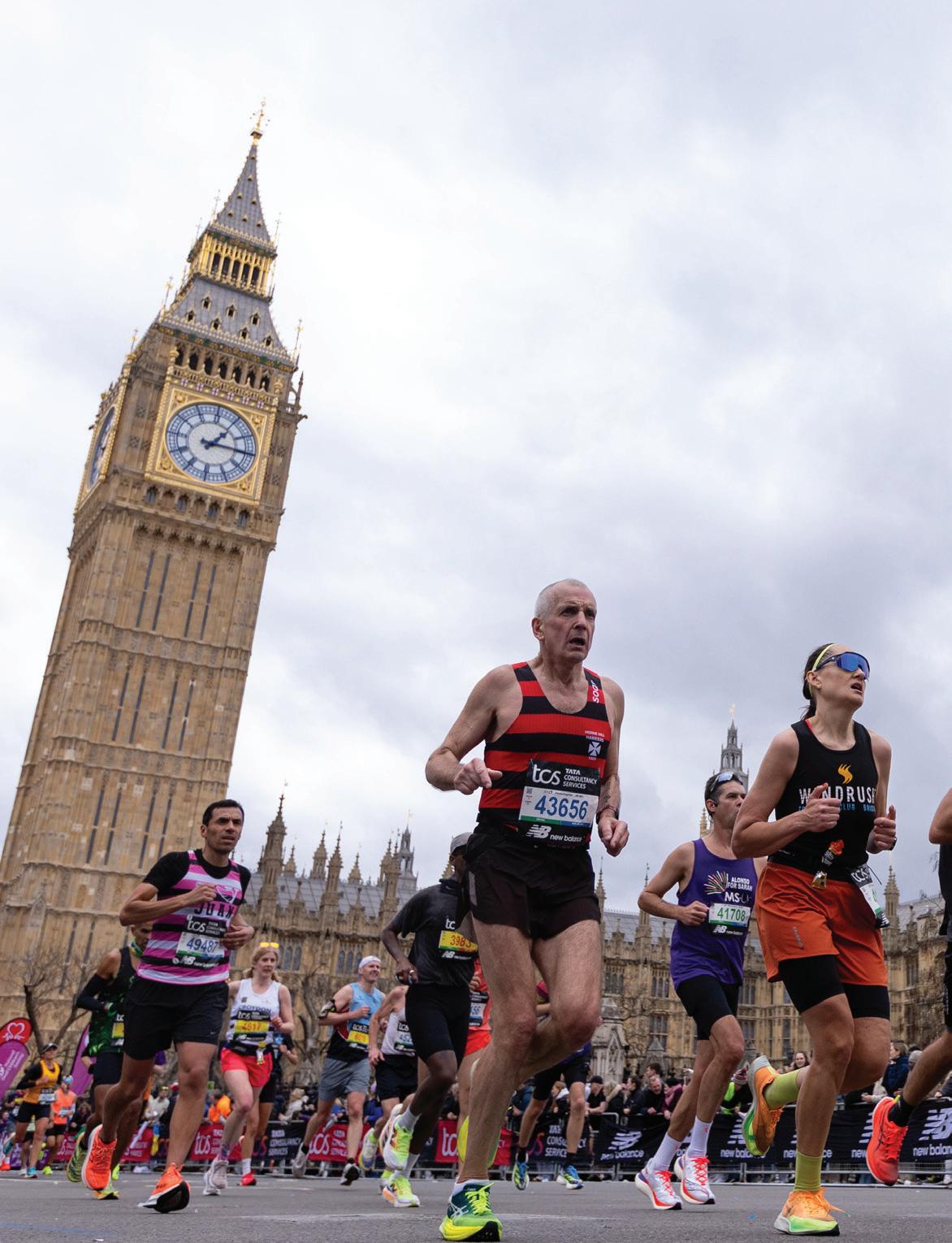
It’s not hard to be convinced of London’s charm. It’s a diverse city with something for everyone. From Michelin Star restaurants to spectacular street markets, world-class musicals and plays to worldfamous sites like Buckingham Palace, Big Ben, Trafalgar Square and Tower Bridge, London has a lot to showcase.
And then there is the London Marathon. One of the most popular marathons in the world, the idea for the marathon was actually born in a pub when some members of a local running group were reminiscing about the New York City Marathon and believed London deserved one too. Now, more than four decades later, the London Marathon is the world’s largest one-day fundraising event, having raised more than 1.3 billion pounds (approximately $2.4 billion CAD) since its inception in 1981.
The people of London know how to make this event extra special. There are roaring crowds the entire way along the route, and locals hand out beer instead of water in the East End. Then there are the costumes. Creative and impressive, runners dress up in all manners of attire from Superman to Big Ben and even a pint of beer, you’ll see just about anything on the race course.
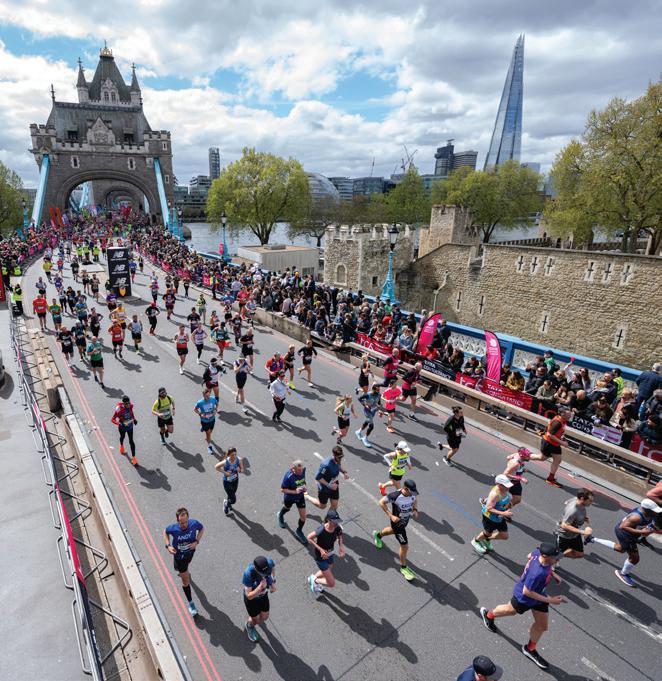
The route itself is a spectacular distraction from the hard work at hand. Beginning in Greenwich Park, runners must test their restraint as the first few kilometres are downhill. Runners pass over the Tower Bridge and run along the Thames River past London classics like Big Ben, the Parliament Buildings, and the London Eye. Once beyond St. James Park, they lay eyes on the finish line—the Mall in front of Buckingham Palace. •
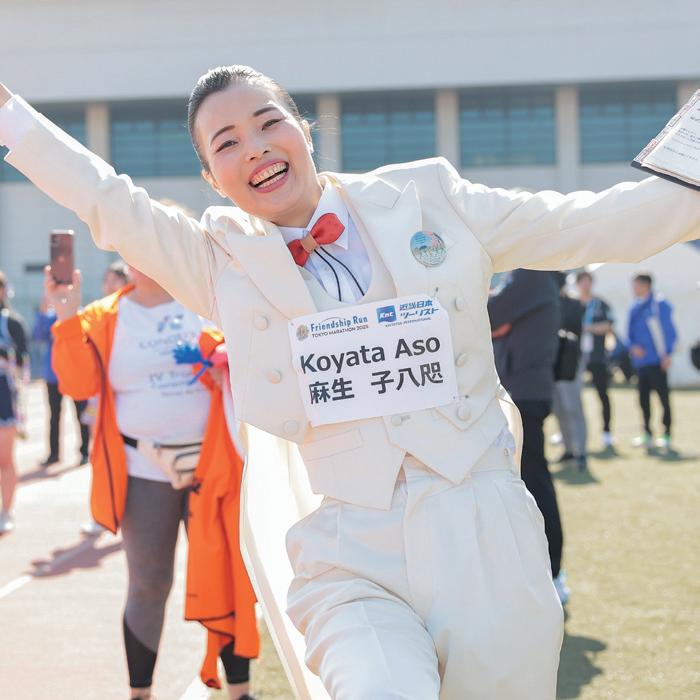
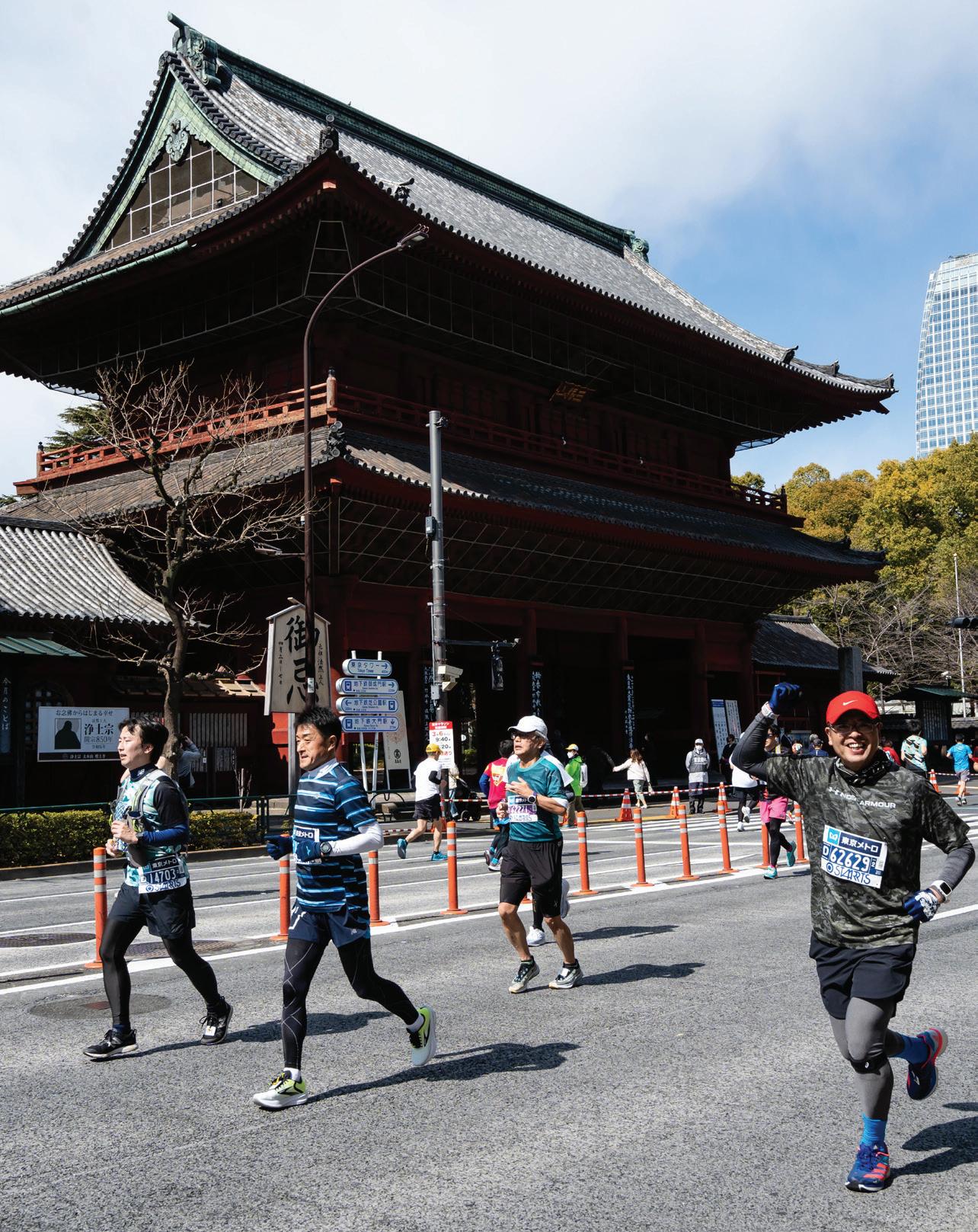
Tokyo is arguably one of the most fascinating cities in the world. Boasting the title of most populous city on earth, the metropolitan area of Tokyo is home to more than 37 million people. With a rich culture and a striking contrast between ancient temples and modern skyscrapers, deep-routed traditions and sophisticated technology, Tokyo is a city that exudes excitement. So, what better place to run a marathon?
There are countless reasons that the Tokyo Marathon should be high on your list. For one, it’s one of the most technologically advanced marathons, with live tracking, results, and cutting-edge health measures for runners. And for a race that hosts nearly 40,000 runners, the organization and logistical precision is bar none.
Beyond the logistics, the Tokyo Marathon is something to behold. Millions of spectators take to the street, some donned in costumes, many holding homemade signs, all cheering enthusiastically as they spur on the runners.
Live performances add to the atmosphere as runners pass through Tokyo’s most impressive districts. The relatively flat route begins close to the world’s busiest train station— Shinjuku Station. Course highlights include Sensō-ji Temple, the oldest Buddhist temple in the city; Tokyo Skytree, the tallest freestanding structure in Japan; and Ginza, an upscale area known for luxury shopping.
BOSTON, U.S.A. | APRIL
COURTESY BOSTON MARATHON
One of America’s oldest cities, Boston is steeped in history. There is a vibrant, almost romantic “true American” atmosphere about Boston, which also boasts two of the top universities in the world— Harvard and MIT. With diverse neighbourhoods, a sports culture in a league of its own, and a string of parks and green spaces for all to enjoy, Boston is a city one easily falls in love with.
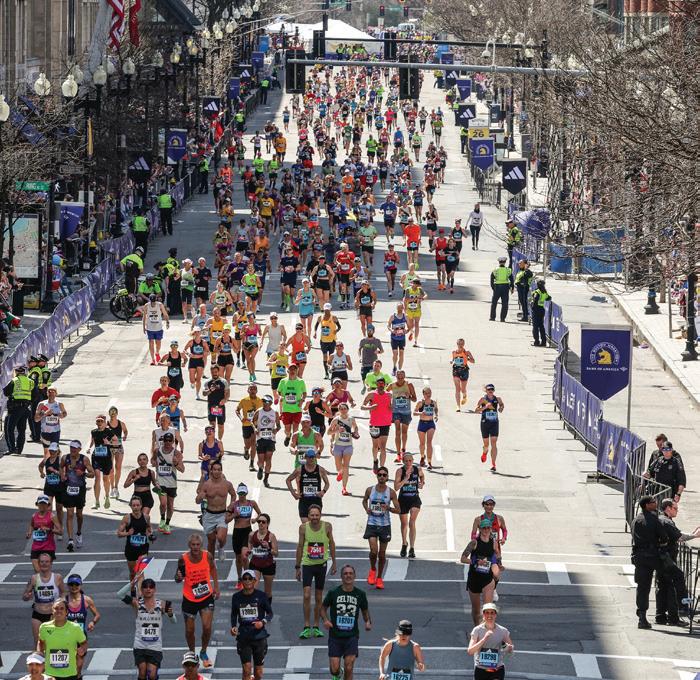
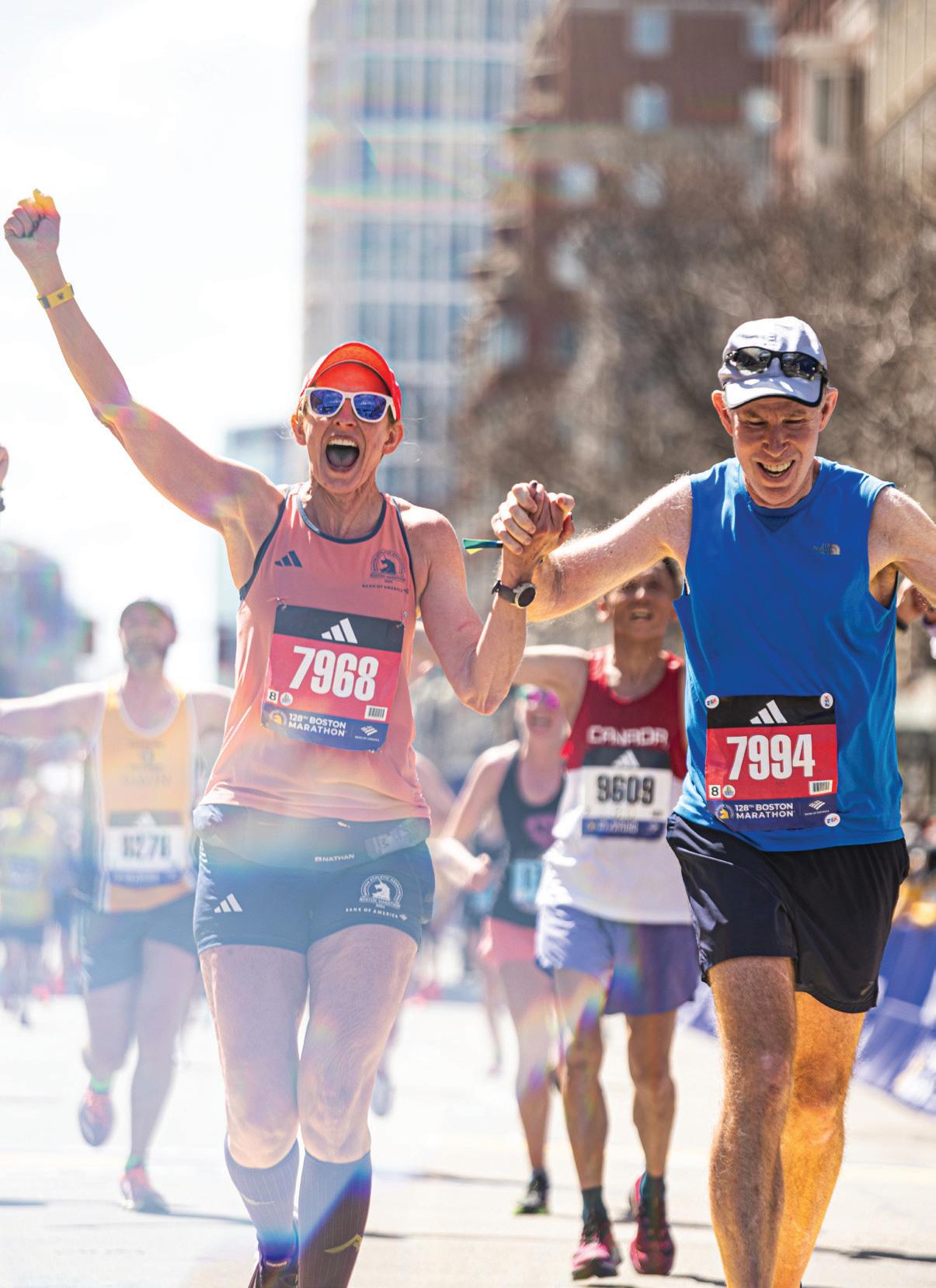
It’s only fitting that a city with such history also takes the crown for oldest annual marathon in the world. First held in 1897, the Boston Marathon has become iconic, attracting runners from 120 countries and all 50 U.S. states.
Despite the prestige and long history, Boston is not for the faint of heart. It’s considered one of the slowest marathons to complete, partly due to the unpredictability of the weather and the hills. Weather in the past has varied from freezing rain, strong winds to extreme heat. From kilometre 24 to 34, runners must contend with the Newton Hills, the last of which is known as Heartbreak Hill. But once they have completed the hills, they are two-thirds of the way done and the growing crowds have enough enthusiasm and support to will the tired runners across the finish line on Boylston Street.
One notable thing. Boston is a net downhill course—meaning the total descent is greater than the elevation gain. Because of this, world records can not officially be made on the course.
BERLIN, GERMANY | SEPTEMBER
COURTESY BERLIN MARATHON
It’s hard to imagine that a city as vibrant and culturally rich as Berlin could have a recent history as dark and complicated as it does. Visit it today and you’ll still see the remains of WWII, which ravaged the city. Holes from bullets and shrapnel have been left in the facades of buildings as a reminder of those perilous days.
As has a small part of the Berlin Wall, which stretched 155 kilometres, separating East and West Berlin for nearly 30 years beginning in 1961.
Today, Berlin is a hub of culture and creativity. It’s a city that never sleeps with a legendary nightlife, thriving art sphere, and impressive food scene. The city also happens to be a pretty perfect place to run your first marathon.
Known as being flat and fast, the route doesn’t have much elevation change and with temperate weather in late September, runners aren’t exposed to the extremes they are in some of the other major marathons.
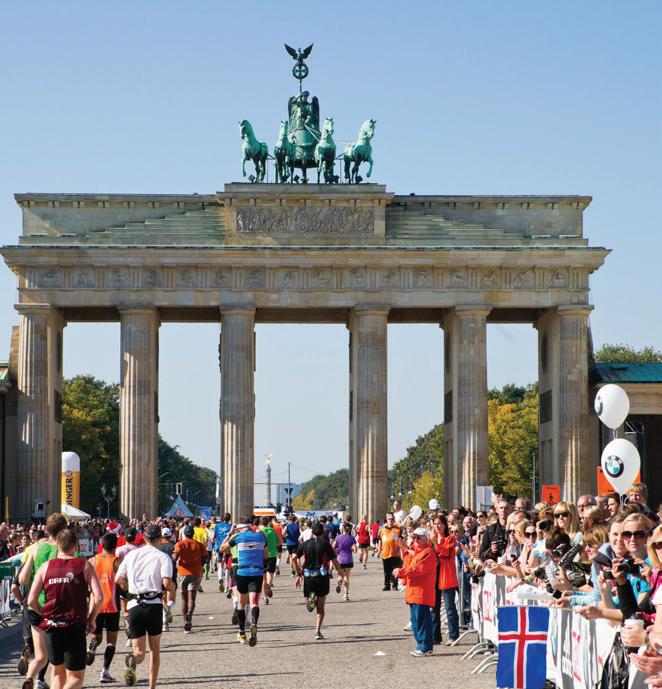
The Berlin Marathon is also the perfect opportunity to take a sightseeing tour of the city. Beginning west of the Brandenburg Gate, runners pass sights like the Victory Column, the German House of Parliament and Checkpoint Charlie. After 42.195 kilometres passing through the boroughs of Berlin, runners run through the iconic Brandenberg Gate before crossing the finish line.
CHICAGO, U.S.A. | OCTOBER
BANK OF AMERICA CHICAGO MARATHON
So much can be said about Chicago. It’s a city where grit and glamour have coexisted pretty much since the day it was founded. During prohibition, infamous gangster Al Capone called the city home. Then, there is the long history of music—Nat King Cole, Chaka Khan, Jennifer Hudson, and Sam Cooke are just some of the legends that came out of the windy city.
Chicago is a city full of character, with stunning architecture and an energy you can’t recreate. Go for the deep-dish pizza, watch a ball game at Wrigley Field, and stay for one of the world’s most-loved marathons.
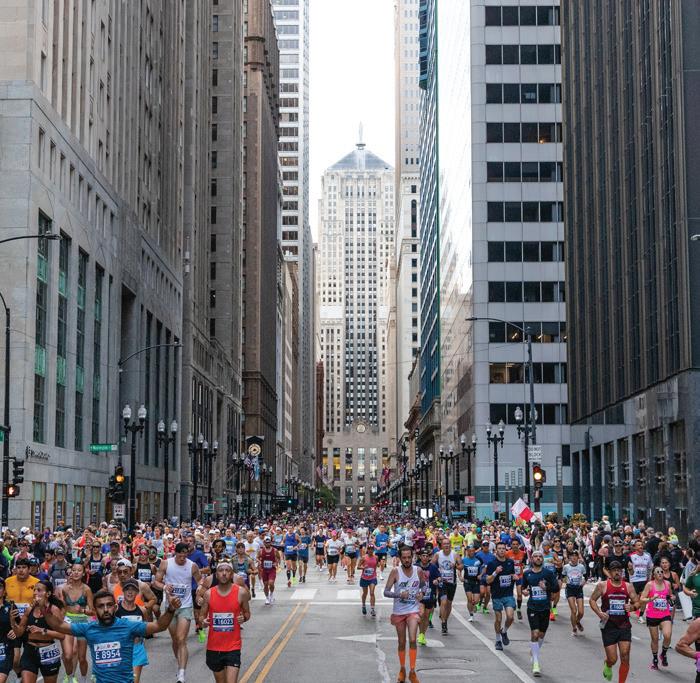
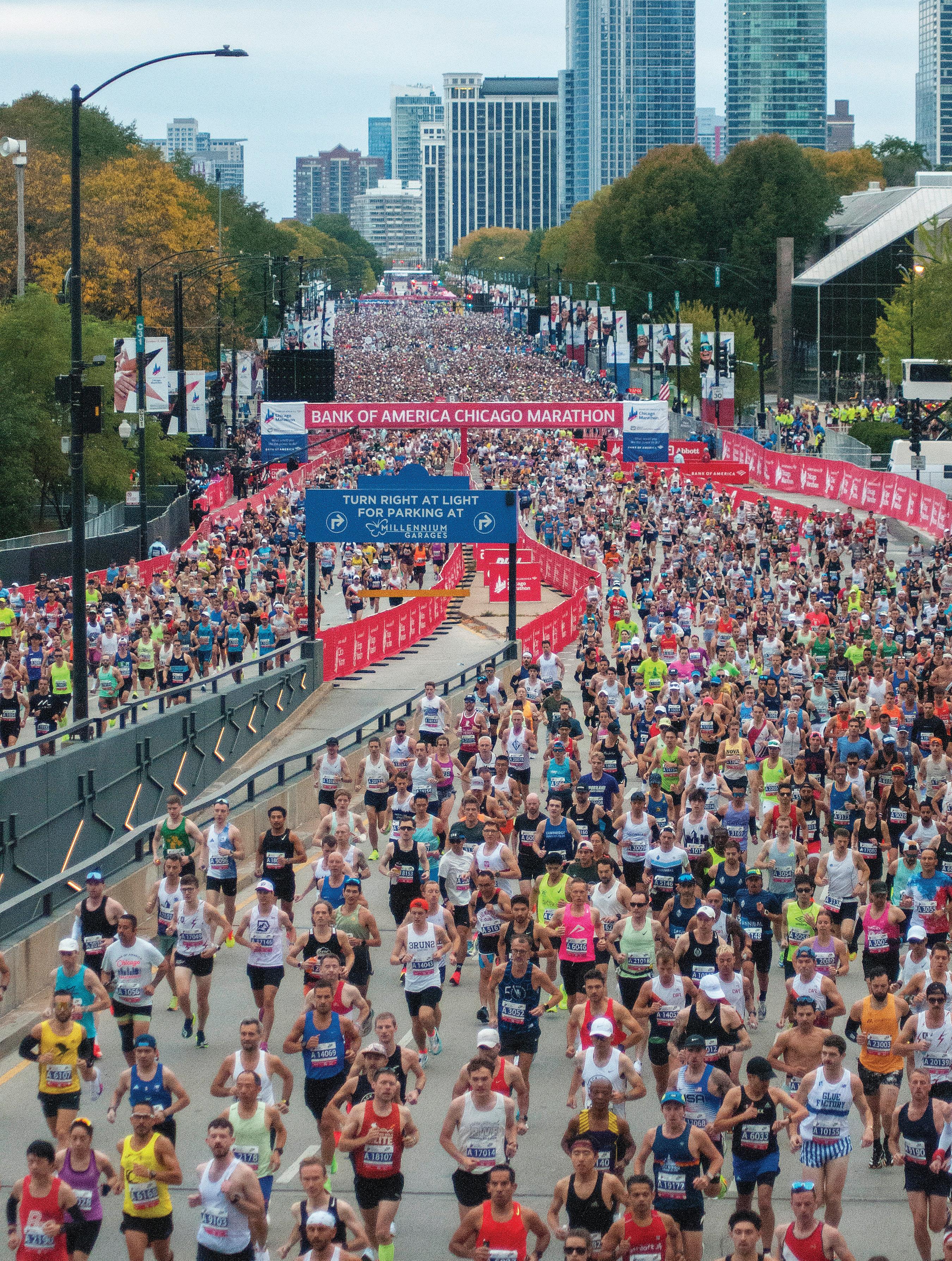
Every October, the Chicago Marathon welcomes more than 50,000 participants on an epic tour of 29 of the city’s unique neighbourhoods. Starting and ending at Grant Park, the route is truly something to behold. After running under the shadows of skyscrapers downtown, runners experience the vibrancy that is Chicago. They pass through Boystown—the city’s LGBTQ+ district—Greektown, Little Italy, Chinatown, and Pilsen, where mariachi music fills the air.
The cultural richness of Chicago is reason enough to participate in this marathon. But, if that’s not enough, the Chicago Marathon route is flat and currently holds the record for fastest marathon time for both men and women at 2:00:30 and 2:09:56 respectively. So, if you want a gentler initiation into the Abbott World Marathon Majors, Chicago may be the perfect race for you. •
NEW YORK CITY, U.S.A. | NOVEMBER
NEW YORK ROAD RUNNERS, SCOTT MCDERMOTT
New York, New York. What can be said about New York that hasn’t already been sung about by some of history’s greatest lyricists? It’s just one of those cities that everyone needs to experience at least once in their lives. There is an energy about the place that is unmatched. The buzz of traffic, the rush of the people, the mixture of cultures and traditions all exist in unison within a city defined by high fashion and big business.
Millions of people from around the world flock to the city that never sleeps to live out their own big-city fantasies. They want to grasp a piece of the excitement. While New York City is known for its shopping, sports, food, and chaos, the New York City Marathon allows people to see the city differently.
It’s almost no surprise that the New York City Marathon is the largest in the world, with 1.2 million runners finishing the spectacular race since its inception in 1970. Runners get to encounter the best of NYC and its citizens. Each year, approximately two million spectators take to the route to cheer on runners and offer encouragement as they tackle the trying course.
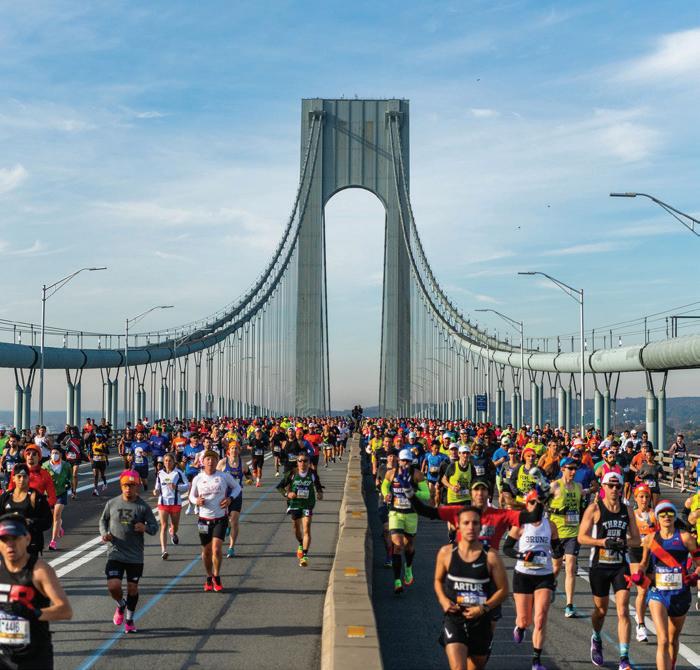
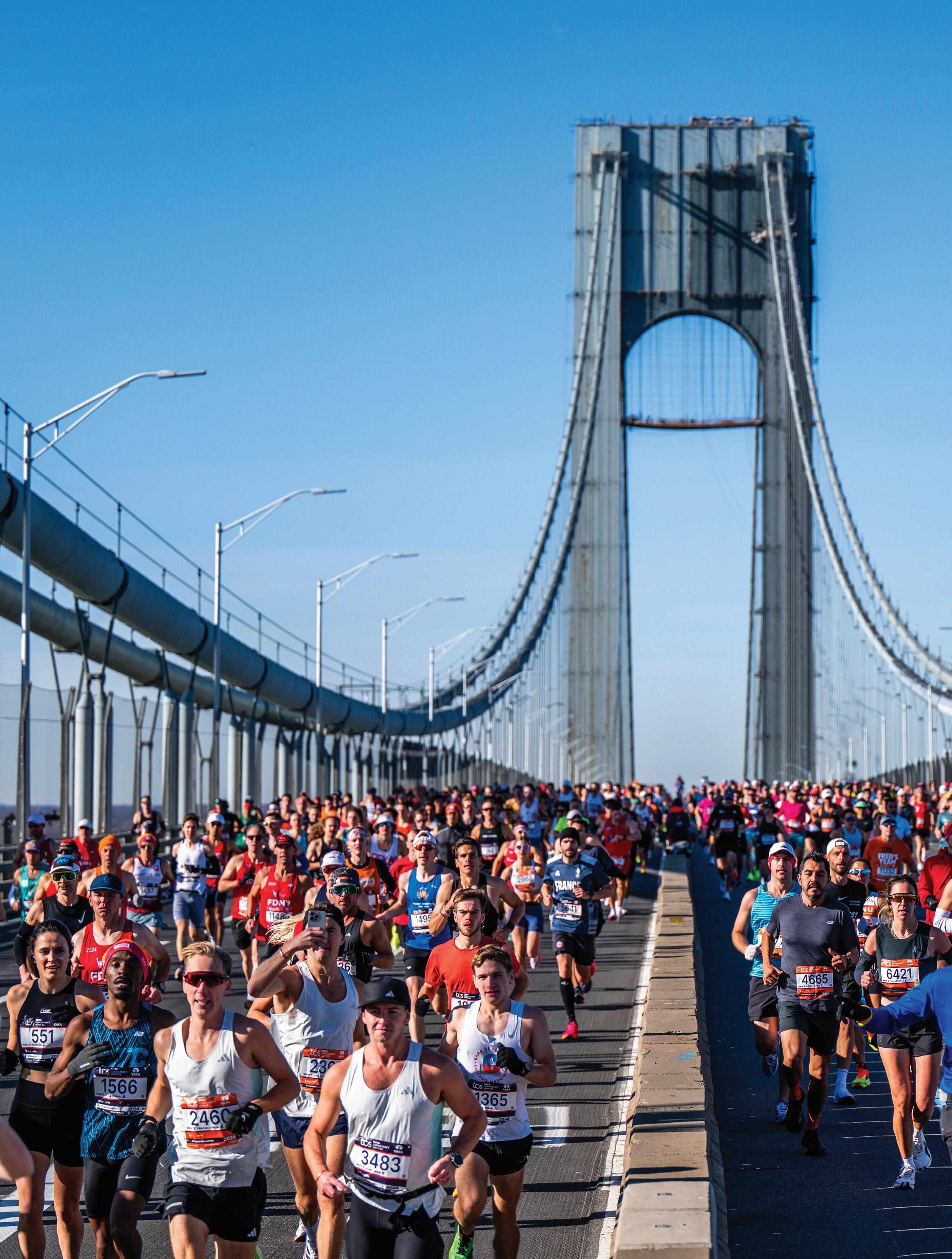
Despite the electric energy and unparalleled atmosphere, runners beware. The NYC Marathon is thought to be the toughest of the majors. Starting in Staten Island, runners cross the spectacular Verrazano-Narrows Bridge before facing a multitude of hills, over five bridges and through the city’s famous boroughs before crossing the finish line in Central Park.
NEW THIS YEAR: SYDNEY, AUSTRALIA | AUGUST
TCS SYDNEY MARATHON PRESENTED BY ASICS
It’s one of the most iconic and recognized cityscapes in the world. Setting eyes on the Sydney Opera House and Harbour Bridge sits atop the bucket lists of people the world over. With beautiful beaches such as Bondi and Manly and with a food scene that would make a foodie cry tears of joy, Sydney is a haven unlike any other city in the world.
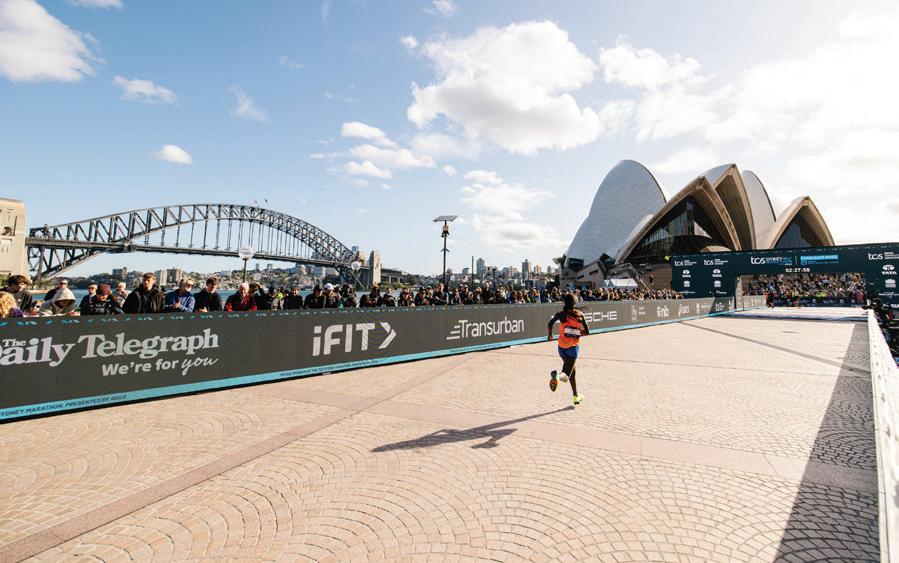
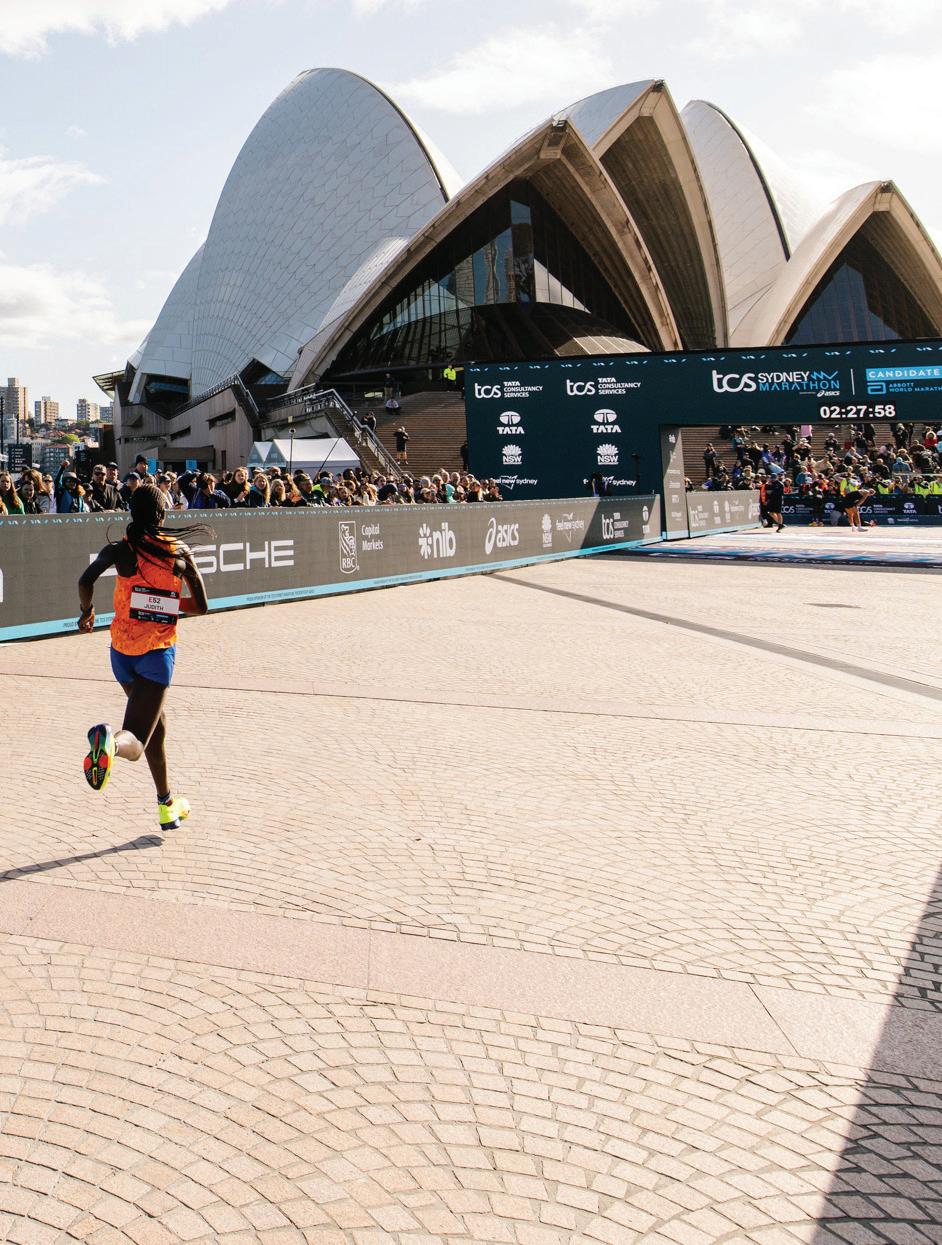
When it seemed like Sydney couldn’t possibly get any better, the Abbott World Marathon Majors announced the city as the newest edition to its ranking in 2025. Sydney will host its first world major marathon this August, which runners will surely relish given the cooler average temperatures—an advantage unique to the only major marathon held south of the equator.
Unlike Berlin, London and Tokyo, Sydney is not a flat city and therefore has the added challenge of hills to contend with. Despite having the most elevation gain of any of the majors, the scenery is sure to distract. Runners begin in North Sydney before crossing the Harbour Bridge, taking in the awe-inspiring views of the harbour.
Winding through Darling Harbour and the Royal Botanical Gardens, runners have the thrill of crossing the finish line at the Sydney Opera House.
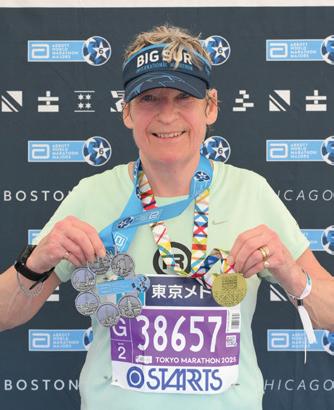
Congratulations to our IMPACT Magazine Guest Editor, Louise Hodgson-Jones on earning her Six Star Medal in Tokyo this year.
HOW TO PREDICT YOUR MARATHON TIME
Yasso 800’s are a simple, effective workout that can predict your goal race time
BY MARNIE KUNZ
A USATF and RRCA-certified running coach and NASM-certified trainer, creator of runstreet.com, based in Brooklyn, New York. RUNSTREET RUNSTREETMEDIA MARNIE KUNZ
Yasso 800’s are a track workout that can help predict your marathon time. The theory is that whatever pace you can run 10 x 800-metre intervals (in minutes) is a predictor for your marathon time (in hours). So, for example, if you run your 800-metre repeats in 3:30 this predicts a marathon time of 3:30.
The Yasso 800’s are a great speed workout for runners of all abilities not just marathoners. Besides the physical benefits of speed work, they offer something that is hard to find in training— simplicity. Once you learn how to do Yasso 800’s, you can do them anytime and use them as a tool to improve your running speed and endurance.
HISTORY OF YASSO 800’S
The Yasso 800’s workout is named after its creator, Bart Yasso, a former chief running officer at Runner’s World. He had been doing the 800’s workout for years helping him predict his marathon times. At the height of his running career Yasso was regularly running sub-three-hour marathons. At the time he said: “If I can get my 800’s down to 2 minutes 50 seconds, I’m in 2:50 marathon shape. If I can get down to 2:40 (minutes), I can run a 2:40 marathon.”
BENEFITS OF YASSO 800’S
Yasso 800’s will improve your endurance, running efficiency, speed and race pace. Running 800-metre intervals for 10 repeats is no easy task, but they will help improve your marathon pace and may help you hit your marathon goal time. They also train your body to perform well even when you are fatigued, boosting your stamina for long-distance races.
Yasso 800’s workouts also offer the benefit of simplicity. This is an easy speed workout to remember, which makes all the difference when you're training. You can also program the workout into your Garmin watch for easy access on the run.
HOW TO DO YASSO 800’S
The original Yasso 800’s workout included 10 repeats of 800 metres (two laps around a standard track), with running recovery laps for an equal amount of time as your fast intervals. For example, if you run your 800-metre intervals in 4:00, then you do a recovery run for four minutes between each interval. As with all interval training, you want to aim for consistency in your times. The first few repeats may not feel very difficult, but it will be challenging to maintain the same pace for 10 intervals.
You can also run a Yasso 800’s workout on the treadmill or outside on roads using a GPS watch or running app to measure 800 metres.
SETTING YOUR DISTANCE
If you are training for a shorter race than a marathon, or if you are just beginning your Yasso 800’s workouts, run four intervals to start. For marathon runners, add an interval each week until you reach 10 x 800’s. Do not add an interval until you meet your time goals in a workout. So, e.g. if your goal is 3:30 and you run four repeats of 800 metres, do not add an 800 for the next week until you can do all four repeats in 3:30 or less.
As with all speed training, you should do a 5- to 10-minute warm-up and cool down run at a relaxed pace before and after your workout. Do not forget also to stretch. I recommend doing the Yasso 800’s workout once a week when you are in training mode.
SAMPLE YASSO 800’S WORKOUT
Here is a sample workout you can use to start your own speed training. Do this speed workout once a week until your race and add in some time to taper if you are marathon training. Warm-up: Run for 10 minutes at a relaxed, easy pace. Do dynamic stretches.
Intervals: Run 800 metres (half of a mile or two laps on a standard running track) at your goal pace. For marathon runners, this will be your goal race time in minutes. (For a 4-hour marathon, run your 800’s in four minutes). Do 10 intervals. Recovery: Jog for the same amount of time as your interval but at a relaxed, recovery pace. Do a recovery jog between each 800-metre interval. Cool down: Run for 10 minutes at a relaxed, easy pace. Stretch.
YASSO 800’S WORKOUT MODIFICATIONS
If you are training for a shorter race than a marathon, you can adapt the Yasso 800’s workout to your distance goals. For a halfmarathon, I recommend doing at least five 800’s, and for a 5-kilometre or 10-kilometre race, run at least four 800’s.
For half-marathon time goals, aim for your 10-kilometre race pace for the 800’s. So, e.g. if you run 10 kilometres at an 8-minute mile pace, run your 800’s at the same pace, in 4 minutes. If you are training for a 5-kilometre or 10-kilometre race, run your 800’s 30 seconds slower than your goal 5-kilometre pace.
The simplest way to run your Yasso 800’s workout is at a track. Then you will know that running two laps equals 800 meters, which is easy to measure.
This article is edited for length and reprinted with permission from Marnie Kunz – www.runstreet.com.
What Is a Recovery Run?
Do recovery runs help you recover? Here’s your guide to recovery runs and why they are an important approach to training.
BY ANDREW SIMMONS
A USATF Level 2 and TrainingPeaks Level 2 certified coach and the founder/head coach of Lifelong Endurance. From Denver, CO where he still trains as a competitive amateur.
TRAININGPEAKS LIFELONGENDURANCE LIFELONG_ENDUR
Recovery runs are best executed after a moderate or high Training Stress Score® (TSS®) effort like a workout, race, or strength training session. TSS® is a way of expressing the workload from a training session. Endurance athletes often suffer from sore muscles after these types of workouts, and recovery runs are meant to loosen up the body by increasing blood flow and flushing out waste. This is vital to performance, as stiffness and soreness can limit your mobility, diminish your power output, and make workouts uncomfortable and daunting to complete.
When you work out, especially at high intensities, several physiological processes take place that increased blood flow can help remedy (see chart).
For athletes who are training more than 50 miles per week or practicing multiple sports, like triathletes, a recovery run can be a great way to flush the major movers and jump-start the recovery process.
HOW ARE RECOVERY RUNS DIFFERENT FROM EASY RUNS?
There isn’t a distinct difference between an easy aerobic run and a recovery run other than the intention of the workout. Your day-to-day aerobic run that’s solely focused on maintaining a Zone 1 or Zone 2 heart rate meets the definition of a recovery run. However, an aerobic run and recovery run begin to look different when they are completed. Recovery runs—which generally consist of 20-30 minutes of aerobic running—are intended to follow a hard effort to remove waste. Runs longer than 30 minutes begin to produce metabolic waste and, depending on your fitness level, can take you longer than 8-12 hours to recover from. These types of runs certainly don’t qualify as recovery runs!
ACTIVE VERSUS PASSIVE RECOVERY
There are two types of recovery: active recovery and passive recovery. Going out for a recovery run, completing an easy spin on your bike, or doing 20-30 minutes of yoga are examples of active recovery. Using a percussion massager or compression boots, taking a nap, or getting a massage would be considered passive recovery.
The biggest differentiation is that active recovery increases heart rate and blood pressure, resulting in vasodilation (i.e., the dilation of blood vessels) and the transportation of metabolic waste.
WHICH IS RIGHT FOR ME?
How you choose to approach your recovery should always come down to understanding your body and where you’re going to get the most value. If you’re physically beat up from your last run, an easy run may not provide recovery and instead could increase your recovery time. The variables to consider are numerous, and it will take some experience to determine if a recovery run is the best solution to optimize your recovery.
If you’re injury prone or currently run less than 24 miles per week, a 20–30-minute recovery run might actually put you in a worse position. If your body has a tough time recovering from high-impact sports like running, you might want to consider an easy ride or yoga session as a recovery option. Conversely, if you’re training between 40 and 60 miles per week, a 20–30-minute run later in the day after a difficult workout might be the right fit to help you increase mileage, recover, and get an additional training benefit.
Gender can also influence recovery. A recent study compared a population of men and women after a half-marathon to assess muscular function, power development, and the influence of delayed onset muscle soreness (DOMS). The greatest finding was that the women, on average, showed earlier functional recovery than the men. This is potentially because women have lower muscle mass,
DURING A HIGH INTESITY WORKOUT
Acidity rises inside muscles
Small tears occur in muscle tissue
Metabolites cause stiffness
DURING A RECOVERY WORKOUT
Blood vessels open up (aka, vasodilation) to promote increased blood flow and nutrient absorption
Connective tissue loosens, reducing stiffness
Muscles are flushed with freshly oxygenated blood
force, and power output than men at the same relative intensity and therefore fatigue less. This may also be due to the direct and indirect influence of sex hormones (i.e., estrogen versus testosterone), which in women produce a lower amount of metabolites and metabolic waste. The study showed that estrogen might lower the impact of exercise-induced skeletal muscle damage, therefore reducing the impact of DOMS as compared to men.
One of the greatest influences on recovery for female athletes is where they are in their menstruation cycle, as fatigue is higher during menstruation. Menstruation also plays a role in metabolic demands during recovery. One study showed that menstruation raises basal metabolic rate by more than six per cent, which will have a significant impact on glycogen stores, recovery, and overall perception of fatigue. This increase in caloric demand occurs over a period of three to five days as women move through their menstrual cycle, which can complicate fuelling procedures leading into and during a race.
USING METRICS TO ASSESS RECOVERY
Assessing the quality of your recovery requires experimentation and introspection; there is no specific metric that can truly determine your ability to perform. However, using a metric like Training Stress Balance (TSB) can give you a guesstimate of how you’ll feel in your next workout and ultimately give you a gauge of how ready you are to perform at race-level effort. The closer your TSB is to a score of 0, the more recovered you are. On the other hand, a score of -20 or -30 indicates that you need to take a few easy days to recover your body.
At the end of the day, performance can only improve by applying stress to the body and then recovering adequately. Increased adaptation to training stimuli leads to improved fitness as well as the ability to manage greater fatigue. The fitter you get, the less time you need to recover.
So, it can reasonably be said that a true recovery run can exist, meaning you can simultaneously apply a small stress load, increase blood flow to muscles, and recover. Simply put, recovery runs are a straightforward way to get real performance benefits.
This article is edited for length and reprinted with permission by TrainingPeaks - www.trainingpeaks.com.
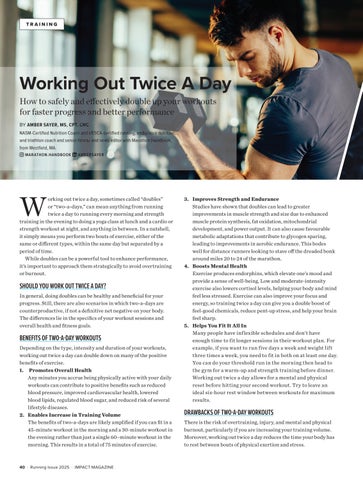
Working Out Twice A Day
How to safely and effectively double up your workouts for faster progress and better performance
BY AMBER SAYER, MS, CPT, CNC
NASM-Certified Nutrition Coach and UESCA-certified running, endurance nutrition, and triathlon coach and senior fitness and news editor with Marathon Handbook, from Westfield, MA.
MARATHON.HANDBOOK AMBERSAYER
Working out twice a day, sometimes called “doubles” or “two-a-days,” can mean anything from running twice a day to running every morning and strength training in the evening to doing a yoga class at lunch and a cardio or strength workout at night, and anything in between. In a nutshell, it simply means you perform two bouts of exercise, either of the same or different types, within the same day but separated by a period of time.
While doubles can be a powerful tool to enhance performance, it’s important to approach them strategically to avoid overtraining or burnout.
SHOULD YOU WORK OUT TWICE A DAY?
In general, doing doubles can be healthy and beneficial for your progress. Still, there are also scenarios in which two-a-days are counterproductive, if not a definitive net negative on your body. The differences lie in the specifics of your workout sessions and overall health and fitness goals.
BENEFITS OF TWO-A-DAY WORKOUTS
Depending on the type, intensity and duration of your workouts, working out twice a day can double down on many of the positive benefits of exercise.
1. Promotes Overall Health
Any minutes you accrue being physically active with your daily workouts can contribute to positive benefits such as reduced blood pressure, improved cardiovascular health, lowered blood lipids, regulated blood sugar, and reduced risk of several lifestyle diseases.
2. Enables Increase in Training Volume
The benefits of two-a-days are likely amplified if you can fit in a 45-minute workout in the morning and a 30-minute workout in the evening rather than just a single 60–minute workout in the morning. This results in a total of 75 minutes of exercise.
3. Improves Strength and Endurance
Studies have shown that doubles can lead to greater improvements in muscle strength and size due to enhanced muscle protein synthesis, fat oxidation, mitochondrial development, and power output. It can also cause favourable metabolic adaptations that contribute to glycogen sparing, leading to improvements in aerobic endurance. This bodes well for distance runners looking to stave off the dreaded bonk around miles 20 to 24 of the marathon.
4. Boosts Mental Health
Exercise produces endorphins, which elevate one’s mood and provide a sense of well-being. Low and moderate-intensity exercise also lowers cortisol levels, helping your body and mind feel less stressed. Exercise can also improve your focus and energy, so training twice a day can give you a double boost of feel-good chemicals, reduce pent-up stress, and help your brain feel sharp.
5. Helps You Fit It All In
Many people have inflexible schedules and don’t have enough time to fit longer sessions in their workout plan. For example, if you want to run five days a week and weight lift three times a week, you need to fit in both on at least one day. You can do your threshold run in the morning then head to the gym for a warm-up and strength training before dinner. Working out twice a day allows for a mental and physical reset before hitting your second workout. Try to leave an ideal six-hour rest window between workouts for maximum results.
DRAWBACKS OF TWO-A-DAY WORKOUTS
There is the risk of overtraining, injury, and mental and physical burnout, particularly if you are increasing your training volume. Moreover, working out twice a day reduces the time your body has to rest between bouts of physical exertion and stress.
Doubles can also increase cortisol levels, which can suppress the immune system, impact appetite, and disrupt sleep patterns. The greater the intensity and duration of your workouts, the more cortisol they will increase.
Lastly, working out twice a day can be mentally taxing as it takes up more time and energy in the day, whether from the additional minutes of exercising, or commuting to and from a workout location.
ESSENTIAL TIPS FOR SUCCESSFULLY WORKING OUT TWICE A DAY
If you want to add doubles to your training plan, the goal needs to be capitalizing on the benefits while mitigating the potential risks.
1. Don’t Do Two-a-Days Every Day
Limiting the number of days you exercise twice will give your body ample recovery time. Similarly, if you are a beginner and just started to add two workouts in one day, gradually increase the frequency, duration, and intensity of the secondary workouts over time. For example, add an easy 15-minute shake-out ride on an indoor cycle in the evening on the days you have a higher intensity threshold run or interval session in the morning, and progress to 30 minutes after a couple of weeks.
2. Pair Smartly
To reduce the risk of injury and maximize fitness gains, double up with two very different forms of physical activity, such as high-impact cardio with strength or strength with flexibility or speed/power with low-impact cardio. Where possible, try to choose exercises that use different muscle groups. For example, if you cycle in the morning, do upper-body and core-strength training exercises rather than a lower-body workout.
3. Be Mindful of Intensity
Going full blast for both workouts can be overtaxing, so mix up the intensity of your doubles so that at least one workout is more of an active recovery in terms of modality (yoga, walking, or deep-water walking) or effort level. Two intense workouts in one day may be just too much.
4. Prioritize Your Primary Workout
Make your harder workout your first workout of the day. If you want to run and lift weights and your running workout is your priority, run in the morning and save the lifting for later in the day to avoid running on tired muscles.
5. Monitor Your Heart Rate
Your resting heart rate can provide a window into how well you’re recovering from workouts. If you notice your heart rate upon waking to be trending upward, it’s a sign you need to cut back and give your body more recovery time.
6. Keep a Fitness Log
Record all your workouts, including subjective data on how you feel, to help stay on top of niggles and signs of overtraining.
7. Rest Honour the rest day and ensure you get a full rest day weekly or at least every other week.
8. Fuel Like a Pro
Fuel your body with the same desire for excellence. Focus on whole, unprocessed foods, and ensure your caloric and nutrient needs are met to keep your body healthy. Carbohydrates are key to high-intensity workouts such as running, HIIT, and just about any form of cardio. But be sure to get all your macros in (carbs, proteins, and healthy fats). Also, keep your hydration in check.
9. Listen to Your Body
Modify your training schedule accordingly. The goal of working out is to improve your health and fitness, not detract from your health or quality of life.
If you are going to give those doubles a try have someone help you organize your training sessions, like a coach or personal trainer, to make sure you are being safe and maximizing your gains.
This article is edited for length and reprinted with permission from Marathon Handbook - www.marathonhandbook.com.
Training Smarter Past 50
Running can bring on many challenges as we get older, but it also has its advantages if you take a different approach to training
BY CAOLAN MACMAHON
A UESCA and USATF L1 ultrarunning coach who has run over 60 marathons and ultramarathons since turning 50 including six Boston and three New York City Marathons, from Boulder, CO.
THELONGRUNCOACHING CHRONICRUNNER
I’ve seen many runners 50 and over continuing to do what they’ve always done, and when that stops working, they often feel frustrated and believe the solution lies in doing more— more miles, more speed work, more of something. But more may not be the solution.
Let’s take Joanna, a 55-year-old who is training for a marathon: She has trained through many marathon cycles, but this time she feels like she’s working harder even though her paces keep dropping. In frustration, she tries to run more and faster. She begins feeling deep fatigue and watches as her easy pace becomes more difficult to run. As she continues to push harder, she digs herself into a deeper and deeper hole. Her times are slow, her body begins to hurt, her heart rate both at rest and when active rises, she feels irritable, her sleep is a mess, and she feels like she’ll never feel strong again. She wonders: Is this just part of getting old?
Next, we have Joe, a new runner. He’s 58 and has a few pounds to lose, but he’s generally healthy and wants to stay that way. He starts running two miles a day, four to five days a week. He’s vexed because he can’t seem to run any farther or faster, and his shins and knees are starting to hurt. He just doesn’t know what to do next. He wonders: Is it just too late to start running?
The solution for both runners is better, smarter training. Smart training begins with listening to your body. Of course, a good training plan is key, but if you aren’t listening to your body, then you end up injured, exhausted, plateaued, and ready to give up in disgust. Too many people believe you need to beat your body into submission if you want to get fitter, stronger, and faster. You can thank Friedrich Nietzsche—who famously said, “That which does not kill us makes us stronger”—for encouraging this self-destructive tendency. Maybe this applies to some things, but when you approach training this way all the time, it will certainly leave you a broken mess.
So, what should you be listening to? Let’s take a look.
RESTING HEART RATE
To start, you should be monitoring your resting heart rate. Every runner should know what their resting heart rate generally is, within a few points. This is your heart rate when you first wake up, but it’s also good to know where your heart rate typically settles when you’re just sitting and relaxing. If you notice your heart rate is a bit higher for a few days, it will benefit you to take some extra recovery time. This doesn’t necessarily mean complete rest, but you need to back off both volume and effort. If you catch this early, it’s quite easy to resolve. But if it’s been going on for a while, then you’ve dug your hole deeper, and it will take more time to get out.
SLEEP QUALITY AND QUANTITY
Notice the quality and quantity of your sleep. One of the ironies about sleep is that often your sleep becomes poor when you are the most fatigued: you have trouble falling asleep, you wake up often and can’t get back to sleep, and you wake up in the morning still feeling exhausted. Sleep disturbances often arise due to deep systemic fatigue. Often, doing less helps improve your sleep.
PERSISTENT ACHES AND PAINS
Notice how your muscles feel. Some runners erroneously believe they should always feel sore. Many think that if you’re sore all the time, then you’re getting strong. Unfortunately, that’s not how this works. Yes, you will be sore after some runs or strength work. But the key to getting stronger is allowing your body the chance to repair following a stress. If you’re always sore, that’s your body saying you are doing too much of something.
SLOWING PACES
If you’re running at the same effort but your paces are inexplicably slowing, that’s your body telling you that you’re doing something wrong. Most runners run just a little too fast too often. This leads to frustrating plateaus and chronic overuse injuries.
As you get older, you need to be even more attentive to your body. You also need to be more vigilant about self-care, both physical and mental. Adding gentle mobility work, restorative bodywork such as massage, purposeful cross-training, or even a good old hot bath can do the body good. When I was much younger, I would try to run through anything. Today when I feel something isn’t quite right, I’ll take an extra easy day, go for a swim, or have a massage. I don’t want to lose time and consistency to an injury and nipping it in the bud is by far the smartest thing to do.
With all this in mind nothing is more important to your running than consistency. You want to stay healthy. Injuries interrupt training. Being in pain all the time, even if you can run, just isn’t fun. What is fun is feeling good and strong and able to do what you want to do.
Older runners may bring a mental advantage to their training and racing. Chances are that you have gained some mental tenacity through the trials and tribulations of life. You see in ultra-longdistance events that older runners fair very well against their younger, faster, and physically stronger competitors, often because they have the mental toughness that these grueling efforts demand.
Running also serves a social function. If you run with people or in a race, you connect with an active community that supports and inspires you. It’s good to be around those with whom you share passions. With more older runners sticking with running and many more joining the ranks, you have even more people to share your passion with. While running is not the only activity that can bring these benefits, there are certain aspects inherent to running that make them easier to attain: I don’t need a team. I can go at my own pace. I can choose my own goal, be that a 100-metre sprint or a 100-mile endurance run. I can run anywhere—road, trail, treadmill, even a pool. I can run on my schedule. Running is an autonomous activity.
But I believe running is more than an activity, exercise, or a workout. Running can also help you tune into yourself, your environment, your dreams, your pain, your ambitions, your hopes. Running gives you an opportunity to discover and exercise your greatness from where you are right now.
Extract from Running Past 50 by Caolan MacMahon (Champaign, IL: Human Kinetics, 2025). Edited and reprinted with permission of www.Canada.HumanKinetics.com.
ARE RUNNERS OVER 50 MORE PRONE TO INJURY?
The answer is maybe, maybe not. A lot depends on how recovery is balanced with training—and life—stresses. As you age, your bones tend to get smaller and less dense. Why? It’s believed that as you get older, you absorb less calcium and vitamin D, which are crucial to bone health. But the Utah paradigm and Wolff’s law* suggest that it is not just calcium and vitamin D at issue—what matters even before all that is the stress on the bone. What kind of stress? Specifically, it is the stress caused by muscles pulling on opposite ends of the bone. Impact is one thing, but it’s the actual pull of the muscle on the bone that provides the stimulus for calcium uptake. You can consume all the calcium in the world and still have weak bones if you do not stress them. Without the stress calcium will not go into your bones. Period.
* Wolff's law and the Utah paradigm are both models that explain how bones adapt to mechanical forces.
12 Weeks to Your First 10 km
An achievable plan to get you from a 5 km to a 10 km
BY ED BICKLEY TODD FRASER/CANADA RUNNING SERIES (CRS)
Competitive Masters’ runner with over 1,100 race finishes including 100+ marathons and 100+ half-marathon finishes, coach with Strides Running, former president of the Calgary Roadrunners Club, from Calgary, AB. STRIDESRUNNING ED.BICKLEY
Many runners begin their racing experiences with the five-kilometre distance as it has the advantage of being ‘just long enough’ to be a challenge, while being short enough to be both attainable and enjoyable without requiring too much time preparing. If you’ve completed one or more such races, you’re running regularly two to four times a week, and you aspire to move up to the 10-kilometre distance, good for you! Although this is a bigger challenge, it can also be double the fun and satisfaction with the right training. The program that follows is designed to get you comfortably to your first 10-kilometre finish line. A simple way to get a sense of what you’re capable of on a normal day is to take your last or typical five-kilometre time and multiply it by 2.1
I’ve personally finished close to 300 10-kilometre races over the last 35 years, but I learned more from my first than from any after that. It was a cautionary tale of poor preparation and grossly optimistic pacing by going out too fast, followed by intensely painful cramping after the race. As I subsequently learned how to train for the distance, I have never had trouble with cramps in or after a race again. In the words of Oscar Wilde: “Experience is simply the name we give our mistakes.”
None of us needs to live through a day like that. The goal, particularly in a first effort at the distance, should be to have fun and finish comfortably; 10-kilometres requires a bit more preparation than does five, but it’s far from insurmountable.
Before you begin training, it’s important to consider your objectives and set some targets:
• Select an upcoming event 12-14 weeks out; for many people, committing is half the battle.
• Understand the time you can devote to training. If your lifestyle or interest allows about four runs per week, this program can be fit into it; you can even add another run per week if you feel it helps you.
• Set your time goal. This can be a broad range of times (e.g. between 45-55 minutes) or a set of conditional targets like an ‘A’ goal (45 minutes if everything goes perfectly), a ‘B’ goal (50 minutes on a good day) and a ‘C’ goal (55 minutes if it’s a tough day). A simple way to get a sense of what you’re capable of on a normal day is to take your last or typical five-kilometre time and multiply it by 2.1.
THIS TRAINING SCHEDULE:
• Focusses on consistent running and slowly adding mileage with 4-5 runs per week. Most of these runs should be at a steady, conversational pace (you can comfortably carry on a conversation during it).
• Includes a weekly longer run (also at conversational pace) to build endurance, gradually increasing over the 12 weeks.
• Features the main workout of the week, a 10-kilometre goal race pace run (somewhat akin to a ‘tempo’ workout in other programs) to accustom your body to running at your goal pace for several kilometres.
• Has several cross-training days (cycling, swimming, xc-skiing, elliptical training, etc.) If you feel you can fit in more running time, you can substitute an easy run for ONE of these per week. Enjoy the journey.
Toronto 10K
12-WEEK 10 KM TRAINING PLAN
12 Weeks to Master a Faster Half-Marathon
An achievable plan for an intermediate to advanced masters athlete
BY LISA HARVEY BRETT CLARKE
1992 Olympian - 10,000 metres; 3x World Outdoor Track Team Member; 8x World Cross-Country Team Member; multiple Canadian medalist at distances from track to cross-country; top 3 Open and Master at numerous North American road races from 5-kilometres to Marathon; Mile2Marathon Run Coach in Calgary, AB. LISARUNSWIM
Running a fast half-marathon is an achievable goal for an advanced Masters runner. In this half build you will be guided through a 12-week training plan where the goal is to run four days per week with the remainder of the week for cross-training, strength, and flexibility exercises. Before beginning this plan you should be comfortable running three to four times per week with some faster running at your 10-kilometre and half-marathon paces. For all runners including the Masters athlete, it is very important to listen to your body and modify your training to avoid injuries.
The plan consists of a workout (Tuesday), long run (Sunday), two easy runs (Wednesday/Friday), two strength-flexibility days and an optional cross-training day. Running by effort at the beginning is key to determine the running pace that feels best for you. The long run should be done at a comfortable pace that you could maintain for an hour or more, this is called Long Slow Distance (LSD). Think about controlled breathing, relaxed arm swing, low knee lift, and feet touching the ground lightly with each stride. Some long runs are just a run whereas others have half-marathon pace sections embedded. Easy runs are shorter runs during the week where you are running 15 to 30 seconds faster than your long run. The workouts are a chance to practice race paces and good running form. They consist of a warm-up, strides, intervals, and a cool down.
COACHING TIPS
• Be Patient – follow the plan and take rest days off running.
• Believe in yourself – use positive self-talk to get you through tough training.
• Flexibility – adjust the plan to fit your work/life schedule.
• Running shoes – wear shoes that are supportive and feel good on your feet.
• Maintain flexibility and strength – short sessions throughout the week will help to avoid injuries.
• Switch up running routes and surfaces – flat, hilly, paved, and trail.
LEGEND
STRIDES – Accelerations to practice faster leg turnover and good running form (good posture, knees driving forward, arms bent).
On an 80 to 100 metre flat stretch of pathway or grass, think about starting at an easier pace and finishing fast.
MP – Marathon pace
HMP – Half-Marathon pace
NEGATIVE SPLIT – Run at your long run pace for the first half of the run and then increase to half-marathon pace for the second half.
Oak Bay Half Marathon
12-WEEK HALF-MARATHON TRAINING PLAN
16 Weeks to an Improved Marathon Time
An intermediate plan for a better marathon performance
BY JOSH ZILLES PAM DOYLE
Run coach with StrideWise Running and assistant coach for the University of Windsor Cross Country team. Holds a Master of Science in Human Kinetics (MSc.) Lifelong runner, competing in distances from 800 metres to the marathon, from Toronto, ON.
JOSH_Z55 | STRIDEWISERUNNING
This is a marathon-training plan for the intermediate runner who has run several 10-kilometre races or half-marathons and is looking to either race their first marathon or improve their current marathon time.
You should have some experience training for distance races, be running at least four days a week, and be comfortable running 10 kilometres in one run. This plan has two rest days a week to help you absorb the training performed throughout the week. Recovery is just as important as training, so make sure you use these days to rest so you can get the most out of your training.
No one workout or run is more important than the other. Listen to your body and try to stay as consistent as possible. Consistent hard work combined with smart training leads to breakthroughs.
HERE’S A DEFINITION OF SOME OF THE TERMS
Easy Runs: These runs fill the majority of your mileage within the week and should be done at a conversational pace (anywhere from 30 to 90 seconds slower than marathon pace). Take these runs easy so that you have plenty of energy to run hard on your workout days.
Workouts: These are your hardest effort of the week. Make sure you warm-up and cool down properly so your body is ready for the hard work it’s about to go through. These workouts work on several different muscular and cardiovascular adaptations; we want to get as many of these done as possible, so don’t leave everything out there on one workout so that you can’t do anymore the following week. Consistency is key for the marathon.
Long Runs: These should be done with the same effort as your easy runs (unless you’re doing our optional marathon pace efforts
in your long run). As these increase, try practicing taking in carbs while running like you will during your marathon. A good place to start is taking in one gel every 45 minutes.
Rest Day: Rest is just as important as the training. This is when your body regenerates and adapts to the training you’ve been doing. Make sure you use these days to relax so you can prepare for the training to come. Some good recovery practices include sleeping in/going to bed early (this is when your body does most of its healing), eating well and plenty (food is fuel), putting your feet up/relaxing.
MP: Marathon pace. This is the pace at which you want to run your marathon, adjusting as needed for external factors such as weather or terrain.
Strides: These are 80 per cent sprint efforts that go for about 80 metres. Slowly progress up to speed, hold for 20 metres, then progress back down. These should feel fast but relaxed. Don’t strain on these; practice good form throughout the stride.
Optional Long-run Workouts: Throughout the training plan, on some long runs, there are optional workouts you can do. This is only if you’re feeling strong and are looking for something more. Consistency is key, so make sure that if you are doing these, you aren’t taking away from the next week’s training or workouts.
Threshold: Threshold is roughly the pace you could hold for an hour. During training, a good way to tell you’re at the right pace is to use the “talk test.” You should be able to say short sentences but unable to hold a conversation. When finishing, you should feel like you could have done more if needed but are happy to be done.
Banff Marathon
16-WEEK MARATHON TRAINING PLAN
1
2
3
4
5
6
7 Rest Day
8 Rest Day
min run (last 5 min progressive, finishing at marathon effort) + 4x strides
min run (last 5 min progressive, finishing at marathon effort) + 4x strides
min warm-up + drills & strides, 2 sets of 5x 200300m continuous hills [jog down recovery between each] [walk down set rest] 15
Training for your First 50 km Trail Race
An effective plan for those who want to graduate from 25 km trail races
BY ERIC CARTER AND GARY ROBBINS TY HOLTAN
Founders of Ridgeline Athletics, offering one-on-one and customized coaching and ultramarathon training. From Squamish, B.C. Eric holds a PhD in Exercise Physiology specializing in mountain running, alpine climbing, and ski mountaineering. Gary is one of Canada’s premiere ultra-endurance runners, completing many 100+ mile races with a rack of wins.
For many the 50-kilometre race is their first entry to ultra racing and even though it’s the shortest ultra, it certainly shouldn’t be underestimated. These races are often FAST, and elevation gain can add up quickly. This training plan is intended for someone who has a bit of a training history and is comfortable running two to three times per week with a long run distance in the 20-to-25-kilometre range. Twelve weeks is a short amount of prep time if you’re starting from scratch but if you’re coming from a good base and adding a structured plan, you’ll be in good shape.
TRAINING GOALS:
• Our primary goal is to get sufficient running volume in. This means most of the plan has easy or long runs. We use an effort scale of 0-10 and an easy or long run should be around a 4/10. This is a conversational pace and requires an athlete to consciously go slower than often feels most pleasurable.
• Tuesdays are intensity workouts. These are higher RPE ranges from 6 which is kind of “fun hard” to 8 which is really just “hard hard.” Your one-mile efforts at a RPE of 9 aren’t flat out but should feel like quite fast running. Your goal should be to maintain a consistent effort through these sessions without significantly slowing down throughout the workout. All intensity sessions should start with a ~15 min warm-up and finish with a similar cool down. Recovery time between the intervals is listed in brackets with the intervals and can be very slow jogging or walking. Intensity sessions should be primarily on runnable trail terrain. These can be relatively flat or rolling.
Hill sessions should be uphill—running or power hiking (or a mix).
• Look ahead to what your race has for vertical and terrain. Your runs should be on trails that ideally match the expected terrain in your race. If you’re doing a mountain race, get on trails with lots of vertical. If you’re doing a flatter and faster race, get on those buff, single-track routes. Use your long runs to test your gear and your nutrition ahead of race day. This is one of your single most useful tools—make sure those foods are palatable at the end of a long run and that your shoes/ vest/whatever doesn’t chafe you.
MAINTAIN CONSISTENCY:
Maintaining structure and consistency is critical. Try not to stack your sessions all in one part of the week. If you miss a workout, sometimes it just makes sense to leave it behind rather than try to make it up. Monitor for excessive fatigue and small injuries that could get worse. Remember the process is supposed to be fun— enjoy your training and good luck at your race.
LEGEND:
RPE - Rate of Perceived Exertion. An effort scale of how hard you should be working. 1 being easy and 10 hard.
X-train - Cross-training sessions that are intended to be aerobic activity that isn’t running to reduce mechanical load on your joints and muscles. Cycling, swimming, and rowing are all great choices. If you have nothing else, a walk will do.
Squamish 50
12-WEEK 50 KM TRAIL TRAINING PLAN
12 Weeks to Improve your 70.3 Performance
A graduated training plan to help you achieve your goals
BY JASPER BLAKE FINISHERPIX
Holds a BSc Honours in Human Kinetics from the University of Guelph; Ironman Champion and Triathlon Canada Long Distance Athlete of the Year; 5x Ontario Triathlete of the Year; NCCP-certified coach in Triathlon, Athletics, Alpine Skiing, Tennis and Fundamental Movement Skills, from Victoria, B.C. B78COACHING B78COACHING B78COACHING
This 12-week training plan is designed for intermediatelevel athletes who have experience at longer distances and who are looking to improve their 70.3 distance times. The plan operates on a four-week cycle meaning there will be three weeks of progressive training load followed by an easier/adaptation week. The last four-week cycle (weeks 9-12) will see 2.5 weeks of progressive load followed by a 10-day recovery/taper phase.
Many of the workouts in this training plan are repetitive and progressive. This is by design. The goal is to establish a routine that you can be consistent with. Often simplicity is the best course of action. This training plan has been built using Rate of Perceive Exertion or RPE for short. The RPE scale is 1-10 whereby 1 is very easy and 10 is best effort. When designated for a workout, RPE ratings apply to the main set—please do warm-ups and cool downs easy. RPE 3-5 activation sets in the warm-up should be done with higher RPE to warm up for the set that is coming. A RPE of 8-8.5 can be roughly correlated to your Functional Threshold Power or FTP on the bike and your running threshold effort or pace.
The workouts, with some higher intensity on the bike and run, are designated to be done on hilly terrain. If you don’t have access to hills, the workouts can be done on flat terrain using the same RPE scale.
Where there are two workouts a day, these can be done at opposite ends of the day. The Saturday bike/run is a brick workout—do the run immediately after the bike. The easy swim on Saturday can be done either immediately after the brick or a little later.
On the Saturday before race day there are two options for the swim—one done in your normal setting/pool and the other is an open water option should you wish to use the race venue.
LEGEND
WU Warm-up CD Cool down
MS Main set
Time trial
Harmony IRONMAN 70.3 Calgary
MON TUE WED THU F SAT SUN
Swim, Recovery 1500m (RPE 3-5)
WU: 200m choice, 100m kick
MS: TWO ROUNDS 4x
50m on 15 sec rest descending (get faster) 1-4. 200m easy pull without paddles, 100m easy kick.
CD: 200m choice.
Bike, Recovery/RPM 45 min (RPE 3-5)
WU: 10 min easy
MS: 5*(4 min easy at 80-90rpm, 1 min easy at 95+rpm)
CD: 10 min easy
Swim , Recovery 1500m (RPE 3-5)
WU: 200m choice, 100m kick
MS: TWO ROUNDS
4*50m on 15 sec rest descending (get faster) 1-4. 200m easy pull without paddles,100m easy kick.
CD: 200m choice
Bike, Recovery/RPM
45 min (RPE 3-5)
WU: 10 min easy
MS: 5*(4 min easy at 80-90 rpm, 1 min easy at 100+rpm)
CD: 10 min easy
Swim , Recovery 1500m (RPE 3-5)
WU: 200m choice.
100m kick
MS: TWO ROUNDS
4*50m on 15 sec rest descending (get faster) 1-4. 200m easy pull without paddles. 100m easy kick.
CD: 200m choice
Bike, Recovery/RPM
45 min (RPE 3-5)
WU: 10 min easy.
MS: 5*(4 min easy at 80-90 rpm, 1 min easy at 105+rpm) CD: 10 min easy
Swim , Recovery
1500m (RPE 3-5)
WU: 200m choice
100m kick
MS , TWO ROUNDS
4*50m on 15 sec rest
descending (get faster)
1-4. 200m easy pull without paddles
100m easy kick
CD: 200m choice
Swim , Threshold 2000m (RPE 8-9)
WU: 300m choice, 100m kick. 4*50m as 25 fast, 25 easy on 15 sec rest. 100m easy choice
100m kick 4*50m as 25 fast, 25 easy on 15 sec rest 100m easy choice
MS: 20*50m strong and steady on. 20 sec rest
CD: 200m choice
Run, Hills 45 min (RPE 8-10) WU: 20 min easy to the base of a suitable hill MS: 10* (20 sec uphill strong/ fast, 40 sec easy down)
CD: 5 min easy
Run, Recovery 30 min (RPE 3-5)
Easy cruise, technically engaged
Bike, Endurance
2 hrs (RPE 6-7)
WU: 20 min easy
MS: 90 min easy/steady, should be able to carry on a conversation
CD: 10 min easy
Run, Recovery
30 min (RPE 3-5) Easy cruise, technically engaged
Bike, Endurance
1 hr (RPE 6-7)
WU: 10 min easy
MS: 45 min easy/steady, should be able to carry on a conversation
CD: 5 min easy
Run, Recovery
20 min (RPE 3-5) Easy cruise, technically engaged
Bike, Hills 90 min (RPE 8-9)
WU: 20 min easy
4*(30 sec spin up over 100 rpm, 90 sec easy) 2 min easy
MS: 4*(5 min strong/hard effort uphill, 6 min easy down)
CD: 20 min easy
Swim, Endurance 3000m (RPE 6-7)
WU: 200m choice
100m kick. 200m with a pull buoy as 25 scull, 25 pull without paddles. 100m kick
MS: 3*600m pull on. 30 sec rest. 100m easy back/free. 12*25m fast on. 15 sec rest.
CD: 200m easy choice
Bike, Hills 90 min (RPE 8-9)
WU: 20 min easy. 4*(30 sec spin up over 100 rpm, 90 sec easy) 2 min easy.
MS: 4*(5 min strong/hard effort uphill, 6 min easy down)
CD: 20 min easy
Swim, Race Prep 1600m (RPE 6-7) WU: 200m choice 100m kick. 4*50 descending 1-4 on 15 sec rest 100m choice.
MS: TWO ROUNDS 8*25 fast on 30 sec rest 50m easy back/free, 200 easy pull without paddles
CD: 100m easy choice
Bike, Race Specific Prep 1 hr- (RPE 7-8)
WU: 30 min easy
MS: 2*(5 min at race pace/ power/effort, 5 min easy) CD: 10 min easy
Day off
Run, Off the Bike, 30 min (RPE 7-8) 5 min easy, 20 min at race pace/effort, 5 min easy
Swim, Recovery 1500m (RPE 3-5) WU: 300m
choice MS: 10*100 as 50 easy swim, 50 easy kick on 15 sec rest
CD: 200m easy choice
Bike, Race Specific Prep
2 hrs 20 min (RPE 7-8)
WU: 30 min easy
MS: 5*(10 min at race pace/ power/effort, 5 min easy)
CD: 15 min easy
Run, Off the Bike, 20 min (RPE 7-8) 5 min easy, 10 min at race pace/effort 5 min easy
Swim, Recovery 1500m (RPE 3-5)
WU: 300m choice
MS: 10*100 as 50 easy swim, 50 easy kick on 15 sec rest
CD: 200m easy choice
Bike, Pre Race Check, 20 min (RPE 3-5) Easy 20 min
spin Run, Pre Race 10 min (RPE 3-5) Swim, Pre Race 1000m (RPE Mixed)
WU: 200m choice, 100m kick MS: 8*25 descending 1-4 (get faster) on 15 sec rest, 200m easy pull without paddles CD: 200m choice
OPEN WATER OPTION
Swim, Pre Race Activation Open Water Option 15 min (RPE Mixed) WU: 5 min easy mixed choice MS: 8*(20 strokes long and strong/fast, 30 strokes easy) 5 min easy
Run, Endurance 2 hrs 30 min (RPE 6-7)
WU: 10 min easy
MS: 2 hrs 15 min easy/steady- should be able to carry on a conversation
CD: 5 min easy
Swim , Endurance
3100m (RPE 6-7)
WU: 300m choice
200m kick
MS: 3*800m swim with 1 min rest between
CD: 200m easy choice
Run, Endurance 1 hr 15 min (RPE 6-7)
WU: 10 min easy
MS: 1 hr easy/steadyshould be able to carry on a conversation
CD: 5 min easy
Swim , Endurance
2700m (RPE 6-7)
WU: 300m choice
200m kick
MS: 2000m swim
CD: 200m easy choice
Race Day! Good Luck!
2025 SERVUS EDMONTON MARATHON Building on Growth. Journey together.
The 2025 Servus Edmonton Marathon and Festival of Events is a celebration of achievement, community, inclusivity, and the incredible energy of downtown Edmonton
Overlooking the stunning North Saskatchewan River Valley, this event welcomes participants of all levels to experience a fast, scenic, supportive and encouraging course. Runners will be immersed in the city’s natural beauty and rich sporting and cultural spirit, with distances ranging from 1 km to 42.2 km.
Known as “The Friendly Marathon,” the Servus Edmonton Marathon is gaining recognition as one of Canada’s best destination races. With an affordable entry point, Edmonton welcomes runners from across the country and beyond to experience its welcoming atmosphere. The official host hotel, The 4 Star Westin Edmonton, offers budget-friendly accommodations starting at just $134 per night, making it an accessible choice for those looking to combine participation in a major city marathon with a weekend of urban adventures.
Championships, where elite runners compete and chase their dreams and national titles. But it’s not just about the top competitors—every participant is celebrated, no matter the distance or speed. With a flat, fast course ideal for personal bests, the races wind atop the River Valley and dynamic downtown core, where runners are energized by the unmatched spirit of over 15,000
to finish. Edmonton’s community spirit shines through, creating a welcoming and uplifting environment that embodies the city’s commitment to sport, health, wellness, and active living.
We could not be prouder of the growth and future of this event. Working with our community, we deeply care about how our event represents Edmonton and we strive to support the collective well-being of our participants.”
spectators. From enthusiastic cheering zones, DJ stations, to live entertainment along the route, the atmosphere shows participants the best of Edmonton and its community and love for the sport.
As the Servus Edmonton Marathon continues to grow, it tells the story of Edmonton as an inclusive and healthfocused city. Whether you’re a first-time marathoner, a seasoned runner, a participant striving for personal goals or a spectator soaking in the atmosphere, this event is an experience like no other. Come and be part of something truly special—the 2025 Servus Edmonton Marathon is awesome! We believe in you and we can’t wait to see you at the start line on Sunday, August 17, 2025!
Marathon weekend is packed with excitement, headlined by the Athletics Canada Canadian Half Marathon
The heart of this event are 400 incredible super volunteers who bring time, passion and dedication, ensuring every runner feels supported from start
For more information please visit www.edmontonmarathon.ca and follow @edmontonmarathon on Instagram. Don’t forget to visit our Hotel booking and Explore Edmonton
RUNNING EVENTS | TRIATHLONS
ADVENTURE RACES | WALKS
DUATHLONS | OBSTACLE RACES
CYCLING EVENTS
IRONMAN
MARCH 2025 LOCATION
02-Mar Victoria Goddess Run Victoria, BC
02-Mar Chilly Half Marathon Burlington, ON
02-Mar Campbell Valley Trail Run 5 & 10K Langley, BC
06-Mar Secret 3K
Calgary, AB
15-Mar Fat Dog Ultra 6km Abbotsford, BC
15-Mar Runnin’ O’ the Green 5K & 8K
Bellingham, WA
16-Mar Shamrock’n Race - 5K, 7-Mile, Half Marathon Burnaby, BC
16-Mar Calgary Wild Rose Women's 1-Day Retreat Calgary, AB
16-Mar St. Patrick's Day 5km Toronto, ON
16-Mar Barcelona Marathon Barcelona, Spain
16-Mar Aldergrove Ramble 4.8 K and 8 K
Langley, BC
16-Mar Cochrane Wild Rose Women's Indoor Triathlon Cochrane, AB
22-Mar The Big 80's Run+A9 Burnaby, BC
30-Mar Around The Bay Road Race Hamilton, ON
29-Mar The Whidbey Woods Trail Run Whidbey Island, WA APRIL 2025 LOCATION
05-Apr 5 Peaks Trail Running Series: Alice Lake Alice Lake, BC
05-Apr Moab Rocks Moab, UT
12-Apr NN Rotterdam Marathon Rotterdam, Netherlands
12-Apr OAT Run (Olympic Adventure Trail Run) Port Angeles, WA
12-Apr Foot Levelers Blue Ridge Marathon Roanoke, VA
13-Apr Synergy Bazan Bay 5km Road Race Sidney, BC
13-Apr Dirty Feet Trail Run #1 Kamloops, BC
13-Apr Spring Trio 5-10-15 km Calgary, AB
19-Apr The Foxtail Rail Trail Race
Dundas Valley, ON
19-Apr Big Easter Run Vancouver, BC
23-Apr Limestone Race Weekend Kingston, ON
25-Apr BC Backyard Ultra Salmon Arm, BC
26-Apr Jasper Canadian Rockies Half Marathon Jasper, AB
27-Apr London Marathon London, England
27-Apr Vancouver Sun Run
Vancouver, BC
27-Apr Run the River Fall Challenge Edmonton, AB
27-Apr Mississauga Marathon (Half, 21.1K, 10K, 5k) Mississauga, ON
27-Apr Big Sur International Marathon Big Sur, CA
27-Apr Get Shit Done 5km, 10km, 21km
Calgary, AB
TBD Bighorn Bushwhack Adventure Race Kelowna, BC MAY 2025 LOCATION
03-May 5 Peaks Trail Running Series: Kelso Kelso, ON
03-May The Cumby Cumberland, BC
03-May The Rugged Raccoon Night Race
Saint Mary's, ON
03-May 5 Peaks Trail Running Series: Golden Ears Golden Ears, BC
03-May Suntrail Pure Grit Trail Race Wiarton, ON
03-May Demi-Marathon Lévis Lévis, QC
03-May Eyeball the Wall Calgary, AB
03-May Leading Edge Physiotherapy RunWild St. Albert, AB
03-May TransRockies Moab Fondo Fest Moab, UT
04-May Know Where To Turn Airdrie, AB
04-May Hike for Hospice Okotoks, AB
04-May Edmonton First Responders Half Marathon Edmonton, AB
04-May BMO Vancouver Marathon Vancouver, BC
04-May Winnipeg Police Half Marathon Winnipeg, MB
04-May Toronto Marathon Toronto, ON
04-May The Ranney Gorge Run Trent Hills, ON
04-May Dirty Feet Kal Park 50 Vernon, BC
04-May Shoppers Drug Mart® Run for Women - Moncton Moncton, NB
04-May Sasamat Ice Cracker Open Water Swim Vancouver, BC
09-May Red Deer PCN Women’s ALOHA Fun Run Red Deer, AB
10-May 5 Peaks Trail Running Series: Sikome Lake Calgary, AB
10-May Medicine Hat Massacre Elkwater, AB
10-May Physio Fit Run Winnipeg, MB
10-May 5KM Route La Clinique Du Coureur Lac Beauport, QC
10-May Survival of the Fittest Squamish, BC
10-May Run and Walk to Remember Altona, MB
10-May Conquer the Canuck Cambridge, ON 10-May Shoppers Drug Mart® Run for Women - Waterloo Waterloo, ON 10-May Shoppers Drug Mart® Run for Women - Vancouver Vancouver, BC 11-May Fredericton Marathon Race Weekend Fredricton, NB
11-May 5 Peaks Trail Running Series: Terwillegar Park Edmonton, AB 11-May Sport Chek Mother’s Day Run, Walk and Wheel Calgary, AB 11-May Blossom 13K Penticton, BC 11-May Sporting Life 10K Toronto, ON 11-May Westwood Lake Triathlon Nanaimo, BC
17-May Lakou Backyard Ultra Parkland County, AB
17-May Chris Walker Memorial Giants Head Grind Summerland, BC
17-May Whitefish Marathon, Half Marathon & 5K Whitefish, MT 17-May Toronto Spartan Event Weekend Orono, ON
17-May Conquer the Coulee Medicine Hat, AB
18-May Run Around The Square Goderich, ON
18-May Windermere Marathon Spokane, WA
18-May Scotiabank Blue Nose Marathon Halifax, NS
18-May Woody’s RV World Marathon Red Deer, AB
18-May Union Trail Medicine Hat, AB
23-May The Women’s Soap Run Canmore, AB
24-May PUMA Toronto Women’s Spring 5K/10K Toronto, ON
24-May Sulphur Springs Trail Race Ancaster, ON
24-May The Jack Ride Caledon, ON
24-May Boyne Book It Fun Run Carman, MB
24-May Dairy Capital Run Woodstock, ON
24-May Shoppers Drug Mart® Run for Women - Oakville Oakville, ON
24-May Shoppers Drug Mart® Run for Women - Edmonton Edmonton, AB
24-May XMan Montreal Sutton, QC
24-May Toronto Women’s Run 10K/5K Toronto, ON
25-May WBYO’s 5ish Fun Run Winnipeg, MB
25-May Tamarack Ottawa Race Weekend Ottawa, ON
25-May Blackwell Dairy Fun Run Kamloops, BC
25-May The Storm Adventure Race Angus, ON
25-May Cycle Canada Century Ride Toronto, ON
25-May Oak Bay Half Marathon Victoria, BC
25-May Edinburgh Marathon Edinburgh, Scotland
25-May Saskatchewan Marathon Saskatoon, SK
25-May MS Walk Multiple Locations
25-May SUDBURYROCKS!!! Marathon Sudbury, ON
25-May Subaru IRONMAN 70.3 Victoria, BC
25-May Servus Calgary Marathon Calgary, AB
25-May Shoppers Drug Mart® Run for Women - Markham Markham, ON
25-May Ski to Sea Bellingham, WA
25-May Plunge for the Cure Vancouver, BC
27-May La Course de la Releve Dolbeau, QC
31-May Hardwood Singletrack Classic Barrie, ON
31-May Blackfoot Ultra Sherwood Park, AB
31-May Big Jungle Run Burnaby, BC
31-May Run for Water Trail Race 10K, 25K, 50K Trail Races Abbotsford, BC
Millarville Race Track to Sheep River Prov Park & Return
RUN
31-May Hungry Hungry Half
Kelowna, BC
31-May Pelee Island Winery Half Marathon Pelee Island, ON
31-May Shoppers Drug Mart® Run for Women - Victoria Victoria, BC
31-May Pharmaprix® Course pour les femmes - Quebec City Québec City, QC
31-May Drumheller Wild Rose Women’s Walk/Run Drumheller, AB JUNE 2025 LOCATION
01-Jun Half Corked Marathon
Osoyoos, BC
01-Jun Mudskipper Indiana Borden, IN
01-Jun The Cowichan Crusher Grand Fondo Lake Cowichan, BC
01-Jun Life Cycle (Jun 01 - 30) Virtual
01-Jun Rock ‘n’ Roll Marathon: San Diego San Diego, CA
01-Jun Dirty Feet Trail Run #2
Kelowna, BC
01-Jun Drumheller Wild Rose Women's Triathlon Drumheller, AB
01-Jun Shoppers Drug Mart® Run for Women - Ottawa Ottawa, ON
01-Jun Run Up for Down Syndrome Burnaby, BC
01-Jun Subaru Triathlon Series Milton Milton, ON
01-Jun Gutsy Walk for Crohn’s and Colitis Canada Multiple Locations
01-Jun Course des Pompiers Laval, QC
01-Jun 5 Peaks Trail Running Series: Whitemud Park Edmonton, AB
01-Jun Footstock Cochrane, AB
01-Jun Manulife Heart & Stroke Ride for Heart (Jun 1- 30) Toronto, ON
01-Jun Victoria Youth Triathlon Victoria, BC
01-Jun Spring ARK Fest Burlington, ON
06-Jun TransRockies Golden Rush (Jun 6-7) Golden, BC
07-Jun Whistler Half Marathon Whistler, BC
07-Jun Oliver Sprint/Standard Tri/Du Oliver, BC
07-Jun Twelve Mile Creek Half Marathon St. Catharines, ON
07-Jun Penticton Beer Run Penticton, BC
07-Jun Moon In June Road Race Burlington, ON
07-Jun Vertical Slam Ultimate Challenge Taylor, BC
07-Jun Banff Jasper Relay Banff, AB
07-Jun Run, Walk & Ruck for Mental Wellness Regina, SK
07-Jun Gran Fondo Jasper Jasper, AB
07-Jun Shoppers Drug Mart® Run for Women - Toronto Toronto, ON
07-Jun Women’s 4 Hour – Mountain Bike Relay Oro Station, ON
07-Jun 5 Peaks Trail Running Series: Crawford Lake Crawford Lake, ON
07-Jun 5 Peaks Trail Running Series: Canmore #1 Canmore, AB
07-Jun Tri for Evan Calgary, AB
07-Jun Dash For Dialysis Relay Run Calling Lake, AB
08-Jun Shoppers Drug Mart® Run for Women - Winnipeg Winnipeg, MB
08-Jun Oliver Half Iron & Aquabike Oliver, BC
08-Jun Betty's’ Run for ALS Calgary, AB
08-Jun Ride Don't Hide Kelowna, BC
08-Jun Belgian Waffle Ride Cowichan Valley, BC
08-Jun TRi KiDS Triathlon Series - Burlington Burlington, ON
08-Jun Welland Open Water Swim & SwimRun Challenge Welland, ON
08-Jun RBC Race for the Kids Vancouver, BC
08-Jun Pharmaprix® Course pour les femmes - Montreal Montréal, QC
08-Jun Shoppers Drug Mart® Run for Women - Hamilton Hamilton, ON
08-Jun Applewood Valley Gran Fondo Fort Langley, BC
13-Jun The Longest Day Road Race Vancouver, BC 14-Jun Shoppers Drug Mart® Run for Women - Saskatoon Saskatoon, SK
FRIDAY, JUNE 13TH
UBC CAMPUS
KIDS’ MILE - 6:30PM I 5K - 6:45PM 10K 7:00PM
All Donations go to Support the
COME FOR THE RUN STAY FOR THE PARTY
Enjoy an evening run on UBC’s beautiful campus followed by Vancouver’s best post-run party
BBQ | LIVE BAND
KIDS’ PLAY ZONE BEER GARDEN PICNIC AREA
The Wasa Lake Triathlon is an annual event held in the stunning Wasa Lake Provincial Park of British Columbia. Our events include Trikids, Standard Triathlon, Sprint Triathlon, Super Sprint Triathlon, Standard Team, Aquabike (1500m swim+40km bike).
14-Jun Shoppers Drug Mart® Run for Women - St. John’s St. John’s, NL
14-Jun Gravel Unravel: Gamble Graveller - Bon Jon Pass Out Olympic Pen, WA
14-Jun Chinook Classic Triathlon
Chestermere, AB
14-Jun Shoppers Drug Mart® Run for Women - London London, ON
14-Jun Chestermere Loop the Lake Run
Chestermere, AB
14-Jun North Sun Ultra Edmonton, AB
14-Jun TriGator for Kids Elmira, ON
14-Jun Big Five Marathon Limpopo, South Africa
14-Jun Kelowna Wine Country Half Marathon Kelowna, BC
14-Jun Gravel Unravel: Bon Jon Pass Out Quilcene, WA
14-Jun Run To The Farmers’ Market Half Marathon Millarville, AB
14-Jun Dirty Feet Beat The Buzzer Kamloops, BC
15-Jun Wasa Lake Triathlon
15-Jun Branch Out Bike Tour
Cranbrook, BC
Invermere, BC
15-Jun Survivorfest Running Event Sherwood Park, AB
15-Jun Mont-Tremblant Spartan Trifecta Weekend
Mont-Tremblant, QC
15-Jun Subaru Triathlon Series Guelph Lake 1 Guelph, ON
15-Jun Tour du Lac Brome Knowlton, QC
15-Jun Sadownik Miles for Smiles 1-24 hrs Fort St John, BC
15-Jun Manitoba Marathon Winnipeg, MB
15-Jun Banff Half Marathon & 10K Banff, AB
20-Jun Enbridge Ride to Conquer Cancer
Multiple Locations
21-Jun Rise: Run, Yoga, Meditate Calgary, AB
21-Jun The Sunburn Solstice Trail Run Mount Hope, ON
21-Jun Shoppers Drug Mart® Run for Women - Calgary Calgary, AB
21-Jun Subaru 5i50 Sprint Triathlon
Mont-Tremblant, QC
21-Jun Niagara Ultra Niagara Falls, ON
21-Jun CFB Esquimalt Navy Run Victoria, BC
21-Jun Midnight Sun Marathon
21-Jun Woody’s Triathlon
Tromsø, Norway
Red Deer, AB
21-Jun Woody’s Triathlon - Kids of Steel Red Deer, AB
21-Jun Slay The Dragon Trail Running Race Vernon, BC
21-Jun Minotaur SkyRace and Mini-Taur 10 km Crowsnest Pass, AB
21-Jun Padden Triathlon Bellingham, WA
21-Jun Kananaskis 100 Mile Relay Race Kananaskis, AB
21-Jun Mud Hero Ottawa Ottawa, ON
21-Jun Relentless 24 - The Rockies' 24-hour Endurance Run Canmore, AB
22-Jun MultiSport Canada Rose City Triathlon Weekend Welland, ON 22-Jun IRONMAN 70.3 Mont-Tremblant
Mont-Tremblant, QC
22-Jun Vancouver Half Marathon & 5K Vancouver, BC
22-Jun Shoppers Drug Mart® Run for Women - Whitby Whitby, ON
22-Jun Chinook Classic Gran Fondo Calgary, AB
22-Jun Run for the Diamond Uxbridge, ON
26-Jun Gravel Unravel: Gamble Graveller - Why-Not-Chee Olympic Pen, WA
28-Jun Yukon River Quest Whitehorse, YK
28-Jun Powderface Marathon & Half Marathon Powderface Mtn., AB
28-Jun Kettle Mettle Dirty Fondo 2 Day Okanagan, BC
28-Jun Calgary Wild Rose Women's Run Calgary, AB
29-Jun Wild Rose Women’s Triathlon Calgary, AB
30-Jun BC Bike Race (June 30-July 6) North Vancouver, BC JULY 2025 LOCATION
01-Jul Canada Day Road Race Multiple Locations
04-Jul Fernie Gravel Grind Weekend Fernie, BC
05-Jul Lake Windermere Aquathlon Windermere, BC
05-Jul Flapjack 15 (virtual) Virtual
05-Jul Gran Fondo Badlands Drumheller, AB
05-Jul The Limberlost Challenge Lake of Bays, ON
05-Jul Summit 700 presented by Salomon Blue Mountain Resort, ON
05-Jul VFAC Summerfast 10K Vancouver, BC
05-Jul Alpha - 006 Ham-Sud, QC
06-Jul Across the Lake Swim Osooyos Osooyos, BC
06-Jul Québec Mega Trail Beaupré, QC
06-Jul XTERRA Victoria Victoria, BC
06-Jul Okanagan Trestles Tour Penticton, BC
06-Jul Collingwood Open Water Swim & SwimRun Challenge Collingwood, ON
06-Jul Stampede Road Race Calgary, AB
06-Jul IRONMAN 70.3 Muskoka Huntsville, ON
06-Jul Great White North Triathlon Stony Plain, AB
09-Jul Le Tour du Lac Labrecque Labrecque, QC
10-Jul TransRockies Singletrack 6 (Jul 10-15) Castlegar, BC
11-Jul XTERRA Quebec Québec City, QC
12-Jul Sinister 7 Ultra - 100 mile, 50 mile, 50 km Crowsnest Pass, AB
12-Jul Knee Knackering North Shore Trail Race West Vancouver, BC
12-Jul The First Blaze Trail Race Milton, ON
12-Jul 5 Peaks Trail Running Series: Albion Hills Albion Hills, ON
12-Jul San Lorenzo River Marathon Santa Cruz, CA
12-Jul Reggie Ramble Gravel Grinder Warkworth, ON
12-Jul The First Blaze Trail Race Niagara Falls, ON
13-Jul Not Since Moses Five Islands, NS
13-Jul MultiSport Canada Bracebridge Triathlon & Duathllon Bracebridge, ON
13-Jul Kenora Mudskipper Challenge & Open Water Swim Kenora, ON
13-Jul MRA Family Ice Cream Run #2 Winnipeg, MB
13-Jul Prospera Granfondo Axel Merckx Okanagan Penticton, BC
13-Jul Dirty Feet Trail Run #3 Vernon, BC
13-Jul Victoria Half Olympic & Sprint Triathlon Victoria, BC
14-Jul Summerside Open Water Swim & SwimRun Challenge Summerside, PEI
18-Jul Summer Night 5K London, ON
19-Jul 5 Peaks Trail Running Series: Cypress Mountain West Vancouver, BC
19-Jul Broken Goat Rossland, BC
19-Jul Tour de Whatcom Bellingham, WA
19-Jul Interior Savings Across the Lake Swim Kelowna Kelowna, BC
19-Jul Interior Savings Kids Shore Splash! Kelowna, BC
19-Jul 5 Peaks Trail Running Series: Bowmont Park Calgary, AB
19-Jul Bluewater Triathlon and Duathlon Brights Grove, ON
19-Jul The Range Gravel Cycling Classic Claresholm, AB
19-Jul XTERRA Conquer the Crater Sudbury, ON
19-Jul Sylvan Lake Open Water Swim Sylvan Lake, AB
19-Jul Totem to Totem Marathon Skidegate, BC
19-Jul Kincardine Women’s Triathlon Kincardine, ON
20-Jul Enbridge Tour Alberta for Cancer Strathmore, AB
20-Jul Heart of the Rockies Triathlon & Duathlon Invermere, BC
20-Jul Heart of the Rockies Open Water Swim Invermere, BC
20-Jul Heart of the Rockies Gran Fondo Invermere, BC
19-Jul Young Hearts Triathlon Invermere, BC
20-Jul 5 Peaks Trail Running Series: Goldbar Edmonton, AB
20-Jul Subaru Triathlon Series Owen Sound Owen Sound, ON
20-Jul Parry Sound Open Water Swim and SwimRun Challenge Parry Sound, ON
20-Jul Nova Scotia Marathon/Half Marathon and 10K Barrington, NS
20-Jul Back-Country Trail Run & Mtn Bike Race Elkwater, AB
Jul 21 Dirty Feet Run for Ice Cream Kamloops, BC
21-Jul SOO 200 Sault Ste. Marie, ON
21-Jul La Course de la Traversée Roberval, QC
21-Jul Sinister 7 Ultra Crowsnest Pass, AB
23-Jul Victoria Splash & Dash Championships Victoria, BC
24-Jul The Midsummer 8K Kelowna, BC
26-Jul Nasty Nuttby Killer 5km Nuttby, NS
Events for Women
Wild Rose Women’s Spring Indoor Triathlon - Cochrane
March 16 , 2025 th
Wild Rose Women’s Multisport Weekend - Drumheller
May 31 and June 1 , 2025 st st
Wild Rose Women’s Multisport Weekend - Calgary
June 28 and 29 , 2025 th th -
Wild Rose Women’s Gran Fondo 35km/ 75km - Calgary
August 17 , 2025 th -
Wild Rose Women’s Sub Ultra 16km - Calgary
September 21 , 2025 st
Wild Rose Women’s Indoor Triathlon - Vancouver October 26 , 2025 th
Wild Rose Women’s Indoor Fall Triathlon - Cochrane
November 9 , 2025 th
26-Jul Buckin’ Hell
26-Jul Summer Epic 8 Hour MTB Relay
North Vancouver, BC
Barrie, ON
26-Jul Australian Outback Marathon Yulara, Australia
26-Jul Toronto Carnival Run Toronto, ON
26-Jul Gravel Unravel: Why-Not-Chee Wynoochee Lake, WA
26-Jul Tally in the Valley Trail Race Hamilton, ON
27-Jul Jack and Jill’s Downhill Marathon
27-Jul IRONMAN 70.3 Calgary
North Bend, WA
Rocky View, AB
27-Jul IRONKIDS Calgary Calgary, AB
27-Jul Capilano Volkswagen Cypress Challenge West Vancouver, BC
27-Jul The Lucky Triathlon Festival Woodland, WA
27-Jul MS Bike Grand Bend to London
Grand Bend, ON
27-Jul Elk Valley Ultra Fernie, BC
27-Jul Toronto Triathlon Festival Toronto, ON AUGUST 2025 LOCATION
02-Aug Rattlesnake Island Swim Peachland, BC
02-Aug Tour de Lavender Sequim, WA
03-Aug Canadian Death Race
Grande Cache, AB
03-Aug Camarillo Marathon Camarillo, CA
03-Aug Canaqua Sports Midsummer Classic Welland, ON
04-Aug Dartmouth Natal Day Road Race Dartmouth, NS
04-Aug TransRockies Run Colorado, USA
06-Aug La Petite Patte Jeannoise Métabetchouan, QC
08-Aug Fat Dog 120 Trail Race
Manning Park, BC
09-Aug Falling Water Trail Marathon/ Half Marathon Eugenia, ON
09-Aug Columbia River Triathlon & Endurance Sports Festival Vancouver, WA
09-Aug Iron Legs Mountain Races Bragg Creek, AB
09-Aug Red Deer Spartan Event Weekend Red Deer, AB
09-Aug TransRockies Run (Aug 4-9) Buena Vista, CO
09-Aug Bruce Peninsula Multisport Race Wiarton, ON
09-Aug Rock the Quarry Tri and Mile Swim Goshen, IN
09-Aug Loop the Lake Invermere Invermere, BC
10-Aug 5 Peaks Trail Running Series: Chickakoo Chickakoo Lake, AB
10-Aug Stomping Down Barriers For Mental Health Strathmore, AB
10-Aug Pinawa Multisport Festival Pinawa, MB
10-Aug Mont-Tremblant Half-Marathon Montréal, QC
10-Aug Lake Chaparral Triathlon Calgary, AB
10-Aug Skaha Lake Swim Penticton, BC
16-Aug Kalamalka Lake Swim Coldstream, BC
16-Aug Dirty Feet Heartbreak 100K, 50K & Relay! Kamloops, BC
17-Aug La Course Endurance du Fjord La Baie, QC
17-Aug Wild Rose Women's Gran Fondo Calgary, AB
17-Aug MultiSport Canada Toronto Island Triathlon Toronto Island, ON 17-Aug Squamish 50 Squamish, BC
17-Aug MS Bike - Ottawa to Brockville Ottawa, ON
17-Aug Servus Edmonton Marathon Edmonton, AB
17-Aug Annapolis Royal 5K Annapolis Royal, NS
17-Aug Calgary Women’s Run Calgary, AB
Aug-17 Wooly Bully Races Amherst Island, ON
19-Aug Ryder Hesjedal’s Tour de Victoria Victoria, BC
22-Aug TransRockies Gravel Royale Panorama, BC
22-Aug The Full Stoke 3 Days (Aug 22-24) Revelstoke, BC
22-Aug The Half Stoke 3 Days (Aug 22-24) Revelstoke, BC
22-Aug TranSelkirks Run (Aug 22-24) Revelstoke, BC
22-Aug Ottawa Spartan Event Weekend (Aug 22- 24) Calabogie, ON
23-Aug The Devil's Key Duntroon, ON
23-Aug I love Regina Run Regina, SK
23-Aug Mud Hero Manitoba Winnipeg, MB
23-Aug MultiSport Canada Wasaga Beach Tri & Duathlon Wasaga Beach, ON
23-Aug Sioux Narrows Swim Festival Sioux Narrows, ON
23-Aug Gruesome Twosome 22K, 11K & 5K Aldergrove BC
23-Aug Moose Mountain Trail Races West Bragg Creek, AB
TBD Cobequid Trail Run Truro, NS
23-Aug Gellatly Bay Swim West Kelowna, BC
TBD Run the Rock Marathon Texada Island, BC
23-Aug Stoked Scramble & Ultra Revelstoke, BC
23-Aug Helsinki Marathon Helsinki, Finland
23-Aug Kelowna Made Festival Kelowna, BC
23-Aug PUMA Toronto Women's Race Series Summer 5/10k Toronto, ON
24-Aug Subaru Iron Girl Canada Women’s Triathlon Grimsby, ON
24-Aug Black Spur Ultra - 108 km & 54 km Kimberley, BC
24-Aug Calabogie Peaks Trail Run Calabogie, ON
30-Aug 5 Peaks Trail Running Series: Whistler Blackcomb Whistler, BC
30-Aug Subaru Triathlon Series - Guelph Lake 2 Guelph, ON
31-Aug Run Regina I Love Regina Run & Walk Regina, SK
31-Aug TRi KiDS Triathlon Series - Niagara Port Colborne, ON
31-Aug TRi KiDS Triathlon Series - Milton Milton, ON
31-Aug Kauai Marathon and Half Marathon Koloa, HI SEPTEMBER 2025 LOCATION
01-Sep Fast Days of Summer 5000 Kelowna, BC
01-Sep Vancouver Triathlon Vancouver, BC
06-Sep Petra Desert Marathon Petra, Jordan
06-Sep Marathon des Châteaux du Médoc Bordeaux, France
06-Sep Klondike Road Relay Whitehorse, YK
06-Sep Lost Soul Ultra Lethbridge, AB
06-Sep Marathon des Châeaux du Médoc Pauillac, France
06-Sep GOAT (Great Olympic Adventure Trail) Run Port Angeles, WA
06-Sep 5 Peaks Trail Running Series: Canmore #2 Canmore, AB
06-Sep 5 Peaks Area 8 Area 8, ON
06-Sep Patagonian International Marathon Puerto Natales, Chile
06-Sep High River Race High River, AB
06-Sep RBC Gran Fondo Whistler Whistler, BC
06-Sep Appletree Marathon, Half & 5K Vancouver, WA
07-Sep Ultra Trail Harricana (Sep 5-7) La Malbaie, QC
07-Sep Kidney March Calgary, AB
07-Sep Finlayson Arm 28K/50K/100K Victoria, BC
07-Sep Blitz Duathlon Kananaskis, AB
07-Sep Forever Young 8K Richmond, BC
07-Sep Triathlon Esprit de Montréal Montréal, QC
07-Sep GMS Queen City Marathon Regina, SK
07-Sep Walk in the Park Kamloops, BC
07-Sep 30 km des Rives de Boucherville Boucherville, QC
Owner of CORFit Hybrid Athletics, specializing in functional fitness, endurance training, and competitive preparation. CORFit is also a HYROX affiliate in Calgary, AB. CORFITYYC CORFITYYC
For years, distance runners have been celebrated for their endurance, mental toughness, and ability to push past physical limits. However, as training methodologies evolve, a new trend is emerging—integrating strength training into endurance programs. More athletes are recognizing the importance of building full-body strength alongside cardiovascular endurance, leading many to transition from traditional road races and marathons to HYROX, a hybrid fitness competition that perfectly blends endurance with strength.
WHAT EXACTLY IS HYROX?
HYROX is a global fitness race that follows a standardized format, allowing athletes to test their endurance, strength, and mental resilience. The competition consists of a one-kilometre run followed by a functional workout station (weights vary based on gender, ensuring appropriate challenge and scalability for all competitor) repeated eight times in the following order:
1. One-kilometre run
2. One-kilometre ski erg
3. One-kilometre run
4. 50-metre sled push
5. One-kilometre run
6. 50-metre sled pull
7. One-kilometre run
8. 80-metre burpee broad jump
WHY ARE DISTANCE RUNNERS TRANSITIONING TO HYROX?
9. One-kilometre run
10. One-kilometre row
11. One-kilometre run
12. 200-metre farmer’s carry
13. One-kilometre run
14. 100-metre sandbag walking lunges
15. One-kilometre run
16. 100 wall balls
Many endurance athletes are embracing HYROX as a natural evolution of their training—one that enhances performance, prevents injury, and offers a fresh competitive challenge.
A New Challenge – HYROX provides a structured, goal-oriented race that balances endurance with strength-based challenges.
Injury Prevention – Incorporating strength training into endurance programs helps reduce common overuse injuries associated with long-distance running.
Full-Body Fitness – HYROX builds a well-rounded athletic profile by integrating upper-body strength, core stability, and power.
Competition & Community – Unlike solo road races, HYROX fosters a high-energy, mass-participation atmosphere where athletes compete together.
Team Options for Added Motivation – With Doubles (split workouts, run together) and Relay (four-person teams), HYROX offers accessible options for all fitness levels.
LEVERAGING RUNNING STRENGTHS IN HYROX
Distance runners already have key advantages when transitioning to HYROX:
Aerobic Engine – Their superior cardiovascular endurance allows them to sustain effort across HYROX’s eight one-kilometre runs.
Mental Resilience – Long-distance training fosters the mental toughness needed to push through fatigue and discomfort.
Pacing Strategy – Runners understand how to manage effort over time, a crucial skill when balancing endurance with functional fitness.
HOW RUNNERS SHOULD ADAPT THEIR TRAINING FOR HYROX
While runners have a strong aerobic base, strength and power development are essential for success in HYROX. Training should focus on:
Building Strength – Resistance training for movements like sled pushes, lunges, and farmer’s carries.
Developing Power – Incorporating explosive exercises like burpees and wall balls.
Enhancing Functional Fitness – Grip strength and core stability training to support sled drags, rowing, and kettlebell carries.
A NEW CHAPTER IN ATHLETIC PERFORMANCE
For runners seeking a new challenge, HYROX is the perfect blend of endurance and strength—offering a race format that rewards wellrounded fitness. The transition requires adaptation, but those who embrace the challenge will find themselves stronger, more resilient, and ready for a new level of competition.
As the fitness industry continues shifting towards hybrid endurance-strength events, HYROX is emerging as the ultimate proving ground, redefining what it means to be a complete athlete. Are you ready to take on the challenge?
TRAINING TIPS: ONE WEEK TRAINING SIMPLIFIED
Training for HYROX requires a balance of endurance, strength, and functional fitness. Here's a refined and effective weekly training plan to help athletes build the power, stamina, and resilience needed for race day.
Monday: HYROX simulation session
A combination of running and functional exercises focused on race-specific movements.
Example: Alternating rounds of sled push, burpees, and rowing paired with one-kilometre runs.
Tuesday: Full-body strength and conditioning
Strength training in supersets with a one-kilometre run or row between each.
Active recovery options include mobility work, yoga, or a light walk.
Thursday: HYROX gym session
Another race-focused workout incorporating strength, endurance, and transitions.
Example: Farmer’s carries, lunges, and ski-erg intervals with running.
Friday: Full-body strength and conditioning
Strength training in supersets with a one-kilometre run or row between each.
Exercises: Step-ups, deadlifts, thrusters, seated row, reverse lunges, lat pulldown.
Saturday: Endurance run
Steady-state eight- to 12-kilometre run to build aerobic capacity and running economy.
Optional: Finish with wall balls or sled pulls for race-specific fatigue training.
Sunday: Rest and recovery
Prioritize foam rolling, stretching, or a light mobility session.
HYROX TRAINING TIP
Master the transitions. HYROX success isn't just about strength or endurance—it's about moving efficiently between exercises. Incorporate quick transitions in training, such as finishing a one-kilometre run and immediately starting sled pushes, to replicate race intensity.This plan ensures a structured yet adaptable approach, balancing strength, endurance, and recovery while building HYROX-specific fitness.
THE MYSTERY OF THE MUSCLE CRAMP
Severe
muscle spasms are a curse to some athletes with the cause and prevention still unclear
BY RYAN STUART
alf an hour before my right leg seizes, before I’m gagging on pickle juice, before I’m limping when I should be pedalling, I hear my body complain and ignore it.
I’m deep in a mountain running race and my legs are not happy. On a short, steep climb, my right leg suddenly locks up in a muscle cramp that leaves me hobbled. The pain is excruciating. And familiar. Muscle cramps are common in sports like running and cycling, and I have experienced them many times. To prevent and treat them, I have tried everything from drinking litres of water to gobbling bunches of bananas, swallowing pickle juice to downing
salt pills. The diversity of interventions hints at the painful truth. Despite plenty of effort, scientists still don’t know much about muscle cramps.
“By nature, muscle cramps don’t lend themselves to study,” says Kevin Miller, a professor in the Department of Health and Human Performance at Texas State University, who has studied them for 15 years.
They’re unpredictable, for one, and taking samples from a rockhard, spasming muscle is almost impossible—even if a patient was willing to let a researcher stab them with a needle. Instead, Miller and his colleagues guess that something overexcites the nerves that govern the contraction and relaxation of a muscle, creating a feedback loop. The nerve locks up the muscle, causing pain, which further excites the nerve, spasming the muscle even more.
A freelance writer, trail runner and skier living in Courtenay, B.C. His next race is the Kusum Klimb; he hopes he won’t cramp.
For decades scientists assumed the culprit was dehydration and a resulting drop in electrolytes. Salts like potassium and sodium are crucial to muscle action and water is the biggest component of blood. But no study showed that improved hydration helped with cramping.
A newer theory suggested muscle fatigue was the main driver of cramps. But just about every marathoner is tired by mile 20, but not all cramp up.
For his Ph.D. Miller dug into the literature and combined with his own novel studies, developed a new theory for the cause of muscle cramps—the spider web.
“As scientists we love to draw boxes,” he says. “We like it when one box leads to the next box, which leads to cramping. But my research shows it’s not linear. It’s more of a spider web of interrelated factors.”
Miller found there are many potential recipes for cramps, and everyone has a unique one. In one study, a researcher interviewed triathletes after a race and found they hadn’t been performing as well as they expected before they got the cramp. “Stress has an oftenoverlooked effect on the nervous system,” says Miller.
Intensity and duration are likely part of my “recipe.” In training I rarely hit the sustained heart rate of race day for the race distance.
“There’s a lot of research that says that cramping is a protective mechanism,” says Miller. “It’s our body telling us we can’t continue or we risk injury.”
A bad sleep, weather, low blood sugar can all play a role. But cramps can also happen for no obvious reason, which suggests there are missing elements.
Chloride is one possibility, says Michelle Stehman, an assistant professor in the Department of Exercise Physiology at Saint Francis University in Pennsylvania. Scientists know chloride is important for maintaining muscle function, though they don’t know exactly how. “We just know it helps keep muscle contractions happening,” says Stehman.
The direct role of sodium and potassium in muscle function pulled the focus of research, but Stehman is intrigued by historic studies that suggested chloride played a role in labourers who experience cramps. She suggests runners prone to cramping should check the ingredients in their electrolyte drink. Most include sodium and potassium, but not all have chloride.
Otherwise, Stehman and Miller’s best advice for runners, cyclists and any other athlete, is to mimic racing duration and intensity during training, add extra rest before an event, and, unfortunately, accept that suffering is probably inevitable, at least in the short term.
The only way to figure out why cramps happens to me is to reverse engineer them, says Miller. He has developed a post-cramp questionnaire that asks questions about sleep, stress, training, race intensity, nutrition, and, yes, hydration, electrolytes and fatigue.
“When you get a cramp you answer the questions,” he says. “The next cramp, you do it again. You’re looking for patterns…to figure out your individual recipe.”
I’m left with a simple choice: dial back my effort and avoid future cramping or accept the inevitable and try to refine my race preparations. So, I buy a new electrolyte with chloride, add more intensity to my training plan, and mentally prepare myself for the challenges lying somewhere down the trail.
WHAT TO DO WHEN YOU GET A CRAMP
Pickle juice, mustard, vinegar: they all work to ease cramping, shortening duration up to 40 per cent over drinking water or doing nothing. But stretching is a better, faster fix, says Miller. “We’ve known for decades that a muscle can’t cramp if it is lengthened,” he explains. Any ingested intervention takes about five minutes to kick in, while gently stretching the angry muscle will work in less than a minute. The catch? Once a muscle has cramped it is much more likely to cramp again.
BUILDING STRONGER RUNNERS
How collaborative testing and assessment optimize performance and prevent injury
BY CARLA ROBBINS AND DR. AMY MACKINNON ANDREA CRUZ
Carla is a Calgary, AB-based exercise physiologist, co-owner of Vital Performance Care with a Master’s of Kinesiology from the University of Calgary. She works with a range of clients—from youth and aging individuals to professional, Olympic and World Championship competitors.
VITALPERFORMANCECARE
Amy is a Calgary, AB-based chiropractor and co-owner of Vital Performance Care and Coalition Performance Care. She manages return to sport programs for youth and was a therapist for the Canadian Olympic Bobsleigh and Skeleton Teams at the 2018 Winter Olympic Games.
COALITIONCALGARY COALITIONCALGARY
For many runners, seeking professional help only happens when pain becomes impossible to ignore. That persistent ache in the knee, the sharp pull in the calf, or the dreaded foot pain that flares up after every long run—these are often the triggers that send runners into the clinic. But what if there was a better approach? What if runners could identify underlying weaknesses and inefficiencies before they led to injury? This is where collaborative testing and assessment come in. By combining exercise physiology testing with orthopaedic and manual therapy evaluations, a comprehensive picture of a runner's biomechanics can be built. Together, this data can assist in keeping runners healthy, strong, and performing at their best.
WHY TESTING AND ASSESSMENT MATTER
Running may seem simple—just put one foot in front of the other— but it's a complex interplay of strength, stability, and biomechanics. Small imbalances can lead to inefficiencies that compound over time, eventually resulting in pain or injury. Testing provides objective data that goes beyond subjective pain descriptions or visual assessments. “If you’re not testing, you’re guessing” as the saying goes. Key benefits of proactive assessment include:
• Identifying asymmetries and deficits before they result in decreased performance or injury.
• Providing clear benchmarks to track progress individually while comparing to normal values.
• Guiding tailored strength, mobility, and rehabilitation while maintaining a scheduled running program.
• Integrating manual therapy insights to help optimize the musculoskeletal system (muscles, joints and nervous system).
THE COLLABORATIVE APPROACH
Step 1: Orthopaedic and Manual Therapy Assessment led by manual therapists. This starts with a hands-on orthopaedic evaluation:
• Detailed injury and performance history – understanding a runner’s past injuries and training habits provides context.
• Special orthopaedic tests – sensitive evaluations identify specific joint or soft tissue dysfunction.
• Joint mobility assessment – reveals stiffness or hypermobility that could affect stride efficiency.
• Soft tissue palpation – detects muscle tension, adhesions, or restrictions impacting movement quality.
• Neuro-muscular screening – evaluates nerve tension, motor control (coordination), and proprioception (balance).
• Provision of a plan – providing a proposed plan of management integrating different forms of manual therapy (massage therapy, chiropractic care and physiotherapy).
Step 2: Exercise Physiology Testing led by exercise professionals. With the manual therapy notes in hand, the goal is now to quantify a runner’s strength, power, and movement efficiency:
• Power and jump testing (force plates) – measures ground reaction forces, landing asymmetries, and energy output. This helps us understand how a runner generates and absorbs force.
• Maximal isometric strength – evaluates key muscle groups critical for running efficiency and injury resilience like the calves, hip flexors, glutes, hamstrings and groin.
• Movement patterns – assesses running mechanics, single-leg stability and running-specific biomechanics to pinpoint deficiencies.
PUTTING IT ALL TOGETHER
Data without context is just numbers. Hands-on therapy without objective measures can miss critical details. Once testing is complete, a customized plan can be developed:
1. Data-Driven Decision Making
Analyze test results to prioritize interventions. For example, a runner might need more single-leg stability work or require more hamstring strength, based on normative data. Findings may include muscle imbalances contributing to that achy left hip or hitch in the stride.
2. Targeted Treatment and Strength Programming
Merge insights from both assessments. A runner with limited ankle mobility, for instance, may receive joint mobilizations alongside specific calf strengthening to maximize force absorption while increasing tissue capacity.
3. Ongoing Communication
Collaborate closely with the runner, their coach, and other healthcare providers. Adjustments can be made as needed based on feedback and follow-up testing.
4. Reassessment and Progression
Testing isn’t a one-time event. Periodically reassess to ensure progress is being made and refine the plan accordingly.
CASE IN POINT
Consider a runner training for a marathon who begins to experience left hip discomfort during long runs. Traditional restand-ice advice might provide temporary relief, but the root cause remains unresolved. Through our collaborative assessment, one might discover that their ability to decelerate (eccentric force) as their foot hits the ground is limited on the left side. Manual testing could reveal restricted quad mobility on that side. Armed with this information, program design may focus on eccentric strength of the quads, manual release of the quads and hip flexors with massage and dry needling.
The goal can remain simple: keep runners training, not sidelined by recurring pain. Testing and assessment serve as the foundation, allowing us to treat the individual, not just the injury. Runners deserve more than generic advice or quick fixes. They need a fullspectrum approach that integrates performance data, manual therapy, and ongoing support.
So, before you push through that nagging pain or reach for another round of ice and ibuprofen, consider this: investing in a proactive assessment could be the key to unlocking your best performance yet.
Because smart runners don’t just run—they test, assess, and progress.
Running and IT Band Pain
How
to treat one of the more common running injuries
BY HANNAH ANTONY
Hannah provides progressive rehab programming to fill the gap between acute injuries and return to sport. She holds a Bachelor of Kinesiology at the University of Calgary and a Masters of Physiotherapy at the University of Queensland, from Calgary, AB. HANPHYSIO HANPHYSIO HANPHYSIO
Occasional aches and pains are part of being a runner. But if you start experiencing an intense pain on the outside of your knee, a pain that initially occurs only while running but slowly creeps in during the day with stairs or sitting, you may be dealing with iliotibial band (ITB) pain.
The ITB is a thick piece of connective tissue running from your hip down the outside of the leg to the knee. ITB pain is one of the most prevalent overuse knee injuries in runners.
MYTHS OF ITB PAIN:
1. You must do painful rolling to treat it.
2. Stretching is the best treatment.
3. You must stop running to get rid of it.
4. It’s caused by friction at the knee.
WHY DO RUNNERS GET ITB PAIN?
Pain was once believed to result from friction, but since the ITB is firmly anchored to the outer knee bone, it is now thought to be caused by compression on the bony prominence (the lateral femoral epicondyle) and possibly by impingement of sensitive fat tissue. Overuse injuries are usually a combination of factors, especially for runners:
• Training load - did you do too much too soon?
• Fuelling - are you eating and drinking enough for the amount of running you’re doing?
• Recovery - are you giving yourself enough rest, recovery, and cross-training for your body to keep pounding the pavement day after day?
• Preparation - was your body prepared to handle the load and demand you’re putting it through on your runs? Recovery times can vary. Most people can recover within six to twelve weeks, but there will be some people who recover sooner and some who take longer.
WHAT CAN YOU DO TO RELIEVE YOUR ITB PAIN?
Load management
Finding the sweet spot—relative rest. This means finding a level of running that doesn’t aggravate your symptoms.
• Reduce your running volume and duration.
• Try to reduce or limit back-to-back running days.
• Use cross-training and physio exercises on non-run days while symptoms reduce to minimize strength losses.
• Split your runs into run/walk intervals. The run portion should not push into pain, however. Discomfort can hover around 2/10 but should not spike.
Lower-limb training and preparation
Although research doesn’t specifically say strengthening will cure your ITB pain, it can be useful to prepare your body for the demands of running, and during the days off from running while symptoms reduce.
Try using hip abductor (side glute) strengthening exercises combined with other treatment strategies. Include glute med and leg strengthening exercises three to four times a week such as:
• Side planks with hip abduction
• Hip thrusts
• Single leg Romanian deadlifts
• Single leg squats with support Include plyometric exercises when running volume is reduced to keep the tendons and ankle complex springy. Try skipping for two minutes for a warm-up or pogo jumps for 2 x 30 seconds.
Stretching can temporarily help with symptoms but should be combined with other treatment strategies. Since the ITB is attached to the upper hip muscles, that’s usually where the stretch is felt most.
Treatment
Pain relief is a big factor with ITB pain and manual therapy can help in the short term. To address acute symptoms, you can choose any manual therapy method that works for you. Excruciating foam rolling isn't necessary if it doesn’t help. Massage, physiotherapy, or rolling are all options if they provide relief. Seeing a physiotherapist can help you determine the best exercises and volume for your ITB pain. When combined with training modifications and exercise, these treatments often yield the best results.
A myth about the ITB you may have heard is that you are trying to loosen it up by rolling and stretching. A stiff ITB is actually better for elastic energy storage needed for running, and that stiffness might actually help reduce your pain.
Running retraining
Changing running techniques and biomechanics may not help your pain. The key thing to remember about running technique is that you’re never taking away the impact, you’re just changing where the impact is going.
As a temporary way to reduce symptoms, you can try adopting a higher cadence while running. This encourages more of a forefoot strike which places more load on the ankle and calf, and less load on the knee where the symptoms are. Then you can gradually return to your regular running style.
Fuelling and recovery
Low energy availability (LEA) is a common condition runners may face which can have an impact on how the body reacts to the demand of running. It is important to discuss this with your family doctor and dietician.
CAN YOU PREVENT ITB PAIN FROM HAPPENING IN THE FIRST PLACE?
Most injuries aren’t completely preventable, but you can use the same strategies to try to prepare your body for your runs. If your goal is longevity in your running, then it might be best to implement some of the strategies above and listen to some of the little aches and pains rather than always pushing through. One or two weeks of less running is much easier to handle than months of managing an injury.
FORWARD IS A PACE
The mindset for resilience in running and life
BY MANDY GILL CONNOR RADLEY
Best-selling author, keynote speaker, podcast host and ultrarunner from Vancouver, B.C. MANDYGILLDOTCOM MANDY.GILL1
Mandy Gill hiking the Tour du Mont Blanc.
It was during the early morning training hours of a long run before sunrise on a Saturday when my friend Caitlin looked at me and said, “I expect it to be hard, but if I’m moving forward, that’s the only pace that matters. Forward is a pace.”
Both of us had 100-kilometre trail races that year. Her words stuck with me. Forward is a pace. In running, we often define success by speed. But Caitlin’s philosophy suggested a deeper truth: progress is progress, no matter the pace. So why do we judge ourselves so harshly for moving slower than we expect?
This mindset doesn’t just apply to ultramarathons. In a world obsessed with speed—whether in training, work, or personal growth— it’s all too easy to push ourselves to levels of fatigue if we’re not having honest check-ins with ourselves, forgetting that sometimes, the best way to move faster in the long run is to slow down.
Whether you’re hitting the road, climbing a mountain of emotions, or just trying to put one foot in front of the other, one truth remains: progress isn’t always about speed—it’s about moving forward. Some days, that means sprinting toward your goals; other days, it’s simply showing up. Either way, you’re still in the race.
HOW TO EMBRACE THE FORWARD IS A PACE MINDSET IN RUNNING AND MENTAL HEALTH
1. Small Steps, Big Gains – Healing, training, and growth all follow the same principle: consistency beats intensity. Whether it’s logging a slow recovery run or choosing to take a deep breath instead of spiraling, every small action adds up.
2. Trust the Process and Show Up – Resilience is built over time. Research shows it takes over 60 days to form a habit, and running is no different. Some days will feel effortless, others will feel impossible—but if you keep showing up, you’ll get stronger, both mentally and physically.
3. Reframe Setbacks as Part of the Journey – A tough run or a bad mental health day doesn’t erase progress. Setbacks aren’t failures—they’re detours. Whether you're overcoming injury, burnout, or personal challenges, the key is to reset, refocus, and keep moving.
4. Your Language Matters – How you talk to yourself matters. When the miles get tough or the weight of the day feels heavy, shift your self-talk from “I can’t do this” to “I am strong enough to get through this.” Your words shape your reality.
5. Visualize Success and Take Action – Mental endurance fuels physical endurance. Picture yourself crossing that finish line— whether it’s an actual race or just getting through a run. When you believe in your ability to keep going, your body and mind will follow.
Just as physical training strengthens muscles, the way we train our minds influences our resilience. Our thoughts shape our reality, and the patterns we repeat daily can either propel us forward or hold us back. On average, humans have around 60,000 thoughts per day. What's striking is that 75 per cent of these thoughts tend to be negative, and 95 per cent are repetitive. We all have familiar internal conversations, yet many of us overlook taking time to assess the quality of our self-talk. Without realizing it, ineffective and unhelpful self-communication can pull us in the exact opposite direction of our goals. However, by consciously improving our self-talk, we can significantly boost our ability to succeed.
I learned early on from my dad just how powerful self-talk can be in influencing outcomes. I remember opening his bathroom cabinet and seeing sticky notes on the inside of the door. There were never more than one or two, but he rotated them weekly with new “I” statements or quotes. One day, I asked him why he did this. His response was simple yet profound: “Because what I tell myself every day shapes what I believe and what I achieve.”
One of the notes that stuck with me read: “I am capable, prepared, and ready for any challenge that comes my way.”
Those words weren’t just reminders—they were tools he used to train his mind to focus on progress instead of doubt.
How you communicate with yourself—through words of encouragement or words of defeat—can either work for you or against you. Positive self-talk can help you push through difficult moments, build resilience, and keep you moving forward. As runners, we know that mental strength is just as important as physical endurance.
FIVE POWERFUL MINDSET PROMPTS FROM RESET WITH RESILIENCE
1. “If I create the right path for myself to succeed, no one can break my focus.”
Prompt: What steps can I take today to create a clear, healthy path for my mental well-being in order to stay focused on my goals?
2. “Distractions are just an excuse to stay in my own way.”
Prompt: What unhealthy distractions am I allowing to stand in my way. Am I self-sabbotaging without knowing it? If so, how can I remove them?
3. “It is in moments of discomfort, of stepping beyond what is comfortable, that the best experiences can present themselves.”
Prompt: What uncomfortable emotions or situations can I face today that will help me grow stronger in my mental health journey?
4. “It takes a lot of experience doing ‘the start’ the wrong way to accept how to do it the smart way.”
Prompt: What past challenges can I reflect on, and how can I approach my mental health today in a healthier, more mindful way?
5. “My power is in my response to setbacks.”
Prompt: How can I shift my response to setbacks, using them as an opportunity for personal growth?
No matter where you are in your journey—remember: forward is a pace. Keep moving, trust the process, and know that progress is measured in more than just speed.
Excerpt from Reset with Resilience: A Guide to Greatness When Your Goals Go Sideways by Mandy Gill (Page Two Press, 2025).
RACE DAY FUELLING
Some easy whole-food solutions to power you through a race
BY ZUZANA FAJKUSOVA RAVEN EYE PHOTOGRAPHY
Author of The Vegan Weight Loss Manifesto and Plant-Powered Athlete, from Vancouver B.C. Through nutrient-dense plantbased nutrition, mindful movement, and sustainable living, Zuzana empowers others to thrive with vitality and compassion. ACTIVEVEGETARIAN
There’s something magical about race day. The early morning excitement, the hum of nervous energy, the way complete strangers cheer for you like you’re a champion. Every step is fuelled by something deeper than just training—it’s powered by passion, perseverance, and yes… the right nutrition. When I was actively running long races, I learned that aid station snacks weren’t always my friends. Energy gels, sports drinks, and candy bars promised quick fixes, but more often than not, they left me sluggish or dealing with an upset stomach. Not exactly the fuel I needed to feel strong and unstoppable. So, I set out to find a better way. What I discovered changed my running experience—and it might just change yours too.
NOURISH TO FLOURISH: WHAT YOUR BODY CRAVES MID-RUN
Running is a beautiful, rhythmic conversation between you and your body. To keep it going strong, you need two key things: quick energy and electrolytes. Here are some tips.
• Short runs (under an hour) Fuel with hydration and electrolytes.
• Going the distance (45 minutes+) You’ll need easily digestible carbohydrates to sustain your effort.
• Liquids go down easier than solids. Think natural energy gels, coconut water, or blended fruit for quick absorption.
• Electrolytes are non-negotiable. Every drop of sweat takes sodium, potassium, magnesium, and chloride with it. Replenish them to keep your legs happy and your heart steady.
IMPACT Magazine Art Director Marc Morin powered through the Canadian Death Race fuelled by dates.
AID STATION FOOD
Not all fuel is created equal. Let’s take a look at what’s commonly found at aid stations and how they stack up.
A RUNNER’S SECRET WEAPON: SALTED BABY POTATOES
It sounds too simple but trust me this is race-day gold. A small bag of lightly salted baby potatoes became my go-to fuel, giving me steady energy with zero stomach issues. My personal favorites? Japanese yams—they’re naturally sweet, delicious, and packed with longlasting energy.
How to prepare:
1. Boil small potatoes or Japanese yams until fork-tender.
Helps with hydration, but often full of artificial ingredients.
sugar + potassium to prevent cramps. Pretzels
High in sodium, but low
2. Drain, let cool, and sprinkle with a pinch of unrefined salt like Celtic sea salt for better mineral balance.
3. Pop them into a resealable bag and enjoy on the go! Why does this work so well? Unlike processed energy gels, potatoes provide steady, long-burning fuel. The natural sodium helps replenish electrolytes, keeping your muscles firing smoothly without any mid-run crashes. Plus, there's something grounding about eating real food in the middle of a race—it reminds you that running is about more than speed; it's about strength, endurance, and joy.
HOMEMADE ENERGY BOOST: CHIA DATE GEL
Some of these work in a pinch, but others can cause more harm than good. The good news? You don’t have to rely on them! With a little planning, you can pack real-food fuel that will support you all the way to the finish line.
WHOLE-FOOD RACE FUEL: SIMPLE, TASTY, AND KIND TO YOUR BODY
Forget ultra-processed snacks—these natural alternatives will power you through every mile.
Medjool Dates ~66 (per date)
Chia Energy Gel
Quick energy + fibre for digestion.
Hydrating, rich in omega-3s Coconut Water ~45 (per cup)
A natural electrolyte powerhouse. Raw Superfood Granola Bars* ~174 (per bar)
* Granola Bar recipe available online
A healthy boost of protein
Ditch the artificial energy gels and try this natural alternative—it’s easy to make and packed with real nourishment.
Ingredients:
• 2 Medjool dates
• 1 Tbsp. chia seeds
• 1/2 cup coconut water
• 1/2 tsp. lemon juice
Directions:
1. Blend everything until smooth.
2. Store in a small reusable squeeze pouch.
3. Sip as needed for a quick and natural energy boost. This gel doesn’t just provide energy, it hydrates too! Chia seeds absorb liquid, helping you stay fuelled and refreshed at the same time. Plus, the natural sugars from dates give you an instant lift, while coconut water keeps your electrolytes balanced.
RUN WITH STRENGTH, FINISH WITH JOY
Fuelling wisely isn’t just about performance—it’s about feeling GOOD while you run. When you nourish your body with whole, natural foods, you’re giving yourself the best chance to run strong, avoid crashes, and truly enjoy the miles ahead.
Remember, every run is a celebration—of your body, your determination, and the simple joy of movement. So, fuel up with kindness, listen to what your body needs, and run with heart.
Happy running. The road or trails are yours!
RUNNER'S GUT
Causes, symptoms, and how to prevent digestive complaints
BY RUTH BURROWES, MSCFN
Registered dietitian and distance runner who is passionate about sports nutrition and helping people develop a healthy relationship with food and their bodies, so they can achieve peak performance, from Calgary, AB. R UTH-BURROWES
Have you ever had your runner’s high burst by the sudden urge to run to the washroom? Congratulations, you’ve joined the club of endurance athletes suffering from exercise-induced digestive upset, not-so-fondly known as “runner’s gut.”
This condition refers to gastrointestinal distress during or immediately following exercise and can include symptoms like cramping, nausea, bloating, diarrhea and bowel urgency. Distance runners are notorious for digestive complaints, with some studies reporting 30 to 90 per cent prevalence in these athletes.
If you’re part of that statistic, fear not. Although there’s no cure for runner’s gut, understanding the root causes and corrective action can help prevent frequent flare-ups.
CAUSES OF RUNNER’S GUT
There are a couple of factors that make runners more prone to gastrointestinal issues. Firstly, repetitive, high-impact sports, like running, causes jostling of the stomach and intestines. All the sloshing can contribute to symptoms like diarrhea or feeling the sudden urge to go.
Secondly, intense and prolonged exercise reduces blood flow to the digestive system which can cause injury to the lining of the intestinal tract, increasing gut sensitivity. Unfortunately, not much can be done to mitigate these causes of runner’s gut; however, there are several nutritional factors that also increase your risk of trots.
Dehydration
Dehydration occurs when excessive fluid loss disrupts normal digestion. During exercise, sweating increases the risk of dehydration and losing more than two per cent of body weight in fluids can lead to nausea, vomiting, and diarrhea. Staying properly hydrated is essential for maintaining digestive and overall health.
Timing and Type of Pre-Workout
Foods
Exercise temporarily slows digestion, so your body needs enough time to process food before activity. The type of food you eat also impacts digestion speed. High-fibre, fat, and protein-rich foods take longer to break down, whereas simple carbohydrates digest quickly, providing fast energy for workouts.
Hypertonic Solutions
Hypertonic solutions contain a high concentration of solutes, such as sugar or salt. When consumed in large amounts, they pull water into the gut from surrounding tissues, potentially causing bloating, cramping, diarrhea, and worsening dehydration.
Other Considerations
Anxiety can significantly affect digestion through the gut-brain axis. Pre-workout nerves trigger stress hormones that influence gut movement, leading to nausea, cramping, diarrhea, or constipation. Managing stress and choosing easily digestible foods can help prevent digestive discomfort before exercise.
PRACTICAL TIPS TO REDUCE YOUR RISK OF DIGESTIVE UPSET
1. Start exercise hydrated
Athletes should always keep a water bottle with them to promote good hydration. Sipping throughout the day helps your body better absorb the fluid better than chugging large amounts in one sitting.
Most people can benefit from aiming to drink five to 10 millilitres per kilogram of body weight four hours before exercise, and another three to five millilitres per kilogram of body weight two hours before exercise, if you have not urinated or only produced small amounts of dark urine.
2. Modify your pre-workout meal
Before training, focus on higher carb and moderate protein meals that you tolerate well. If you are prone to stomach upset, a good rule of thumb is to leave two to four hours between your pre-workout meal and exercise.
Toast with peanut butter and honey, oatmeal with cinnamon and banana, or a smoothie with fruit are examples of meals to have two to four hours before training. If consuming food less than 90 minutes before exercise, focus on simple carbs that will digest quickly such as dates, saltine crackers, or rice cakes with jam or honey.
3. Avoid very high carbohydrate drinks
Fruit juices, soft drinks, and energy drinks tend to be hypertonic, meaning they have high concentrations of dissolved carbohydrate which draws water into gut, leading to diarrhea, dehydration, and bowel urgency. Opt for traditional sports drinks which are formulated to be hypotonic, making them ideal for hydration.
4. Develop a relaxation routine
Reduce anxiety-related digestive upset by using relaxation techniques before training. Guided meditation and visualization can also be powerful tools to help athletes feel calm and focused going into a training session or race. Reading, journaling, or watching TV are other great ways to relax before a workout.
5. Focus on variety
Some data suggests that people who eat a variety of plant foods have better gut health. While it’s recommended to avoid unfamiliar foods before training and races, expanding the variety of foods in your diet can support good gut health in the long term. Choosing different coloured fruits and vegetables, experimenting with new spices, and adding more plant-based protein to meals are easy ways to increase variety in your diet.
6. Training your gut
Our guts are adaptable, meaning we can build up tolerance to foods during exercise. More research is needed to give specific strategies for how to train your gut, but the key is to practice eating during your longer runs to help improve your body's ability to absorb and use nutrients during exercise. Take it slow and experiment with different fuelling strategies until you figure out what works best for you.
Protein Cookies
Easy to make and packed with 8 grams of protein
RECIPE AND PHOTOGRAPHY BY LORI RASMUSSEN
Creator, author, and photographer behind the food blog My Quiet Kitchen from Asheville, North Carolina. Since 2018, Lori has shared her passion for nutritious, flavour-focused, and practical plant-based recipes with readers around the world.
MYQUIETKITCHEN MYQUIETKITCHEN
Homemade vegan protein cookies are a healthier, more affordable alternative to store-bought protein cookies and bars. With pea protein powder, cocoa, and unrefined sweeteners, you'll love how naturally wholesome these are! These protein cookies taste like real food. They're moist from mashed banana, lightly chocolatey, not overly sweet, and thanks to peanut butter and pure pea protein powder, they're very satisfying.
Prep Time – 20 minutes
Cook Time – 12 minutes
Makes 12 Cookies
INGREDIENTS
• 1 cup mashed ripe banana (about 2 medium-large bananas)
• 2 t sp. coconut sugar
• 1 /3 cup natural peanut butter, salted
• ¾ cup pea protein powder, unsweetened
• ¼ cup cocoa powder
• 1 t sp. baking powder
• ½ cup rolled oats
• 1 /3 cup mini, vegan chocolate chips
DIRECTIONS
1. Preheat oven to 350° F.
2. Line a baking sheet with parchment paper or a silicone baking mat.
3. Place bananas in a mixing bowl and mash with a fork. Whisk in the vanilla, coconut sugar and peanut butter.
4. In a medium-sized bowl whisk together the pea protein, cocoa, baking powder and oats. If using unsalted peanut butter be sure to add about ¼ tsp. fine sea salt here.
5. Pour dry ingredients into the wet ingredients and stir to combine. The dough will be very thick. Fold in the chocolate chips.
6. Scoop up a scant 3 Tbsp. of dough per cookie. Using a 1.5 Tbsp. cookie scoop works well. Put two scoops of dough into your palm, squeeze them together and roll into a smooth ball. Use your palms to gently flatten each cookie into a thick patty shape.
7. Place on cookie sheet and use a fork to create a criss-cross pattern on top of the cookies, further flattening them into a cookie shape.
8. Bake for 12-14 minutes or until the bottoms are golden.
9. Let cool on the pan for about 5 minutes before transferring to a cooling rack.
NOTE: Cookies can be stored in the refrigerator for up to five days or frozen for up to one month.
Nutrition facts per serving (2 cookies) Calories 210; protein 8 g; fat 6 g; carbs 30 g.
Tomato Panzanella Salad
A vibrant, flavourful blend of tomatoes, crispy bread and vinaigrette
RECIPE AND PHOTOGRAPHY BY HEIDI RICHTER
A Vancouver Island-based recipe developer, food writer and photographer. She is the author behind the award-nominated blog, The Simple Green.
THE_SIMPLE_GREEN THESIMPLEGREEN
Panzanella is an Italian bread salad traditionally made up of leftovers. This simple vegan panzanella salad is made with a base of toasted sourdough or ciabatta bread, fresh diced tomatoes, and a red wine and olive oil vinaigrette. Topped with fresh basil, this Panzanella is a perfect way to enjoy the fresh flavours of summer any time of the year.
Prep Time – 10 minutes
Cook Time – 10 minutes
Serves 6
INGREDIENTS
Salad
• 2 lbs. heirloom tomatoes, or your favourite variety
• 6-8 slices ciabatta sourdough bread, about 4 cups cubed
• 1 tsp. sea salt Vinaigrette
• 1 medium shallot, finely diced
• 1 clove garlic, finely diced
• 1/3 cup extra virgin olive oil
• ¼ cup red wine vinegar
• 1 tsp. Dijon mustard
• ½ cup fresh basil leaves, roughly chopped
• Fresh cracked pepper
NOTE: Toast bread in either a toaster, oven or skillet. For oven or skillet cut bread into cubes and add a light coating of olive oil. Bake in a single layer on a parchment paper lined baking sheet for 20 minutes at 250° F, carefully shaking halfway. Alternatively, add the bread cubes to a large skillet with a small amount of olive oil over medium heat for 10-15 minutes, stirring regularly.
DIRECTIONS
1. Chop tomatoes into bite-sized pieces (stems removed) and add to a large bowl. Sprinkle with 1 tsp. sea salt, toss to combine and let tomatoes sit for 10-15 minutes.
2. Meanwhile, toast the bread slice then allow them to cool. Once cool enough to handle, tear the bread into small 1” pieces. Set aside.
3. After the elapsed time, gently strain the liquid from the salted tomatoes into a measuring cup (keep the juice for the dressing). Add the tomatoes to a bowl and set aside.
4. In a serving bowl whisk together the tomato liquid, diced shallot, diced garlic, Dijon mustard, red wine vinegar and olive oil.
5. To the serving bowl with the dressing, add chopped tomatoes, basil and toasted bread cubes and toss well to combine.
6. Season with freshly cracked pepper and serve.
Nutrition facts per serving Calories 318; protein 8 g; fat 2 g; carbs 42 g.
Sesame Cashew Soba Noodle Salad
High-protein soba noodles paired with a creamy, spicy sauce
RECIPE AND PHOTOGRAPHY BY NISHA VORA
Nisha Vora is a vegan recipe developer, food blogger, and cookbook author from San Diego, CA. She is well-known for her outstanding recipes and bestselling cookbooks at Rainbow Plant Life.
RAINBOWPLANTLIFE RAINBOWPLANTLIFE
This dish is a powerhouse of nutrient-rich whole foods, packed with flavour and effortless to make! It’s not just delicious—it’s also loaded with protein. Soba noodles alone provide 8 grams per serving, while tempeh and edamame take the protein content even higher. Tempeh, made from fermented whole soybeans, is minimally processed, making it
Prep Time –25 minutes
Cook Time – 25 minutes
Serves 4
INGREDIENTS
• 8 oz buckwheat soba noodles or brown rice noodles
• 1 head of broccolini, or broccoli, cut into florets
• 1 ½ cups shelled edamame
• 3 large carrots, peeled and shaved into ribbons
• 2 watermelon radishes, sliced into thin strips
• ½ cup fresh cilantro, finely chopped
• 1 bunch scallions, sliced on an angle
• Black or white sesame seeds for garnish
Spicy Sesame Cashew Sauce
• ¼ cup cashew butter
• 1 ½ Tbsp. fresh lime juice
• 2 tsp. reduced-sodium tamari or soy sauce
• 1 Tbsp. coconut nectar, brown sugar, or agave nectar
• 1 Tbsp. toasted sesame oil
• ½ - 1 tsp. crushed red pepper flakes
• ½ cup water
Pan-Fried Tempeh
• 1 Tbsp. refined coconut oil or neutral oil of choice
• 8 oz tempeh, cut into ½-inch slices
• 2-3 tsp. reduced-sodium tamari or soy sauce
a highly nutritious and protein-rich addition to your meal. And let’s talk about the spicy sesame cashew sauce—it’s absolutely irresistible! Creamy, spicy, slightly sweet, and tangy, it brings bold, well-balanced flavours to every bite. If you can’t find cashew butter and/or don’t make it home, almond butter will do the trick. Use peanut butter only if you really love the taste of peanut butter because it has a more pronounced, less subtle taste than either cashew butter or almond butter.
DIRECTIONS
1. Bring a large saucepan of salted water to a boil. Once the water is boiling, add the soba noodles and broccolini (or broccoli) and cook according to the package instructions. Usually noodles have a cook time of 5-6 minutes, which is the perfect amount of time for broccoli. If you are using noodles with a longer cook time, add the noodles first and then add the broccoli when there is 5-6 minutes left of cook time on the pasta. Drain in a colander and rinse well under cold water and toss to remove some of the starch. Alternatively, you can steam or blanch the broccoli in a separate pot.
2. Meanwhile, make the Pan-Fried Tempeh. Heat oil in a large frying pan over medium-high heat. Once the oil is hot, add the tempeh slices in a single layer. Brush the top layer with a bit of the tamari. Cook the tempeh slices, undisturbed, for 3-5 minutes, or until nicely browned. Flip and cook on the other side until well browned, brushing again with the tamari.
3. To make the Spicy Ginger Sesame Sauce, place all of the ingredients in a high-speed blender and blend until smooth and creamy. Alternatively, add all of the ingredients except for the water in a medium bowl and whisk until well incorporated; add the water gradually, whisking to thin.
4. To assemble the salad, toss the cooked noodles with the Spicy Ginger Sesame Sauce. Add the cooked tempeh, along with the edamame, carrot ribbons, radish slices, cilantro, scallions, and sesame seeds.
NOTE: If you buy 100% soba/buckwheat noodles, they will be gluten-free, as buckwheat is a pseudo-grain that’s naturally gluten-free. However, many commercial varieties of soba noodles are made with part buckwheat flour, part wheat flour and are therefore not gluten-free.
Nutrition facts per serving Calories 633; protein 34 g; fat 25 g; carbs 81 g.
Easy Broccoli Pesto Pasta
A delicious way to get more veggies into your mains
RECIPE AND PHOTOGRAPHY BY SOPHIA DESANTIS
A cookbook author, food photographer and recipe creator as well as a clientcentred health coach. After her 14-year career as a teacher, she runs Veggies Don’t Bite full-time while navigating life with three young boys, in San Diego, CA. VEGGIESDONTBITE VEGGIESDONTBITE
Traditionally, pesto is made from basil, but this recipe changes things up, swapping out greens for new greens—broccoli! This twist on the classic brings a subtle sweetness and a boost of nutrients while maintaining that creamy, nutty richness you love. It’s incredibly simple to make, packed with flavour, and pairs perfectly with your favorite pasta. Plus, the vibrant green hue makes every bite as beautiful as it is delicious. Whether you're looking for a fresh take on comfort food or a sneaky way to add more veggies to your meal, this broccoli pesto pasta is a game-changer!
Prep Time (Pesto) – 5 minutes
Total Time with Pasta – Under 30 minutes
Serves 8
INGREDIENTS
• 1 cup raw broccoli
• 2 cups baby spinach
• ½ cup fresh basil
• ¾ tsp. sea salt
• ¼ tsp. ground black pepper
• 4 cloves garlic
• 1 cup walnuts
• ½ cup veggie broth or water
• 1-2 Tbsp. olive oil (optional)
DIRECTIONS
1. Place all ingredients in a food processor and blend until well mixed, adding broth or water to bring the pesto to desired consistency.
2. Taste and adjust to desired taste.
3. Serve with your favourite pasta!
NOTE: You can add more garlic if you like it garlicy. You can substitute veggies with kale, chard or asparagus, but fresh, raw broccoli will give you the best results. Try different seasonings such as oregano, sage or red pepper flakes! When you are adding the broth or water, add a little, then mix to see if you need more. Be careful not to add too much because it will become runny.
This recipe makes about 2 cups, and each serving size is ¼ cup.
*Nutrition facts are for the pesto only.
*Nutrition facts per serving Calories 120; protein 2 g; fat 11 g; carbs 3 g.
Ragu Bolognese
A delicious way to get more veggies into your mains
RECIPE LAUREN TOYOTA EUGENIA ZYKOVA
Creator of Hot for Food blog and cookbooks, Lauren is one of IMPACT Magazine’s Top Vegan influencers, vegan chef, content producer and author based in Los Angeles, CA.
HOTFORFOOD HOTFORFOODBLOG
Everyone has got to have a good go-to Bolognese recipe in their back pocket, and this is mine. A classic ragu Bolognese is not a super tomatoey-saucy sauce, as it’s usually made with ground meat and its juices. I used mushrooms because they’re superior to meat and just as juicy! Sure, there’s usually red wine in the base of the Bolognese, but I made the executive decision to not do that—you can also tweak this to your liking. It’s also traditional to use a flat pasta like pappardelle or tagliatelle, and you want to kiss and coat the noodles, not drown them in sauce.
Prep Time – 10 minutes
Cook Time – 45 minutes
Serves 4-6
INGREDIENTS
• 1 white onion, peeled and coarsely chopped
• 2 carrots, coarsely chopped
• 1 celery stalk, coarsely chopped
• 1 pound cremini/baby bella mushrooms
• 2 zucchini, peeled and coarsely chopped
• 2 Tbsp. olive oil
• 1 Tbsp. minced garlic (2 or 3 large cloves)
• 1 tsp. sea salt
• 1 3 cup tomato paste
• 1 Tbsp. vegan mushroom or beef-flavoured bouillon base or 2 cubes
• 1 2 cup unsweetened soy or cashew milk
• 2 tsp. balsamic vinegar
• 1 package (16 oz/454 g) pappardelle
• 1 Tbsp. vegan butter
• 1 cup shredded vegan Parmesan, divided
• Ground black pepper, to taste
• Finely chopped fresh parsley for garnish (optional)
NOTE: You can substitute 1 Tbsp. of vegan Worcestershire for the vegan beef-flavoured or mushroom bouillon base.
DIRECTIONS
1. In a large food processor, add the onion, carrot, and celery. Pulse blend until finely minced and set aside in a bowl. You should have 2 to 2 ¼ cups of this mixture.
2. Add the mushrooms and zucchini to the processor bowl. Pulse blend until finely minced and nearly a puree, then set aside in another bowl. You should have 4 to 4 ½ cups of this mixture.
3. In a large cast-iron pan or Dutch oven over medium heat, add the olive oil and the onion, carrot, and celery mixture. Sauté for about 5 minutes, until reduced to about half. Add the garlic and sea salt and cook for another minute. Add the mushroom and zucchini mixture and cook for 15 to 18 minutes, stirring occasionally, until it looks more brown than green or gray and most of the water has been cooked out and you really can’t distinguish the vegetables.
4. Add the tomato paste and bouillon base and cook for 3 to 5 more minutes, until it starts to caramelize. If you wanted to add in a splash of red wine, here’s where you would do it and just cook a little longer.
5. Add the soy or cashew milk and balsamic vinegar and deglaze the pan, scraping up any brown bits at the bottom. Turn the heat down to low and simmer for another 10 minutes or so while your pasta cooks.
6. Meanwhile, bring a large pot of salted water to a boil and cook the pasta to al dente. Reserve 1 cup of the pasta cooking water and add it along with the vegan butter and ½ cup of the shredded vegan Parmesan to the sauce mixture. Stir to combine until the cheese is mostly melted, about 2 minutes, and then use tongs to add the cooked pasta right into the pot of sauce. Use the tongs to coat the pasta properly, 1 to 2 minutes, until heated through and all the Parmesan is melted.
7. Serve the Bolognese topped with the remaining vegan Parmesan, black pepper, and parsley.
Nutrition facts per serving Calories 336; protein 19 g; fat 14 g; carbs 40 g.
Spinach Artichoke Pasta
Super creamy, yet light and fresh
RECIPE AND PHOTOGRAPHY BY JENN SEBESTYEN
Jenn is the creator of Veggie Inspired, a food blogger who shares simple and flavourful plant-based family recipes from Chicago, IL.
VEGGIE_INSPIRED VEGGIEINSPIRED
This easy recipe is like your favourite party dip in pasta dinner form! It’s made from mostly pantry staples with just a few ingredients and comes together very quickly. It is also easily made gluten-free with your favourite gluten-free pasta.
Prep Time – 10 minutes
Cook Time – 20 minutes
Serves 6
INGREDIENTS
• 1 cup raw cashews
• ¼ cup nutritional yeast
• 2 Tbsp. coconut aminos, tamari or soy sauce
• 1 Tbsp. lemon juice
• 1 ½ cups non-dairy milk
• ¾ tsp. salt
• ¼ tsp. pepper
• 2 Tbsp. olive oil, or broth
• 1 yellow onion, diced
• 3 cloves garlic, minced
• 2 Tbsp. flour
• 1 can (14 oz) artichoke hearts
• 1 bag (5 oz) fresh baby spinach
• ¼ cup fresh parsley, chopped (for garnish)
• 12 ounces medium shaped pasta
NOTE: A medium-size noodle such as penne, farfalle, rigatoni, or a medium shell works excellent with this recipe, but any shape will do. Add a pinch of red pepper flakes for a little kick of heat.
DIRECTIONS
1. Cook the pasta according to package directions until al dente. Reserve 1 cup of pasta cooking water before draining the noodles.
2. Place all sauce ingredients in a high-speed blender. Blend on high until smooth and creamy.
3. Heat oil (or both) in a large, deep skillet over medium heat. Add diced onions and sauté for 5 to 6 minutes until soft and translucent. Add garlic and sauté for 1 minute.
4. Add flour to the onion mixture and stir well until no white bits of flour remain.
5. Pour about ¼ cup noodle water into the onion mixture and whisk until smooth and creamy. There will still be chunks of onion, but there should be no lumps of flour. Be sure to scrape the bottom of the pan and ensure all of the flour is incorporated before pouring the rest of the sauce in. Don’t skip this step!
6. Pour in the remaining sauce and stir. Bring to a boil and reduce heat to a low simmer and cook until the sauce is thickened. This should only take a few minutes.
7. Add the chopped artichoke, spinach and cooked noodles and mix well to combine. If the sauce is too thick, add some of the reserved pasta water, ¼ cup at a time, until the desired consistency is reached.
8. Serve hot with chopped, fresh parsley.
Nutrition facts per serving Calories 451; protein 14 g; fat 15 g; carbs 65 g.
Spicy Noodles
This creamy, peanut spicy noodles recipe is a great 20-minute lunch or dinner recipe that's flavourful and so simple!
RECIPE AND PHOTOGRAPHY BY MARIA KOUTSOGIANNIS
Recipe developer & food blogger at FoodByMaria, and winner of Guy Fieri’s 2023
Food Network’s Flavortown, from Calgary, AB.
FOODBYMARIA FOODBYMARIAOFFICIAL
Blend the rich, nutty taste of creamy peanut butter with the bold heat of gochujang, a staple in Korean cuisine, and you’ll have a sauce that’s both irresistible and unforgettable. This fusion of flavours creates the perfect balance of sweet, savoury, and spicy—one you’ll want to make again and again. With just 10 simple ingredients, this recipe is easy to prepare yet packed with depth and complexity. Whether you're drizzling it over noodles, using it as a dipping sauce, or tossing it with your favorite protein, every bite bursts with bold, mouthwatering flavour.
Prep Time – 10 minutes
Cook Time – 10 minutes
Serves 2
INGREDIENTS
• 150-200 g mafalda noodles
• 2 green onions, chopped
• 1 ½ Tbsp. gochujang
• 2 cloves garlic, minced
• ¼ cup olive oil
• ¼ cup peanut butter
• 2 Tbsp. soy sauce or tamari
• 2 tsp. sugar
• Juice of half a lime
• Cilantro, green onions and chopped peanuts for garnish
DIRECTIONS
1. Cook noodles according to package instructions and set aside.
2. In a heat-proof bowl add green onion, cilantro, gochujang and garlic.
3. In a small frying pan or pot heat ¼ cup olive oil and once hot, add to the bowl and stir to combine.
4. To the bowl, whisk in peanut butter, soy sauce, sugar and lime juice. Add the noodles directly to the sauce bowl and stir to coat the noodles. Enjoy topped with chopped green onions, cilantro and peanuts.
NOTE: Can’t find Mafalda noodles? Try a thick rice noodle or fettuccine. If you can’t find gochujang, try sriracha or Thai chili paste.
Nutrition facts per serving Calories 567; protein 19 g; fat 46 g; carbs 78.2 g
Remembering GORD HOBBINS
Honouring the legacy of a Canadian running icon who will continue to inspire generations
BY PETE ESTABROOKS
Also known as ‘The Fitness Guy’, Pete is one of Canada’s foremost experts on personal training and fitness in Calgary, AB. He was the recipient of IMPACT Magazines Canada’s Top Fitness Trainers & Instructors in 2018 and 2019. FITGUY1959
We runners are connected through the earth by our feet— we are a transmission medium. We share love, we share kindness, we share the common goal of a good pace, a great race and peace in our hearts.
Of course we judge ourselves, beat ourselves up over missed splits and abysmal performances. That’s us to us. Us to others is kindness.
Running is waving at strangers, shouldering up to friends that are struggling and smiling quietly, not commenting when your buddy passes gas gunning up a hill.
We run for the experience, the stories, the agony, the ecstasy and everything in between. All of us are connected by the miles we run and the smiles we share. We each have a group we relate to, a cadre we admire and a special few we look up to.
Once in a lifetime there is one that separates from the pack, defines us all and represents the goodness of an era.
Gord Hobbins was exactly that.
Gord’s love for running and his kindness for runners knew no constraints. Where you placed in an event was irrelevant. The same smile, pat on the back or hug went across the board. All runners were shown the same camaraderie and respect. He was uniquely charismatic with his quiet calm and quirky take on all things running.
Gord’s assistance to runners and race directors and the community at large was legendary. Never me first, always how can I help. He was, without hyperbole, the kindest man you’ll ever have met.
As we run these next few years keep not a good thought, but a Gord thought.
“Run hard and may the sun always be in your face and the wind at your back”.
Much love.
#RunInPeaceGord
To celebrate Gord’s legacy his family invites those who wish to honour him to consider donating to a mental health or suicide prevention organization, or a charity that supports the running community. But perhaps the most meaningful tribute is to simply head out for a run or check in with a friend.