SPORTS MEDICINE
The Key to Healthy Hips
Many running problems can be caused by your pelvis being out of alignment BY WOLF SCHAMBERGER, MD, FRCPC – Canadian Marathon runner-up, Past Clinical Associate Professor Emeritus and consultant to Allan McGavin Sports Medicine Clinic, UBC, Author: READ MY HIPS! in Vancouver B.C. WOLFSCHAMBERGER
WOLF.SCHAMBERGER.5
H
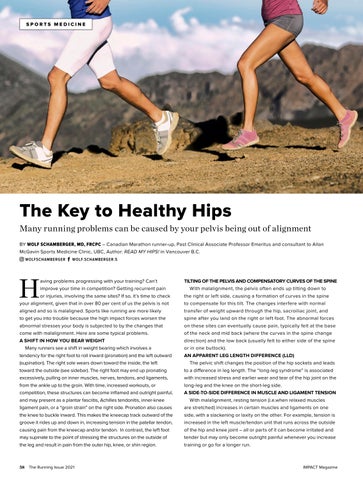
aving problems progressing with your training? Can’t improve your time in competition? Getting recurrent pain or injuries, involving the same sites? If so, it’s time to check your alignment, given that in over 80 per cent of us the pelvis is not aligned and so is malaligned. Sports like running are more likely to get you into trouble because the high impact forces worsen the abnormal stresses your body is subjected to by the changes that come with malalignment. Here are some typical problems. A SHIFT IN HOW YOU BEAR WEIGHT Many runners see a shift in weight bearing which involves a tendency for the right foot to roll inward (pronation) and the left outward (supination). The right sole wears down toward the inside, the left toward the outside (see sidebar). The right foot may end up pronating excessively, pulling on inner muscles, nerves, tendons, and ligaments, from the ankle up to the groin. With time, increased workouts, or competition, these structures can become inflamed and outright painful, and may present as a plantar fasciitis, Achilles tendonitis, inner-knee ligament pain, or a “groin strain” on the right side. Pronation also causes the knee to buckle inward. This makes the kneecap track outward of the groove it rides up and down in, increasing tension in the patellar tendon, causing pain from the kneecap and/or tendon. In contrast, the left foot may supinate to the point of stressing the structures on the outside of the leg and result in pain from the outer hip, knee, or shin region.
58 The Running Issue 2021
TILTING OF THE PELVIS AND COMPENSATORY CURVES OF THE SPINE With malalignment, the pelvis often ends up tilting down to the right or left side, causing a formation of curves in the spine to compensate for this tilt. The changes interfere with normal transfer of weight upward through the hip, sacroiliac joint, and spine after you land on the right or left foot. The abnormal forces on these sites can eventually cause pain, typically felt at the base of the neck and mid back (where the curves in the spine change direction) and the low back (usually felt to either side of the spine or in one buttock). AN APPARENT LEG LENGTH DIFFERENCE (LLD) The pelvic shift changes the position of the hip sockets and leads to a difference in leg length. The “long-leg syndrome” is associated with increased stress and earlier wear and tear of the hip joint on the long-leg and the knee on the short-leg side. A SIDE-TO-SIDE DIFFERENCE IN MUSCLE AND LIGAMENT TENSION With malalignment, resting tension (i.e.when relaxed muscles are stretched) increases in certain muscles and ligaments on one side, with a slackening or laxity on the other. For example, tension is increased in the left muscle/tendon unit that runs across the outside of the hip and knee joint – all or parts of it can become irritated and tender but may only become outright painful whenever you increase training or go for a longer run.
IMPACT Magazine