CANADA’S BEST SOURCE OF HEALTH & FITNESS INFORMATION
impactmagazine.ca
Olympic Bound ERICA WIEBE
STAYCATIONS WITH THE
WILD
TOP OUTDOOR
Podcast Picks
Hiking with Fido Follow us
THE OUTDOOR SUMMER ISSUE
With Shane Homes, you can love your new home, or customize it! Shane models are flexible so you don’t have to compromise on your new home wish list. Plus, customization is more affordable than you think! From condos to estate homes, and every style in between, there's a floorplan, price, and community that's just right for you.
LOVE IT OR... CUSTOMIZE IT! info@shanehomes.com
shanehomes.com
#YourShaneHome
The Calgary Zoo brings wonder and connects you to nature in fun, playful and educative ways. Get your tickets today at calgaryzoo.com
Photo by A Barrett Photography
Get off the beaten track.
For the ultimate adventure head to Golden, B.C.
In the heart of the Canadian Rocky Mountains, sitting at the confluence of two historic rivers and surrounded by six of Canada’s most stunning national parks you will find the mountain adventure town of Golden. Golden is a paradise for those seeking unrefined adventure and a wide variety of outdoor activities, including some of the best hiking opportunities in Western Canada. Choose from easy trails to challenging overnight hikes, all with spectacular scenery. Use the interactive ‘My Golden Experience Finder’ to help you to uncover your own unique Golden adventure. Help keep our community and visitors safe: Remember to check the latest public health advisories and follow the protocols. Find more hints and tips on travelling safely and responsibly at www.tourismgolden.com/travel
Start planning: tourismgolden.com
tourismgolden.com
THE OUTDOOR SUMMER ISSUE
CONTENTS
Cover photography by Graham McKerrell
76
Features 38 Tripping on the Wild Side Canadian travellers have a robust choice of safe wildlife encounters
42 Canada’s Olympic Sweetheart Wresting champion Erica Wiebe is ready to take on the world, again
46 IMPACT Picks for the Best Outdoor Podcasts We tuned in to a couple dozen podcasts to sift out our favourites
Inside Every Issue FIRST IMPACT
OUTDOOR
16 Outdoors For All 16 Campaign for Trail Running 18 Everyday Bike Maintenance
30 Hiking with Fido 32 Staying Safe in the Open Water 52 SUP Across Canada 54 Adventuring With the Family
FINAL IMPACT
82 A Natural Connection
AT H L E T E S W I T H I M PAC T
WORKOUT
48 Lifelong Passion for Whitewater 50 A Healing Journey
20 Take Your Fitness to the Next Level 24 Dynamic Cardio Kickboxing Sequences
TR AVE L
56 A Guide to Bikepacking SPORTS MEDICINE
28 Diagnosing Summertime Foot Injuries
FOOD & NUTRITION
RUNNING
72 Food for Thought 74 The Goods on Plant-based Protein
34 Training for an Ultramarathon RECIPES H E A LT H & W E L L N E S S
36 This Is Your Brain On Nature
ONLINE EXCLUSIVES
Visit impactmagazine.ca • Who to Watch in Tokyo • 2021 Trail Running Shoe Review • Outdoor Gear for Summer
6 Outdoor Summer 2021
76 Refreshing Juice Recipes to Give You a Boost 78 Maple Glazed Nut-free Trail Mix 80 Tropical Fruit Leather 82 Toasted Edamame with Cherry Tomatoes 83 Vegan Banana Bread Breakfast Cookies
52 IMPACT Magazine
42 48
24 38
IMPACT Magazine
Outdoor Summer 2021 7
COME AND RUN WITH US Sun Peaks Resort – August 22 – 5km, 10km Kamloops Area – August 29 – 12.5km, 25km, 50km
WWW.DIRTYFEET.CA
Sponsored Content
As Good As They Get Wireless Earbuds
Huawei’s FreeBuds 4i have all the features you’re looking for at an affordable price R E V I E WE D B Y N AD I A M O HARIB
W
hether you want to stay FreeBuds 4i brings some of the same connected on a run, ride or, functions found at much higher price-tags at long last, sit back and listen for $139 CAD. to some tunes while on a flight to a far-off Huawei calls FreeBuds 4i “the best destination - Huawei has you covered. deal on the market” because compared Its latest entry-level FreeBuds 4i, to other products in the under $150 CAD a replacement for the FreeBuds 3i, category they offer outstanding value with sports crystal-clear sound with active the inclusion of features not found in this noise cancellation (ANC). price segment, like its 10-hour, non-stop The earbuds are playback time. created to be sleek FreeBuds 4i The FreeBuds 4i and comfortable – brings some of the a feature that has same functions are designed to deliver been extensively found in products fantastic sound quality assessed with selling at much and a comfortable fit thousands of comfort higher costs – tests. There are extra but at a much at a great price. soft, silicone ear prettier price tag tips included with for $139 CAD. every pair so you can tweak your buds for a Taking these Bluetooth babies out better fit if that’s required. for a trial run, (in my case, a slow 5 km,) The FreeBuds 4i are designed to deliver I loved how they fit easily in my ears fantastic sound quality and a comfortable and perfectly isolated the piano music fit at a great price. soundtrack chosen for my athletic outing.
ADDITIONA L INFORMATION
Learn about the Huawei FreeBuds 4i at consumer.huawei.com/ca/headphones/freebuds4i FOLLOW
At the same price range, most earphones do not offer ANC. But Huawei FreeBuds 4i adopts built-in acoustic components and algorithms to generate inverted soundwaves – technology that allows the buds to actively cancel out noise and achieve a more immersive audio experience. I hear ya! The sound was sweet. Friends reported excellent sound quality on phone calls and I enjoyed the tap, double tap controls for taking/ending calls and to play/pause music. The luxuriously long playback time means these buds free up my hands for multi-tasking during long Zoom meetings and I don’t have the hassle of a recharge required when I close the laptop to head out for a dog walk. By the way, your FreeBuds 4i take just one hour to fully charge. And if you are in a rush, you can get four hours of music playback on a 10-minute charge. Inspired by the black sand beaches of Iceland, Huawei FreeBuds 4i has an edgeless design with curves like flowing water intended to enhance comfort for the user. Available in Canada in Ceramic White or Carbon Black (above), they also come in a colour-matching, sleek-looking charging case which fits easily into pockets.
OUTDOOR SUMMER EDTION VOLUME 30, ISSUE 5 A leader in the industry for 29 years, IMPACT Magazine is committed to publishing content provided by the best experts in their fields for those who aspire to higher levels of health and fitness.
VANCOUVER • CALGARY • TORONTO PUBLISHER & EDITOR-IN-CHIEF Elaine Kupser elaine@impactmagazine.ca GUEST EDITOR Marissa Tiel marissatiel@gmail.com ART DIRECTOR Kelly Findley design@impactmagazine.ca VP BUSINESS DEVELOPMENT Janet Henderson janet@impactmagazine.ca VP PARTNERSHIPS & MARKETING Rhyan Pietromonaco rhyan@impactmagazine.ca
COPY EDITOR
Tom Lundteigen
LEGAL COUNSEL
Gregory Forrest
PRINTING
Dollco Print Solutions Group
DISTRIBUTION
Media Classified Streetbox Media
CONTACT IMPACT Magazine Head Office 2007 2nd St. S.W. Calgary, AB T2S 1S4 403.228.0605 ADVERTISING advertising@impactmagazine.ca
SUBSCRIPTIONS $45 for one year, or $70 for two years (includes GST) impactmagazine.ca/subscriptions WEBSITE www.impactmagazine.ca
IEVE
MENT IN PU
BL
ING
© 2021 Impact Productions Inc.
CH
ISH
The opinions expressed in IMPACT Magazine are the writers’ and not necessarily those of the publication. IMPACT Magazine advises you to consult your physician if you do not follow a regular fitness program. All content is the property of IMPACT Productions Inc. and cannot be reproduced in any form without written consent of IMPACT Productions Inc.
impact-magazine
A
SOCIAL impactmag impactmag
2 013
impactmagcanada
EL
AIN
E KUPS
ER
Funded by the Government of Canada
10 Outdoor Summer 2021
IMPACT Magazine
October 1 – 31, 2021
# Move F o r wa rd TO R e g iste r at ST WM .c a
CONTRIBUTORS MARISSA TIEL Guest editor Marissa Tiel is an award-winning journalist based in Vancouver, B.C. Whether balancing on a ridge at the top of a mountain, fighting off clouds of mosquitos in the woods or fending off frostbite, she enjoys being in the moment to get the story. She is currently hiking the Great Divide Trail, an 1,100-km trail that begins in Waterton National Park, AB and ends in Kakwa Provincial Park, B.C. In 2018, she hiked the Pacific Crest Trail, about 4,265 km from Mexico to Canada. MARISSATIEL
MARISSATIEL WWW.MARISSATIEL.COM
GRAHAM MCKERRELL Cover photographer, Graham McKerrell is a commercial and sports photographer in Calgary, AB. His passion for photography and the outdoors comes through in everything that he captures. A captivating intensity, infectious exuberance and constant drive to deliver his best work are striking features of his personality. He believes that traveling and meeting bright, talented passion pursuers is the greatest inherent benefit to working with the outdoor community. MCKERRELLPHOTOGRAPHY
GRAHAM.MCKERRELL.9
KHYBERRIDER WWW.MCKERRELLPHOTOGRAPHY.COM
DOUG O’NEILL Based in Hamilton, ON, writer and nature enthusiast Doug O'Neill has been published in (and worked as an editor/blogger for) a wide variety of Canadian, U.S. and U.K. publications. He's also the co-author of 110 Nature Hot Spots in Manitoba and Saskatchewan: The Best Parks, Conservation Areas and Wild Places. His favourite hiking/camping accessory? “My portable espresso maker. Please don't judge me!” DOUGONEILL
DOUGONEILL WWW.MUCKRACK.COM/DOUG-ONEILL
JACOB PUZEY Jacob Puzey is the head coach and director of Peak Run Performance. He has run and competed around the world, from short races on the track to ultramarathons in the mountains. He currently coaches athletes from all over the world of all ages and abilities, from newbies to national champions and loves helping his athletes reach new heights in their running performance. Jacob currently resides in Invermere, B.C. TEAMPEAKRUN
TEAMPEAKRUN
PEAKRUNPERFORMANCE WWW.PEAKRUNPERFORMANCE.COM
HEIDI RICHTER Heidi Richter is a Vancouver Island, B.C. based food photographer and recipe developer. She fuels her passion for food, gardening and photography with copious amounts of matcha tea and sourdough bread. She is the author of the award nominated blog The Simple Green, which features plant-based recipes inspired by the magic of the seasons. THE_SIMPLE_GREEN
THESIMPLEGREEN WWW.THESIMPLEGREEN.COM
CONTRIBUTORS
Alexandera Houchin, Amy McDonnell, Andrew Alcalde, Brendan Brazier, Dr. Chana Davis, Chrissy Carroll, Dr. David Strayer, Dr. David Legg, Emily Jackson, Jacqueline L. Scott, Jari Love, John Churchill, Karen Dommett, Linda Abbruscato, Lina Augaitis, Mark Bittman, Dr. Mary Scourboutakos, Dr. Mark Fromberg, Megan McDuffie, Michael van Vliet, Nadia Moharib, Olivia Galati, Rachelle Haddock, Dr. Roy Mathews, Rhiannon Russell, Sarah McManaman. PHOTOGRAPHY
@Adventuresofwhisky, Beau Grealy, Bowhead Corp, Brain Changes Initiative, Cathie Archbould, Cairo Puzey, Eddie Clark, Emily Mangum, Heliconia, Indigenous Tourism BC / Sea Wolf Adventures, Jenia Kos, Jon Adrian, Joanne Sweeting / Tourism Golden, Katy Whitt, Kerri Conan, Kevin Clark, Megan McDuffie, Michael van Vliet, Pavel Boiko, Sarah Mcmanaman, Todd Duncan, Travel Alberta / Katie Goldie Wrestling Canada Lutte.
12 Outdoor Summer 2021
IMPACT Magazine
BOWNESS • BRIDGELAND CHINATOWN • EAST VILLAGE INGLEWOOD
SEPTEMBER 19 2021 calgarymarathon.com
@CalgaryMarathon @calgarymarathon @calgarymarathon
MEMO
The Impact
T
he past sixteen months have been life-changing, for better and for worse. Like many, I experienced personal loss during COVID, but also strengthened family bonds like never before. I’ve developed countless new relationships and partnerships thanks to video conferencing. My heart has been warmed by the Elaine Kupser, Publisher & number of old friends who have Editor-In-Chief come out of the woodwork to elaine@impactmagazine.ca help during these times. I have been reminded of the meaning of loyalty and the true, vibrant colours of the wonderful people I am surrounded by in my community. The adversity we have faced this past year has brought out the best in so many. And now it is time to get back to the gyms; to sign up for those races, to support our beloved fitness industry that gives so much to us, and so desperately needs us now. Get outdoors and support the local tourism right in your backyard. We are so fortunate to live in such a beautiful country. Last summer I put together a special digital edition of IMPACT Magazine, knowing it could have possibly been my last issue due to the hard times all local businesses had fallen on because of the pandemic. If I was going out, I wanted to go out big. I donated all of the advertising in that issue for free to businesses adversely affected by COVID-19, and my community of contributors were right there by my side to assist. We all banded together to
do what we could for one another, and it was a beautiful and inspiring moment. By surprise, we won a national magazine award for that issue and I was incredibly humbled and proud of that accomplishment, what it stood for, and for being recognized by my peers on a national level. It could have been a great way to complete my career; a good time to throw in the towel. But I’m not done yet. We have fought hard this past year to continue to stay in business and produce the best magazine possible for our readers. I still love what I do, and I’ve had so much help and support from my team, colleagues, advertisers and family. I’m now working on the 30th Anniversary Edition of IMPACT Magazine, which will be out this fall. In addition to celebrating 30 years in publishing, we will also be celebrating others in our industry with our Health, Fitness & Sports Industry Resilience Awards. I would like to thank my Guest Editor, Marissa Tiel, who was the perfect choice for this OUTDOOR Summer Issue. Many years ago, Marissa was a journalism intern with IMPACT, and has since thrived as an award-winning writer and photographer. She is an avid outdoor adventurer (Pacific Crest Trail; The Great Divide Trail) and I’m thrilled and thankful that we were able to steal a few months of her time in between adventures where she could share her knowledge and talents with IMPACT and our readers. Lastly, a special thank you to the beautiful and remarkable Erica Wiebe, who graces the cover of this issue. We can’t wait to cheer for you and all our Canadian Olympians in Tokyo next month! Stay strong, stay safe, and thank you for your continued support of IMPACT Magazine as we move towards our 30th year celebrations.
THE 2021 HEALTH, FITNESS & SPORTS INDUSTRY RESILIENCE AWARDS Presented by IMPACT Magazine Nominations go live July 30, 2021 www.impactmagazine.ca
14 Outdoor Summer 2021
IMPACT Magazine
LEASE A 2021 CADILLAC XT5 PREMIUM LUXURY AWD FOR ONLY EXAMPLE ON A 2021 XT5 PREMIUM LUXURY (MSRP $64,653)*
PER MONTH
+ 4 YEARS / 80,000 KM** PREMIUM CARE MAINTENANCE
CALL: (403) 265-7690 1720 BOW TRAIL SW CALGARY, ALBERTA
SHOP ONLINE AT WOLFECADILLACCALGARY.COM
NEW ELIGIBLE 2021 CADILLAC XT5 PREMIUM LUXURY OR LUXURY AWD STOCK NUMBER: AVAILABLE ON ELIGIBLE MODELS WITH AN MSRP BETWEEN $57,000 – $64,653 MSRP) WHILE AVAILABLE. LEASE WITH ALBERTA LEASECO LEASING - LEASING FOR A 48 MONTH TERM. MONTHLY PAYMENT OF $599 EXCLUDES GST. REQUIRES $1,515. CASH DOWN PAYMENT. INTEREST AT 4.99% APR (OAC), 16,000 KM PER YEAR KM ALLOWANCE. 0.20 PER EXCESS KM CHARGE. DRIVE OFF ON DELIVERY COST OF $1,515.39 WHICH INCLUDES ADMIN DOCUMEN DOCUMENTATION FEE $699.00. LICENSING, ADMIN, GOV'T, AMVIC $6.25, PPSA: 45.00, GM PREFERRED FEE $150 DEALER PREFERRED FEE $200 TIRE TAX $20.00 AND UPFRONT GST OF $18.81 INCLUDED IN DRIVE OFF PAYMENT, ADVERTISED PAYMENT OF $599 / MONTH EXCLUDES GST. ALL FEES & CAP REDUCTION. LEASE END VALUE BUYOUT COST: $28,600 +GST/DOC FEE. OFFER ENDS AUGUST 30TH, 2021.
FIRST IMPACT
CAMPAIGN FOR TRAIL RUNNING
Great strides are happening in adaptive sports The importance of recreation is well researched and perhaps unquestioned, and this is certainly the case for those experiencing disability. How a disability affects an individual varies of course and can range from physical, intellectual, sensory, and developmental. Thankfully, across Canada there are several programs that are leading the way with inclusive and accessible experiences, and these are examples for others to mirror. There are also several other commercial enterprises that are recognizing the benefits of handicapitalism and pursuing innovative approaches that ensure people experiencing disability can participate equitably. Based in Canmore, AB, Rocky Mountain Adapted offers outdoor programs for every season including alpine skiing, crosscountry skiing, snowshoeing and winter camping. In the summer, participants can take part in biking, kayaking and hiking including the use of a trail-rider, which is a modified wheelchair that looks like a cross between a wheelbarrow and a rickshaw. Friends are positioned in the front and back and act as sherpas by pushing and pulling the trail rider along the hike. New to the Alberta adapted outdoor scene is Adaptable Outdoors, based out of Pincher Creek, AB, now entering their second summer of adventure programming. Programs include hiking, fishing and paddling. In British Columbia, Whistler Adapted
16 Outdoor Summer 2021
offers similar programs as well as swimming, triathlon, yoga and gymnastics. The Niagara Penguins in St. Catharines, ON offer programs in handcycling and boccia, among others, for youth and young adults with a physical disability. All Trails now provides hand-curated trail maps and driving directions as well as detailed reviews and photos from hikers, campers and nature lovers focusing on trail access for persons using wheelchairs. There are also a plethora of commercial enterprises developing innovations through technology and equipment. Bowhead Corp adapted bikes in Bragg Creek, AB is pioneering the design of accessible mountain bikes, and Arc’teryx recently showcased the creation of a prosthesis for climbing that mimicked the design of a mountain goat’s hoof. Canada has fantastic outdoor recreation opportunities and kudos to the organizations profiled here that are helping enable persons experiencing disability to not just participate but lead and thrive. By David Legg, Ph.D, Professor at Mount Royal University in Calgary, AB davidfhlegg davidfhlegg — By Karen Dommett, Program Manager, Calgary Adapted Hub powered by Jumpstart in Calgary, AB yycadaptedhub yycadaptedhub yycadaptedhub
Since 1896, running has held a place at the Olympic Games. In the 125 years since that first instance of the modern Olympics, multiple running events have joined track and field as well as the road marathon, but trail running has remained absent from the Olympic programme. A group out of Spain is looking to change that. Organizers of the Penyagolosa Trails race, which is a stop on the Ultra-Trail World Tour, have launched a campaign to get trail running into the Games. They have their sights set on the 2028 Olympics, which are set to take place in Los Angeles, Cali. The West Coast state also happens to be home to one of the world’s most difficult and oldest 100-mile trail races, the Western States Endurance Run. An online manifesto argues that the discipline has already met the requirements to be part of the Olympics. Trail running is practised in more than 75 countries and five continents and it represents the core Olympic values of excellence, friendship and respect. The manifesto, Make Trail Olympic, also notes that trail running has been gaining popularity over time. An online petition has garnered more than 900 signatures as of press time. If the movement continues to gain steam, we may be able to watch a truly picturesque trail run through some world-class Californian terrain.
IMPACT Magazine
BOWHEAD CORP
Outdoors For All
Group aims for the 2028 Summer Games in Los Angeles
O R T H O D O N T IC HEROES. IN 3 CO NV EN IE NT
LO CATI ON S!
MARKET MALL, CANMORE AND NOW
ASPEN LANDING From a children’s early evaluation to a persistent jaw pain as an adult, we know that people dream of having a powerful smile and a healthy bite.
FIGHTING FOR HEALTHY BITES IN OUR COMMUNITY. Antosz Vincelli Orthodontics brings a fun environment, modern technologies and over 30 years of experience to help families take down the toughest orthodontic problems. Call us for a complimentary consultation at 587.355.8772
To learn about our locations visit avortho.ca
FIRST IMPACT
TOOLS & SUPPLIES • • • • • •
Everyday Bike Maintenance Things you should be doing after every ride
Bike Wash Chain degreaser Chain lube Brush set or microfiber rag Metric hex wrench set Floor pump
Since cleaning and lubrication are the most important maintenance activities, the items to complete that work should be your first purchases. Bike-specific cleaners are easier on paint and on seals that protect the moving parts of the bike. Chain degreasers are specifically made to remove the dirt and lube from chains. For fair weather cyclists, a dry lube is recommended since it will attract less dust. The main tool you will need is a metric hex wrench set, which will be able to take care of any axles for wheels, and all the little bolts on the bike for handlebars, stems, saddles, bottle cages etc. Lastly, a good floor pump to check tire pressure is the best way to prevent flats. Tires and tubes will not hold air forever.
BY JOHN CHURCHILL – Bike Fit Technician & Strength Coach at TCR Sport Lab in Calgary, AB TCRSPORTLAB
TCRSPORTLAB
I
TCRSPORTLAB
n a year with bike parts on high demand and in short supply, everyone should be taking extra care of their bikes. A clean and properly lubed chain will last much longer than a greasy chain that is black, or a dry, squeaky chain. Either way, too much lube that collects dirt, or too little lube can cause premature wear and need replacement much earlier. Regular inspection of the entire bike can catch loose bolts or parts so they can be taken care of before becoming a larger problem. The best way to take care of your bike between visits to the bike shop is to keep your bike clean and your drivetrain clean and greased. The best time to do this is as soon as you finish your ride. Using a regular, dry, clean rag will get most of the dust off of a frame and wheels as well as the braking surface (rim or disk). If the bike is a little dirtier than just dust, some bike cleaner in a spray bottle and that same rag will help remove some of the road grime from
18 Outdoor Summer 2021
the bike. Using a bike-specific cleaner can help with contamination of your braking surface to reduce any noise and maintain your braking power next time you ride. To degrease the chain and drivetrain, a chain degreaser and rag will do the job. Just spray the degreaser on the rag, and use it to scrub the majority of the old lube off the chain. If it needs more of a clean, you can spray the degreaser directly onto the chain and use the rag to wipe everything off. Just be careful to keep the dirty degreaser away from any braking surfaces. After you have cleaned your chain and gears, you will need to re-lube the chain. Squeeze one drop of chain lube on each link of the chain from the inside. You can do this by spinning the pedals backwards. Once the whole chain is covered spin the pedals backwards two or three times to get the lube fully into the chain. Allow that to sit for at least 15 minutes, then wipe any excess lube off the chain. Excess
lube will only attract more dirt making for a very dirty chain. At the beginning of every ride, a quick check of the bike should be done. First, and most important to safety, is to make sure the brakes are working well. Pull the brake levers and make sure they are engaging on the rim or the disk and that the wheels are moving freely. The second thing to check is that the quick-release axles are tight. Next, do a quick visual inspection of the bike. Check the tires for cuts or wear, check that all the bolts are tight, look at the gears and see that the derailleur is not going to move into the wheel. Finally, before setting out, check your tire pressure; 80 to 100 psi for road bikes, 40 to 60 psi for city bikes, 20 to 30 psi for mountain bikes. When in doubt, your tires should have a recommended tire pressure on the side walls. And the best part – get out there, ride, and don’t forget to smile!
IMPACT Magazine
READY TO TALK GROWTH? Rocky View County has a solid economic recovery strategy. Now is the time to plan for the future and invest. Cultivate your company’s success in Rocky View County.
Business & Economic Development
Rocky View County has the 5th largest tax base in Alberta and grew commercial and industrial assessment by 15.2% last year. Rocky View County has grown its commercial and industrial tax base by 379% since 2001.
THIS IS THE ROCKY VIEW ADVANTAGE.
WORKOUT
Exercises To Take Your Fitness to the Next Level These exercise movements are simple and effective! BY JARI LOVE Creator of the GET Ripped! Workout system and one of Canada’s Top Fitness Instructors 2021 in Calgary, AB RIPPEDJARI
JARILOVEFITNESS
Location: Repsol Sport Centre, Calgary, AB
W
hether you work out indoors at a gym or outdoors with your favourite hiking trails, these exercises can take your passion for fitness to the next level. By incorporating these exercise movements, you can help prevent injuries and also improve your sport. Proper technique, for any physical activity, comes from a strong foundation and core. By working our major muscle groups, such as our abdominal muscles, glutes, and quads, we build strength and muscular endurance.
20 Outdoor Summer 2021
IMPACT Magazine
1
1
STANDING ABS
1-3 sets, 20 reps each side • Standing upright with feet shoulder width apart, extend your right arm towards the ceiling. • Bring your right knee up to 90 degrees while bringing your right elbow down towards your right knee, crunching at the same time. • Avoid touching the floor with your right foot between each rep.
2
CROUCHING SQUATS
1-3 sets, 20 reps • Flexing the knees at 90 degrees, and rest your elbows on your legs. Keep your core tight and head forward. • Without locking your knees extend both (knees back) and feel the stretch in the hamstring then return back to your original position with knees flexed at 90 degrees. • You can do these as singles or pulses to make it more challenging.
KATY WHITT
2
IMPACT Magazine
Outdoor Summer 2021 21
3
NARROW ROW LUNGE WITH STEP & WEIGHTS
1-3 sets, 12-15 reps each side • Using a bench, place your right foot in the middle of the bench and your left foot back into a lunge position on the floor. • With weights in each hand and palms by your side and facing each other, bend your right knee to 45 degrees and hinge slightly at the hips so that the back is straight and leaning forwards slightly. • The weights will now be by your right knee with palms still facing each other. • The left back foot should be up slightly on your toes. • Bring your elbows back towards the wall, squeezing the scapula and simultaneously bringing your right knee up to 90 degrees while keeping your core tight and body straight. • Then, protract the arms towards the knees while bringing the right leg behind and lowering yourself into a lunge so that both knees are at 90 degrees. • Keep your core tight, the weights by your side, and chest up. • Then bring yourself up to the starting position by bringing your right foot back to the middle of the bench.
3
4
ELEVATION SQUAT WITH STEP & OPTIONAL WEIGHTS
1-3 sets, 15-20 reps each side • Using a bench, place your right foot towards the left edge of the bench and the left foot on the floor. • With weights in each hand by your side, keep your core tight and chest up, lower into a squat so that the knees are at 90 degrees while keeping the knees behind the toes. • Then come upright and place your left foot beside the right foot on the bench. • Keeping the optional weights by your side, take your right leg over to the right side of the bench and lower into a squat so that the knees are at 90 degrees while keeping your knees behind the toes. • Then return your right leg back beside your left leg, and repeat by bringing and standing your left leg back on the floor into that squat position.
4
22 Outdoor Summer 2021
IMPACT Magazine
WE’RE
BACK! Drop-in or purchase a Membership today!
forever active. forever strong.
WORKOUT
Dynamic Cardio Kickboxing Sequences Improve your endurance, coordination and stamina, just in the “kick” of time! BY ANDREW ALCALDE One of Canada’s Top Fitness Instructors 2021 in Vancouver, B.C.
WARM-UP: SKIPPING ROPE
ANDREWABRAHAMALCALDE
5-10 Minutes We all know that a 5-10 minute warmup is the best way to get the blood flowing, synovial joints moving and the major muscle groups prepared for exercise. An efficient warm-up that goes hand in hand with kickboxing is the skipping rope. It tones the muscles, creates definition and builds stamina. Additionally, the skip rope improves hand-eye coordination, lateral movement, speed and agility, which effectively prepares us for the following exercises. To prevent injury, stay light on your feet and bounce weight from left to right. For an added challenge, perform a 2-minute skipping rope interval in between each exercise.
ANDREW.A.ALCALDE
T
TODD DUNCAN
he summer months are here, the sun is shining and many of us, if not most, want to take advantage of the beautiful weather. While most fitness facilities across the country have reopened, we find ourselves torn between choosing to work out indoors or basking in the warm sun rays. So why not combine them and use nature as our fitness studio! Cardio kickboxing is the perfect workout that combines full-body aerobic exercises with boxing and martial arts movement. There is less emphasis on technique, keeping the boxing martial arts moves simple. The good news is, this workout offers very little to no resistance training and can be performed anywhere. The focus of cardio kickboxing is simple: movement, fun, accessibility and safety. It is a full-body workout that helps build stamina and cardiovascular endurance, stimulates the mind, builds confidence and is the perfect release after a stressful day. Here are a few killer workouts to add to your routine to keep the heart rate going, target the appropriate muscles and make you feel like an ultimate fighter!
24 Outdoor Summer 2021
IMPACT Magazine
1
1
SQUAT & FRONT KICK
2 sets, 8 reps on each side Variation: 16 reps alternating sides • To begin, stand straight with feet hip-width apart and tighten your stomach muscles. • Mimicking a traditional boxing stance, bend your elbows and bring your fists close to your chin. • Lower down as if sitting in a chair. • Return to the starting stance, but as you straighten your legs to lift, shift body weight onto your left leg. • With the right leg, leading with the knee, extend your foot out. • Return to the starting position and sit back into the squat.
2
FRONTAL KNEE RAISE & BACK KICK
2
2 sets, 8 reps each side Variation: 16 reps alternating sides • Stand tall and plant both feet on the ground with arms raised straight above your head. • Pulling arms down and shifting weight on to the left leg, raise your right knee to the center of the body meeting both arms. • Return to your starting stance. Shift weight on to the right leg. • Look over your left shoulder, focusing on a target behind you, and extend your left leg behind you driving your heel towards that target.
3
3
LUNGE & TORSO TWIST
3 sets, 8 reps on each side Variation: 16 reps alternating sides • Step forward with your left foot until your leg reaches a 90-degree angle but try not to bend your left knee past your toes. • Plant foot into position. • Your back leg will also bend at a 90-degree angle, raising the back heel off the floor. • When in the lowered position, twist your torso to the left side and return to front-facing. • Stay in position and continue to twist your torso until reps are complete. • Step back to standing position. Trainer’s Tips • Always be light on your feet and in ready position at all times. • Stay on the balls of your feet with the heels available to pivot and turn. • When it comes to kicks, think about power and not height. • It’s not about the height of the kick, but the intensity of the strike. IMPACT Magazine
Outdoor Summer 2021 25
4
4
MOUNTAIN CLIMBERS
5 sets, 1 minute work rate, 30 second rest rate Mountain climbers are an incredibly effective exercise, engaging multiple muscle groups at once. They fire your heart rate up, working nearly every muscle group in the body. They are a very accessible movement that can be performed anywhere, with just you and your body weight. • Start in a press-up position, making sure your hands are shoulder-width apart and directly beneath them. • At the desired speed, pull the left knee towards your chest without letting it touch the ground. Trainer’s Tip • When performing this exercise, keep your abs tight, stay light on your toes, maintain a tall spine and be sure your bottom is not rising into the air.
5
5
DOUBLE LATERAL & ROUNDHOUSE KICK & JAB
3 sets, 8 reps each side Combining basic kickboxing movements to create sequences, this combo mimics the feeling of being in a ring with an opponent. Performing combinations also improves your hand-eye coordination, technique and endurance. Besides, a little bit of choreography never hurt anyone! • In a basic fighting stance, shift weight to the right side, maintaining your balance. • Pull both arms across the body and raise your left knee until they meet in the center. • Return and repeat motion. • Set the heel of your right leg towards the direction of your kick. • Keep your arms raised and bring your leg up to the side. • Snap your leg forward and ensure the heel of the right leg is still in place with the direction of your kick to deliver maximum power. • Return to the fighting stance. • Guards up from the fighting stance position, put your weight into throwing a jab with your left arm. • Return to basic fighting stance. Trainer’s Tip • Just remember that your punch should be powered from your core, shoulder and back muscles and not just from the elbow to the wrist.
26 Outdoor Summer 2021
IMPACT Magazine
SPORTS MEDICINE
Diagnosing Summertime Foot Injuries Prevention and treatments for your sole BY DR. ROY MATHEWS, D.P.M. – Podiatrist at Vancouver Podiatry in Vancouver, B.C. VANCOUVERFOOTDR
PODIATRISTVANCOUVER
W
ith summer on our doorstep, most people are looking to spend more time outside and be more active. This includes more walking, hiking, running and exploring our beautiful landscape and your feet will help you go the distance. However, an increase or change in activity can lead to pain in the foot and ankle. In fact, some of the most common injuries we see at our practice occur from simple walking and being active. In general, foot pain is caused by faulty foot mechanics that over time will stress the bones, joints, ligaments, tendons, muscles and even nerves of the foot. It is necessary to treat the mechanical or structural cause of the pain to reduce the chance of permanent damage. Here are the most common biomechanical foot problems and how you can manage them:
PLANTAR FASCIITIS (HEEL PAIN) The plantar fascia is a tendon-like structure that runs from the heel bone all the way into the toes. The force of body weight on the foot can cause the arch to lower and the foot to lengthen, stretching out the plantar fascia. Over-pronation (rolling of the foot towards the center of gravity) or pronating too long during the gait cycle are the most common causes of plantar fasciitis. Pain will usually, but not always, present itself in the heel first thing in the morning or after some rest. It may also increase with long periods of standing and walking. Simple treatments such as rest, ice and anti-inflammatories can be helpful in the acute phase. If pain in the heel or arch persists for longer than three weeks, proper assessment is necessary to treat the cause. Long-term therapies include strengthening of the arch, proper shoe gear, custom orthotics, steroid injections, laser and in the worst-case scenarios, surgery. Prevention of plantar fasciitis is achieved by strengthening the foot’s arch by walking barefoot, toe walking and calf raises. Wearing supportive shoes and arch supports with strenuous activities is essential if you over-pronate or have flat feet.
28 Outdoor Summer 2021
METATARSALGIA (PAIN IN THE BALL OF THE FOOT) A common area of pain in the summer is caused by shoes with minimal support such as flip flops and light shoes. Pain in the ball of the foot, under the central metatarsal bones, usually starts as an ache at the end of the day. Pain can increase and affect walking. The most common cause of metatarsalgia is a collapse of the metatarsal arch, the arch in the ball of the foot, or as a hammertoe develops. Too much pressure under one bone can eventually lead to a stress fracture of the metatarsal bone. Treatments include more supportive shoes with significant cushioning, arch supports, custom foot orthotics, immobilization and rest. Seeking a professional assessment to determine the structural cause is always important. If you have structural mal-alignments such as a bunion or hammertoe, prevention of stress to the forefoot is essential. This is achieved with orthotics or corrective surgery.
BUNIONS A bunion is a mal-alignment of the big toe joint as it slowly shifts out of the foot. Bunions are very misunderstood as for years people have been mistakenly told these are bumps of extra bone that grow out of the foot. A bunion needs to be assessed properly with X-rays to evaluate how far the bone has shifted out of the foot. Surgery involves shifting the bone permanently back into the foot, not cutting the bone off. The most modern bunion surgery allows walking in a running shoe two to three weeks after surgery. The best way to prevent bunions, especially if you have a history of them in your family, is to avoid shoes that compress the toes. Strengthening the arch will help avoid overpronation and decrease pushing the big toe towards the second toe. If any type of foot pain lingers for more than four weeks, it is best to seek professional help to assess the mechanical cause of the pain.
IMPACT Magazine
IRRC ARE LOCALLY OWNED COMMUNITY DRIVEN SPECIALTY RUNNING STORES FI N D AN I N DE PE N DE NT R ETAI LE R N EAR YOU!
32 YEARS STRONG Helping our clients live healthier lives – one workout at a time
W
e work with people of all shapes and sizes but we love working with clients who want to fight ageing every step of the way,” says One on One owner Sandra Bueckert (pictured below). “Age is the great equalizer and at 55, I’m a part of the resistance.” “I chose One on One many years ago as I wanted to gain muscle
and become stronger,” says Elizabeth Walsh, a 20-year client. “I knew the best way for me was to be with experts and to have appointments I would not miss.” There are no fads or gimmicks at One on One. It’s the home of sweat equity. Workouts for clients looking to reach their goals online or in-person are by appointment only. “Every client has different goals and different issues to consider. We get it. We understand,” says Sandra. If you’re ready to expand your path to physical and mental health, maybe it’s time to give Sandra and her team a call at One on One.
Personal Fitness Instruction Inc. Personal Training Nutritional Consulting
JOIN THE 2021
LEAN AND MEAN CHALLENGE What is the challenge? The top two CLIENTS that lose the most body fat between July 8 and Nov. 25 win prizes. In celebration of our 32nd anniversary, there’s over $2,500 in prizes including a $1,000 shopping spree for the winner. BODY FAT TESTING STARTS ON JULY 8
www.oneononefitness.ca 1516 17 Ave. SW, Calgary, AB 403.244.9059 oneononefitness@shaw.ca
IMPACT Magazine
Outdoor Summer 2021 29
OUTDOOR
HIKING WITH FIDO How to make the most of the trails with your pooch BY SARAH MCMANAMAN Expert dog trainer at Sublime Canine Services, and avid dog hiker in Dartmouth, NS CALLOFTHEWILDCANINES
30 Outdoor Summer 2021
CALLOFTHEWILDCANINES
S
ummer is finally upon us and there is truly no better feeling than hitting the open trails with your dog. It just feels right. Not to mention it is one of the best things you can do for your own physical health and mental wellbeing not to mention your dog’s. Here are some considerations before taking to the great outdoors with your dog.
TO LEASH, OR NOT TO LEASH? There is nothing I love more than watching dogs romp around in the forest, truly enjoying life to its fullest. That being said, it might not be appropriate for all dogs. You need to truthfully ask yourself: is it safe to let my dog off-leash? If the answer is yes, then go for it! If the answer is no, that is OK too. Dogs can still have an excellent outdoor adventure while on-leash. You can get a good harness and hands-free leash and start exploring. You could also try using a long line (which can come in lengths of 10, 15, 25, 30+ feet) to give your dog extra room to stretch those legs and sniff around while still having a safety line attached to them.
IMPACT Magazine
LEFT There’s no
4 ADVENTURE HOUNDS & A CAT TO FOLLOW ON INSTAGRAM
better feeling than hitting the trails with your dog. RIGHT Whisky and Echo love exploring the wilderness.
JINX, ZEUS & THOR @SOLANALEIGH Squamish, B.C. Human: Solana Favourite adventure spot: Trail running and adventuring in the backcountry
ROO @ROOHADYMOOSE Guelph, ON Human: Alyse Favourite adventure spot: Bruce Peninsula backcountry
WHISKY & ECHO @ADVENTURESOFWHISKY Cochrane, AB Humans: Taffin & Jared Favourite Adventure Spot: Canmore, Banff & Kananaskis
KOBI @OUTDOORRUNNING Fort Nelson, B.C. Humans: Angie & Jay Favourite adventure spot: Stone Mountain Provincial Park
GARY (THE CAT) @GREATGRAMSOFGARY
WHAT ARE THE LAWS?
WATER
Check the internet before hitting the trail. In some areas you may be free to unclip that leash, but a lot of national and provincial parks or protected areas require your dogs to remain on-leash. Some areas won’t allow dogs at all, so make sure you check to see whether or not the area has any rules about dogs.
If you aren’t hiking along a lake or river, you are going to need to bring water for your dog. Be mindful of keeping them hydrated and not hiking in extreme heat. The last thing you want is a dog with heat stroke when you are 10 kilometres into the woods.
TRAIL DIFFICULTY Is your dog well-conditioned and physically fit, or are they a weekend warrior? If you are just starting out adventuring with your dog, take the trail difficulty into account. A 20-kilometre hike for your dog’s first hike may be too strenuous, so start small and build up from there.
IMPACT Magazine
SAFETY Safety first! Pack a first aid kit. Know your area. Check to see if you will have cell reception in the area before you go. Make sure your dog’s microchip information is up to date and that they have a collar with an ID tag attached. If ticks are an issue in the area you are going, ask your vet about tick preventatives and give yourself and your dog a good once over to check for ticks after your day in the woods. Stay safe and have fun!
Outdoor Summer 2021 31
SARAH MCMANAMAN, ADVENTURESOFWHISKY
Canmore & Edmonton, AB Human: James Favourite adventure spot: Lake Louise and Moraine Lake
OUTDOOR Professional swim coach, Mark Fromberg knows a thing or two about open water swimming.
STAYING SAFE IN THE OPEN WATER Pro tips every swimmer should know BY MARK FROMBERG, MD Retired physician, author and open water swim coach in Kelowna, B.C. OPENWATERSWIMBOOK
32 Outdoor Summer 2021
IMPACT Magazine
JON ADRIAN
N
othing quite like a pandemic for us all to consider new forms of outdoor activities that can be done without a lot of people or exercise facilities. Open water swimming has floated to the top of many people’s list almost everywhere. With so many people opting to try out lakes, rivers, and oceans over pools, many of which have imposed all kinds of restrictions, it might be a good time to remind swimmers of some safety best practices. To stay safe in open water versus a pool swim, there are many important differences to consider. Many of these become quickly evident as unsettled anxiety when stepping into a broad watery expanse, even among seasoned pool swimmers.
For those who are already competent swimmers, consider the following: 1. Open water swims are not temperaturecontrolled like most pools are. A pool may be a comfortable 26-28 C, while open water (lake, river, ocean) can be 10-15 C colder. In this case, swimming with a wetsuit may be strongly recommended, especially if you are thinly built or expect to be immersed continuously for more than 15-20 minutes. Even if the open water temperature reaches a comfortable 22 C, this temperature is a full 15 C colder than your body core temperature, enough to risk hypothermia with sustained exposure, especially in thinner people. Since we all have different builds and different tolerances to the cold, every swimmer needs to recalibrate their cold exposure, especially if not wearing a wetsuit. 2. Cold water exposure, especially to the face and neck, is also known to cause a number of cardiac reactions in susceptible people. The macho desire to run and then dive into cold water without acclimatizing first is not a great idea. Walk in, splash water on your face. Ease into the colder environment, especially early in the open water swim season. 3. Most open water swims are often too deep or too murky to see bottom, which by itself is unsettling for some swimmers as they worry what is in the water. Regardless of if you can see bottom, there is no line underneath you (as there is in a pool) to guide you, meaning that your ability to swim straight will require a new skill: sighting. To take on virtually any open water swim, this is a must-have skill, which includes an assessment of the landmarks that will guide your swim, be it buoys or land-based structures. 4. Swimming alone in open water is generally a bad idea unless you are intimately familiar with the water you are swimming in. Learning about the currents, the tides, the undertows, drop-offs, possible boat traffic, and underwater hazards is usually best done with someone with intimate knowledge of the water you are contemplating swimming in. Learn your open water intimately, and consider
IMPACT Magazine
how the weather forecast can change everything, including your risks when winds and waves can challenge even the most experienced open water swimmer. Some days you will need to shelve your best laid plans to swim open water. Can you say: “Not today?” 5. Wearing a brightly coloured swim cap and using a personal swim buoy are great strategies to be seen by others who may be monitoring your swim, and by those in
watercraft who may not be expecting to see a swimmer off their bows. Once familiar and comfortable with the many variables that present themselves in rivers, lakes, and oceans, open water swimming can be a meditative, relaxing experience. No two swims are ever the same, since the water and the weather offer new variables every day. Think about commonsense safety first, and then reap the benefits of a sport you can do for a lifetime.
OPEN WATER SWIMMING GEAR Open water swimming doesn’t have to be an expensive sport. Open water access is almost always free, and the equipment needed can be easily procured for a few hundred dollars. Here is a list of the most useful/recommended gear for open water swimmers: Goggles This is another important piece of equipment that needs to fit well and be relatively free from too much wear and tear. It should not leak and should allow to see well both directly and peripherally. Since we all have different faces, find the brand that fits best on your face, without any pressure points. Remember that it is harder to adjust goggles in deep, open water than it would be in the pool. In open water, other goggle features are also potentially important. Like sunglasses, if they are tinted or reflective, they can diminish glare on sunny days, which can be critical when trying to sight for a buoy or an object on shore. Swim cap You should always wear a brightly colored swim cap when swimming in open water, first to be seen, and second to keep your head warm, since you can lose a lot of heat through your head. When the water is under 20 C, a silicone cap is thicker (and therefore more insulative) than a latex cap; If the water is under 15 C, consider double-capping (two silicone caps, with the outer one being brightly colored, or wearing a neoprene cap under your swim cap. Tracking and/or timing device If you are keen to understand your swim distance and swim speed, get yourself a tracking device, such as a Garmin product, most of which now work well in water. For most others, an ordinary Timex watch can be useful, not only to time your swim route, but also to keep track of how long you have been in water, which may be critical information on colder swims.
Wetsuit Unless you are in the tropics, this is your most important single piece of equipment. It will keep you well insulated from the cold to allow longer swims, and will provide you additional floatation, enough to make it all but impossible to dive even a few feet down (this is why scuba divers need weight belts). The wetsuit must fit you well and should not have any significant tears in it. It is also critical that you feel comfortable in a wetsuit, since many can feel anxious with the feeling of chest compression if it is even slightly too small. Keep in mind that wetsuits that are made for swimming are different from suits made for kiteboarding or waterskiing, which are not usually built for shoulder flexibility or minimal water resistance. Personal Swim Buoy (PSB) In recent years, PSBs like the Swim Buddy have become very popular with open water swimmers (and increasingly in open water swim races), giving them a feeling of added safety knowing that they can be more easily seen, whether by boats, other swimmers, or supporters nearby. They can also provide a resting platform on a long swim. They are brightly colored (orange, pink, green and yellow are common colors), and vastly improve the visibility of an open water swimmer, who may be hard to see while mostly submerged among waves in a black wetsuit. Many PSB models even have a dry bag within them, allowing personal items (T-shirt, sandals, towels, car-keys, etc.) to be carried along on a point-to-point swim.
Outdoor Summer 2021 33
RUNNING
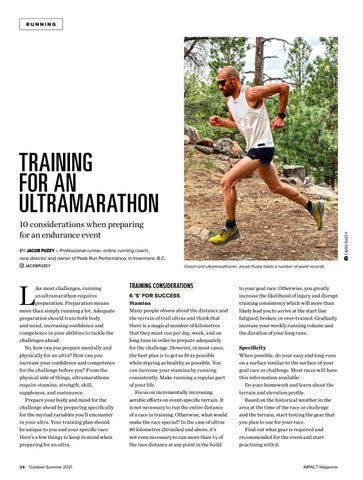
TRAINING FOR AN ULTRAMARATHON CAIRO PUZEY
10 considerations when preparing for an endurance event BY JACOB PUZEY – Professional runner, online running coach, race director and owner of Peak Run Performance, in Invermere, B.C. JACOBPUZEY
L
ike most challenges, running an ultramarathon requires preparation. Preparation means more than simply running a lot. Adequate preparation should train both body and mind, increasing confidence and competence in your abilities to tackle the challenges ahead. So, how can you prepare mentally and physically for an ultra? How can you increase your confidence and competence for the challenge before you? From the physical side of things, ultramarathons require stamina, strength, skill, suppleness, and sustenance. Prepare your body and mind for the challenge ahead by preparing specifically for the myriad variables you’ll encounter in your ultra. Your training plan should be unique to you and your specific race. Here’s a few things to keep in mind when preparing for an ultra.
34 Outdoor Summer 2021
Coach and ultramarathoner, Jacob Puzey holds a number of world records.
TRAINING CONSIDERATIONS 6 ‘S’ FOR SUCCESS Stamina Many people obsess about the distance and the terrain of trail ultras and think that there is a magical number of kilometres that they must run per day, week, and on long runs in order to prepare adequately for the challenge. However, in most cases, the best plan is to get as fit as possible while staying as healthy as possible. You can increase your stamina by running consistently. Make running a regular part of your life. Focus on incrementally increasing aerobic efforts on event-specific terrain. It is not necessary to run the entire distance of a race in training. Otherwise, what would make the race special? In the case of ultras 80 kilometres (50 miles) and above, it’s not even necessary to run more than ¾ of the race distance at any point in the build
to your goal race. Otherwise, you greatly increase the likelihood of injury and disrupt training consistency which will more than likely lead you to arrive at the start line fatigued, broken, or over-trained. Gradually increase your weekly running volume and the duration of your long runs. Specificity When possible, do your easy and long runs on a surface similar to the surface of your goal race or challenge. Most races will have this information available. Do your homework and learn about the terrain and elevation profile. Based on the historical weather in the area at the time of the race or challenge and the terrain, start testing the gear that you plan to use for your race. Find out what gear is required and recommended for the event and start practising with it.
IMPACT Magazine
What shoes will you wear? What socks? Shorts? Top? Will you wear or carry a jacket? Will you carry sleeves or gloves or a neck gaiter? Will you wear a hat or glasses? Will you layer your clothing? Will there be drop bags and crew access points, or will you be required to carry everything for the duration of the event? How much will the temperature and the weather fluctuate throughout the course of the race? Sustenance Find out what foods and fuels will be on course as well as the distances between aid stations. Test the nutrition that will be on course on your long runs to determine what works for you and what you will be better off not consuming while racing. Remember we don’t want to try new things on race day, so training with nutrition that will be on the course is important so you know if it works for you, or not. Based on the distances between aid stations and the time that you anticipate it taking for you to move from aid station to aid station, determine how much liquid and calories (along with other gear) that you’ll need to carry. How are you going to transport it: will you wear a pack, a belt, or use hand-held water bottles? How much liquid will you need to carry between aid stations? What fuel sources do you want to carry to eat between aid stations? Will there be drop bags? Will you be able to ditch some of your gear and clothing and fuel at certain aid stations or be able to pick up more at another? Strength You can increase your strength and durability by training on undulating terrain, strength training and crosstraining. Ascending and descending hills prepares the legs for the challenges you’ll encounter on race day. Adding some lunges and functional strength work will help prepare the legs for the strain that they’ll experience in an ultra. Additionally, cycling, hiking, swimming, and Nordic skiing will continue to build your aerobic
IMPACT Magazine
base while reducing the impact between the ground and the body. Combined, these efforts will increase aerobic fitness and muscular endurance, reduce the risk of injury, and prepare the body and mind to tackle and ultra.
perceived exertion) for most of the race as a means of keeping your heart rate at a sustainable rate. Are pacers permitted? If they are, will you have someone to pace you for a portion of the run?
Speed As odd as it sounds, despite the relative “slow” pace of most ultras, there is still a place for speed work in a well-rounded training program for an ultramarathon. The goal of speed work for ultrarunners is not so much to increase the VO2 max per se, but rather to maximize the running economy of the athlete–in other words, the efficiency with which an athlete moves. You want to be able to maximize the speed at which you are able to move while minimizing the amount of effort required to do so. The more economical you learn to run, the lower the likelihood of injury and the more efficiently (faster with lower energy expenditure) you’ll be able to move from point to point.
Specific Equipment What time does the race start and when do you think you’ll finish? It could quite possibly be dark. How will you light the way? Will you wear a headlamp or a handheld light or both? When will you need it? Will you start with it and then stuff it in a pack or drop bag or will you need to pick one up from your crew or drop bag later in the race? If you will need a light at some portion of the race or challenge, be sure to practise well in advance so that you are comfortable using the light(s) that you intend to use. Are support crews permitted? If they are, will you make use of one of your own? They could provide you with additional food, gear or aid while on the course.
Suppleness Ultramarathons require mental and physical flexibility. With increased training volume often comes increased tension so it’s important to decompress from time to time. This can be done through yoga, foam rolling, and stretching.
RACE DAY CONSIDERATIONS You’ve done the hard work – the preparation and training – now it’s time to really think about the race. Not all races are created equal, so you’ll want to cater your race-day plan to your specific event. Pacing When it comes to race strategy, learn to run by feel. Many ultras are on trails which means that the terrain will likely vary and weather will change throughout the duration of the race. Aim to keep your effort at or below your first ventilatory threshold (6/10 on the scale of rate of
Fuel Make fueling early and often the priority throughout the race so that you can prolong the onset of the inevitable bonk. This will allow you to use the fuel that you consume more efficiently. Mental From a mental standpoint, it’s important to minimize stress and tension. Hope for the best and prepare for the worst. Make a plan and plan to execute it, but also be equally prepared to scrap the plan and shoot from the hip. The ability to troubleshoot is key to success at ultrarunning. If you plan to have a crew or pacer, make sure that you surround yourself with those with the ability to troubleshoot and the ability to be flexible. The ability and confidence to troubleshoot often come from experience. This can come through racing as well as training by simulating race type circumstances. For more information on training considerations, visit : www.peakrunperformance.com
Outdoor Summer 2021 35
H E A LT H & W E L L N E S S
This Is Your Brain On Nature Spending time in nature benefits mental & physical health BY DAVID STRAYER, PhD & AMY MCDONNELL David is the John R. Park professor and head of Cognitive Neuroscience Amy is a graduate student in Cognitive Neuroscience; Department of Psychology at the University of Utah in Salt Lake City, UT
I
f Henry David Thoreau were alive today, he would probably tell you to get off your cell phone or computer and take a hike in a park or, better yet, take a longer trek into nature. Recent advances in environmental neuroscience are supporting Thoreau’s admonishing. Over the past few decades, researchers have accumulated evidence showing that spending time in nature benefits mental health, physical health, stress physiology, and cognitive functioning. This may seem intuitive. As our world becomes more and more urbanized, people spend an increasing amount of time indoors. For many of us, getting outside and into nature is the “mental reboot” we need to recalibrate our senses and reconnect with our evolutionary roots. We often return from an outing feeling more focused and less stressed. But why? Research suggests that being in nature changes the way we attend to the world around us. In our everyday urban environments, we are constantly bombarded with stimuli competing for our limited attention–email notifications, text messages, television and persistent chatter. Over time, this constant stimulation depletes our neural reserves. When we are in nature and off our technology, we give the brain a chance to rest and recuperate from these relentless attentional demands.
36 Outdoor Summer 2021
Researchers at the University of Utah are studying how this cognitive restoration may be reflected in our brain activity. Dr. David Strayer and his colleagues in the Applied Cognition Laboratory take research participants deep into the wilderness of Southern Utah and record brain activity using electroencephalography, or EEG. EEG is non-invasive, temporally sensitive, and can provide a more objective measure of an individual’s experience without relying on self-reports, which are known to be subject to participant bias. Strayer’s lab explores how attentional processes in the brain change in nature compared to urban environments. Because urban environments place higher demand on our attentional networks than natural environments, Strayer hypothesizes that we should see a change in how neural correlates of attention function in nature. To date, Strayer and his team have observed improvements in brain activity related to working memory, visual engagement, and error-processing after immersion in nature for four days. Environmental neuroscientists are working to understand what it is, specifically, about nature that has such a positive impact on the brain. Is it the exercise that is often associated with being outside? Is it that we stow away our cell phones and attend to a more quiet world around us? Is it the socializing we do around a campfire? Or is it the sum of these elements that creates a more restorative environment and gives the brain a chance to rest and recuperate? We lean on wisdom from scientists and philosophers, alike, to better understand Thoreau’s insights. For more information, check out Strayer’s TEDx Talk on YouTube.
IMPACT Magazine
INDIGENOUS TRAIL RUN SERIES
A race series to promote a healthier way of life through physical activity; bringing communities together!
Sept. 25, 2021 9:30AM-4PM
Oct. 2, 2021 8AM-3PM
3 CATEGORIES: Solo Race; 2 Person Team (beginner trail run/walker); Corporate (3 people)
Blackfoot Crossing Historical Park Trail Race
Tsuut’ina Trail Run
Enjoy a 15 km trail run through the beautiful scenery of the traditional Blackfoot territory surrounding the area where Treaty Seven was signed on the 22nd of September, 1877.
A 15 km trail run of amazing scenery on the beautiful Tsuut’ina Nation overlooking the Canadian Rockies with two creek crossings and elevation changes.
For more info, visit the SN7 Facebook page
@siksikarecreation
For more info, visit
www.7chiefs.com/trailrun
REGISTR ATION IS NOW OPEN!
TRIPPING ON THE WILD SIDE CANADIAN TRAVELLERS HAVE A ROBUST CHOICE OF SAFE WILDLIFE ENCOUNTERS BY DOUG O’NEILL Writer, author and nature enthusiast in Hamilton, ON DOUGONEILL
38 Outdoor Summer 2021
DOUGONEILL
IMPACT Magazine
A colony of sea lions is among the comon wildlife sightings on the West Coast.
A
wildlife biologist once told me that you’re more apt to smell a moose long before you see it. That wasn’t the case for me one summer afternoon two years ago when I was hiking Beaver Pond Trail in Algonquin Park, in an area just off Highway 60 that’s known for wildlife-viewing. As the trail name suggests, I was out to observe beavers. I only twigged to the presence of something bigger than me—and bigger than a beaver—when I heard the sudden snapping of a fallen branch behind me. Like a scene out of Blair Witch, I knew I was being watched. After standing still for about 15 minutes, the hoofed ungulate with flattened antlers clumsily emerged from behind a thicket of cedar trees.
FREE-ROAMING BISON Knowing that the plains bison in North America once numbered 25 million— before the decades-long slaughter— endears visitors to the herd of 40 majestic plains bisons (distant cousins to the buffalo) that roam freely throughout the 500-hectare Lake Audy Bison Enclosure at Riding Mountain National Park in southern Manitoba. Either from the elevated viewing platform or from the safety of their vehicles, visitors can observe the bison (which weigh as much as 2,000 pounds), a mix of females, bulls and calves. Other wildlife sightings at Riding Mountain National Park include elk, coyotes, moose, timber wolves, beavers, white-tailed deer and snowshoe hares.) You can also see bison—along with elk, of course—at Elk Island National Park in Alberta.
IMPACT Magazine
GET DOWN WITH WOLVES I hesitated when owner-wolf protector Gilles Granal instructed me to crouch on the ground in the 40-hectare wolf enclosure at Adventuraid Park Mahikan, an eco-adventure camp and wolf sanctuary in the Saguenay-Lac-SaintJean region of Quebec. Granal explained how wolves can read a human’s emotional state as I slowly knelt on the scratched ground while two curious grey wolves, named John and Luna, circled closer, cautiously sniffed me and then playfully tugged at my sleeves. Granal stayed close, watching the wolves. “Luna likes you,” he said. An unexpected face lick confirmed it. Guests who spend the night in one of the cabins at the sanctuary can listen to the wolves’ nocturnal howling. Alternatively, you can join scheduled public Wolf Howls at Bonnechere Provincial Park in Ontario. In Western Canada, you can take in an interpretive tour at Northern Lights Wolf Centre in Golden. B.C., and spend some time walking with the wolves. Closer to Calgary, there’s the Yamnuska Wolfdog Sanctuary. On its 160 acres near Cochrane, the sanctuary introduces you to wolfdogs through a variety of tours, including the option to enter an enclosure with the four-legged stars themselves.
INDIGENOUS TOURISM BC / SEA WOLF ADVENTURES
Perhaps it was the cow moose’s siesta time or maybe it was simply disinterested in my human presence, but after a few minutes (during which I was engulfed in a cloud of her powerful scent) she continued her ungainly saunter. Why hadn’t I sniffed the beast sooner? Had I been upwind from the creature? Was the moose’s odour (think wet dog smell amplified a hundredfold) lost in the pungent scent of cedar? That’s the wonder of wildlife encounters: you become more attuned to nature—and to your own senses.
Outdoor Summer 2021 39
A 20-acre area is home for resident grizzly bear, Boo, at the Kicking Horse Grizzly Bear Refuge in Golden, B.C.
Imagine 50,000 red-sided garter snakes in one big cluster. That’s what lures the not-sosqueamish to the Narcisse Snake Dens, 100 km north of Winnipeg. The snake dens are a network of limestone caverns and crevasses (which provide warmth during winter) from which the snakes emerge during spring mating season. You can also witness the massive tangle of snakes (from viewing stations) in late-summer to early fall when the garter snakes return to the warm limestone shelter before the cold arrives.
BEAR EXPERIENCES OF A DIFFERENT SORT! Viewing polar bears in winter from the safety of a tundra buggy is a fairly common wilderness experience. Less popular is the opportunity to track polar bears on foot. Churchill Wild, which operates several wilderness lodges in sub-Arctic Manitoba, offers walking safaris at Nanuk Polar Bear Lodge. With a trained wildlife interpreter and, frequently, an Indigenous guide from the local Cree community, guests can
40 Outdoor Summer 2021
explore the sub-Arctic terrain on foot each fall in search of mama bears and their cubs. Another unique bear experience, offered by B.C.-based Maple Leaf Adventures, gives visitors the chance to see the hallowed Spirit Bear at the Great Bear Rainforest. The Spirit Bear is a rare subspecies of black bear with a coat of creamy white fur which is the result of a double recessive gene. The spirit bear is sacred to the Indigenous people who live in this part of British Columbia. An opportunity to be educated on the Rockies’ great predators is available at Kicking Horse Mountain Resort. A 20-acre wild enclosure is home to Boo, a grizzly bear who was orphaned nearly 20 years ago. If you’re on Vancouver Island, you can take a boat from Campbell River to the traditional territories of the Homalco First Nation at Bute Inlet, keeping eyes peeled for dolphins, humpback whales and orcas along the way. An Indigenous guide joins you on the trip. Once at Bute Inlet, you can check out the grizzly bears from a number of viewing platforms in this tour offered by Homalco Wildlife & Cultural Tours.
THE CARIBOU OF NEWFOUNDLAND Slow-growing lichens attract herds of woodland caribou to the Bay Du Nord Reserve in Newfoundland. (A caribou eats about five kilograms of lichens each day.) Wildlife enthusiasts can book a Coastal Safari at Bay Du Nord Reserve, the largest wilderness reserve in all of Newfoundland, to observe these caribou. If you’re inclined to travel further north in Canada to Kluane National Park, you can see caribou, mountain goats and Dall sheep, witness the great caribou migration during week-long wilderness tours in Nunavut.
SEA LIONS OF HAIDA GWAII If time is tight and you’re keen to maximize your wildlife viewing, consider a water-based tour in Haida Gwaii, B.C. with Moresby Outfitters. On my last Zodiac tour I got close enough to see the whiskers of a sea lion —but far enough away to respect their space. That’s the hallmark of wildlife viewing encounters in Canada.
IMPACT Magazine
JOANNE SWEETING, TOURISM GOLDEN
SLITHERY SNAKES GALORE!
ICONIC ADVENTURES IN BANFF & JASPER
MALIGNE LAKE CRUISE
BANFF GONDOLA
COLUMBIA ICEFIELD ADVENTURE
LAKE MINNEWANKA CRUISE
COLUMBIA ICEFIELD SKYWALK
ULTIMATE EXPLORER PASS Summits. Alpine lakes. Glacial landscapes. The ultimate way to experience the Canadian Rockies.
BUNDLE & SAVE UP TO 25%* BOOK YOUR ADVENTURE TODAY ultimate-explorer.com | 1.866.606.6700 * Purchase must be made 48 hours prior to visit.
CANADA’S OLYMPIC Wresting champion Erica Wiebe is ready to take on the world, again BY MARISSA TIEL MARISSATIEL
MARISSATIEL
42 Outdoor Summer 2021
IMPACT Magazine
O
n August 18, 2016, Erica Wiebe woke before her alarm and threw up in the toilet. It was the second week of the Rio Olympics and after watching fellow athletes’ performances, it was finally her chance to take to the wrestling mats. She could barely eat or drink and spent the 15-minute bus ride to the venue listening to Sean Paul on repeat. Hold and believe, oh we already won, we still hold on. When Wiebe walked into the building, it felt like she’d arrived. “I felt 10 feet tall and I felt completely ready to go and compete,” she says. “I already felt like a champion and all that was left was to just be present and release everything that I had done to prepare for the last 10 years.” She made it through her first match, then her second. If she won the semifinal, she’d be guaranteed a medal: gold or silver. When the bell chimed after six full minutes of action, Wiebe looked down at her colour and up at the scoreboard. She’d done it. She had scored three points, her opponent had zero and she was off to the Olympic final at her very first Games. Her opponent would be tough. Guzel Manyurova of Kazakhstan already had two Olympic medals; a silver and a bronze. She was a legend in the sport, someone Wiebe looked up to. She remembers thinking that Manyurova likely really wanted that gold medal to complete her collection. Not today, she thought. Wiebe was first to score in a match that started off slow. She would go on to score two more times to win Olympic gold in the 75kg division of women’s freestyle wrestling.
She loved the physicality of the sport and the technique involved. It was unlike anything she'd done before. She was hooked. Her mom saw how much Wiebe loved wrestling and took her to nationals in Nova Scotia. They were there without a coach. Wiebe won. After she graduated high school, she moved to Calgary to go to school and joined the University of Calgary (U of C) Dinos in 2007. Wiebe had been to the Olympics before, though never as a competing athlete. She was a training partner at the London Games in 2012 and got to experience the sights, the sounds, the energy and the range of emotions that go hand-in-hand with the Olympic experiences. “I had committed to myself that I would do whatever it took to be there in Rio,” she says. When Wiebe returns to the Games this summer as the reigning Olympic champion, things are going to look a lot different. But for an athlete who’s become a household Canadian name on the wrestling mat, being adaptable is just part of the game. Olympic qualification for Canada’s wrestlers looks a little different than for other sports. Ahead of an Olympic year, Wrestling Canada will hold a tournament to decide who would be on the Olympic team. Once they’ve selected that squad, the athletes have to then go out and qualify their IOC quota spot at an international competition. Wiebe, along with Rio teammate Danielle Lappage qualified to be on the Canadian Olympic Wrestling team in December 2019.
In her youth, Wiebe was a multi-sport athlete. She played team sports through elementary and high school including basketball, soccer and volleyball. In high school, she was introduced to wrestling through a unit in gym class and then sought out the co-ed club after school with her best friend. “We just thought it was a fun opportunity to wear spandex and wrestle with boys.”
They were on their way to Ottawa to compete at the Pan-American Olympic Qualification Tournament on March 11, 2020. It was the same day the World Health Organization declared COVID-19 a pandemic. The world hit “pause.” Since all the athletes had already travelled to Ottawa for the competition, organizers opted to push ahead despite the developing coronavirus pandemic. The competition
GRAHAM MCKERRELL
SWEETHEART IMPACT Magazine
MAIN Reigning Olympic Champion, Erica Wiebe, is heading to Tokyo to show the world she's the best at what she does.
I already felt like a champion and all that was left was to just be present and release everything that I had done to prepare for the last 10 years.
”
ERICA WIEBE Outdoor Summer 2021 43
“I’ll be able to feel [my friends & family’s] support a couple thousand kilometres away.” ERICA WIEBE was meant to be a homecoming of sorts for Wiebe, who grew up in Stittsville, Ont., a small community about 30 km west of downtown Ottawa. However, the competition took place without fans. “It was just surreal,” says Wiebe, who ended up qualifying for her second Olympic team, “and you know, a week later we heard the news that the Games were to be postponed and [it] started this cascade of uncertainties.” The team had planned to take a week off, but when they tried to get back to training, it was anything but routine. With the Dinos, she had walked into an elite training environment. Today, Wiebe’s is a small but mighty team. When they returned to Alberta after the tournament in Ottawa, they had nowhere to train. U of C had closed and most gyms were closed. In July, they started training outside. The grassy field they practised on felt more like a parking lot in the summer heat. In the fall, they were allowed back into the U of C, but it was short-lived. They’ve since found a home at a private sport facility where the team is able to practise with COVID-19 safety protocols in place. In the spring, without anywhere to wrestle, Wiebe says they did a lot of indoor cardio by
way of bike. She kind of enjoyed it and decided to purchase a set of wheels for herself. Being outdoors in the fresh air and trying a new sport were good for her mental health. Even when it comes to recovery, Wiebe’s go-to activity is getting to the mountains for a hike. “Being active in the mountains means finding the calmness and strength that is part of that experience,” she says. “Trees are built by their downward hunger for earth and upward yearning for light. These aims teach us many things about what it is to grow strong and tall.” This past fall, Wiebe added another challenge. She started her MBA at Queen’s University’s Smith School of Business and Cornell University’s SC Johnson Graduate School of Management. She has always prided herself on being a student-athlete, graduating from U of C with a degree in Kinesiology in 2012 and then an honour’s arts degree in 2016. Her post-Tokyo plan was to attend school once again, but when she applied last January, she had intended to defer a year. When the news dropped that the Olympics would be postponed a year, the program asked her if she’d consider starting right away. She said yes. Wiebe is now about halfway
done with the program and has deferred her current course load to after the Games, now scheduled to take place July 23 to August 8. Heading into Tokyo as the reigning Olympic Champion won’t be too much of a change for Wiebe. She was ranked second in the world ahead of Rio. However, a lot has changed for the sport itself. There’s new weight classes at play in Tokyo and an athlete’s competition won’t be completed in one day; it’s been extended to two. Not to mention that there will be limited fans allowed at the venue and none of them will be from Canada. “I know that my friends and family, like everyone, was so excited to go to Tokyo but obviously they can’t be there in person,” she says. “I know I’ll be able to feel their support a couple thousand kilometres away.” Wiebe is thankful for her Olympic gold medal. She’s proud of it. But she’s not defined by it. In Tokyo she won’t be focused on defending her title, rather showing the world she’s the best at what she does. “The gold medal is up for grabs,” she says. “I have been preparing for these last five years to showcase the depth and range of what I’m capable of.” And if that means a gold medal, so be it.
CAREER HIGHLIGHTS
44 Outdoor Summer 2021
1ST 2011 Commonwealth Championship, 72kg
1ST 2016 Canada Cup, 75kg
2ND 2012 World University Championship, 72kg
1ST 2016 Olympic Games, 75kg
2ND 2012 FISU World Championships, 72kg
1ST 2016 Rio Olympics, 75kg
3RD 2013 Pan American Championships, 72kg
1ST 2018 Canada Cup, 76kg
3RD 2013 FISU World Championships, 72kg
1ST 2018 Commonwealth Games, 76kg
1ST 2014 World University Championship, 75kg
1ST 2019 Canada Cup, 76kg
1ST 2014 FISU World Championships, 75kg
3RD 2019 Pan American Championships, 76kg
1ST 2014 Commonwealth Games, 75kg
1ST 2020 Matteo Pellicone Ranking Series, 76kg
1ST 2015 Canada Cup, 75kg
1ST 2021 Matteo Pellicone Ranking Series, 76kg
IMPACT Magazine
WHAT IS OLYMPIC FREESTYLE WRESTLING? In Olympic freestyle wrestling, athletes are trying to score points by skillfully pinning their opponent, or putting them at a disadvantage. Freestyle wrestlers are allowed to grasp their opponent’s legs, can trip them and they can use their legs or upper body in any action. Matches are six minutes long and are divided into two three-minute halves with a 30 second break in between. Canada has a colourful history in Olympic wrestling. Canadian athletes have won 11 medals in the sport since Los Angeles 1984 and 17 dating back to London 1908. Women’s wrestling was added to the Olympic programme in 2004, when Tonya Verbeek won silver in the 55kg weight class. Canada has seen a female athlete on the podium at every Games since. Verbeek took home bronze in Beijing and silver in London (both in the 55kg division) while Carol Huynh won gold at the Beijing Games and bronze in London in the 48kg division.
HOW TO WATCH WRESTLING AT THE GAMES Wrestling is a popular sport in Japan. It is set to take place during the second week of the Olympics, from August 1-7. It will take place at Makuhari Messe Hall A, near Tokyo’s Disneyland. There will be 18 gold medals up for grabs: 12 for men and six for women. Men can take part in freestyle wrestling or Greco-Roman wrestling in different weight classes, while women compete in freestyle wrestling in six different weight classes: classess: 50kg, 53kg, 57kg, 62kg, 68kg, 76 kg.
Amar Dhesi, 125kg – August 2-3 Danielle Leppage, 68kg – August 3-4 Jordan Steen, 97kg – August 6-7 Erica Wiebe, 76kg – August 1-2
IMPACT Magazine
Outdoor Summer 2021 45
WRESTLING CANADA LUTTE
CANADIANS COMPETING IN TOKYO
IMPACT Picks for the Best
OUTDOOR PODCASTS
Each week Rich Roll delves deep into all things wellness to unlock your best self.
We tuned in to a couple dozen podcasts to sift out our favourites MARISSATIEL
T
MARISSATIEL
he world of audio storytelling has been getting larger and larger. There’s a huge variety of show formats now from one-on-one interviews and deep conversations, to audio storytelling with original reporting. The outdoor world is no different. Happy listening.
46 Outdoor Summer 2021
30 For 30 Podcasts Starpowered storytelling Great audio and amazing storytelling backbenche this series, which is produced by ESPN. Each season (there’s eight so far) has a different theme. Some will use the entire season to tell a story, while others are contained to singular episodes. Try: season 1, ep. 3: On the Ice; season 4, ep. 3: Six Who Sat; season 6, ep. 2: Out of the Woods
IMPACT Magazine
BEAU GREALY
BY MARISSA TIEL
Billy Yang Podcast Host Billy Yang speaks with some of the top athletes, creativetypes and entrepreneurs. If you like deep dives in interview format, this is the podcast for you. Try: ep. 12: Scott Jurek; ep. 23: Courtney Dewaulter; ep. 55: Adam Campbell
Climbing Gold Deep dive with climbing names If you’ve ever tuned into the world of climbing, you’ll be familiar with this show’s host. Alex Honnold (you know, the guy who climbed Yosemite’s El Capitan without a rope) dives deep into the culture of his sport. This podcast is fresh off the press, or soundwaves, and features interviews with some of the sport’s biggest names. Try: ep. 1: More Bird Than Larry Bird; Bit of Gold Bonus: Crack Wars; ep. 5: A Magician Needs a Stage
The Dirtbag Diaries Grassroots storytelling Inspired by the campfire tale, Dirtbag Diaries highlights explorers who reach for the stars and sometimes fall short. Try: ep. 10: False Summit; ep. 161: Sacred Slopes; ep. 162: Flight of the Monarch
Nitty Gritty Training All about OCR Remember the obstacle course racing (OCR) craze? The hosts of this podcast never left, they’re living it. Join OCR Champion Faye Stenning and Olympian Jess O’Connell as they discuss training strategies for running, fitness and OCR, nutrition, injuries, and more. Try: Rebecca Hammond – Dr. Queen of the Beach to You; Dr. Peter Duggan Tells It Like It Is
Out Alive Podcast Stories of survival What happens when things go wrong? Backpacker’s Out Alive seeks to answer this by speaking to the people who had tragedy strike while they were outside. Try: Tragedy on the Appalachian Trail Part 1; A Snowy Second Chance
Outside Podcast Outdoor variety Since 2016, Outside Podcast has been sharing stories from the outdoors. Backed by the veritable Outside Magazine, episodes come out weekly, so there’s no shortage of fresh content. From an epic treasure hunt, to important conversations with people who spend their time outdoors, to surviving scary situations, this podcast has your outdoor listening needs covered. Try: The Doctors Prescribing Nature; Why You Desperately Want to Jump in a Lake; How the Pandemic is Teaching Us to Listen to Nature; The Story Behind the Forrest Fenn Treasure Hunt
IMPACT Magazine
The Rich Roll Podcast Long conversations with exceptional guests What do a free-climbing legend, action-loving actress and a tenured neuroscientist have in common? Well, you likely won’t find them sharing a drink together, but they are among the over-100-and counting-varied guests featured on the Rich Roll Podcast. Rich Roll, a plant-fuelled ultra-endurance athlete, hosts guests from various backgrounds who delve into all things wellness. With longer run times (1.5 to 2.5 hours), episodes really get at the heart of each guest’s thoughts. Try: ep. 323: Dan Buettner; ep. 406: Wim Hof; ep. 536: Mirna Valerio
She Explores Podcast By women, for women The She Explores catalogue is more than 180 episodes deep and counting. Using interviews, in-the-field audio and listener submissions, host Gale Straub highlights female adventurers and the outdoors. Try: ep. 114: Safer Alone in the Backcountry; ep. 138: Purpose and Perspective in the Superstition Mountains; ep. 159: The Promise of Climbing; ep. 164: Outdoorsy Puns and “Subpar” Parks
Some Work All Play Podcast These coaches are your new best friends Hosts Megan and David Roche will quickly have you feeling like one of the gang. The duo has a coaching background and answers reader questions, touching on topics for athletes of all stripes. Try: ep. 4: Imposter Syndrome and Strides; ep. 43: Healthy Competition and Hills are Hard; ep. 45: Racing Season and Fears/Phobias
Trail Runner Nation Conversations about the trail With an amazing library of over 500 episodes, there’s no shortage of audio content over at Trail Runner Nation. Episodes tie in coaches, athletes and more for a well-rounded look at the world of trail running and its peripheries. Try: ep. 484: Tolerating the Transition – What to Expect on Race Day; ep. 522: Failure is Part of Success
Wildertainment Entertaining Wilderness Stories This podcast tackles entertaining wilderness adventure stories. Wildertainment weaves together audio pieces that will have you sitting on the edge of your seat. Try: Helicopter Crash Mountain Survival; ‘Shocking’ Mountaineering in Canada / Jimmy Chin Photoshoot
The Xterra Podcast powered by Braveheart Coaching Highlighting endurance endeavours A relatively new player in the world of podcasts, Xterra Podcast powered by Braveheart Coaching is hosted by five-time off-road triathlon world champion Lesley Paterson and her husband, Dr. Simon Marshall. They talk with guests who enjoy epic outdoor adventures. Try: ep. 9: The Science of Endurance with Dr. Alex Hutchinson; ep. 12: The Power of Endurance Sports Outdoor Summer 2021 47
AT H L E T E S W I T H I M PAC T
Lifelong Passion for Whitewater Jerry Kappel forges ahead one paddle stroke at a time BY RACHELLE HADDOCK – Paddler, storyteller and co-conspirator with the Captain Greenshirt Collective, Calgary, AB CAPTAIN_GREENSHIRT_COLLECTIVE
A
sk Jerry Kappel how he is faring, and his response is invariably the same: “Good, always good!” The octogenarian kayaker is not just being polite. At 81, Kappel’s joie de vivre knows no bounds. After decades spent on the water, he maintains an infectious enthusiasm and passion for paddling. The sport provides him with a sense of purpose and community. Kappel’s youthful spirit and love of whitewater kayaking offer a special source of inspiration for others, whether paddlers or not. Kappel has been an athlete and paddling-community builder throughout his life. As a young man living in Czechoslovakia (what we know today as the Czech Republic), Kappel built kayaks by hand and partnered with other paddlers to explore new rivers. They promoted the sport by organizing and running river trips for kayakers and canoeists. In 1968, Kappel defected to Calgary and continued kayaking in Ontario, Quebec and Alberta. In 1969 he had a podium finish in a 160 kilometre kayak race from Banff to Calgary that featured international paddlers. He traveled back to the Czech Republic to compete in the Adrenaline Cup race series between 2010 and 2014. Now, at the start of his ninth decade of life, he remains an avid paddler and has become a well-known fixture in Calgary’s paddling scene. Harvie Passage, Calgary’s local whitewater play park, is just minutes from the seniors’ housing complex where Kappel lives. This is where you can find him most days when the river is flowing. Whether he is joining the mix of up-and-coming young boaters or coaching older athletes new to the sport, you can spot Kappel moving gracefully across the rushing water with a smile on his face and a determined glint in his eyes. During the off-season, he takes his boat to the community pool, to keep his strokes solid and rolling skills sharp. He also regularly goes to the YMCA to maintain his strength and flexibility. Kappel has trained in
48 Outdoor Summer 2021
MAIN & RIGHT Jerry Kappel smiles in an eddy above Calgary's Harvie Passage on the Bow River.
Judo and Ki Aikido which lends itself nicely to the dynamic and responsive movements required by whitewater paddling. “I do engage in general exercise,” says Kappel, “but mainly I do it to prepare for other adventures.” Kappel continues to push his skills. With a cataract surgery behind him, he had his sights set on paddling the left channel at Harvie Passage – a section of Class 3 whitewater on the Bow River – during the summer of 2020. Kappel would be among the oldest to run this stretch of whitewater. Like all athletes, however, his ability to train was curtailed by the COVID-19 pandemic as the facilities he accessed were shuttered. Pair that with a shoulder
IMPACT Magazine
IMPACT Magazine
GRAHAM MCKERRELL
injury he suffered early last season and Kappel has had to put his plans to run the left channel at Harvie Passage on hold. As he bides his time, Kappel is not sitting still. This past winter, Kappel put over 25 days on his downhill and Nordic skis. “I am always happy if I do something exciting,” says Kappel. For those lucky to know him, Kappel is a wellspring of positivity. His attitude and approach to life challenge perceptions about what is possible for an aging athlete. Watching Kappel playing on the water or laughing with fellow boaters while resting in an eddy is a potent reminder of how we can each engage in lifelong activities that nurture our bodies and souls as we age well.
Outdoor Summer 2021 49
AT H L E T E S W I T H I M PAC T
A Healing Journey A grieving mom finds solace through movement Personal trainer, Erica
BY RHIANNON RUSSELL – Freelance journalist based in Whitehorse, YK RHRUSSELL
W
hen the pandemic hit in the spring of 2020, Erica Van Vlack quit her job as a personal trainer at a gym in Whitehorse, Yukon. She was newly pregnant, and as someone who, in her words, “doesn’t pregnant well,” she decided to start her own business so she could have more flexibility. Van Vlack is an avid athlete—she runs, bikes, swims, and lifts weights. She’s loved movement her whole life, from growing up in Ontario playing team sports to competing in triathlons as an adult. It helps her clear her head and feel good. During her pregnancy, running and long hikes were too uncomfortable, so she did strength and mobility workouts in her home gym—a little cabin on the property she shares with her husband and two-year-old son Gunnar. She worked with her fitness clients virtually from there too. “She was on every Zoom class, she was in every workout,” Van Vlack says of her in-utero little one. With every client, she had a joke or a goal based around the baby’s arrival. You’ll be able to do this exercise once
50 Outdoor Summer 2021
Van Vlack shares her unimaginable loss.
she’s out! Your injury will be healed by the time she arrives! Last December, Van Vlack went into labour. At the hospital, she quickly delivered her daughter, Trinity, and then immediately began hemorrhaging. It was a whirlwind: The doctor told her Trinity hadn’t survived and that Van Vlack had to go to the operating room right away to save her own life. Once Van Vlack emerged from surgery, she had to face the fact that Trinity was gone. There was no medical explanation for her death— the placenta was healthy, she says, and there was no abruption. Before she left the hospital, she and her husband held their daughter. She was beautiful. “Just because Trinity isn’t here doesn’t mean that she isn’t playing a part in my every move,” says Van Vlack. “It’s important to recognize the milestones in a stillbirth just as much as the milestones in a living child. Trinity has changed me, as all babies do. She was born still, but still born.”
IMPACT Magazine
She’s changed me into this person of being present, enjoying moments
Movement, and spending time outdoors, has remained important to Van Vlack as she’s mourned her daughter. At home, deep in their grief, she and her husband walked every day. Friends babysat Gunnar so the couple could get out into nature alone. “That’s what Alex and I did to heal,” she says. “Those walks brought up some of the hardest and strongest conversations of connection between us.” A month after Trinity’s death, they decided to go for a swim at the local pool. The water felt supportive, cradling. Focusing on her breath forced Van Vlack to tune out everything else. Every 100 metres, she cried, gasping for air. She developed panic attacks in the months since and moving has helped her cope. Her hands tremble and her legs shake; she wants so badly in those moments to escape her body. Instead, she goes to her gym and lifts heavy weights. “I think of Trinity in my movement,” Van Vlack says. “I’m rooting my feet down because she’s rooted down, and I’m lifting weight over my head because she’s held high.”
IMPACT Magazine
Often, partway through, she’ll break into deep sobs and silent screams—a release. “Once I move through it,” she says, “it feels like I’m able to breathe again.” Movement is now a way for her to honour Trinity. If her daughter was here, she says, she knows they’d be on the go, that Trinity would be a baby eager to move and crawl and play. “I move because I know if I don’t, I’m not honouring her.” Van Vlack says her daughter has given her a new perspective on life. She now knows the importance of appreciating the little things — buds on the trees, the feel of sun on our skin. “If we’re not… walking with our eyes open instead of our heads down, we miss so much,” she says. “She’s changed me into this person of being present, enjoying moments, because you know what, life will change.” For more about Erica Van Vlack go to www.ericavanvlack.com or @ev_strength_conditioning on Instagram.
Outdoor Summer 2021 51
CATHIE ARCHBOULD
Erica Van Vlack
A SUP can take you to
OUTDOOR
some incredible places, like Quarry Lake in
SUP ACROSS S CANADA Explore the water this summer with tips from an expert BY LINA AUGAITIS Multi-time SUP World Champion, Pan American Games athlete, and multi-time Canadian National SUP Champion, in Coldstream, B.C. LINAAUGAITIS
LAUGAITIS
52 Outdoor Summer 2021
LINA AUGAITIS DYE
tand-up paddleboarding (SUP) is an incredible sport that’s easily accessible at any age or skill level and can be done on most bodies of water. In Canada, SUP is most commonly seen on lakes, around beaches and at cottages and cabins mostly to cruise, socialize, sunbathe, swim from, and for fitness. Many people are also starting to use their SUPs like canoes and kayaks, as a method to tour around on multi-day trips. The accessibility with a SUP is awesome as it can take you to special places and allow you to see things from different perspectives. When it’s hot, a SUP can be easily used as a diving platform. You can stand and paddle hard if you wish to get a sweat on and then lie down and rest as you please. For training, I use a narrow and light race board for speed and a great workout, but am also a big fan of inflatable SUP boards. The adventures and accessibility offered by an inflatable SUP are endless. I enjoy bringing an inflatable SUP with me on canoe trips, on planes, on hikes, and even towed on a bike trailer. My kids love them as they’re softer to fall on and I don’t have to worry about durability if they bump into something. Inflatables can be packed up and taken
on a hike up to a mountain alpine lake if you have the stamina. Your reward will be enjoying the views from the middle of the lake. It’s incredibly freeing and magical. Or, you could cruise down a meandering river on a float with friends and choose to paddle, stand, kneel, sit or lie down. For those with access to the coast, how about hitting the ocean on a calm day when you can enjoy the underwater world seen from a standing perspective, or the thrill of surfing some waves and challenging yourself in the chop. The community that surrounds the sport of SUP is one of acceptance, giving, and encouragement. I encourage you to seek out other SUP lovers and go out and explore the possibilities. Before you head out on the water, be sure to take appropriate courses and learn the skills and the safety measures needed to return home with stories to share and memories to hold. Also if possible, check out your local SUP shop for upcoming clinics, courses, and events. Always remember to stay safe, have a plan, tell someone your plan, know your limits, check the weather, wear and have the correct safety gear and of course, have fun out there.
IMPACT Magazine
TRAVEL ALBERTA / KATIE GOLDIE
Canmore, AB.
WHERE TO SUP? BRITISH COLUMBIA
Surf the various surf breaks in Tofino, and explore the coastal waters such as the Broken Group Islands where the touring possibilities are endless. Discover the many lakes of the Okanagan Valley, including Kalamalka Lake in Coldstream – my home. These beautiful lakes are perfect for flatwater paddling. You can enjoy mellow day paddles or go for a tour and explore further. Paddling can be easily combined with other local activities including mountain biking, hiking, or wine touring. Deep Cove in North Vancouver offers a nice variety of waters to paddle from flatwater to choppy ocean with currents and tides. There are some nice destination campsites such as Twin Lakes and Granite Falls or you can enjoy the afternoon paddling around the various islands and explore the coastal environment. ALBERTA
Start your river run on the Upper Kananaskis River downstream from Widowmaker rapid for whitewater fun. Be prepared and knowledgeable with whitewater paddling–it is always best to take a course before heading out on a river. Moraine Lake and Lake Louise both
Paddleboarding around Spring Island near
have picturesque views and are cold but beautiful lakes. Plan to arrive early (or later in the afternoon) to score a parking spot. Quarry Lake near Canmore is popular among locals and has easy access. You could also try the nearby Canmore Reservoir, which is just up the road on the way to the Canmore Nordic Centre. The beautiful Ha-Ling Peak towers over the reservoir’s turquoise waters. Calgary’s Bow River provides numerous entry and exit points for a fun float through the city. Popular access points include Bowness Park, Prince’s Island, Shouldice Park and Edworthy Park. You could also work on your slalom skills at the south channel of Harvie Passage, accessible from Pearce Estate Park. ONTARIO
Paddle around Toronto Island. The lake can be flat but you can expect choppy water as well. Enjoy the picturesque views of the big city’s skyline and parks from the water. Algonquin Park is a great destination for SUP touring. Choose one of the many established routes in the park and pack your board for a multi-day tour. The Ottawa River Valley offers options for all abilities, from flatwater lakes and estuaries to whitewater rapids.
RECOMMENDED GEAR The Basics Your board, paddle, fin, and safety gear. At a minimum, I don’t leave the shore without a PFD, a signaling device (whistle) and a board leash. If you own an inflatable SUP, don’t forget your pump and all its parts. It’s also a good idea to have some repair kit with you (usually comes with the board.) SUP Touring Gear can vary depending on location, length, type of water, etc. In addition to the standard safety gear and paddling gear I have listed some basics to get you started. I have toured both on inflatable and hard boards. The type of board is dictated by the style of tour and transport to and from. It is always a great choice to take a course or consult someone with local experience before heading out and to do your research on the area you are exploring. Additional gear for touring: first aid kit, navigation (ie: map, compass, GPS), extra water/clothes/food, fire starter, signaling device (ie: whistle, phone, Spot tracker, VHF radio), knife, sun protection, shelter (bivy or survival bag), repair kit, extra paddle, waterproof bag to put it in and a way to secure your things to the board (eg. tiedowns and bungee cord).
Kyuquot Sound, B.C.
DESTINATION BC/BOOMER JERRITT
River SUP Having the right gear will set you up for success on the river. Rivers have unique risks, and can be intimidating but also exhilarating. This list is not extensive but offers a good starting point and if you are serious about learning to river SUP, I highly recommend taking a course to learn more about river safety and river skills. River SUP gear: An inflatable SUP can be a good choice for rivers, a detachable coiled quick release leash, PFD, helmet, often a drysuit or wetsuit and close-toed shoes, durable paddle, drybag with emergency gear. Always paddle with friends.
IMPACT Magazine
Outdoor Summer 2021 53
OUTDOOR
Adventuring With the Family Immersing your kids in nature helps them develop a deep love for the outdoors BY EMILY JACKSON World champion kayaker, mom and outdoor lover, in Rock Island, TN EMILYJACKSONK AYAK
G
etting out with the entire family can feel challenging at times, not only when you have to try and guess what Mother Nature has planned, but also how your kids are going to react to whatever the adventure entails. Trust me when I say, I’m no exception. My kids, Tucker, 8, and Parker, 4, are out with me several times a week, if not every day! Spending so much time with them in the outdoors has taught me, as well as them, a lot! Here are some pointers I have for anyone who wants to get the kids out with them.
54 Outdoor Summer 2021
GENERAL TIPS • Dress Appropriately and have back-up clothes! Weather can change fast, having a sweatshirt, or a sun shirt, for when the weather change surprises you, can really help keep the kids comfortable. • Snacks Snacks Snacks! Snacks can not only be used to help replenish energy but they can also be used as bribes for getting to the next mile marker. • Turn it into a mission or expedition. Often I empower my kids by saying,
MAIN Adverturing with the whole family doesn't have to be a challenge. Making things fun is part of the play. RIGHT Parker, 4, gets a little help from mom, Emily Jackson, at the bike park.
we’re going on a mission, and you guys are trying to do . This makes it seem like more of a game for them. Or they have an idea of what they are trying to overcome versus we are just walking to walk. Kids often need a bit more stimulation so this perspective helps them stay engaged. • Distraction — bring the tools and toys that will keep them engaged. My favourite is bionoculors. • Invest in child-sized water bladders. Stopping for water for multiple people multiple times can be tiring and really slow you down. We invested in the kids’ own water bladders and it saves us a ton of time, but also helps the kids stay hydrated without slowing the group down.
IMPACT Magazine
What will be fun for the kids? Emily Jackson
KAYAKING
Hiking is one of the easiest ways to get your kids outside. It requires the least amount of investment and you can do it just about anywhere. Here are some tips that have set me up for success hiking with my kids: • Keep the mileage pretty low, or plan on being gone all day. Often we are pulling the kids along and we forget that the goal is for us all to get outside together, so if the kids want to splash around in the creek for an extra hour, take the time to enjoy the things they are excited about. • Have a set destination, when no one knows how far you’re really going, it can be hard to motivate or stay on schedule, but if you have a set place, it helps put the time-frame into place. • Pack a picnic — I can’t emphasize the importance of food/snacks on any family trip enough — you know you’re going to get that food later but kids seriously slow down when they are unsure when their next snack will be.
We are a family of whitewater paddlers so we spend a lot of time out on the river. The kids absolutely love being in their own kayaks, but I have to remind myself that at their age, it has very little to do with the actual kayaking and more about the overall experience. That means, bring water guns! • Invest in a good PFD — having a big bulky PFD (personal flotation device) leaves your kid feeling like a Stay Puft Marshmallow man, which isn’t necessary. Check out some different PFD options that will keep them safe and comfortable, and remember more flotation, or bigger, doesn’t mean safer. PFDs can be too big on the kids too. • Bring water — when swimming or spending time on the water it’s really easy to get dehydrated because you never feel thirsty. Reminding the kids to drink is key when out on the water. • Dial up the fun factor — water toys are always a ton of fun. Water guns, floaties, or anything that will engage them, go a long way. My daughter will often say she is tired of paddling and then I will bust out her little Barbie from my kayak and she will be good to go for another long period of time.
BIKING My son LOVES getting out on the bike. This activity is something that I really allow him to be the ‘leader on’ often. Having him ‘lead’ the way makes him more enthusiastic and engaged on the ride. Some other tips: • Safety first — helmets are always important; making sure the kids’ helmets are fitting properly and comfortable is key. Finding out they are uncomfortable in the middle of the ride can be challenging. • Bells and Whistles — my daughter enjoys having streamers, bells and so forth on her bike; giving the kids more accessories on the bike can help get them motivated and excited to be out riding. • Bring a first aid kit! Kids fall and scratch themselves up biking all the time. Nothing a little ointment and a bandage can’t fix, but often having them then and there on the ride can help get the kids back in action. Just watch they don’t start complaining about a ton of non-existent owies just to get tattooed with a million kid-friendly bandages (done that).
IMPACT Magazine
• Water glare can really amplify sunburns, so be sure to lather up. If you ever see us out together you’ll notice us goofing off and prioritizing “what will be fun for the kids,” and not getting caught up on reaching the top of the mountain. While overcoming hard obstacles together can be empowering, I have found focusing more on the experience itself has really provided me a solid platform to do more rad stuff with my kids. They remember the experiences as being fun, rather than mom dragging them up the side of the mountain. This means we splash each other, we sing silly songs, we play animal guessing games and if we want to chill in a random spot to take in where we are together, we always do. By removing the pressure to perform from my kids, they have really blossomed on their own, and are often asking me, “hey Mom, when can we go on an adventure?” If you ever want to follow along with some of our adventures in some unique locations, check out: Great Family Adventure on Facebook, #thegreatfamilyadventure and great.family.adventure on Instagram.
HELICONIA, WWW.HELICONIA.CA
HIKING
Outdoor Summer 2021 55
TR AVE L
The right gear is the gear you already have. The right bike is the bike you already have.
EDDIE CLARK
Alexandera Houchin
A GUIDE TO T BIKEPACKING Exploration and adventure on two wheels BY ALEXANDERA HOUCHIN – Ultra-endurance bike rider and racer, bike mechanic from the Fond du Lac Nation of Lake Superior Ojibwe
56 Outdoor Summer 2021
he concept of bikepacking has been around for as long as people have been riding bikes, but the term is quickly becoming more popular. Bikepacking is, essentially, strapping everything you need to spend the night (or multiple nights) outside, onto your bicycle. It’s the perfect hybrid between bike touring and backpacking. It combines some of the simplicity of hiking with the thrill of mountain biking. Maybe you’ve heard of the term, maybe you’ve even gone so far as to think about giving a try for yourself or your family. Anyone with a capable bike can head out for a bikepacking adventure of their own. The beautiful thing about bikepacking is that no two bikes are the same. Everyone has their own unique way of carrying gear on their bicycles; there is no one right way to do it. Some people use racks, some use bags specifically made to strap onto one’s bike, and others use dry bags and Voile straps to cinch everything onto their bike.
BE PREPARED You should also have the proper gear to keep you safe in the variety of conditions that always seem to present during a bike adventure. It’s crucial to know how the climate changes where you are traveling. In lower elevation areas, it’s unlikely that a temperature change of 15 C will occur in a matter of hours, but it’s best to be prepared regardless. I recommend bringing several layers, an insulated down coat and a rain jacket. Gloves and extra socks have been a highlight on past cooler trips. There are several different types of shelters to use on a bikepacking trip. Minimal tents pack down well, especially if you can share the load with another person. Some people use bivy sacks, essentially a dry, waterproof tube you shimmy your sleeping bag into. Others use hammocks and a tarp. There are so many options.
IMPACT Magazine
CHOOSE A ROUTE There are several things to consider before heading out on your first bikepacking trip. First and foremost, you need to envision a route that you would like to ride that is within your riding ability. Today, there are many resources available for those who want to follow someone else’s route. Sites like www.bikepacking.com have a collection of rides and routes ranging from overnighters to multiple day trips. They offer suggestions for navigating the route. You may also craft your own route using maps, Google Earth and other suggestions from people who ride in your area. After you have a route in mind, it’s time to think about a few details.
WHAT TO EAT? Packing food for these trips is the hardest decision I make. I love bringing real food and cooking over a nice fire at the end of the night. I enjoy beans, lentils, tortillas, potatoes, onions, garlic and more. Some people bring freeze-dried meals or other dehydrated foods. Bikepacking allows you to cover nearly twice as much ground as you would if you were hiking, but still allows you to go slow enough to take in the scenery. I love the built-in breaks that riding a bike provides (coasting!). Learning to dial in your “kit” (everything that you’ve packed) is part of the joy. You learn quickly what you don’t need (three pans), do need (extra socks) and eventually get to the point of being minimalist (carrying 30 pounds of gear + food + water is a workout and you find ways to do without).
TAKE CARE OF YOUR RIDE It’s important to be able to perform minor maintenance on your bicycle. Things will go “wrong” at some point. Whether it’s a flat tire or shifting issues, it’s important to know a few bike maintenance tips before you roll out. Being able to change a flat, mildly true a wheel (twisting a spoke to move the rim), lubricate a chain, and adjust brakes should get you through most rides. Carrying all the tools you need to perform these repairs is also part of preparation.
IMPACT Magazine
WANT TO GIVE IT A TRY? Pack up your gear and go for a ride on of these routes
B.C. Englishman River Overnighter 50 km, out and back You’ll start and end in the coastal town of Parksville. This route uses a mix of unpaved and singletrack on unceded K’ómoks First Nation land. You’ll get great views of the coastal range before heading inland toward Englishman River Falls Provincial Park for your camp spot. Western Kettle Valley Railway 470 km, point to point This point-to-point route offers up some of the Okanagan’s greatest hits. The majority of the route follows the Kettle Valley Rail Trail along with gravel forest service roads and a few pavement links. Distances between communities offer good lodging and resupply options.
BC Trail 1,200 km, point to point Beginning in the Fraser Valley, this route uses mainly unpaved routes on its way to Fernie, B.C. it follows some of the course of the annual BC Epic race.
ALBERTA Jewell Bay Overnighter 87 km, out and back hybrid Beginning in Canmore, you get a bit of a warm up before the big climb up Skogan Pass. Camping is available at Jewell Bay backcountry site overlooking Barrier Lake in the Bow Valley Provincial Park.
The Audible: Cypress Hills 160 km, point to point hybrid This inter-provincial route is best started in Elkford, Alta. Using mostly quiet gravel roads, you’ll be transported into the hills at Cypress Hills Interprovincial Park. Don’t forget to pack your star-gazing eyes; the park is an official dark sky preserve. AR700 700 km, loop This route follows the same path as the Alberta Rockies 700, a self-supported bikepacking event. Starting in Canmore, the route takes you over Highwood Pass, the highest paved road in Canada, continuing south along the front range before looping back north through B.C.
ONTARIO Griffith Highland Overnighter 70 km, loop This mellow route near Ottawa makes use of forest service roads. Do the ride in a day, or camp overnight at one of the crown land sites. Central Ontario Loop Trail (COLT) 450 km, loop Starting out in Fenelon Falls, riders generally do this loop clockwise, meaning that the waterfront is only about a 68-kilometre ride away. Check out Ontario’s second oldest lighthouse in Presqu’ile Provincial Park before the route loops back north and around. BT700 760 km, loop This ride starts just north of Waterloo and takes you on a grand tour of southwestern Ontario. If you like butter tarts, you’ll certainly be pleased with the route, which is situated in a region known for this pastry.
Outdoor Summer 2021 57
Sponsored Content Feature
TOP DOCTORS — 2021 —
& MEDICAL CHAMPIONS
A look at top local doctors and medical industry professionals who are passionate and dedicated to improving the health and lives of others by giving extraordinary care. Your passport to better health begins here.
58 Outdoor Summer 2021 – Top Doctors & Medical Champions
Written by Nadia Moharib Photography by Graham McKerrell, Jenia Kos and Phil Crozier
PHI Medical Aesthetics Marda Loop Suite 306 3332 20th St SW Calgary, AB T2T 6T9 403-930-8677 Mahogany 152 Mahogany Centre SE Calgary, AB T3M OT2 587-391-5750
Lisa Iverson, RN (Co-Founder, Clinical Director, Nurse Injector); Jodie Tilley (Co-Founder, Director of Operations).
PHI Medical Aesthetics
beauty_phi PHI Medical Aesthetics beautyphi.com
Put your best face forward Restoring and enhancing NATURAL beauty
T
he team at PHI Medical Aesthetics views aging as a privilege. But founders behind the city’s first injectables-only clinic say you don’t have to look the part. “We are trying to press pause on aging and restore the youthful look that was once enjoyed” says Clinical Director, Lisa Iverson. “We help create your best-rested, well-hydrated self. So, when you look in the mirror, the external reflection matches how you feel on the inside.” Lisa found her calling as a talented cosmetic injector while working with some of Canada’s most renowned plastic surgeons. Several years ago, she teamed up with her bestie, Jodie Tilley, who spent a decade working in the field of cosmetic and reconstructive surgery, to create PHI, which
Sponsored Content Feature
now has two Calgary clinics. While many dentists, doctors and medispas offer injectables as one of many services, agerejuvenation through injectables and medical grade skin care is the PHI team’s sole focus, making them true masters of their craft and leading industry experts. The unique and welcoming injectables boutique offers quick and painless ‘lunch time’ treatments including Botox, dermal fillers, hair restoration and age-rejuvenation treatments. They are also one of the most reputed clinics for liquid rhinoplasty, a nonsurgical nose job achieved with the addition of fillers to reshape the nose. Iverson has always appreciated working with people who value taking care of themselves, which describes the typical PHI patient. PHI sees many high-
level athletes including Olympians and local professional athletes. “Injectables are just another aspect of your overall health,” says Tilley. But a healthy lifestyle only goes so far. Advancing years lead to a loss of facial volume which can cause eyes to look slightly sunken, cheeks to hollow out and skin to lose firmness and elasticity. And an enviable low body mass index (BMI) exacerbates the problem because fat helps plump out lines and wrinkles. PHI offers subtle and natural tweaks and enhancements without resorting to the dreaded overdone or fake look. “We are helping to restore our beautiful patients to the best versions of themselves, with natural results” Tilley says. “It’s confidence boosting and life changing for our patients, which is exactly why we built PHI.”
Outdoor Summer 2021 – Top Doctors & Medical Champions 59
Neur vana Naturopathic Medicine Corey Deacon, DNM, CFMP, FAARFM, BCN, QEEGD; Dr. Alexandra Smith, ND; Dr. Ryan Best, ND; Dr. Erik Nelson, ND.
Neurvana Naturopathic Medicine Taking an integrative approach to get to the root of health issues
F
or Corey Deacon, it’s a no-brainer to believe in the power of neurofeedback to treat conditions, like concussions, anxiety and depression because it helped reverse his symptoms stemming from head injuries acquired from sporting mishaps. “It got to the point where I couldn’t leave the house without having a panic attack and I rapidly cycled between low mood, low selfesteem, rage and fatigue,” he says. That was then. Now, the Neurvana Naturopathic Medicine co-owner, relies on integrative health and neurofeedback to unravel mysteries behind patients’ symptoms and find solutions. Four neurofeedback practitioners, a psychological trauma specialist, three naturopathic doctors and a nurse make up the clinic’s medical team which addresses
everything from neurological, degenerative and skin conditions to pediatric issues and Lyme disease – experts equipped to focus on men’s health, pain management, integrative cancer treatment and women’s hormone problems. Results are often achieved by incorporating cutting-edge approaches and a blend of conventional and naturopathic options, says Deacon, adding “everything is a tool and sometimes we need multiple tools.” He works with electroencephalogram (a test detecting electrical brain activity using small electrodes attached to the scalp) and quantitative MRI in a rare way to harness the technology as a diagnostic tool for something other than epilepsy. Understanding brain function with an analysis of electrical activity allows the neuroscientist to determine whether an issue is structural or electrochemical thus
60 Outdoor Summer 2021 – Top Doctors & Medical Champions
Suite 330 2020 4th St SW Calgary, AB T2S 1W3 403-917-1586 neurvanahealth neurvanahealth neurvanahealth neurvanahealth.com
improving treatment modalities. “Some people’s brains get stuck in a certain state,” Deacon says. “Our goal is to help people that are struggling, particularly with neurological and psychological complaints.” One patient, previously diagnosed with OCD, PTSD, anxiety and depression, was on psychotropic medications which no longer worked, gaining weight, struggling with low libido, low energy and chronic pain when they met. “She started getting almost immediate improvements with our neuro-rehab program,” Deacon says. “She has been with us for six months and is off all of her medications except one and is on the lowest dose. Most people would say that is an absolute miracle. She has her energy back, does not have depression … and her pain is gone.”
Sponsored Content Feature
The Knee Clinic Dr. R. Dale A. Macdonald, BA, DC, CSCS, FRCCS(C), ICSSD (Clinical Director at Elite Sport Performance, Calgary PRP Clinic & The Knee Clinic).
The Knee Clinic
kneeclinicyyc kneeclinicyyc kneeclinicyyc kneeclinic.ca
Meticulous approach takes the guesswork out of knee issues
T
he approach is absolutely surgical, given it is accurate and precise. But there is no surgery at The Knee Clinic. Indeed, many Albertans suffering from knee pain and dysfunction do not have to go under the knife to solve their issues, says Clinical Director, Dr. Dale Macdonald. “We make family doctors look good in the eyes of the patient by giving them access to specialized care with a minimal wait time. They can refer them and a week later they have an assessment, diagnosis and a plan,” he says. “Only a small percentage of bad knees need surgery.” He says many languishing in limbo on surgical wait lists haven’t had an expert knee assessment. That’s where The Knee Clinic, Alberta’s only private knee facility, steps in. “Every year there are about 140,000 knee injuries in Alberta – not counting any of the Sponsored Content Feature
Suite 535 10333 Southport Rd SW Calgary, AB T2W 3X6 403-457-5633
degenerative and arthritic cases. There is nobody to see all of these chronic ones that aren’t quite surgical yet,” MacDonald says. “We fill the void between the family doctor and the surgeon.” The 20 person-strong team includes professionals from the fields of sport medicine, chiropractic, physiotherapy, nursing, massage therapy, acupuncture and naturopathic medicine, all relying on specialized skill and advanced imaging to identity the problem and ensure patients receive the most effective treatment plan for everything from acute injuries to degenerative issues. “Our mandate as sport specialists is to find ways to help people continue to do the things they are passionate about. They may need to modify a few things, but we will find a way to keep them going. And, psychologically, that’s a big win for the patient,” he says.
Many find success with a more conservative and tailored treatment trajectory and are grateful to avoid surgery. “One of the worst things for patients is to have a referral made by a family doctor and wait idly, not knowing what they should or should not do. They end up doing less for fear of injury and their whole life gets put on hold. Our tag line is stop waiting, stop guessing. People find tremendous value in the timely, expert services we offer.” Macdonald says the clinic sees a high rate of sucess because patients who are serious about chasing down the expertise required to get to the root of the problem and then tackle solutions are motivated to be active participants in their road to recovery. The team also hosts Canada’s first online knee clinic, conducting clinical consultations with patients across North America.
Outdoor Summer 2021 – Top Doctors & Medical Champions 61
Wanda Lee (Founder and CEO).
LITA Group of Companies Working passion and purpose into business success stories
N
ot every self-described hippie is a successful entrepreneur with Botox and good looks. But Wanda Lee, founder and CEO of the LITA Group of Companies, is an intriguing blend of all that – and more. She is the brains in the boardroom on four-inch Louboutins and she is also a devoted mother balancing business endeavors with mastering home-made muffin recipes or feeding her baby organic applesauce. Lee, unapologetically, believes it’s just fine to want to be successful and look good, too. “I work very hard and I think I look pretty good for a 47-year-old mother of six but that’s not who I am. That’s not the most important part of me,” says Lee. “There is value making it OK to be both.”
LITA, which stands for ‘Love is the Answer,’ underscores Lee’s strategy to approaching life and business. Doing the right thing for the right reasons pays off and not just at the Pearly Gates. The veteran business development consultant who has founded more than 15 companies and supported the launch, rebrand and expansion of more than 30 others – is steadfast in her conviction that often dismissed endeavors, like happiness in the workplace, are key to success. The phrase, ‘It’s not personal, it’s business,’ makes her cringe. And that’s because Lee sees the two as an optimal blend for any venture to thrive. In six years, the systemic-familytherapist-turned-business-mentor has amassed a diverse portfolio which includes
62 Outdoor Summer 2021 – Top Doctors & Medical Champions
The Calgary Institute of Plastic Surgery, Pharm Drugstore + More, Net Equity Management, LAB11, The Institute of Wellness X Advanced Aesthetics, Sovereign Development Group and Marriage Works. How does LITA better businesses? It starts by watching it in motion and conducting an analysis of the organization from top to bottom. “We look at it with fresh eyes and study how the entire organization works,” Lee says. “We end up finding substantial costsavings, whether they are efficiencies or waste of resources. And we make changes for them.” Lee says the lens must also be focussed on employees – because tapping into what makes them tick translates into increased productivity and commitment to the
Sponsored Content Feature
L I TA G r o u p o f C o m p a n i e s Wanda Lee, Founder and CEO of LITA Group of Companies and her children.
Suite 301 3007 14th St SW Calgary, AB T2T 3V6 403-286-4263 wandalee.official thelitagroup litagroupofcompanies www.thelitagroup.ca
company mission. Business in Lee’s world is personal. “We don’t work with anyone unless we fall in love,” she says. “There has to be this synergy. We are not just caring if the margins go up and the costs go down. I want to hear about your grandchildren and I want you to know I have two Frenchies. When you align with people, when you really care what they care about, you do the right thing.” LITA works with companies at every stage. Would-be entrepreneurs with a dream, established organizations looking to franchise or companies wanting to run their operation better. “We handle it all,” Lee says. “We view it as a partnership. We get paid if you do.” LITA works because it recognizes being
Sponsored Content Feature
really good at something is only part of the equation for success. “If you are a hairdresser, for example, the reality is you can’t be behind the chair and be the accountant and doing marketing and social media,” she explains. “We align with people who are gifted at what they do and we run their business. We take everything off their plate so they can be laser-focussed on their speciality.” That leaves companies poised to achieve “traction with their mission, footing in their market and a clear vision for their future” and teams galvanized to get the job done. “We have to infuse purpose. It’s like this Kool-Aid they drink, Lee says. “It doesn’t matter if you are the janitor or the CEO, if you are happy and making a difference it impacts efficiency.”
Business Barbie? The moniker still stings but Lee’s track-record is a perfect rebuttal. “I used to find it really offensive. Everyone thought I was successful because of what I looked like but I earned it, which matters, because I have proven them wrong,” she says. While Lee always aligns with the best of the best and hires the right person for the right job, male or female, it’s not a fluke that her executive team is comprised of women. “There are a lot of very successful women in business but it is still a man’s world. Women are still outnumbered, underpaid and under recognized,” she says. “Women have to support each other. I feel like it’s my responsibility to even it out a little.”
Outdoor Summer 2021 – Top Doctors & Medical Champions 63
G LO W M D C l i n i c s Arina Hogan (Clinical Esthetician & Makeup Artist); Jason Olandesca, BN, RN, CCPE (Founder & Owner); Rowenna Roxas, RN (Nurse Aesthetician); Julia Witukiewicz, HCA (Clinic Coordinator and Skincare Expert); Missing from photo: Amanda Perizzolo, DTCM, R.Ac SMAC (Acupuncturist); Danielle Keller, MD (Medical Director).
GLOW MD Clinics
Suite 314 6707 Elbow Dr SW Calgary, AB T2V 0E5 403-404-4569 (GLOW) glowmdclinics glowmdclinics glowmdclinics.com
The place to glow for partners in self-care
J
ason Olandesca knows getting that enviable, healthy glow is not a shallow pursuit. That’s because the GLOW MD Clinics’ owner and founder understands it is simply an indicator of the well-being and confidence that comes with self-care done right. The clinic opened more than a decade ago to create a “comprehensive and integrative health centre offering services in health, wellness, vitality and beauty.” Then and now, the GLOW team partners with every client in a bid to be their best. “Self-care is health care,” Olandesca says. “It’s about taking care of our own health — physical, mental and spiritual health. We can count on different experts, advisors, physicians and nurses to help us navigate but we have to steer ourselves and be accountable.”
The team offers an array of services to support one's pursuit and journey in self care. This includes cosmetic injectables such as GLOWTOX (Botulinum Toxin) dermal fillers and biostimulators such as Sculptra and platelet rich plasma treatments, to using the latest technologies to address skin, body and sexual health concerns. The team also offers vitality and wellness services which include acupuncture to address pain and insomnia to coaches who offer intuitive and energy healing options. Patients at GLOW are in good hands, literally, when it comes to safe and successful cosmetic injectable options. Olandesca, an RN with a diverse resume and a master injector, shifted into aesthetics in 2007 when he developed and facilitated the advanced injection practice training program for one of the world’s leading manufacturers of
64 Outdoor Summer 2021 – Top Doctors & Medical Champions
hyaluronic acid fillers. Working with pioneers in the cosmetic injectable industry positioned him to go on to train hundreds of injectors — dermatologists, dentists, plastic surgeons, physicians and nurses – on the “art and science” of neuromodulators and dermal filler injections. “It’s not just pushing a needle through someone’s skin,” he says. Along with advanced aesthetics to achieve vitality and beauty — the GLOW experience goes beyond skin deep. It takes five minutes to do a Glowtox treatment, for instance, but patients spend an hour in the chair being educated and empowered on how to be part of the continuum of their care. “We are partners in their health, care providers looking to help people on the journey towards their glow,” Olandesca explains. “We pride ourselves on building lifelong connections with our patients.” Sponsored Content Feature
D r. J e n n i f e r A d a m s G y n e co l o g y a n d A e s t h e t i c Surger y Dr. Jennifer Adams, MD, FRCSC.
Suite 300 333 24th Ave SW Calgary, AB T2S 3E6 587-327-6360
Dr. Jennifer Adams
info@jenniferadamsmd.com jenniferadams.md.calgary Dr. Jennifer Adams jenniferadamsmd.com
Less invasive ways to help women and cosmetic options to boost confidence
F
or women, there are probably many things preferable to a gynecologist visit. But Dr. Jennifer Adams is one many want to see. That’s because the board-certified gynecologist shifted from treating ovarian cysts, uterine cancer and menstrual matters to the world of cosmetic gynecology and sexual health. “I fell in love with surgery first and then fell in love with women’s health,” she says. “There is just something really rewarding about helping women.” The physician, who believes minimallyinvasive options are usually preferable, relies on cutting-edge innovations to deliver fixes for issues like vaginal dryness, urinary incontinence and painful intercourse. “As a surgeon who treated some of these
Sponsored Content Feature
things surgically, I really saw the value in non-surgical treatments with minimal to no downtime,” says Adams who did a fellowship in minimally-invasive techniques. “That’s the way of the future.” She is the only doctor in Calgary to offer the MonaLisa Touch laser to treat vaginal atrophy symptoms often affecting menopausal women while the TempSure Vitalia procedure achieves non-surgical vaginal tightening inside and out and the O Shot, relying on platelet-rich plasma from a patient’s blood enhances nerve function, blood flow and tissue regeneration, allowing Adams to go beyond the typical gynecologist’s mainstay of lubricants, vaginal moisturizers and estrogen. “I have had countless patients who have said, ‘I’ve not been able to have intercourse
for years,’” Adams says. “They didn’t think it was possible. They have newfound happiness and they feel closer to their partners and are ecstatic about it.” “There’s lots of solutions. That’s the beauty of it.” Other patients want cosmetic options like labiaplasty to revise the labia. It is currently the fastest-growing cosmetic procedure in North America. “In my experience, the vast majority of patients say they have been thinking about this for a long time,” Adams says of the particularly personal procedure. “They want to boost their confidence. It’s the same reason people get other cosmetic procedures. It’s all about feeling your best.” Patients do not require a referral to have a consult with Dr. Adams.
Outdoor Summer 2021 – Top Doctors & Medical Champions 65
Gateway Surger y Jennie Scherer (Patient Care Coordinator); Colleen Kuntze PT, MScPT, BKin; Dr. Raj Sharma BSc, MSc, MD, FRCSC; Dr. Kelly Johnston MD, FRCSC; Dr. Ian Lo MD, FRCSC; Dr. Rachel Schachar MD, MSc, FRCSC; Missing from photo: Dr. Devin Lemmex MD, FRCSC; Dr. Jarret Woodmass MD, FRCSC; Dr. Philippe Magown MDCM, PhD, FRCSC; Dr. David Sheps MD, MSc, MBA, FRCSC.
Gateway Surgery
Suite 300 3916 Macleod Trail SE Calgary AB T2G 2C5 403-910-4585 gatewaysurgery Gateway Surgery gatewaysurgery.ca
Reducing the pain of waiting so patients can get on with life
O
ften, the wait for surgery for an injury or chronic musculoskeletal condition puts a patient’s life on hold. But there is an option to help those living with prolonged pain and dysfunction. It’s called Gateway Surgery, a private centre specializing in minimally-invasive, cutting-edge techniques where patients can go from initial consult to surgery within one to two months. “Unfortunately, the demand for joint and soft tissue surgery has completely overwhelmed the public system and the pandemic has only made this worse,” says surgeon Dr. Kelly Johnston. “Patients can receive expedited, private care for their musculoskeletal problems within Canada and still be managed pre and post-operatively by expert surgeons in their
home province. Patients no longer need to travel to the United States to receive timely care for their joint pain.” Gateway Surgery, headquartered in Calgary with partnerships with surgical sites across the country, was created for individuals needing solutions for everything from hip, knee, spine, shoulder, elbow, wrist or foot/ankle injuries and conditions. Many patients opt for Gateway Surgery as an investment in their health. The return? The ability to reclaim activities made difficult or impossible by musculoskeletal issues. Dr. Raj Sharma, who specializes in hip and knee replacements, says it is the same highquality care provided by the public system — done sooner for patients who just can’t wait.
66 Outdoor Summer 2021 – Top Doctors & Medical Champions
“Anybody who requires a surgery is generally in discomfort and, obviously, will remain in discomfort until we can get a procedure done. Patients are happy to have it done and move on with their lives,” he says. The cost of the surgery goes beyond time on the table with each patient treated to Gateway Surgery’s Circle of Care which means comprehensive follow-up, an afterhours support line, wound checks and assistance with setting up physiotherapy. “I am still a big proponent of publiclyfunded care, but I think Canadians are ready for private options. It’s not fair to tell a patient who is languishing with joint and musculoskeletal pain to wait on a list for years,” Johnston says. “I like working on the Gateway team because it provides a solution for these patients.”
Sponsored Content Feature
The Calgar y Muscle and Sof t Tissue Clinic
Dr. Laurie Fisher, Founder & Owner, PhD, MKin, RMT; Luke Hanratty, Lead Therapist; Delia Einboden, Clinic Director.
Calgary Muscle and Soft Tissue Clinic
Suite 21 10 Richard Way, SW Calgary, AB T2E 7M9 403-764-1400 teamcmstc cmstc.ca
Moving muscles and changing lives
L
ooking for a soft touch, soothing music and the scent of lemongrass in the air? You won’t find it at the Calgary Muscle and Soft Tissue Clinic (CMSTC). “We are therapeutically-based and medically-focussed,” says clinic founder, Dr. Laurie Fisher. “That really does set us apart in the market.” The team includes manual therapists, physiotherapists, and athletic therapists, focused on finding the source of every patient’s pain and dysfunction to create effective treatments plans. To say Fisher, an advanced orthopedic therapist who is a biomechanical kinesiologist with a PhD in myofascial and connective tissue dysfunction, is perfectly poised for the job is an understatement.
Sponsored Content Feature
She is very much a hands-on care provider on the CMSTC team while actively serving on the medical care roster for the Calgary Stampeders Football Club. CMSTC tackles patients’ problems whether they are pre or post surgery, sports-related or unresolved muscle aches, pains or soft tissue and muscle conditions in need of solutions. “We invest our time and energy into every patient to make sure they are getting what they need. If we don’t have what they need, we connect them with those who do,” says Fisher. “Our team works with athletes of all levels, people who move for work, which includes those in military or first response care and patients suffering with chronic pain.” Some turn to CMSTC just to regain
function and movement impaired by soft tissue or muscle pain so they can go about their daily lives. Much of the team’s success lies in extensive background expertise. The massage therapy staff are trained in everything from kinesiology, exercise physiology and athletic therapy - all boasting a shared drive to get to the root of the problem in one-on-one sessions with their patients. “We are not just dealing with symptomology but discovering what is actually causing the pain,” Fisher explains. “We are focused on the therapeutic assessment and manual therapy to compliment massage. When we move the tissue, we move the tissue.” CMSTC is set to open its second location in the city’s northwest this summer.
Outdoor Summer 2021 – Top Doctors & Medical Champions 67
Susan Saretsky PT B.Sc., PT (Pelvic Floor Therapist); Dr. Susan Poelman M.Sc., MD, FRCPC (Dermatology); Dr. Matthew Grossi B.Sc., MD, FRCPC (Obstetrics & Gynecology); Dr. Danya Traboulsi MD, FRCPC, FAAD (Dermatology).
Beacon Dermatology – Women’s Health Clinic Team helps women struggling with below-the-belt issues Beacon Dermatology’s Women’s Health Clinic is a unique resource
W
omen experiencing hidden but very real health struggles below the belt can turn to a team of medical experts for elusive solutions. By addressing the overlap between gynecology and dermatology, the Women’s Health Clinic offers patients comprehensive treatment for conditions involving the female genitalia, labia and vulva. “Any woman with a vagina and a vulva can have a problem,” says dermatologist, Dr. Danya Traboulsi. “It’s really a multidisciplinary team. We are all in the same place and I feel patients feel really cared for and are more likely to buy into treatment.” Medical director, Dr. Susan Poelman, says the unique collaboration of professionals teams up two dermatologists, an obstetrician/gynecologist and a
women's health physical therapist. Rather than women enduring long waits to see specialists and delayed treatment, the blend of talents at this clinic translates into excellence in patient care, often during a single appointment. And the team approach also lends to increased comfort levels for patients with conditions creating burning, itching, pain and debilitating scarring which, let’s be honest, are not always easy to discuss even with a medical professional. “It is very, very gratifying to be able to make a difference in people’s lives. We have patients that drive eight hours to see us and I think that’s a testimony to how well this system works,” Poelman says. “A patient will suffer for 20 years with a condition and not get a diagnosis and
68 Outdoor Summer 2021 – Top Doctors & Medical Champions
then we will give them a diagnosis and a treatment plan. There are a lot of tears because they have never had anyone who understood their disease. Not only are they heard but they have hope that things can be better.” Women are referred to the clinic for conditions such as lichen planus, lichen sclerosis, atrophic vaginitis, vulvodynia, vulvar psoriasis, vulvar contact dermatitis and labial melanosis. Although not typically life-threatening, pain and discomfort which can leave some unable to sit or walk, can be life-altering. That’s why obstetrician/gynecologist, Dr. Matthew Grossi wanted to be on the team. “I think it’s a very underserved area in women’s health and an area where residents, whether in obstetrics and gynecology or
Sponsored Content Feature
Dr. Danya Traboulsi MD, FRCPC, FAAD (Dermatology); Dr. Susan Poelman M.Sc., MD, FRCPC (Dermatology); Dr. Andrei Metelitsa, MD, FRCPC, FAAD (Dermatology); Dr. Lauren Lam, MD, FRCPC, FAAD (Dermatology); Dr. Elaine Dupuis, MD, FRCPC, FAAD (Dermatology).
B e a co n D e r m a t o l o g y – Wo m e n’s H e a l t h C l i n i c Medical, Surgical, Cosmetic & Laser Dermatology Suite 201 3110 17th Ave SW Calgary AB T3E 0B2 587-392-SKIN
dermatology and family medicine, maybe aren’t exposed to enough to feel confident in dealing with some of these conditions,” Grossi says. “We have been able to collaborate really, really well. I’ve received referrals from as far way as Lethbridge and Grande Prairie.” As part of Beacon Dermatology, the team works with a robust in-house clinical trials unit supporting research and the pursuit of improved treatment options and also looks to bring novel treatments available in the U.S. to Albertans. Training fellow physicians wanting exposure to this area of medicine is a key part of what the clinic does, which will ultimately mean more women get the care they need. As part of diagnostic team, the physiotherapist will further manage the pain and dysfunction component. “I see myself as a clinician, an educator
Sponsored Content Feature
and an advocate for women,” says Susan Saretsky, who has worked with women experiencing pelvic health problems for more than two decades. “We can really quickly get on issues so patients feel less frustrated and anxious about their condition” Dr. Traboulsi says everyone’s intent is to make the experience, often coupled with shame and embarrassment, a bit more comfortable and outcomes successful. “It takes time to build rapport. It’s a little different than checking a mole on the arm,” she says. “But it’s hugely important. There are so many people having issues involving vulvar health and it can dramatically change someone’s quality of life. People don’t want to talk about it and the people they do talk to don’t know what to do about it. At least you are telling someone they are not the first and only person with this (condition.) I find that
info@beaconderm.com beaconderm beaconderm.com
really gratifying as a physician.” Beacon Dermatology is a state-of-the-art medical, surgical, cosmetic and laser centre with five board-certified dermatologists specializing in difficult-to-treat skin conditions. The clinic also specializes in cosmetic services with an impressive array of lasers and skilled injectors. Beacon’s medical director and co-founder, Dr. Andrei Metelitsa, is a specialist in cosmetic medicine. Although many treatments at the Women’s Health Clinic are covered by Alberta Health patients require a referral from their family physician.
Outdoor Summer 2021 – Top Doctors & Medical Champions 69
A cce s s O r t h o p a e d i c s Colleen Kuntze PT, MScPT, BKin; Laura Hartley PT, MScPT, BScKin; Dr. Philippe Magown MDCM, PhD, FRCSC; Dr. Justin LeBlanc MD, MSc, FRCSC; Dr. Ian Lo MD, FRCSC; Rebecka Huestis LPN; Corrie Shephard (Patient Care Coordinator); Dr. Rachel Schachar MD, MSc, FRCSC; Kayla Eagle PT, MScPT, BKin; Fiona Sherrington (Patient Care Coordinator); Missing from photo: Dr. David Sheps MD, MSc, MBA, FRCSC; Dr. Aaron Hartley MD, CCFP; Dr. Daniela Porter MD, FRCPC, PM&R; Karen Lee (Patient Care Coordinator); Deanne Meredyk (Surgeon Assistant); Ridhi Lodhia (Surgeon Assistant).
Access Orthopaedics
Suite 300 3916 Macleod Trail SE Calgary AB T2G 2C5 587-355-3090 access_orthopaedics_calgary Access_Ortho AccessOrtho accessorthopaedics.ca
Providing patients with the right care at the right time
P
eople struggling with musculoskeletal injuries and conditions need to get the right care at the right time. That’s where Access Orthopaedics excels with its unique approach designed to provide a detailed assessment of every patient’s case prior to the creation of their treatment plan. The team helps improve care by bettering wait times in the public health-care system and making the best of the time patients do spend waiting. “Access Orthopaedics is a centralized triage and treatment centre for patients with joint and soft tissue problems. It combines multidisciplinary treatment and assessment including musculoskeletal primary care physicians, physical therapy, diagnostic and interventional radiology, physical medicine and rehabilitation, and orthopaedic surgery,” says surgeon, Dr. Ian Lo. “To me, it’s the ideal
one-stop shop for patients to be assessed and treated for their musculoskeletal injuries and conditions.” In addition to serving as a central triage for several shoulder and elbow surgeons, Access offers a spine assessment program providing patients with timely access to comprehensive multidisciplinary care. Numerous clinicians are involved in research which means they are equipped to deliver the latest-and-greatest evidence-informed care. The initial step at Access sees patients evaluated by a physician and a physiotherapist who have easy access to onsite resources for diagnostics and treatment, including radiology services, an injection suite for those who require image-guided injections for pain management and a physiotherapy clinic. The team includes orthopaedic surgeons, a physiatrist,
70 Outdoor Summer 2021 – Top Doctors & Medical Champions
neurosurgeon, primary care physicians and physiotherapists. When the solution isn’t surgery – which is often the case – the patient will be linked to the appropriate resources while those requiring a surgical consultation are triaged according to their unique needs and urgency. Waiting is, of course, never ideal which is why the Access team is committed to providing timely relief to its patients. They do this by empowering them with education, optimizing non-operative management and doing diagnostic testing needed prior to a surgical consult to minimize treatment delays. That push to customize and coordinate care is the foundation of Access Orthopaedics to ensure Albertans are getting timely and appropriate care, or as the team says, connecting the right patient to the right practitioner at the right time. Sponsored Content Feature
WHE RE YOU R A DV EN T UR E S B EGI N Our Basecamp Properties offer modern hotel experiences for adventure travelers in the heart of Canadian Mountain Communities. CANMORE | REVELSTOKE | BANFF (COMING SOON)
basecampresorts.com
@basecampresorts
Mental & physical health go hand in hand. Our experienced, registered therapists are ready to help: Anxiety & depression Child behaviour & family conflict Services tailored to meet your needs Client support over longer periods
To make an appointment: Online: elbowspringscounselling.ca Phone: 403-454-0166 For more info, email: info@elbowspringscounselling.ca
#540, 2424 - 4 Street S.W. Private practice IMPACT Magazine
Avoid lengthy wait lists
Conveniently located in Mission
woodshomes.ca Outdoor Summer 2021 71
FOOD & NUTRITION
Food for Thought What you eat plays an important role in your brain health BY DR. MARY SCOURBOUTAKOS MD, PhD Nutrition expert and family medicine resident in Toronto, ON DR.MARY.SCO
MARY_ J_ SCO
Y
ou know the old saying “you are what you eat?” It’s not just a saying, it’s literally true. Consider your brain. It is primarily made from fat. Where did that fat come from? Your diet. Your brain is built from what you eat. Thus, brain function is significantly influenced by diet. While diet’s role in preventing high blood pressure, high cholesterol and diabetes is well established, diet’s potential to improve brain health and prevent cognitive decline is a burgeoning area of research. Some of the foods which have been shown to be particularly helpful for the brain are highlighted below.
DARK GREEN LEAFY VEGETABLES The results of the Nurses’ Health Study which followed over 13,000 women for over three decades found that when it comes to preventing cognitive decline, the more vegetables you eat, the better. However, among all vegetables, dark green, leafy vegetables (like spinach, kale, romaine lettuce and collard greens) have the most potent ability to decrease risk for cognitive decline. This is because dark green leafy vegetables contain important plant nutrients called carotenoids. Following consumption, carotenoids literally end up in the brain where they surround brain cells and function as security guards protecting
72 Outdoor Summer 2021
brain cells from injury and death. A recent analysis published in the Journal of Nutrition in March 2020 showed that cognitive function in the present was influenced by carotenoid intakes 28 years prior. Thus, while cognitive decline may sound like a symptom of old age, you can’t wait until you have symptoms to capitalize on the powerful effects of leafy greens. Furthermore, it’s also important to note that in order to maximize the absorption of carotenoids, leafy greens must be consumed alongside oil or fat. Hence, fatfree salad dressing is not advisable.
FRUIT While leafy greens have the highest antioxidant content among vegetables, berries have the highest antioxidant content among fruits. This is why berries are often noted to be particularly healthy for the brain. However, berries aren’t the only fruit that deliver antioxidants. Apples contain a type of antioxidant called flavonoids. A study published in the American Journal of Clinical Nutrition in 2020 showed that higher flavonoid consumption is associated with decreased risk for dementia. But the catch is, you have to eat the skin. That’s where most of the flavonoids are located. Apples are also a great source of fibre, which is another crucial nutrient.
BEANS AND LEGUMES Ninety-five percent of people don’t eat enough fibre. While you might not immediately equate fibre with brain health, it plays a crucial role in feeding the bacteria living in our gut. In doing so, fibre is part of the formula for creating an anti-inflammatory state in the body, which is crucial for brain health. Beans and legumes are among the richest sources.
NUTS Everyone needs to eat nuts every single day, not only for brain health but for health in general. A study published in the Journal of Nutrition Health and Aging in 2015 showed that people who eat three to four walnuts every day perform better on cognitive tests compared to people who don’t eat walnuts. Walnuts are a classic brain food because of their omega-3 content, but omega-3s aside, all nuts supply a rich variety of vitamins and minerals. Thus, eating nuts, irrespective of type, is good for brain health. These are just a few of the most important foods that we need to eat every day to promote the health of our brain today and preserve the health of our brain for tomorrow. For more information on how to optimize brain health, visit brainchanges.org
IMPACT Magazine
OU R FAVO U R I T E
Fitness Brands
Affordable, high performance workout equipment to improve your well-being.
ANYTIME, ANYWHERE WITH WOLFBURGH —
WOLFBURGH.COM
IMPACT Magazine
Outdoor Summer 2021 73
FOOD & NUTRITION
The Goods on Plant-based Protein An expert separates protein fact from fiction BY CHANA DAVIS, PhD – Geneticist who loves helping others use science to make healthy choices and is based in Vancouver, B.C. FUELEDBYSCIENCE
FUELEDBYSCIENCE
FUELEDBYSCIENCE
P
rotein is having a moment. We are eating more of it now than ever, and expecting a lot in return. Bigger muscles, less fat, better skin, and more. Is more protein truly better? To figure out how much protein is right for you, it helps to understand what it is and how your body uses it. These insights can also save you money on products you don’t need. Let’s start with the basics.
WHAT IS PROTEIN? A protein is simply a string of amino acids linked together like a bead necklace. Humans, (other) animals, plants, bacteria, and viruses all build their proteins from the same twenty “beads” (amino acids). Proteins perform a wide range of jobs. Some act like bricks and mortar (like collagen in skin or keratin in hair), some are alchemists, converting one chemical to another, and others send or receive signals.
WHAT HAPPENS TO THE PROTEIN IN MY FOOD? The proteins in your food are digested into amino acids, like a bead necklace being chopped to bits. Those beads (amino acids) are strung together inside your cells to build new, different protein “necklaces”. These “necklaces” are soon broken down and recycled to build different ones. Because you’re constantly making and breaking down proteins, you always have a “pool” of free amino acids, even when fasting.
SCAM ALERT! Skip supplements (like collagen) claiming to deliver intact proteins directly to your body. Just like food, protein supplements are broken down and used to build new, different, proteins inside you. Eating collagen for better skin is like eating hair to grow hair.
74 Outdoor Summer 2021
HOW DO PLANT AND ANIMAL PROTEINS DIFFER? Plant and animal proteins are very similar — they are both strings of the same twenty amino acids. Yet, the “protein package” is very different. Unlike animal products, plant-based protein sources deliver fibre, unsaturated fats, and loads of helpful phytochemicals.
HOW MUCH PROTEIN DO I NEED? The basic amount that adults need is around 10 percent of calories or 0.8 g/kg, or a tad more (0.9 g/kg) for plant-based diets. This is easy to get — even an all-potato diet does the trick (11 percent protein).
IS MORE PROTEIN BETTER? The answer depends on your goals. Getting jacked – Eating more protein can help build muscle and strength, to a point. The benefits taper off beyond double the recommended dietary allowance (RDA) (1.6 g/kg). Yet, you need to put in the work, too. If you add protein to your diet, but don’t change your exercise habits, you will NOT build new muscle. Losing weight – There is no one best diet for weight loss. Some people find that protein-rich meals are more satisfying. Satiety is highly personal, and other factors matter just as much (like solid vs. liquid, fibre content, etc.). Extra protein may also help minimize lean muscle loss during weight loss. However, when body-fat stores are generous, most weight loss comes from fat regardless of diet. Don’t expect miracles from slurping protein smoothies. Your body can convert extra energy to fat no matter how it comes in, even from protein. Finding what works best for your body is key. Healthy aging – Retaining lean muscle is vital for healthy aging. Studies suggest that older adults lose less muscle mass when they boost their protein intake by roughly 50 percent above the RDA. In a nutshell – Protein is protein, across life forms. Your body is a protein recycling machine. Be skeptical of supplements. Pair protein with fitness for the best of both worlds.
IMPACT Magazine
Shop Online
WITH THE TRUSTED ECOMMERCE EXPERTS mwleaders2020.com
MARKET WATCH RETAIL LEADER
SCAN HERE TO ENTER FOR YOUR CHANCE TO WIN WINE FOR A YEAR!
WILLOWPARKWINES.COM
RECIPES
Refreshing Juice Recipes to Give You a Boost These invigorating juices will refresh your body & soul BY BRENDAN BRAZIER – Formulator and co-founder of Vega, former pro Ironman triathlete and author of the Thrive book series, currently based in Los Angeles, CA BRENDANBRAZIER
S
ummer is here and with an abundance of fresh fruits, vegetables and herbs we can reap the phytonutrients that are easily absorbed by blending. These juices are delicious, nutritious and energizing!
Kale Mojito Rich in chlorophyll, kale is one of the healthiest vegetables. It’s right at home in this refreshing Thrive Energy super-power smoothie. Prep time of 3 to 4 minutes. High-speed juicer required. Serves 1, Makes 2¼ cups
INGREDIENTS • • • • • • •
2 medium kale leaves, stems removed Handful of fresh mint leaves Zest of ½ lime 3 Tbsp. freshly squeezed lime juice ⅔ cup coconut water 2 Tbsp. coconut nectar About 3 cups ice cubes
DIRECTIONS 1. In a blender, combine all the ingredients except the ice. 2. Add ice until about 2 inches above the liquid line. 3. Blend on high speed until smooth. Some small pieces of kale and mint will remain. Nutrition facts per serving Calories 166; protein 1 g; fat 0 g; carbs 39 g.
76 Outdoor Summer 2021
IMPACT Magazine
Ginger Nitrous The beet is packed with nitrates that the body converts into nitrous oxide, thereby enhancing bloodflow, so this juice will have you quickly absorbing its nutrition and feeling the rush of the ginger. It’s a great sustainable-energy booster and a perfect replacement for coffee. Prep time of 4 to 5 minutes. High-speed juicer required. Serves 1, Makes 1¾ cups
INGREDIENTS • 1 medium or large red beet, peeled • 1 medium or large apple, peeled • 1 medium carrot, peeled and cut in half lengthwise • ½ inch knob of fresh ginger, peeled • ¼ cup freshly squeezed orange juice • 1 Tbsp. freshly squeezed lemon juice • ½ tsp. ginger citrus tea powder mix
DIRECTIONS 1. Juice the beet, apple, carrot, and ginger in a high-speed juicer. 2. Stir in the orange juice, lemon juice, and tea powder mix. Note: You can always add more ginger if you like. In my opinion, the more the better!
Excerpt from Thrive Energy Cookbook by Brendan Brazier. Text copyright © 2014 Brendan Brazier. Photography © 2014 by Kevin Clark. Published by Penguin Canada, a division of Penguin Random House Canada Limited. Reproduced by arrangement with the Publisher. All rights reserved.
IMPACT Magazine
Outdoor Summer 2021 77
KEVIN CLARK
Nutrition facts per serving Calories 251; protein 4 g; fat 0 g; carbs 60 g.
RECIPES
Maple Glazed Nut-free Trail Mix Seeds and dried fruit star in this allergen-free snack BY CHRISSY CARROLL – Registered Dietitian and Running Coach in Bolton, MA CHRISSYTHERD
T
his is a great base recipe for trail mix. Without peanuts or tree nuts, it’s also free of priority food allergens and a perfect snack for kids and adults alike. Prep time of 5 minutes, cook time of 5 minutes, cooling time of 10 minutes. 7 servings
INGREDIENTS • • • • • • • • •
1/4 cup maple syrup 1/8 tsp. salt 1/2 tsp. pumpkin pie spice 1/2 cup shelled pumpkin seeds 1/2 cup roasted shelled sunflower seeds 1/3 cup dried cranberries 1/3 cup golden raisins 6 dried apricots, chopped into smaller pieces 1/4 cup dairy-free chocolate chips or chunks
DIRECTIONS
EMILY MANGUM
1. Prepare a baking sheet with parchment paper. Set aside. 2. Add the maple syrup to a small pot over medium heat. 3. When it starts to bubble, stir in the salt and pumpkin pie spice. 4. Reduce heat to medium low, and add the pumpkin seeds and sunflower seeds. 5. Continue to cook for 3-5 minutes, stirring often. Be sure to watch this closely as it’s a fine line between a nice maple coating and burning the mix. 6. When there appears to be no more “extra” syrup in the pot and everything is sticking to the seeds, remove from heat and pour the mixture onto the parchment paper. Let cool. 7. Once cool, the seeds should have a firm glaze on the outside. Break apart any clusters as needed, and mix in a bowl with the remainder of the ingredients. Enjoy! 8. Store in an airtight bag or container at room temperature for up to a week. Notes: Makes approximately 7 servings of 1/3 cup each. Nutrition facts per serving Calories 225; protein 5 g; fat 10.5 g; carbs 29 g.
78 Outdoor Summer 2021
IMPACT Magazine
OU R FAVO U R I T E
Food Brands
Locally & Sustainably Sourced 100% Recyclable Packaging 100% Rock Glacier Water
www.ulivit.ca
IMPACT Magazine
Outdoor Summer 2021 79
RECIPES
Tropical Fruit Leather Bring on the sun and make your own healthy version RECIPE & PHOTOGRAPHY BY MEGAN McDUFFIE & MICHAEL VAN VLIET Creators of Fresh Off The Grid camping and backpacking recipe blog, in Bend, OR FRESHOFFTHEGRID
T
hese tropical fruit leathers taste like a ray of sunshine. Made of strawberries, mangoes, and bananas, this is the perfect snack to lift your spirits on or off the trail. Store-bought fruit leathers – while delicious – can be expensive and loaded with additives. We prefer to make our own at home using a dehydrator. Making your own fruit leathers is not only cheaper, but it’s also a great way to use ripe produce. You can experiment with different combinations. For this recipe, we went with mango, banana, and strawberry, but a lot of different types of tropical fruit would work. When in season, fresh fruit is best. But there are a lot of great flash-frozen fruits in the freezer section of your grocery store. Just be sure to defrost them before you begin. Prep time of 5 minutes, cook time of 4 hours. Special equipment: dehydrator, dehydrator tray liner, offset spatula 8 servings
80 Outdoor Summer 2021
INGREDIENTS • • • • •
1 lb. strawberries, stems removed ½ lb. mangoes 2 bananas ½ lemon, juiced 1 Tbsp. sugar, or to taste
DIRECTIONS 1. Thaw fruit, if frozen. 2. Add fruit, lemon juice, sugar to a blender and blend until smooth. Lightly oil your dehydrator fruit leather trays. 3. Divide the fruit purée evenly across the trays. 4. The purée should be spread out in an even ¼" layer. 5. Set your dehydrator to 135 F and dehydrate 4-6 hours. 6. Remove trays from dehydrator and carefully peel the leather off the trays. 7. Cut into strips, roll and store in an airtight container until ready to enjoy. Nutrition facts per serving Calories 59; protein 1 g; fat 0 g; carbs 15 g.
IMPACT Magazine
Strawberry-Basil Sparkler Celebrate IMPACT Magazine’s 30 years with this refreshing light spritz bursting with fresh fruit and herbal aromas. Tools • Fifth & Vermouth Cocktail Shaker & Strainer • Final Touch Muddler • Final Touch Jigger • Riedel Champagne Flute Ingredients • 2-3 strawberries, sliced • 3 basil leaves, plus one for garnish • 2 ounces Aperol • 3 ounces Segura Viudas Brut Reserva Cava For a non-alcoholic option, replace the Aperol with 1.5 ounces of pomegranate juice, half an ounce of lemon juice, and 2 dashes of Fee Brothers Rhubarb Bitters. Replace the cava with Fever Tree Light Tonic Water.
Directions • Stack the three basil leaves and tear them above the shaker tin before dropping in. This will help capture all of the plant’s fresh aroma. • Drop the strawberries into the shaker and muddle well • Add your Aperol, fill the tin with ice, and shake it up! • After shaking, add the Cava directly to the tin. This will help mix the ingredients before they are poured into the flute. • Fill your flute 2/3 with ice, and strain in the cocktail. If necessary, you can top up the drink with a little more Cava. • Working over the glass, gently roll the basil into a tube shape before placing in the cocktail. This will help the leaf stay upright in the drink, and at the same time express a little more essential basil oil on the surface of the cocktail.
Pick up everything you need for your next cocktail party at Willow Park Wines & Spirits!
WWW.WILLOWPARKWINES.COM Adam Perry, Marketing Manager
10801 Bonaventure Drive SE, Calgary, Alberta 403-296-1640 | info@willowpark.net
RECIPES
Toasted Edamame with Cherry Tomatoes This favourite summer recipe is beautiful, delicious and easy to make BY MARK BITTMAN – Food Journalist, #1 New York Times best-selling author and former New York Times columnist & food writer in New York, NY BITTMAN
MARKBITTMAN
T
his recipe doesn’t care if you’re in a lawn chair on the porch enjoying a solo supper in the breeze, celebrating a family milestone, or going on a picnic with new friends. It’s easy. The interior of edamame veers more toward the gritty part of the bean texture spectrum, which makes them perfect for toasting — almost like nuts. Another good option is frozen green fava along with chopped fresh oregano and sage leaves instead of the parsley. Further proof this recipe is totally adaptable. Serve over thick bread slices or rice, or toss with pasta or torn salad greens. Total time is about 30 minutes. For variations on this recipe go to impactmagazine.ca.
82 Outdoor Summer 2021
Serves 4
INGREDIENTS • • • • • • • •
3 cups frozen edamame 4 Tbsp olive oil, plus more for drizzling 2 large shallots Salt 4 cups cherry or grape tomatoes 1/2 cup fruity white wine, or water 1 bunch parsley Pepper
DIRECTIONS 1. Preheat oven to 425° F. Put edamame beans in a large rimmed baking sheet, drizzle with 2 tablespoons of olive oil. 2. Toss to coat, then spread them into a single layer. 3. Don’t wait for the oven to come to temperature; just put the pan in. 4. Roast the beans, turning them with a spatula once or twice, until they’re brown and crunchy in places, 15 to 20 minutes. 5. Peel the shallots and slice thinly crosswise; separate the rings best you can. It’s fine if they’re not perfect. 6. Trim any tough stem ends from the tomatoes. 7. Put the remaining 2 tablespoons of oil in a large skillet over medium heat.
8. When it’s hot, add the shallots and sprinkle with salt. Cook, stirring frequently until they soften and turn golden, about 10 minutes. 9. Meanwhile, chop 1/2 cup of the parsley leaves. 10. Transfer the shallots to a small plate with a slotted spoon and turn the heat to high. 11. When the skillet is smoking hot add the tomatoes and sprinkle with salt. 12. As the tomatoes sputter and start to darken in spots, adjust the heat to medium and shake the pan occasionally for even browning until they split and release some juice, about 5 minutes. 13. Add the wine and stir to scrape up any browned bits from the bottom of the skillet. 14. As soon as the edamame are ready, remove them from the oven and sprinkle with a little salt and pepper. 15. Add the tomatoes to the pan, along with the shallots and parsley, and toss to combine. 16. Taste and adjust the seasoning and serve hot or at room temperature, drizzled with more olive oil. Nutrition facts per serving Calories 329; protein 13 g; fat 22 g; carbs 20 g.
IMPACT Magazine
KERRI CONAN
MARKBITTMAN
RECIPES
Vegan Banana Bread Breakfast Cookies A banana bread-chocolate chip cookie hybrid which makes for quick and healthy snacking PHOTOGRAPHY & RECIPE BY HEIDI RICHTER Food photographer and recipe developer in Vancouver Island, B.C. the_simple_green thesimplegreen
I
magine the taste of banana bread combined with the texture of a muffin top, formed into the shape of a perfect chocolate chip cookie! These vegan banana bread breakfast cookies are made with spelt flour and are refined-sugar free. They store well in the fridge so you can make these ahead of time for those Monday mornings when you snooze a little too hard!
Makes 13 cookies
INGREDIENTS
DIRECTIONS
• ⅔ cup mashed banana approximately 1 ½ bananas • 2 Tbsp. flax meal + 4 Tbsp. water • ¼ cup softened coconut oil • ¼ cup maple syrup • ½ tsp. vanilla extract • 1 ½ cups spelt flour • 1 tsp. baking soda • Pinch of salt • ½ cup rolled oats • ½ cup semi-sweet non-dairy chocolate pieces
1. Preheat oven to 375 F. In a small bowl, combine the flax meal (ground flax seeds) and water and let stand for 5 minutes. 2. In a large bowl, add the mashed banana, coconut oil, maple syrup, vanilla and flax mixture and stir to combine. 3. In a small bowl, sift together the spelt flour, baking soda, and salt. Add the flour mixture to the banana mixture and stir to combine. 4. Stir in the oats and chocolate pieces until evenly distributed. You will have a mixture that resembles a cross between a muffin batter and cookie dough. 5. Using a spoon or cookie scoop (my preference), portion the dough into 13 rounds and place them on a large baking sheet approximately 2" apart.
IMPACT Magazine
6. Using the palm of your hand or the back of a spoon, gently flatten each round until approximately ½" thick — the batter is quite sticky, so don’t be alarmed if you have some pulling off onto your hand. If you prefer, flour your hand a little to prevent sticking. 7. Bake for 12 minutes in the preheated oven or until slightly golden around the edges. 8. Remove and allow to cool for 10 minutes on the baking sheet. 9. Gently move each cookie to a wire rack to cool completely. Note: Keep these covered in the fridge to retain their flavour and texture for up to 3-4 days. Nutrition facts per cookie Calories 177; protein 3 g; fat 6 g; carbs 20 g.
Outdoor Summer 2021 83
FINAL IMPACT
A Natural Connection Colour the Trails creates a safe space outdoors for people of colour
Judith Kasiama has created a sense of community for persons of colour in the outdoors.
BY JACQUELINE L. SCOTT – writer and PhD student at the University of Toronto in Toronto, ON
J
udith Kasiama feels at home when she’s in the wilderness. “I love the tranquility of being in nature, the greenery, the sense that life is moving forward,” she says. “Nature is very therapeutic. It’s the best antidepressant; it’s free and natural. I come back to myself when I’m in nature.” Kasiama has always enjoyed outdoor recreation — hiking, skiing, and camping – but found it frustrating when she had to wait on others for rides to nature spaces. Sometimes, the drivers cancelled at the last minute, or simply did not show up at all. Things changed, about seven years ago, when she saved up enough money to buy her own car. However, the one thing that did not change was usually being the only Black or person of colour on the trails. Her friends were interested, but shied away. They did not feel comfortable trying outdoor adventures with so few people who looked like them around. Kasiama decided that this could not continue. “I started Colour the Trails to create a sense of community. It’s where people of different body types, different abilities, can try
84 Outdoor Summer 2021
the things that they have always wanted to try. They can do so in a space which is inclusive and supportive,” says Kasiama of the group she founded. “It’s a safe space for them to come and learn. And it’s affordable too. It’s a way for people of colour to connect to each other, and to nature. “Colour the Trails is also about teaching people of colour about Indigenous communities, and how to have fun responsibly on the shared land.” Mountain biking is one of the most popular events hosted by Colour the Trails. Add in skiing, kayaking and sailing, roller skating, and trail running, and there are activities for every season. With about 16,000 followers on Instagram, the demand is there. Colour the Trails is based in Vancouver and has a chapter in Alberta. Kasiama hopes to expand the organization across Canada. With the ongoing coronavirus pandemic, more people of colour are getting outdoors and exploring the wilderness. Colour the Trails is the perfect program to encourage them to have fun and soak up the healing powers of nature.
IMPACT Magazine
PAVEL BOIKO
BLACKOUTDOORS1
CANMORE ROCKY MOUNTAIN HALF MARATHON 10KM & 5KM SEPTEMBER 12, 2021
w w w. c a n m o r e h a l f m a r a t h o n . c a
Discover Sparkling Hill Resort WHERE WELLNESS IS WANDERLUST
Vernon, B.C.
sparklinghill.com
1.877.275.1556