International Journal for Research in Applied Science & Engineering Technology (IJRASET) ISSN: 2321-9653; IC Value: 45.98; SJ Impact Factor: 7.538 Volume 10 Issue VI June 2022- Available at www.ijraset.com Hydrofluoroalkane propellant and DPI have come to the rescue in replacing chlorofluorocarbon propellant, while nanotechnology continues to be explored for targeted pulmonary delivery. However, the challenge that still exists is achieving higher fraction of respirable drug and consistency in dose delivery. Part of the challenge stems from the operating principles of the devices. Other challenges are formulation optimization, patient noncompliance, incorrect handling of the inhaler device, wrong choice of treatment option and patient’s personal preference to certain device type.[2] A. 1) 2) 3) 4) 5) 6) 7) 8) 9) 10) 11) 12)
Advantages No propellants Provides local action within the respiratory tract and are non-invasive Avoids hepatic first-pass metabolism Allows for a reduction in systemic side-effects Provides rapid drug action High drug dose carrying capacities, reproducibility (Monodisperse) Breath actuated hence no hand-mouth co-ordination required Minimal extra-pulmonary loss of drug due to low oropharyngeal deposition, low device retention and low exhaled loss Reduces extracellular enzyme levels compared to GI tract due to the large alveolar surface area Better patient compliance, simple to use and convenient to carry and do not require spacers[3]
B. 1) 2) 3) 4) 5) 6)
Disadvantages Deposition efficiency depends on patient’s inspiratory airflow. Greater potential problems in dose uniformity. Less protection from environmental effects, Humidity may cause powders to aggregate and capsules to soften. Dose lost if patient inadvertently exhales into the DPI More expensive than pressurized metered dose inhalers. Development and manufacturing are more complex than pMDI.[3]
C. 1) 2) 3) 4) 5)
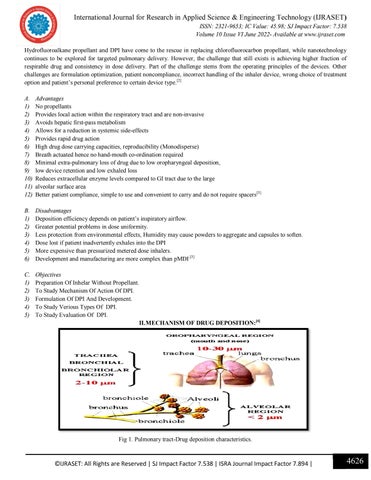
Objectives Preparation Of Inhelar Without Propellant. To Study Mechanism Of Action Of DPI. Formulation Of DPI And Development. To Study Verious Types Of DPI. To Study Evaluation Of DPI. II. MECHANISM OF DRUG DEPOSITION:[4]
Fig 1. Pulmonary tract-Drug deposition characteristics.
©IJRASET: All Rights are Reserved | SJ Impact Factor 7.538 | ISRA Journal Impact Factor 7.894 |
4626