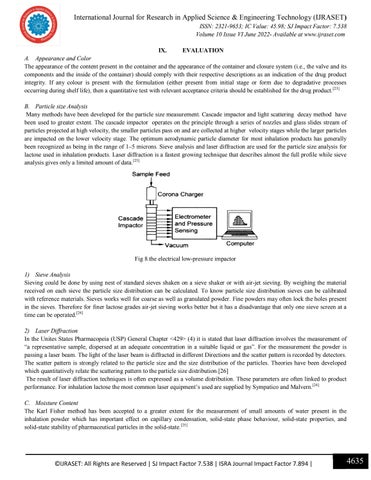
International Journal for Research in Applied Science & Engineering Technology (IJRASET) ISSN: 2321-9653; IC Value: 45.98; SJ Impact Factor: 7.538 Volume 10 Issue VI June 2022- Available at www.ijraset.com IX. EVALUATION A. Appearance and Color The appearance of the content present in the container and the appearance of the container and closure system (i.e., the valve and its components and the inside of the container) should comply with their respective descriptions as an indication of the drug product integrity. If any colour is present with the formulation (either present from initial stage or form due to degradative processes occurring during shelf life), then a quantitative test with relevant acceptance criteria should be established for the drug product.[23] B. Particle size Analysis Many methods have been developed for the particle size measurement. Cascade impactor and light scattering decay method have been used to greater extent. The cascade impactor operates on the principle through a series of nozzles and glass slides stream of particles projected at high velocity, the smaller particles pass on and are collected at higher velocity stages while the larger particles are impacted on the lower velocity stage. The optimum aerodynamic particle diameter for most inhalation products has generally been recognized as being in the range of 1–5 microns. Sieve analysis and laser diffraction are used for the particle size analysis for lactose used in inhalation products. Laser diffraction is a fastest growing technique that describes almost the full profile while sieve analysis gives only a limited amount of data.[23]
Fig 8.the electrical low-pressure impactor 1) Sieve Analysis Sieving could be done by using nest of standard sieves shaken on a sieve shaker or with air-jet sieving. By weighing the material received on each sieve the particle size distribution can be calculated. To know particle size distribution sieves can be calibrated with reference materials. Sieves works well for coarse as well as granulated powder. Fine powders may often lock the holes present in the sieves. Therefore for finer lactose grades air-jet sieving works better but it has a disadvantage that only one sieve screen at a time can be operated.[24] 2) Laser Diffraction In the Unites States Pharmacopeia (USP) General Chapter <429> (4) it is stated that laser diffraction involves the measurement of “a representative sample, dispersed at an adequate concentration in a suitable liquid or gas”. For the measurement the powder is passing a laser beam. The light of the laser beam is diffracted in different Directions and the scatter pattern is recorded by detectors. The scatter pattern is strongly related to the particle size and the size distribution of the particles. Theories have been developed which quantitatively relate the scattering pattern to the particle size distribution.[26] The result of laser diffraction techniques is often expressed as a volume distribution. These parameters are often linked to product performance. For inhalation lactose the most common laser equipment’s used are supplied by Sympatico and Malvern.[24] C. Moisture Content The Karl Fisher method has been accepted to a greater extent for the measurement of small amounts of water present in the inhalation powder which has important effect on capillary condensation, solid-state phase behaviour, solid-state properties, and solid-state stability of pharmaceutical particles in the solid-state.[25]
©IJRASET: All Rights are Reserved | SJ Impact Factor 7.538 | ISRA Journal Impact Factor 7.894 |
4635