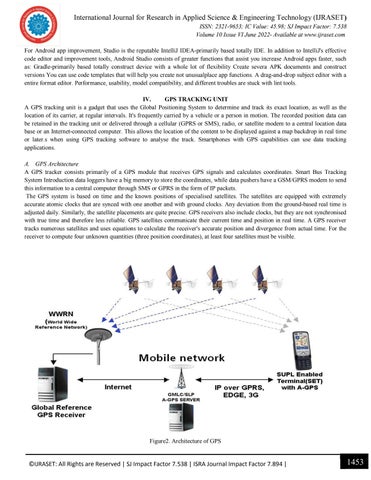
International Journal for Research in Applied Science & Engineering Technology (IJRASET) ISSN: 2321-9653; IC Value: 45.98; SJ Impact Factor: 7.538 Volume 10 Issue VI June 2022- Available at www.ijraset.com For Android app improvement, Studio is the reputable IntelliJ IDEA-primarily based totally IDE. In addition to IntelliJ's effective code editor and improvement tools, Android Studio consists of greater functions that assist you increase Android apps faster, such as: Gradle-primarily based totally construct device with a whole lot of flexibility Create severa APK documents and construct versions You can use code templates that will help you create not unusualplace app functions. A drag-and-drop subject editor with a entire format editor. Performance, usability, model compatibility, and different troubles are stuck with lint tools. IV. GPS TRACKING UNIT A GPS tracking unit is a gadget that uses the Global Positioning System to determine and track its exact location, as well as the location of its carrier, at regular intervals. It's frequently carried by a vehicle or a person in motion. The recorded position data can be retained in the tracking unit or delivered through a cellular (GPRS or SMS), radio, or satellite modem to a central location data base or an Internet-connected computer. This allows the location of the content to be displayed against a map backdrop in real time or later.s when using GPS tracking software to analyse the track. Smartphones with GPS capabilities can use data tracking applications. A. GPS Architecture A GPS tracker consists primarily of a GPS module that receives GPS signals and calculates coordinates. Smart Bus Tracking System Introduction data loggers have a big memory to store the coordinates, while data pushers have a GSM/GPRS modem to send this information to a central computer through SMS or GPRS in the form of IP packets. The GPS system is based on time and the known positions of specialised satellites. The satellites are equipped with extremely accurate atomic clocks that are synced with one another and with ground clocks. Any deviation from the ground-based real time is adjusted daily. Similarly, the satellite placements are quite precise. GPS receivers also include clocks, but they are not synchronised with true time and therefore less reliable. GPS satellites communicate their current time and position in real time. A GPS receiver tracks numerous satellites and uses equations to calculate the receiver's accurate position and divergence from actual time. For the receiver to compute four unknown quantities (three position coordinates), at least four satellites must be visible.
Figure2. Architecture of GPS
©IJRASET: All Rights are Reserved | SJ Impact Factor 7.538 | ISRA Journal Impact Factor 7.894 |
1453