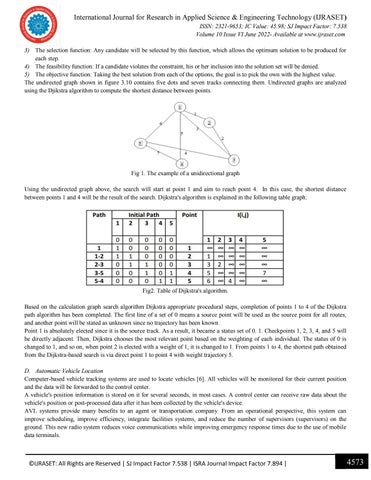
International Journal for Research in Applied Science & Engineering Technology (IJRASET) ISSN: 2321-9653; IC Value: 45.98; SJ Impact Factor: 7.538 Volume 10 Issue VI June 2022- Available at www.ijraset.com 3) The selection function: Any candidate will be selected by this function, which allows the optimum solution to be produced for each step. 4) The feasibility function: If a candidate violates the constraint, his or her inclusion into the solution set will be denied. 5) The objective function: Taking the best solution from each of the options, the goal is to pick the own with the highest value. The undirected graph shown in figure 3.10 contains five dots and seven tracks connecting them. Undirected graphs are analyzed using the Djikstra algorithm to compute the shortest distance between points.
Fig 1. The example of a unidirectional graph Using the undirected graph above, the search will start at point 1 and aim to reach point 4. In this case, the shortest distance between points 1 and 4 will be the result of the search. Dijkstra's algorithm is explained in the following table graph:
Fig2. Table of Dijkstra's algorithm. Based on the calculation graph search algorithm Dijkstra appropriate procedural steps, completion of points 1 to 4 of the Dijkstra path algorithm has been completed. The first line of a set of 0 means a source point will be used as the source point for all routes, and another point will be stated as unknown since no trajectory has been known. Point 1 is absolutely elected since it is the source track. As a result, it became a status set of 0. 1. Checkpoints 1, 2, 3, 4, and 5 will be directly adjacent. Then, Dijkstra chooses the most relevant point based on the weighting of each individual. The status of 0 is changed to 1, and so on, when point 2 is elected with a weight of 1, it is changed to 1. From points 1 to 4, the shortest path obtained from the Dijkstra-based search is via direct point 1 to point 4 with weight trajectory 5. D. Automatic Vehicle Location Computer-based vehicle tracking systems are used to locate vehicles [6]. All vehicles will be monitored for their current position and the data will be forwarded to the control center. A vehicle's position information is stored on it for several seconds, in most cases. A control center can receive raw data about the vehicle's position or post-processed data after it has been collected by the vehicle's device. AVL systems provide many benefits to an agent or transportation company. From an operational perspective, this system can improve scheduling, improve efficiency, integrate facilities systems, and reduce the number of supervisors (supervisors) on the ground. This new radio system reduces voice communications while improving emergency response times due to the use of mobile data terminals.
©IJRASET: All Rights are Reserved | SJ Impact Factor 7.538 | ISRA Journal Impact Factor 7.894 |
4573