March 2017
A Story of Survival Ghaith Alzaim, Sally K. Shobut
SMSA - Syria
ghaith.alzaim@gmail.com
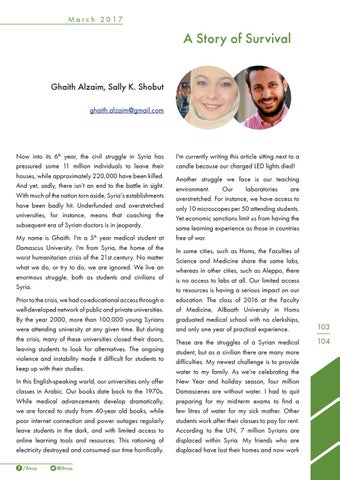
Now into its 6th year, the civil struggle in Syria has pressured some 11 million individuals to leave their houses, while approximately 220,000 have been killed. And yet, sadly, there isn’t an end to the battle in sight. With much of the nation torn aside, Syria’s establishments have been badly hit. Underfunded and overstretched universities, for instance, means that coaching the subsequent era of Syrian doctors is in jeopardy. My name is Ghaith. I'm a 5th year medical student at Damascus University. I'm from Syria, the home of the worst humanitarian crisis of the 21st century. No matter what we do, or try to do, we are ignored. We live an enormous struggle, both as students and civilians of Syria. Prior to the crisis, we had co-educational access through a well-developed network of public and private universities. By the year 2000, more than 100,000 young Syrians were attending university at any given time. But during the crisis, many of these universities closed their doors, leaving students to look for alternatives. The ongoing violence and instability made it difficult for students to keep up with their studies. In this English-speaking world, our universities only offer classes in Arabic. Our books date back to the 1970s. While medical advancements develop dramatically, we are forced to study from 40-year old books, while poor internet connection and power outages regularly leave students in the dark, and with limited access to online learning tools and resources. This rationing of electricity destroyed and consumed our time horrifically. /ifmsa
@ifmsa
I'm currently writing this article sitting next to a candle because our charged LED lights died! Another struggle we face is our teaching environment. Our laboratories are overstretched. For instance, we have access to only 10 microscopes per 50 attending students. Yet economic sanctions limit us from having the same learning experience as those in countries free of war. In some cities, such as Homs, the Faculties of Science and Medicine share the same labs, whereas in other cities, such as Aleppo, there is no access to labs at all. Our limited access to resources is having a serious impact on our education. The class of 2016 at the Faculty of Medicine, AlBaath University in Homs graduated medical school with no clerkships, and only one year of practical experience. These are the struggles of a Syrian medical student, but as a civilian there are many more difficulties. My newest challenge is to provide water to my family. As we're celebrating the New Year and holiday season, four million Damascenes are without water. I had to quit preparing for my mid-term exams to find a few litres of water for my sick mother. Other students work after their classes to pay for rent. According to the UN, 7 million Syrians are displaced within Syria. My friends who are displaced have lost their homes and now work
103 104