( M S I 34 )
Assessing the Impact of TMET Katerina Dima
SCOME Regional Assistant for Europe HelMSIC - Greece ra.scome.europe@gmail.com
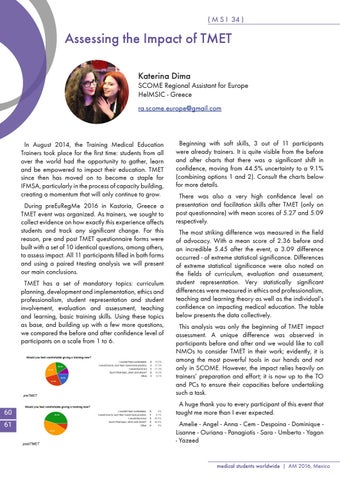
Beginning with soft skills, 3 out of 11 participants were already trainers. It is quite visible from the before and after charts that there was a significant shift in confidence, moving from 44.5% uncertainty to a 9.1% (combining options 1 and 2). Consult the charts below for more details.
In August 2014, the Training Medical Education Trainers took place for the first time: students from all over the world had the opportunity to gather, learn and be empowered to impact their education. TMET since then has moved on to become a staple for IFMSA, particularly in the process of capacity building, creating a momentum that will only continue to grow.
There was also a very high confidence level on presentation and facilitation skills after TMET (only on post questionnaire) with mean scores of 5.27 and 5.09 respectively.
During preEuRegMe 2016 in Kastoria, Greece a TMET event was organized. As trainers, we sought to collect evidence on how exactly this experience affects students and track any significant change. For this reason, pre and post TMET questionnaire forms were built with a set of 10 identical questions, among others, to assess impact. All 11 participants filled in both forms and using a paired t-testing analysis we will present our main conclusions.
The most striking difference was measured in the field of advocacy. With a mean score of 2.36 before and an incredible 5.45 after the event, a 3.09 difference occurred - of extreme statistical significance. Differences of extreme statistical significance were also noted on the fields of curriculum, evaluation and assessment, student representation. Very statistically significant differences were measured in ethics and professionalism, teaching and learning theory as well as the individual’s confidence on impacting medical education. The table below presents the data collectively.
TMET has a set of mandatory topics: curriculum planning, development and implementation, ethics and professionalism, student representation and student involvement, evaluation and assessment, teaching Image 1 and learning, basic training skills. Using these topics as base, and building up with a few more questions, we compared the before and after confidence level of participants on a scale from 1 to 6. Image 1
preTMET
Image 2
preTMET
60 61
A huge thank you to every participant of this event that taught me more than I ever expected.
Image 2
postTMET
postTMET
This analysis was only the beginning of TMET impact assessment. A unique difference was observed in participants before and after and we would like to call NMOs to consider TMET in their work; evidently, it is among the most powerful tools in our hands and not only in SCOME. However, the impact relies heavily on trainers’ preparation and effort; it is now up to the TO and PCs to ensure their capacities before undertaking such a task.
Amelie - Angel - Anna - Cem - Despoina - Dominique Lisanne - Ouriana - Panagiotis - Sara - Umberto - Yagan - Yazeed
medical students worldwide | AM 2016, Mexico