March 2016 can spread knowledge and support the inclusion of disaster medicine in medical curricula. Continuous education through this course and advocacy done by its participants will ensure that future doctors understand the basics of disaster medicine and are familiar with the different aspects of disaster preparedness and response. Additionally, we as medical students, will get equipped with the necessary knowledge and skills to mitigate and timely respond to disasters, and lead the recovery of affected communities.
from their peers as well as from experts, while enjoying Italian cuisine and culture. They are a new generation of trainers who will spread awareness and knowledge in disaster risk management and disaster medicine in their home countries and regions.
TdmT stems out of DisasterSISM, the successful national project that SISM – the Italian Medical Students Association – and CRIMEDIM have carried out since 2008. DisasterSISM has trained 20 medical students as disaster medicine trainers that subsequently reached out and trained over 1500 medical students in 25 Italian medical schools. Efforts and success have been recognised by the Foundation for Advancement of International Medical Education (FAIMER) in 2015, when DisasterSISM won the Students Project for Health competition.
During the preGA in Malta 2016, those TdmT graduates will present the training as part of one of the preGA workshops followed by a real size disaster simulation, a field visit and lectures by invited speakers.
The participants took part in a specially designed full-immersion program which combines all the basic topics in disaster medicine with elements of international humanitarian law, disaster bioethics, public health in disasters, simulation in education, and non-formal education. The classes included conventional lectures and innovative teaching methods, such as case discussions, problem-based learning, simulations, debates, workshops and trainings. By the end of the program, they were able to design and deliver a basic training in disaster medicine to other medical students in their community, region, or country.
The SDGs consist of many aspects and points, and all of them need to be covered by grass root movements and approaches if we want to see the better and brighter future for us all. TdmT advocates for the important role of medical students in disaster risk reduction and thereby, contributes to the fulfilment of the SDGs.
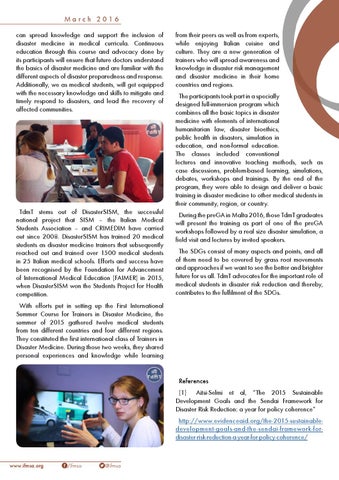
With efforts put in setting up the First International Summer Course for Trainers in Disaster Medicine, the summer of 2015 gathered twelve medical students from ten different countries and four different regions. They constituted the first international class of Trainers in Disaster Medicine. During those two weeks, they shared personal experiences and knowledge while learning
References (1) Aitsi-Selmi et al, “The 2015 Sustainable Development Goals and the Sendai Framework for Disaster Risk Reduction: a year for policy coherence” http://www.evidenceaid.org/the-2015-sustainabledevelopment-goals-and-the-sendai-framework-fordisaster-risk-reduction-a-year-for-policy-coherence/
www.ifmsa.org
/ifmsa
@ifmsa