March 2016
Amibasic Assistance to the Homeless People
Rafaela Nascimento & Iury Magalhaes & Lanna Lacerda & Ricardo Regis
IFMSA - Brazil
rafa_snascimento@hotmail.com In recent decades, the population living in the streets showed significant growth as a result of a globalized society, uneven and sharp social exclusion. Being “homeless” refers to individuals who have no steady residence and who stay permanently or temporarily in public areas of the city, like abandoned houses and others. These people are exposed to precarious conditions, and have poor access to basic rights of a citizen. Faced with the harsh reality experienced by this population, small actions that aim to inform about prevention and preservation of health, making them understand at least a little about their basic rights, are necessary. Thinking about that, members of IFMSA BRAZIL - CESUPA local committee developed a campaign called ‘Além da Rua’ (In English, it means ‘Beyond Street’). The main objective of the campaign was to inform and educate homeless people about their vulnerability to infectious diseases, provide basic assistance to the homeless people and educate medical students about the social problems of society. The campaign took place in two parts: first, on August 22nd, 2015, a training course was held for the students involved in the action, so that they could be able to assist
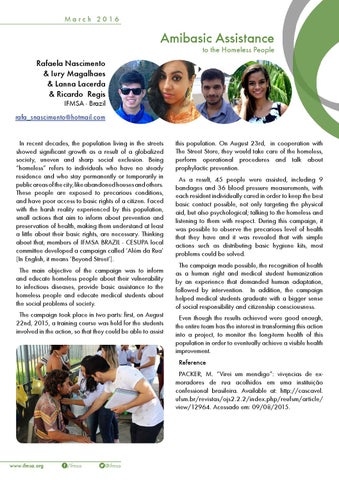
this population. On August 23rd, in cooperation with The Street Store, they would take care of the homeless, perform operational procedures and talk about prophylactic prevention. As a result, 45 people were assisted, including 9 bandages and 36 blood pressure measurements, with each resident individually cared in order to keep the best basic contact possible, not only targeting the physical aid, but also psychological; talking to the homeless and listening to them with respect. During this campaign, it was possible to observe the precarious level of health that they have and it was revealed that with simple actions such as distributing basic hygiene kits, most problems could be solved. The campaign made possible, the recognition of health as a human right and medical student humanization by an experience that demanded human adaptation, followed by intervention. In addition, the campaign helped medical students graduate with a bigger sense of social responsibility and citizenship consciousness. Even though the results achieved were good enough, the entire team has the interest in transforming this action into a project, to monitor the long-term health of this population in order to eventually achieve a visible health improvement. Reference PACKER, M. “Virei um mendigo”: vivências de exmoradores de rua acolhidos em uma instituição confessional brasileira. Available at: http://cascavel. ufsm.br/revistas/ojs2.2.2/index.php/reufsm/article/ view/12964. Acessado em: 09/08/2015.
www.ifmsa.org
/ifmsa
@ifmsa