MSInternational Elective Report: Burn Surgery in the US Institution: University of Washington/Harborview Medical Center Country: United States of America Unit: University of Washington Burn Unit at Harborview Description: 350 bed hospital dedicated almost exclusively to trauma. It is the only burn center for Âź of the land area of the United States, so patients come from as far as Alaska. Learning opportunities: Very practical. The consultants get the students very involved in the operations. Number of students accepted: 1-2 Duration of elective: 1-2 months Accommodation: List of rooms to rent near the hospital is available. The dormitories offered by the University are far from the hospital. Fees payable: US$50 application fee Applicant requirements: Must be in final year of medical studies Contact information: Visiting Student Office, U of Washington Box 356340 Seattle, WA 98195-6340 Phone: +1 206 543-5560 Email: visitstu@u.washington.edu Web address: http://www.washington.edu
B
urns are an overlooked area of trauma that often requires more than surgery. Poor initial managment of burns leads to dramatically lost productivity, and diversion of resources from other areas.
tor support for 24-48 hours. When people have burns to the face, you intubate them because of upper air way swelling. Therefore, you prac tice weaning people from ventila tors, and titrating urine output. Nutrition is a big issue in burns. This is a wonderful rotation to The University of Washington Burn begin learning about surgical nutriCenter at Harborview is an excel- tion. There are many interesting lent place to study burn surgery. cases that come in. They have an entire intensive care unit dedicated to burns. Often the The surgeries are not particularly patients are entirely healthy, and complicated, and the students are just require some fluid and ventila- involved from the first day of the Medical Student International Magazine, Spring 2004
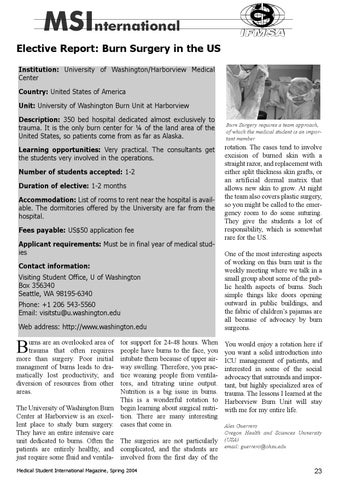
Burn Surgery requires a team approach, of which the medical student is an important member
rotation. The cases tend to involve excision of burned skin with a straight razor, and replacement with either split thickness skin grafts, or an artificial dermal matrix that allows new skin to grow. At night the team also covers plastic surgery, so you might be called to the emer gency room to do some suturing. They give the students a lot of responsibility, which is somewhat rare for the US. One of the most interesting aspects of working on this burn unit is the weekly meeting where we talk in a small group about some of the pub lic health aspects of burns. Such simple things like doors opening outward in public buildings, and the fabric of children’s pajamas are all because of advocacy by burn surgeons. You would enjoy a rotation here if you want a solid introduction into ICU management of patients, and interested in some of the social advocacy that surrounds and impor tant, but highly specialized area of trauma. The lessons I learned at the Harborview Burn Unit will stay with me for my entire life. Alex Guerrero Oregon Health and Sciences University (USA) email: guerrero@ohsu.edu
23