MSInternational Mining for Change: An IFMSA Project Designed to Ease the Burden of Landmines a diversion of resources to helping the victim. This indiscriminate method of destruction is shameless and the problem needs to be addressed.
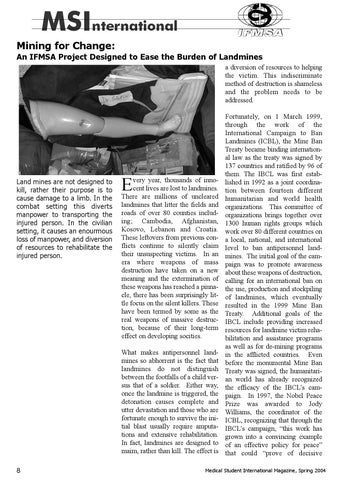
Land mines are not designed to kill, rather their purpose is to cause damage to a limb. In the combat setting this diverts manpower to transporting the injured person. In the civilian setting, it causes an enourmous loss of manpower, and diversion of resources to rehabilitate the injured person.
E
very year, thousands of inno cent lives are lost to landmines. There are millions of uncleared landmines that litter the fields and roads of over 80 counties includ ing; Cambodia, Afghanistan, Kosovo, Lebanon and Croatia. These leftovers from previous con flicts continue to silently claim their unsuspecting victims. In an era where weapons of mass destruction have taken on a new meaning and the extermination of these weapons has reached a pinna cle, there has been surprisingly lit tle focus on the silent killers. These have been termed by some as the real weapons of massive destruc tion, because of their long-term effect on developing socities. What makes antipersonnel landmines so abhorrent is the fact that landmines do not distinguish between the footfalls of a child ver sus that of a soldier. Either way, once the landmine is triggered, the detonation causes complete and utter devastation and those who are fortunate enough to survive the ini tial blast usually require amputa tions and extensive rehabilitation. In fact, landmines are designed to maim, rather than kill. The effect is
8
Fortunately, on 1 March 1999, through the work of the International Campaign to Ban Landmines (ICBL), the Mine Ban Treaty became binding internation al law as the treaty was signed by 137 countries and ratified by 96 of them. The IBCL was first estab lished in 1992 as a joint coordina tion between fourteen different humanitarian and world health organizations. This committee of organizations brings together over 1300 human rights groups which work over 80 different countries on a local, national, and international level to ban antipersonnel landmines. The initial goal of the cam paign was to promote awareness about these weapons of destruction, calling for an international ban on the use, production and stockpiling of landmines, which eventually resulted in the 1999 Mine Ban Treaty. Additional goals of the IBCL include providing increased resources for landmine victim reha bilitation and assistance programs as well as for de-mining programs in the afflicted countries. Even before the monumental Mine Ban Treaty was signed, the humanitari an world has already recognized the efficacy of the IBCL’s cam paign. In 1997, the Nobel Peace Prize was awarded to Jody Williams, the coordinator of the ICBL, recognizing that through the IBCL’s campaign, “this work has grown into a convincing example of an effective policy for peace” that could “prove of decisive
Medical Student International Magazine, Spring 2004