Dentoni et al. / International Food and Agribusiness Management Review / Volume 15, Special Issue A, 2012
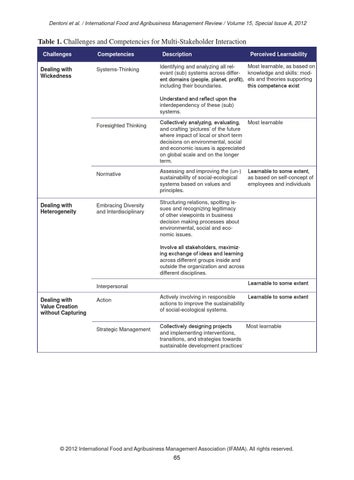
Table 1. Challenges and Competencies for Multi-Stakeholder Interaction Challenges Dealing with Wickedness
Competencies Systems-Thinking
Description Identifying and analyzing all relevant (sub) systems across different domains (people, planet, profit), including their boundaries.
Perceived Learnability Most learnable, as based on knowledge and skills: models and theories supporting this competence exist
Understand and reflect upon the interdependency of these (sub) systems. Foresighted Thinking
Normative
Dealing with Heterogeneity
Embracing Diversity and Interdisciplinary
Collectively analyzing, evaluating, Most learnable and crafting ‘pictures’ of the future where impact of local or short term decisions on environmental, social and economic issues is appreciated on global scale and on the longer term. Assessing and improving the (un-) sustainability of social-ecological systems based on values and principles.
Learnable to some extent, as based on self-concept of employees and individuals
Structuring relations, spotting issues and recognizing legitimacy of other viewpoints in business decision making processes about environmental, social and economic issues. Involve all stakeholders, maximizing exchange of ideas and learning across different groups inside and outside the organization and across different disciplines.
Dealing with Value Creation without Capturing
Learnable to some extent
Interpersonal Action
Strategic Management
Actively involving in responsible Learnable to some extent actions to improve the sustainability of social-ecological systems. Collectively designing projects Most learnable and implementing interventions, transitions, and strategies towards sustainable development practices.
Š 2012 International Food and Agribusiness Management Association (IFAMA). All rights reserved.
65