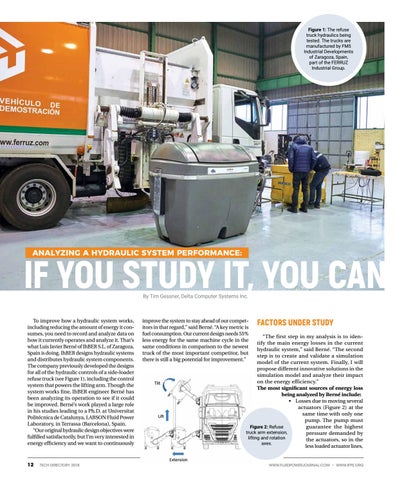
Figure 1: The refuse truck hydraulics being tested. The trucks are manufactured by FM5 Industrial Developments of Zaragoza, Spain, part of the FERRUZ Industrial Group.
ANALYZING A HYDRAULIC SYSTEM PERFORMANCE:
IF YOU STUDY IT, YOU CAN By Tim Gessner, Delta Computer Systems Inc.
To improve how a hydraulic system works, including reducing the amount of energy it consumes, you need to record and analyze data on how it currently operates and analyze it. That’s what Luis Javier Berné of IhBER S.L. of Zaragoza, Spain is doing. IhBER designs hydraulic systems and distributes hydraulic system components. The company previously developed the designs for all of the hydraulic controls of a side-loader refuse truck (see Figure 1), including the control system that powers the lifting arm. Though the system works fine, IhBER engineer Berné has been analyzing its operation to see if it could be improved. Berné’s work played a large role in his studies leading to a Ph.D. at Universitat Politécnica de Catalunya, LABSON Fluid Power Laboratory, in Terrassa (Barcelona), Spain. “Our original hydraulic design objectives were fulfilled satisfactorily, but I’m very interested in energy efficiency and we want to continuously
12
TECH DIRECTORY 2018
improve the system to stay ahead of our competitors in that regard,” said Berné. “A key metric is fuel consumption. Our current design needs 55% less energy for the same machine cycle in the same conditions in comparison to the newest truck of the most important competitor, but there is still a big potential for improvement.”
FACTORS UNDER STUDY
“The first step in my analysis is to identify the main energy losses in the current hydraulic system,” said Berné. “The second step is to create and validate a simulation model of the current system. Finally, I will propose different innovative solutions in the simulation model and analyze their impact on the energy efficiency.” The most significant sources of energy loss being analyzed by Berné include: • Losses due to moving several actuators (Figure 2) at the same time with only one pump. The pump must Figure 2: Refuse guarantee the highest truck arm extension, pressure demanded by lifting and rotation the actuators, so in the axes. less loaded actuator lines,
WWW.FLUIDPOWERJOURNAL.COM • WWW.IFPS.ORG