Heddy Honigmann’s Top 10
And Life Goes On Zendegi va digar hich Abbas Kiarostami
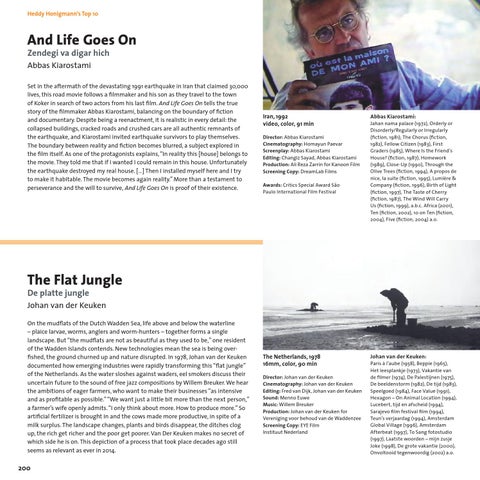
Set in the aftermath of the devastating 1991 earthquake in Iran that claimed 30,000 lives, this road movie follows a filmmaker and his son as they travel to the town of Koker in search of two actors from his last film. And Life Goes On tells the true story of the filmmaker Abbas Kiarostami, balancing on the boundary of fiction and documentary. Despite being a reenactment, it is realistic in every detail: the collapsed buildings, cracked roads and crushed cars are all authentic remnants of the earthquake, and Kiarostami invited earthquake survivors to play themselves. The boundary between reality and fiction becomes blurred, a subject explored in the film itself. As one of the protagonists explains, “In reality this [house] belongs to the movie. They told me that if I wanted I could remain in this house. Unfortunately the earthquake destroyed my real house. […] Then I installed myself here and I try to make it habitable. The movie becomes again reality.” More than a testament to perseverance and the will to survive, And Life Goes On is proof of their existence.
Iran, 1992 video, color, 91 min Director: Abbas Kiarostami Cinematography: Homayun Paevar Screenplay: Abbas Kiarostami Editing: Changiz Sayad, Abbas Kiarostami Production: Ali Reza Zarrin for Kanoon Film Screening Copy: DreamLab Films Awards: Critics Special Award São Paulo International Film Festival
Abbas Kiarostami:
Jahan nama palace (1972), Orderly or Disorderly/Regularly or Irregularly (fiction, 1981); The Chorus (fiction, 1982), Fellow Citizen (1983), First Graders (1985), Where Is the Friend’s House? (fiction, 1987), Homework (1989), Close-Up (1990), Through the Olive Trees (fiction, 1994), A propos de nice, la suite (fiction, 1995), Lumière & Company (fiction, 1996), Birth of Light (fiction, 1997), The Taste of Cherry (fiction, 1987), The Wind Will Carry Us (fiction, 1999), a.b.c. Africa (2001), Ten (fiction, 2002), 10 on Ten (fiction, 2004), Five (fiction, 2004) a.o.
The Flat Jungle De platte jungle Johan van der Keuken
On the mudflats of the Dutch Wadden Sea, life above and below the waterline – plaice larvae, worms, anglers and worm-hunters – together forms a single landscape. But “the mudflats are not as beautiful as they used to be,” one resident of the Wadden Islands contends. New technologies mean the sea is being overfished, the ground churned up and nature disrupted. In 1978, Johan van der Keuken documented how emerging industries were rapidly transforming this “flat jungle” of the Netherlands. As the water sloshes against waders, eel smokers discuss their uncertain future to the sound of free jazz compositions by Willem Breuker. We hear the ambitions of eager farmers, who want to make their businesses “as intensive and as profitable as possible.” “We want just a little bit more than the next person,” a farmer’s wife openly admits. “I only think about more. How to produce more.” So artificial fertilizer is brought in and the cows made more productive, in spite of a milk surplus. The landscape changes, plants and birds disappear, the ditches clog up, the rich get richer and the poor get poorer. Van Der Keuken makes no secret of which side he is on. This depiction of a process that took place decades ago still seems as relevant as ever in 2014.
200
The Netherlands, 1978 16mm, color, 90 min Director: Johan van der Keuken Cinematography: Johan van der Keuken Editing: Fred van Dijk, Johan van der Keuken Sound: Menno Euwe Music: Willem Breuker Production: Johan van der Keuken for Vereniging voor behoud van de Waddenzee Screening Copy: EYE Film Instituut Nederland
Johan van der Keuken:
Paris à l’aube (1958), Beppie (1965), Het leesplankje (1973), Vakantie van de filmer (1974), De Palestijnen (1975), De beeldenstorm (1982), De tijd (1983), Speelgoed (1984), Face Value (1991), Hexagon – On Animal Location (1994), Lucebert, tijd en afscheid (1994), Sarajevo film festival film (1994), Teun’s verjaardag (1994), Amsterdam Global Village (1996), Amsterdam Afterbeat (1997), To Sang fotostudio (1997), Laatste woorden – mijn zusje Joke (1998), De grote vakantie (2000), Onvoltooid tegenwoordig (2002) a.o.