Paradocs: Curated by Aernout Mik
How to Live Jak zyc Marcel Lozinski
Poland, 1981 35mm, color, 83 min Director: Marcel Lozinski Cinematography: Jacek Petrycki Editing: Lucja Osko Sound: Halina Paszkowska Production: Zespol Filmowy “X” World Sales/Screening Copy: Polish National Film Archive
Marcel Lozinski:
Kolo Fortuny (1972), Happy End (1973), Wizyta (1974), Król (1974), Front Colision (1975), The Touch (1978), Matriculation (1979), Microphone’s Test (1980), Workshop Exercises (1987), My Place (1987), Witnesses: Antisemitism in Poland, 1946 (1988), 45-89 (1990, Katyn-Forrest (1990), Seven Jews from my class (1992), Autoportret (1993), 89 mm from Europy (1993), Anything Can Happen (1995), So It Doesn’t Hurt (1998), I Remember (2002), How It’s Done (2006), Poste Restante (2009), Tonia and Her Children (2011)
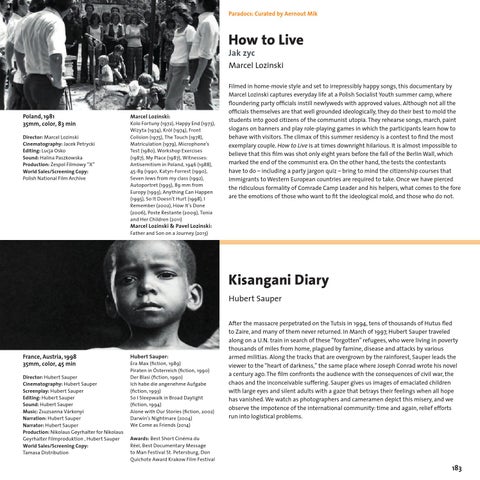
Filmed in home-movie style and set to irrepressibly happy songs, this documentary by Marcel Lozinski captures everyday life at a Polish Socialist Youth summer camp, where floundering party officials instill newlyweds with approved values. Although not all the officials themselves are that well grounded ideologically, they do their best to mold the students into good citizens of the communist utopia. They rehearse songs, march, paint slogans on banners and play role-playing games in which the participants learn how to behave with visitors. The climax of this summer residency is a contest to find the most exemplary couple. How to Live is at times downright hilarious. It is almost impossible to believe that this film was shot only eight years before the fall of the Berlin Wall, which marked the end of the communist era. On the other hand, the tests the contestants have to do – including a party jargon quiz – bring to mind the citizenship courses that immigrants to Western European countries are required to take. Once we have pierced the ridiculous formality of Comrade Camp Leader and his helpers, what comes to the fore are the emotions of those who want to fit the ideological mold, and those who do not.
Marcel Lozinski & Pavel Lozinski: Father and Son on a Journey (2013)
Kisangani Diary Hubert Sauper
France, Austria, 1998 35mm, color, 45 min Director: Hubert Sauper Cinematography: Hubert Sauper Screenplay: Hubert Sauper Editing: Hubert Sauper Sound: Hubert Sauper Music: Zsuzsanna Várkonyi Narration: Hubert Sauper Narrator: Hubert Sauper Production: Nikolaus Geyrhalter for Nikolaus Geyrhalter Filmproduktion , Hubert Sauper World Sales/Screening Copy: Tamasa Distribution
Hubert Sauper:
Era Max (fiction, 1989) Piraten in Österreich (fiction, 1990) Der Blasi (fiction, 1990) Ich habe die angenehme Aufgabe (fiction, 1993) So I Sleepwalk in Broad Daylight (fiction, 1994) Alone with Our Stories (fiction, 2002) Darwin’s Nightmare (2004) We Come as Friends (2014)
Awards: Best Short Cinéma du Réel, Best Documentary Message to Man Festival St. Petersburg, Don Quichote Award Krakow Film Festival
After the massacre perpetrated on the Tutsis in 1994, tens of thousands of Hutus fled to Zaire, and many of them never returned. In March of 1997, Hubert Sauper traveled along on a U.N. train in search of these “forgotten” refugees, who were living in poverty thousands of miles from home, plagued by famine, disease and attacks by various armed militias. Along the tracks that are overgrown by the rainforest, Sauper leads the viewer to the “heart of darkness,” the same place where Joseph Conrad wrote his novel a century ago. The film confronts the audience with the consequences of civil war, the chaos and the inconceivable suffering. Sauper gives us images of emaciated children with large eyes and silent adults with a gaze that betrays their feelings when all hope has vanished. We watch as photographers and cameramen depict this misery, and we observe the impotence of the international community: time and again, relief efforts run into logistical problems.
183