“
Leonard Cohen? What did ‘Blowin’ in the Wind’ have that ‘Big Yellow Taxi’ or ‘Bird on a Wire’ didn’t? This initial outburst was followed by an acknowledgement that perhaps other lyricists would be honoured in the future. Dylan might have been the first, but surely he wouldn’t be the last? Gradually the Cohen and Mitchell fans learned to join in the applause. Dylan was, after all, part of the same songwriting tradition and could reasonably be considered as a harbinger of things to come.
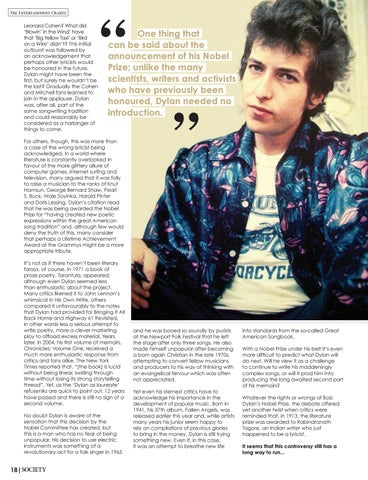
One thing that can be said about the announcement of his Nobel Prize; unlike the many scientists, writers and activists who have previously been honoured, Dylan needed no introduction.
For others, though, this was more than a case of the wrong lyricist being acknowledged. In a world where literature is constantly overlooked in favour of the more glittery allure of computer games, internet surfing and television, many argued that it was folly to raise a musician to the ranks of Knut Hamsun, George Bernard Shaw, Pearl S. Buck, Wole Soyinka, Harold Pinter and Doris Lessing. Dylan’s citation read that he was being awarded the Nobel Prize for “having created new poetic expressions within the great American song tradition” and, although few would deny the truth of this, many consider that perhaps a Lifetime Achievement Award at the Grammys might be a more appropriate tribute. It’s not as if there haven’t been literary forays, of course. In 1971 a book of prose poetry, Tarantula, appeared, although even Dylan seemed less than enthusiastic about the project. Many critics likened it to John Lennon’s whimsical In His Own Write, others compared it unfavourably to the notes that Dylan had provided for Bringing It All Back Home and Highway 61 Revisited, in other words less a serious attempt to write poetry, more a clever marketing ploy to offload excess material. Years later, in 2004, his first volume of memoirs, Chronicles: Volume One, received a much more enthusiastic response from critics and fans alike. The New York Times reported that, “[the book] is lucid without being linear, swirling through time without losing its strong storytelling thread”. Yet, as the ‘Dylan as laureate’ refuseniks are quick to point out, 12 years have passed and there is still no sign of a second volume. No doubt Dylan is aware of the sensation that this decision by the Nobel Committee has created, but this is a man who has no fear of being unpopular. His decision to use electric instruments was something of a revolutionary act for a folk singer in 1965
18
“
The Entertainment Charts
and he was booed so soundly by purists at the Newport Folk Festival that he left the stage after only three songs. He also made himself unpopular after becoming a born again Christian in the late 1970s, attempting to convert fellow musicians and producers to his way of thinking with an evangelical fervour which was often not appreciated. Yet even his sternest critics have to acknowledge his importance in the development of popular music. Born in 1941, his 37th album, Fallen Angels, was released earlier this year and, while artists many years his junior seem happy to rely on compilations of previous glories to bring in the money, Dylan is still trying something new. Even if, in this case, it was an attempt to breathe new life
into standards from the so-called Great American Songbook. With a Nobel Prize under his belt it’s even more difficult to predict what Dylan will do next. Will he view it as a challenge to continue to write his maddeningly complex songs, or will it prod him into producing the long awaited second part of his memoirs? Whatever the rights or wrongs of Bob Dylan’s Nobel Prize, the debate offered yet another twist when critics were reminded that, in 1913, the literature prize was awarded to Rabindranath Tagore, an Indian writer who just happened to be a lyricist. It seems that this controversy still has a long way to run...