icd.ca
A publication of the Institute of Corporate Directors
OCTOBER 2019 SEPTEMBER
Director Journal
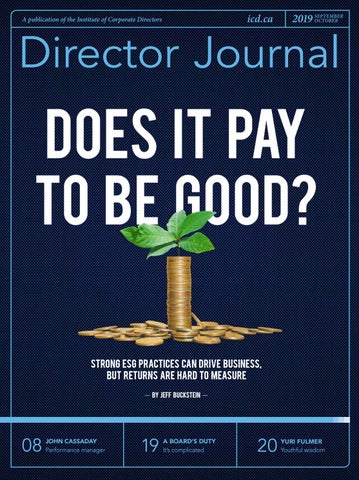
STRONG ESG PRACTICES CAN DRIVE BUSINESS, BUT RETURNS ARE HARD TO MEASURE — By Jeff Buckstein —
08
JOHN CASSADAY Performance manager
19
A BOARD’S DUTY It’s complicated
20
YURI FULMER Youthful wisdom
Director Journal Director Journal is published by the ICD six times per year as a benefit to its members. Digital versions of the articles can be accessed at www.icd.ca/DirectorJournal
EDITORIAL EDITOR Simon Avery
FEATURE Does your board have a strong environmental, social and governance agenda? It could be key to new opportunities – and also determine your access to capital, where you operate and the talent you can recruit
CONTRIBUTORS Jeff Buckstein Jane Gadd Christopher Morris Gordon Pitts Caley Taylor
GRAPHIC DESIGN Kristina Divic
INSTITUTE OF CORPORATE DIRECTORS Rahul Bhardwaj, LL.B, ICD.D President and CEO Sari Diamond Corporate Secretary Patricia Fletcher Vice-President, Education Matthew Fortier Vice-President, Policy Ken Gibson Chief Administrative Officer Jan Daly Mollenhauer, ICD.D Vice-President, Sales, Marketing and Membership
IS THERE VALUE IN GOOD BEHAVIOUR?
12
- by Jeff Buckstein -
Orli Giroux Namian Vice-President, Chapter Relations
2701 – 250 Yonge Street, Toronto, Ontario M5B 2L7 T: 416.593.7741 F: 416.593.0636 E: info@icd.ca
www.icd.ca
ISSN 2371-5634 (Print) ISSN 2371-5650 (Online)
The ICD welcomes a diversity of opinion for inclusion in Director Journal. The contents of this publication do not necessarily reflect the opinions of the ICD, its partners, its sponsors, or its advertisers. Readers are encouraged to consider seeking professional advice and other views. To request reprints of articles, please contact info@icd.ca
Y A-T-IL DE LA VALEUR DANS LE FAIT DE BIEN FAIRE LES CHOSES?
26
- par Jeff Buckstein -
CONTENTS
You have to be prepared to be challenged. YURI FULMER Entrepreneur, investor and director
DEPARTMENTS
04
EDITOR’S NOTE Where’s the bottom line?
05
PRESIDENT’S DESK Out in front
25
DU BUREAU DU PRÉSIDENT Droit devant
We have to ... make performance management a much more important part of our job responsibilities. JOHN CASSADAY ICD Fellow
06
DIRECTORS’ DILEMMA How to manage board succession planning - by Heather Wilson
ICD FELLOWSHIP AWARD
08
John Cassaday has some tough questions for boards - by Gordon Pitts
32
John Cassaday a des questions difficiles au sujet des conseils et du contrôle - par Gordon Pitts POLICY UPDATE
DirectorJournal Building trust and confidence in Canadian organizations is imperative. At the Institute of Corporate Directors (ICD), we believe that this starts with the right leadership and good governance. Directors must lead by being informed, prepared, ethical, connected, courageous and engaged with the world. In the pages that follow, you will find thoughtful and provocative articles that explore these essential leadership qualities. Bâtir la confiance envers les organisations canadiennes est primordial. À l’Institut des administrateurs de sociétés (IAS), nous croyons que cela commence par un bon leadership et une bonne gouvernance. Les administrateurs doivent gouverner en étant informés, préparés, intègres, connectés, courageux et ouverts sur le monde. Dans les pages qui suivent, vous trouverez des articles réfléchis et provocateurs qui explorent ces qualités de leadership essentielles.
19
Looking beyond shareholder profit - by Matthew Fortier NEXT GEN GOVERNANCE
20
Yuri Fulmer took an unconventional path to the boardroom, bringing a restless energy and slate of fresh ideas - by Jane Gadd DIRECTORS ON THE MOVE
37
Director appointments: June 2019 to July 2019
EDITOR’S NOTE
Where’s the bottom line?
SIMON AVERY EDITOR
savery@icd.ca
4
DIRECTOR JOURNAL
Our cover story about good corporate behaviour suggests there is ultimately greater value in a business that seeks to meet the needs of all its stakeholders – not just shareholders. Further, the story describes a shift where companies are growing more sensitive and responsive to what their investors, employees and customers are telling them. Some readers may argue this is just wishful thinking. Certainly, there is no shortage of coverage in the business media of bad corporate behaviour in Canada and beyond, with companies neglecting the interests of investors, employees, customers and the communities in which they operate, while also managing to thumb their noses at regulators and lawmakers. But then there are those truly surprising moments when a market leader moves to put social responsibility ahead of the pursuit of profit. In September, for instance, after scores of high-profile mass shootings across the United States this year – including a horrific event in one of its own stores in Texas – Walmart said it would stop selling ammunition for handguns and some assault-style rifles. The move is expected to cut the retail giant’s market share for ammo in the United States by more than half. In addition, the company is stepping into the nation’s highly politized gun-control debate by calling on Washington to strengthen background checks of gun buyers. Maybe the transition to more socially conscious corporations is a work in progress. Readers will have to decide. But one development that is hard to ignore is that large investors are now weighing non-financial disclosures. The measuring tools are less defined, writes Jeff Buckstein (see page 12), but the results may provide a more comprehensive assessment of an organization’s long-term value than do traditional financial measurements alone. It’s now incumbent on boards, he says, to incorporate an environmental, social and governance (ESG) agenda into their organization’s strategy.
PRESIDENT’S DESK
Out in front One of the most powerful corporate groups in the United States shook investors, directors and the media out of their summer slumber late in August by declaring that companies must shift their thinking to consider the interests of all stakeholders, not just shareholders. The Business Roundtable’s statement seeking to redefine the role and purpose of the U.S. corporation was signed by the leaders of the country’s biggest companies, including Larry Fink, the head of BlackRock Inc., which manages more money than any other investment firm in the world. The communiqué surprised many in the business community, which is still digesting the importance of the message. For members of the Institute of Corporate Directors, however, the ideas our U.S. cousins are now wrestling with did not come out of the blue. A key part of our mandate at the ICD is to make sure members have the education and tools they need to make the best decisions, which includes helping keep you ahead of the issues. We had an early glimpse of the Business Roundtable’s thinking a few months ago at our Fellowship Awards gala, when I sat on stage with Larry Fink and engaged him in a conversation about the board’s responsibilities at a time when globalization is under attack and the angry cry of populism is rising. He talked about the need for businesses to step up and demonstrate their commitment to the communities in which they operate; and he spoke of boards’ collective obligation to pay greater attention to the changes occurring in society.
Canada has also addressed the issue of the role of the corporation in our courts. A decade ago, the Supreme Court of Canada made it clear that board members owe a duty to shareholders and the interests of other stakeholders (see Matthew Fortier’s column on page 19). This ruling was put into context for ICD members at last year’s Fellowship Awards gala by keynote speaker Beverley McLachlin, who served as chief justice at the time of the landmark ruling. The Business Roundtable’s declaration is likely to echo in the U.S. election campaign over the next year. This race is just one of the dramatic events on the horizon, so as we head into a busy fall, fasten your seatbelts as the next chapters of Brexit and the tariff wars play out, and as Canada seeks to establish its place within the context of a federal election. I have recently returned from speaking at the biennial Leading Directors Forum in New Zealand, delivering ICD’s message that resonated strongly with the audience: Effective corporate governance can be a competitive advantage to companies and countries – especially during unstable times that require strong leadership. We are backing that message up this fall with new short courses covering critical and timely subjects. They include: the digital director, the board’s oversight of culture, political intelligence on boards, and the next iteration of board dynamics for executives. I urge you to consider participating in at least one of these courses and getting out to our chapter and national events. Combined, they will help you navigate these tumultuous times with greater insights and clearer context.
RAHUL BHARDWAJ LL.B, ICD.D
President and CEO, The Institute of Corporate Directors
SEPTEMBER/OCTOBER 2019
5
DIRECTORS’ DILEMMA
Q:
THE
DILEMMA
Q: We seem to scramble every time one of our directors decides to retire. What do other organizations do to deal more effectively with board succession planning? HEATHER WILSON ICD’S DIRECTOR OF RESEARCH SERVICES
Implementing an effective process for identifying and developing organizational leaders is a challenge for many boards. However, boards would be well served to attend to their own succession planning more regularly, especially in light of increased external interest in board refreshment. As Heather Briant, a public and private company board member and nominating committee chair of several boards, notes: “Succession can be a sensitive topic, and having it on the meeting agenda confirms it first and foremost as a good business practice.” According to the latest issue of Deloitte’s annual Board Practices report, the No. 1 issue shareholders want to discuss with management and directors is board composition and diversity. However, just over half of the
6
DIRECTOR JOURNAL
U.S. public company boards surveyed said they discuss board succession on an annual basis. “Effective board succession planning requires being proactive,” says Sari Diamond, corporate secretary for the Institute of Corporate Directors. “It takes time to reflect on and locate your next board member.” Without a process in place, boards may find themselves recruiting members hastily and without paying sufficient attention to what skills the organization requires. “Organizations evolve and boards need to revisit their composition – to match the stage of business as well as the current business environment,” she says. By matching strategic initiatives with the board’s recruitment and succession plans, the board can be better positioned to oversee any
challenges and opportunities and contribute to organizational success, she adds. Succession planning should be part of an overall program that includes regular board assessments, the completion of individual director skills matrices and a recruitment strategy. Briant, whose directorships include Freshii Inc., CT Real Estate Investment Trust and Ross Video Ltd., advises boards to maintain a board skills matrix that includes not only skill sets but also diversity criteria such as age, ethnicity, gender and experience to help close any gaps. “These items may vary considerably by company and should be reviewed annually both with management and as a scheduled agenda item by the nominating committee and discussed by the board.”
DIRECTORS’ DILEMMA
On top of preparing boards for changes in their membership, a succession-planning process serves another important purpose: keeping pace with regulations. “Public companies are effectively being steered towards these broad matrices by regulators,” says Adrienne DiPaolo, a partner at Torys LLP in Toronto. “Securities laws have long required public companies to disclose gender diversity initiatives and board renewal mechanisms in their annual proxy circulars. The Canada Business Corporations Act (CBCA) will soon go further – public CBCA companies will also need to address the representation of visible minorities, Indigenous peoples and people with disabilities on their boards starting in 2020,” she says. Boards that do not have a diversity policy should “give consideration to the potential ramifications of the lack of diversity on your board,” Diamond says.
•
(To help boards with their recruitment, ICD has developed a sample board diversity policy. It also offers a registry of qualified director candidates. Both tools are available on the ICD’s website: icd.ca). Briant recommends that boards “use the matrix criteria to solicit input from directors and management, and to create a confidential evergreen list of potential candidates, including recommendations only by reputation. This can be a good starting point for a formal search, particularly when a vacancy occurs unexpectedly.” The succession-planning process should be led by a dedicated group. Many boards assign the responsibility to their governance or nominating committee. Wherever the responsibility lands, a clear mandate should be adopted with regular timelines identified to ensure that the succession process is completed. Briant cautions boards not to seek like-minded replacements, but rather
Be intentional about board succession planning. Assign a committee the responsibility and make sure it appears in the committee’s mandate and work plan.
•
Adopt a board diversity policy and recruit new directors that meet the organization’s diversity goals.
•
Examine the current board composition and ensure it is meeting organizational needs. Use skills matrices to identify gaps in expertise and to recruit directors based on strategic needs.
•
Create an evergreen list of candidates.
•
Have frank discussions with directors about their planned tenure. This practice allows the governance committee time to recruit new board members or develop existing ones.
to seek out candidates with new ideas and experiences. She also suggests that either the board chair or the chair of the nominating committee “canvass each director annually on their interest in continuing to serve, and also evaluate and follow up on peer and management feedback to determine if any directors should be asked to retire.” DiPaolo adds that “having frank discussions with directors about their planned tenure can give the governance committee the luxury of time to develop existing directors or recruit externally.” These discussions also provide an opportunity to survey directors about their interest and availability for serving on board committees, as well as pursuing professional development opportunities to learn and extend their skills. A strong succession process will help boards identify, recruit and develop directors who are able to effectively oversee their organizations.
Send your comments to: Heather Wilson Director of Research Services boardinfo@icd.ca Every issue, we will feature a question from readers or one from ICD’s complimentary research service, ICD BoardInfo (icd.ca/boardinfo).
PRESENTED IN PARTNERSHIP WITH TORYS LLP
SEPTEMBER/OCTOBER 2019
7
ICD FELLOWSHIP AWARD
PHOTOS: CALEY TAYLOR
After 30 years, some hard questions about boards and control With three decades of boardroom experience across different industries, JOHN CASSADAY understands the meaning of effective governance and is unafraid to call out directors who fall short of the mark. In conversation with business writer Gordon Pitts, he singles out do-gooders on not-for-profit boards and company founders seeking perpetual control as two groups in need of shaking up and makes a case for stronger performance management within the leadership of all organizations
8 DIRECTOR DIRECTORJOURNAL JOURNAL
ICD FELLOWSHIP AWARD
After a long and high-impact executive career, including three decades as a corporate director, John Cassaday has collected some strong opinions about the state of corporate governance – and how it might be improved. He has questions, for example, about whether company founders should be able to exert perpetual control through multiple voting shares, one of the mainstays of the Canadian governance system. He takes aim at the underperformance of many not-forprofit directors and he passionately emphasizes the need for stronger performance management among boards in all sectors. At this point in his career, Cassaday clearly wants to tackle big issues – and he approaches them not as a flaming shareholder advocate but as a pillar of the Canadian governance system and a 2019 inductee as a Fellow of the Institute of Corporate Directors. As a corporate leader, he has covered the waterfront – as a country manager for a U.S. multinational food company; the head of a national TV network; and CEO in an entertainment company built
by a cable TV legend. He is a long-time director, now chair, of Manulife Financial Corp., the widely held financial services giant, as well as a busy board member in the not-for-profit sector.
CURBING MINORITY CONTROL It all gives him a weight of authority when he contends it is time to look at shaking up the governance rules for entrepreneurs. Specifically, he would consider putting time limits on the period for which corporate founders can deploy their extraordinary voting power to maintain control of their listed companies – while vastly diluting their own equity interest. He sympathizes with founders’ desire to control their companies’ fate in the early years of going public. And he does not challenge those founders who maintain “serious skin in the game” by actually owning large equity stakes. “The principle of allowing entrepreneurs time to build their
companies and raise capital is a principle worth preserving,” he argues. But if founders go into the publicoffering process knowing they will have sufficient time to accomplish these goals, he asks, shouldn’t that be enough? Yet he sees so-called tech unicorns, particularly in Silicon Valley, going public with a share structure that enables the creators to keep control of their companies forever, even when they hold less than 1 per cent of the equity. There are also plenty of family-business founders who take their companies public with the expectation of perpetual voting control, even as the family’s equity interest is diluted. He concedes that dual-share advocates respond by saying if you don’t like these capital structures, just don’t buy the stock. But Cassaday argues that even beyond the question of fairness and equity, the usefulness of multiplevoting shares declines over the years. He says he doesn’t have all the answers but wants to see serious study and debate on whether the advantages of having no time limits on multiplevoting shares trump the gains of having a meaningful sunset clause in place. Cassaday cut his teeth as a director and marketing executive in the packaged goods industry – rising to run Canadian and British operations of a global company, Campbell Soup – before a career shift to entertainment and media. At 37, he moved to CTV, where his job included wrangling the network’s warring factions of familycompany owners (“the best learning experience of my life”). Then he spent a large part of his career running Corus Entertainment, managing its TV, radio and media-content assets, where he worked with cable and broadcast tycoon JR Shaw and his children. SEPTEMBER/OCTOBER 2019
9
ICD FELLOWSHIP AWARD
10
‘GOD’S WORK’ IS NOT ENOUGH
HOLDING LEADERS ACCOUNTABLE
Yet some of his strongest words are devoted to not-for-profit boards where he is also richly experienced. His roles have included the chair of St. Michael’s Hospital, a fundamental health-care provider in the centre of Toronto, as well as board work for arts and charitable bodies. He finds that many non-profit directors are simply not good enough at their jobs. “The tendency to allow mediocre performance to continue unchecked for a long period is a big issue,” he says. “Fiduciary responsibility on notfor-profit boards is just as important as on any publicly traded for-profit board,” he contends. But too many people join these boards for the exclusive purpose of doing “God’s work,” or for the sake of art or some good cause. It may be a worthy motivation, but he argues there is more to being a serious director. Anyone considering a volunteer director position should approach it with the same seriousness as a board for which they are compensated. “Don’t do it to pad the résumé or just to do something good – it requires the same discipline as in overseeing a corporate entity.” For example, arts organizations sometimes find themselves in trouble financially because directors are passionate about a particular art form or the CEO has a strong creative focus, but the composition of the board is not balanced by other expertise essential to the organization’s continuity. Arts groups have to ask: “What is that balance of earth-shattering, trendbreaking performance versus commercial [considerations]? How do we make sure we can continue to do the extraordinary – and [accept] that sometimes we have to do the [more mainstream] stuff to put people in the seats.”
In both sectors – non-profit and forprofit alike – he is concerned about the performance management of boards. He notes that the Canadian model of governance largely accepts that the chair and CEO jobs should be separate. That presumes that overseeing the board and overseeing management are two really big tasks that are totally different. Yet, too often, chairs are not empowered or willing to conduct proper performance management of their own board members. Often, the only way to replace underperforming directors is to wait for mandated tenures or age rules to take effect – and let them leave. Cassaday argues that to rely on tenure limits to allow a board to be refreshed is not going to cut it any more. “We have to step up and make performance management a much, much more important part of our job responsibilities.” He puts the onus on all directors as peers. “Every director has a responsibility to be honest in the annual peer review of performance of colleagues. It is anonymous. You are not doing yourself or the enterprise any good if you are not stepping up and being fair and honest about how an individual can perform better in the future than in the past.” And if the underperformers don’t rise to the challenge, steps have to be taken to remedy the situation, he says. He acknowledges he has been a director at Manulife for a long time – more than 25 years – and there are people who feel he has been there too long. But he finds value in the rule instituted at Microsoft, which aims to maintain a 10-year average tenure
DIRECTOR JOURNAL
among directors. That allows lots of room to keep the institutional memory intact and also refresh the board in terms of the skills needed. It also means the chair must make decisions about how to maintain this average term – and it may mean taking people out. The departing director may not necessarily be the longest-serving director.
UNDERSTANDING THE INDIVIDUAL Over the years, Cassaday has juggled demanding executive roles with outside board positions. He believes his board experience made him a better CEO with a stronger overview of the broad economy and a wider understanding of best practices. But he advises young CEOs considering external board positions to remember that their first business responsibility must be to the companies they run. Indeed, if you are not successful in your own business, you are not going to be a successful candidate for directorships. “No one is out there looking for failed CEOs to join their boards.” Also, think about the family tradeoffs when you take on yet another demanding position, and consider what
ICD FELLOWSHIP AWARD
there is about the new board and the company that makes them interesting to you – or not. “If you are sitting in a board room in the basement of some hotel on a Friday afternoon on a July day, discussing a topic of zero or no interest to you, and you are not asking ‘What am I doing here?,’ you are a pretty unusual person.” As a practising CEO, he understood the special touch to bring to a director’s role – the right way to frame a question, the proper tone, the avoidance of “gotcha questions” – that is, being constructive in an oversight role. He looks for ways to work with directors to make them better, and that often means instilling confidence. No one wants to feel like dead weight, he observes, and some directors, even experienced business people, still have that nagging doubt about what they are really contributing to a board. Cassaday sees this confidence issue magnified as boards move away from the generalist model – the ex-CEO or corporate-lawyer type who meets the measure of fit and congeniality – to more focused expertise in areas from human resources to technology. “In days gone by, we were all a mile wide and an inch deep. Now we have real subject matter expertise in the areas that are important.” Thus, the chair has to give these specialist directors the sense that they can contribute contextually to discussions where they are not experts, while providing essential input in the areas they have mastered. The words reflect an almost parental concern that comes with being a director for 30 years. They also suggest that John Cassaday remains very engaged in the governance discipline. “I love working with people,” he says, and that may be the most important director’s credential of all.
JOHN CASSADAY
Chair of Manulife Financial Corp. Born in Hamilton in 1953. Earned a BA from the University of Western Ontario and an MBA from the University of Toronto. MANAGEMENT CAREER 1974: Began at RJR MacDonald Inc. in sales promotion and marketing. 1977: Moved to General Foods at the company’s New York head office, where he took on an international marketing role for beverages.
KEY CORPORATE DIRECTORSHIPS Manulife (1993 to present; chair since May, 2018): Sysco (2004 to present); Spin Master (2015 to present); Irving Oil (2009 to present); Sleep Country (2015 to present). Other corporate boards have included Loblaw Cos.; Masonite International; Canadian Airlines; Schneider. NOT-FOR-PROFIT BOARDS St. Michael’s Hospital, 1995-2006, including chair from 2004 to 2006 and vice-chair from 2000 to 2004. St. Michael’s Hospital Foundation, 2004 to present (vice-chair 2008 to present).
1988-89: Served as president of the Canadian branch of Campbell; then headed British operations.
Other boards have included Toronto Area Health Sciences Network; Canadian Stage Company; United Way Metro Toronto; co-chair, University of Toronto capital campaign.
1990-97: Served as president and CEO of CTV network.
HONOURS
1984: Joined Campbell Soup.
1997: Moved to Shaw Communications as president. 1999-2015: Became founding president and CEO of Corus Entertainment, formed from Shaw Media assets (also served as a director of Corus).
Canadian Music and Broadcast Industry Hall of Fame; Member of the Order of Canada for volunteer and business achievements; inducted into the Canadian Marketing Hall of Legends (Builder Category); Association of Canadian Advertisers 2005 Gold Medal Award. SEPTEMBER/OCTOBER 2019
11
F E AT U R E
Is there value in being good? Your organization's environmental, social and governance policy can determine your access to capital, where you operate and the talent you can recruit. Even without international standards in place to measure it, boards should have ESG on their oversight agenda
12
DIRECTOR JOURNAL
F E AT U R E
Patrick Carlson
Don Lowry
— By Jeff Buckstein —
Bill Murphy
janice NORONHA
THIBAUT Millet
Corporate boards and executives used to have a relatively simple mandate: Maximize profit for shareholders. But over the past few years, this mission has been evolving to include meeting the needs of a broader group of stakeholders. In August, leaders of some of the largest corporations in the United States declared that companies must shift their thinking to consider the interests of not only their shareholders, but all stakeholders – including customers, employees, suppliers and the communities in which they operate. Far from being a fleeting vision, this new emphasis is gradually becoming embedded into corporate thinking. Among the nearly 200 CEOs to sign the Business Roundtable’s “Statement on the Purpose of a Corporation” were those of Apple, Amazon, BlackRock, Exxon Mobil, IBM, JPMorgan Chase and Procter & Gamble. Stakeholder needs are broader than those of shareholders, creating a more complex world for directors. Even though financial pressures remain as intense as ever, boards are increasingly expected to have a strong environmental, social and governance (ESG) agenda. Meeting these new expectations may prove challenging, but done correctly can also open the door to new opportunities, experts say. SEPTEMBER/OCTOBER 2019
13
F E AT U R E
A new competitive advantage “There’s a myth that taking care of ESG factors is going to be a cost driver and it’s going to be detrimental to financial performance – but that myth is dead,” says Thibaut Millet, climate change and sustainability leader with EY Canada in Montreal. “ESG is now seen by investors as a proxy for good management, and therefore as a driver for financial performance.” Lindsay Patrick, managing director and head of sustainable finance for RBC’s capital markets arm in Toronto, says contemporary board members do not believe there’s any disparity between lofty ESG goals and hard financial reality because ESG is increasingly being viewed as financially material to a company and the industry in which it operates. “Recent data has shown that companies that are viewed to be strong ESG or sustainability performers have a financial advantage in terms of profitability,” she says, noting that managing through both a financial and sustainability lens leads to better overall corporate resource management. “ESG matters can be another tool for board members to evaluate corporate strategy,” she adds. Don Lowry, the board chair of Capital Power Corp., a wholesale power generator based in Edmonton, notes that the business world’s perspective on ESG issues is changing. As recently as a decade ago, the prevailing view was that the pursuit of profit and strong ESG practices were at odds, requiring trade-offs and a different focus. Today, many businesses, including Capital Power, view the two goals as overlapping, rather than being mutually exclusive, he says. 14
DIRECTOR JOURNAL
“In fact, they’re intricately woven together,” Lowry says. A business that has a harmonious relationship with its stakeholders, consults with them and considers their interests, and voluntarily adheres to strong ESG practices, over and above what is merely required by law, may well receive a stronger social licence with which to operate. In resource-extracting industries, such as mining and oil and gas, for instance, this might strengthen the chances of companies gaining approval and permits for their projects.
Measuring ESG The question that all directors face, as part of their oversight responsibilities, is how to measure the corporate pursuit and attainment of ESG goals, when such goals are relatively intangible compared with globally recognized financial measurements. “Many aspects of environmental protection and social and governance issues do not have a direct bottom line. They’re indirect sometimes, so they can be hard to quantify,” says Patrick Carlson, the CEO and a director of Calgary-based Kiwetinohk Resources Corp., a private oil and gas development company. Unlike International Financial Reporting Standards (IFRS), which have been adopted by Canada and more than 160 other countries to provide a standardized approach to accounting, there are different ESG frameworks, which can create confusion for boards and management. “There is no one-size-fits-all,” says EY’s Millet.
The board of directors then, together with senior management, needs to conduct a material-assessment exercise to determine which of the voluntary ESG standards or guidance frameworks available most closely match their organization’s and industry’s specific needs. If finding that match proves difficult, they might consider proprietary measurements. EY, for example, in partnership with the not-for-profit Coalition for Inclusive Capitalism, has developed an open-source, global model for the definition of a longterm value framework. This effort is called the Embankment Project for Inclusive Capitalism. Boards can use it to customize and improve the measurement of long-term value drivers beyond traditional financial metrics, Millet says. Directors should understand that each business may find a different model works best in terms of creating value for its various stakeholders. For example, Capital Power attempts to make fuel choices that have minimal impact on the environment, Lowry says. “If we tried to squeeze every last gram of carbon today out of, say, a natural gas plant, it wouldn’t be economic. We wouldn’t have a viable enterprise. But what we strive to do is to ensure that we put on the best scrubbers, the best carbon extraction – then marry it to, if we can, energy storage, or pair it with the available wind regimes for on- and off-peak power. We would optimize that plant, and at the same time, fulfill our ESG requirements,” he explains.
F E AT U R E
Outside pressures External forces are also driving increased corporate commitment to strong ESG practices. For example, board members need to understand the growing importance of ESG matters to institutional shareholders, as these issues increasingly have an impact on the availability of capital, says Bill Murphy, a partner and national leader of sustainability services with KPMG in Toronto. “If you’re on the board, part of your role is to ensure that the future of the organization is secure, and that it has the capital it needs at the lowest possible cost. That availability and cost of capital is something that’s now being directly impacted by how the company’s ESG performance is rated,” he says. “Capital and investment dollars are highly mobile,” Lowry adds. “If you’re not subscribing to the type of standards or results which investors expect, they take their dollars elsewhere, and that’s a heck of a motivation to ensure that you’re doing it.” There is growing interest from investors and consumers for firms to pursue a strong ESG agenda, says Millet, who notes that EY regularly measures this increase on a bi-annual basis through its investor survey. “We’re now at 97 per cent of investors who conduct an evaluation of non-financial disclosures. That percentage is pretty compelling,” he says, noting the steady pickup in recent years. “Investors are paying a lot more attention or asking a lot more questions from companies. As a result, organizations are improving their measurement and disclosure practices.”
Companies that aren’t paying attention to these investor and broaderstakeholder concerns will find that the size of the investment community and available capital pools will get ever smaller, Lowry warns. Experts also stress how good ESG practices can help move the corporate mindset to longer-term thinking. Whereas traditional financial metrics are focused on the short term, and don’t provide the full picture of a company’s overall performance, ESG factors attempt to address the longer term. They provide a fuller, more comprehensive picture of the value of the business and the company through less defined measurements such as societal value, Millet says.
Risks and opportunities “The approach to ESG from a board’s perspective should be based on strategic risks and opportunities,” Murphy says. On the risk side, this involves making sure that within the broader business-risk framework, a range of material ESG issues are considered. From an opportunity standpoint, ESG trends may point to new markets, technologies and business models that go well beyond traditional growth assumptions, Murphy adds. “More and more, we’re seeing ESG becoming an explicit expectation in the mandate of the board and integrated into the terms of reference of board subcommittees,” says Janice Noronha, a partner in the sustainability and climate change practice of PricewaterhouseCoopers (PwC) in Montreal.
“Doing it that way forces this to become integral to how the board looks at the value creation within its business, rather than as a silo topic, and provides the oversight that is truly a mandate of the board,” she explains. Board members also need to understand where their organization’s sustainability expertise lies, who is responsible for that, and how well ESG practices are integrated into the overall strategy of the corporation, advises RBC’s Patrick. There is still a lot of work to do in disclosing and appropriately managing ESG factors; however, once a firm knows what to measure, it must manage that process and make sure it is integrated in decision making throughout the organization, Millet says. The drive to adopt the best ESG practices must come from the top of a company. “The board has a duty, a responsibility, to ensure that ESG is heard loud and clear in the boardroom. It isn’t a trade-off. You can’t say ‘We’re going to make more profit today and cut back on the ESG.’ Just like you don’t say ‘We could get more volume if we removed the safety barriers at the plant,’ ” Lowry says. “We believe the old adage that ‘you do well by doing good’ applies to our business. And we’re committed to continuous improvement,” he adds.
JEFF BUCKSTEIN is an Ottawa-based freelance business writer with a CPA, CGA designation. He writes about personal finance, accounting and other businessrelated issues and current events.
SEPTEMBER/OCTOBER 2019
15
F E AT U R E
Deciding what to measure In the absence of a universal standard for ESG practices, companies are seeking other ways to reassure investors. International Financial Reporting Standards (IFRS) contain only limited guidance with respect to ESG-related issues. They specify that remediation costs at the end of a project’s life in the natural resources sector need to be accrued. A resource company, for example, may find itself responsible for the reclamation of a waterway or the cleanup of an abandoned site. And the spirit of IFRS is that anything material to business operations, including significant ESG practices or events, must at least be disclosed as notes to the financial statements. “The questions that board members need to ask are ‘What process exists to determine materiality of ESG developments?’ And ‘Are we comfortable at the board level that we’ve asked the right question(s) around materiality?’ ” says Janice Noronha, a partner in PwC Canada’s sustainability and climate change practice in Montreal. However, in the absence of definitive rules to cover most ESG-related events, directors have alternatives to reassure stakeholders they are overseeing strong ESG practices. And some firms are taking concrete measures to drive home that message with their stakeholders. “We have third-party auditors, so we would engage, say, a Big Four accounting firm once our reports are prepared to audit management to ensure that we’re subscribing to how those calculations are done. I think investors have to draw comfort in those companies that have gone to the highest standard, which is third-party verification,” says Don Lowry, the board chair of Capital Power Corp., a wholesale power generator based in Edmonton. In 2018, the Canadian Coalition for Good Governance (CCGG) issued guidance to support boards in developing a principle-based approach in the governance and oversight of environmental and social issues (E&S). The CCGG’s Directors’ E&S Guidebook informs directors “It is obvious that E&S concerns can create reputational risk for companies, but that risk is increasingly extending to shareholders. Integrating E&S into corporate governance considerations is a part of the fiduciary duty of investors.
16
DIRECTOR JOURNAL
“The expectation is that investors will use their leverage with companies to prevent and mitigate adverse impacts to their portfolios by seeking fuller E&S disclosures, engaging investee companies on areas of concern, and considering further steps where companies do not make desired changes,” the guidebook states. Lindsay Patrick, managing director and head of sustainable finance for RBC’s capital markets arm in Toronto, says board members need to keep an eye on developments with two main reporting standards – the Sustainability Accounting Standards Board, headquartered in the United States, and the Global Reporting Initiative, headquartered in the Netherlands. -JB
•
Contemporary directors and executives must satisfy a broad range of stakeholders, while also trying to maximize profit for shareholders.
•
Adherence to a strong environmental, social and governance (ESG) agenda may open the door to new financial opportunities, including availability of capital and the granting of necessary approvals and permits.
•
Board members need to incorporate an ESG agenda as an integral part of their organization’s strategic risks and opportunities.
•
In the absence of internationally recognized ESG standards, directors and executives must focus on how best to measure their organization’s pursuit and attainment of ESG goals, and report that information to stakeholders.
F E AT U R E
Audit committees in the age of transformation
Conference for Audit Committees Toronto, ON | December 9-10, 2019
BOARD DYNAMICS FOR EXECUTIVES Professional Development Program for Senior Management
BUILDING STRONGER INTERACTIONS BETWEEN LEADERSHIP AND THE BOARD
“
Optimizing the dynamics between Management and the Board is essential to achieving better outcomes.
”
JANET YALE President and CEO, Arthritis Society Former Executive VP, Telus
A fresh perspective on optimizing management-board effectiveness. Understand management-board dynamics: clearly define roles and accountabilities of both management and the board Optimize interactions with board members: develop strategies to effectively communicate and inform both inside and outside of board meetings Improve organizational decision-making: learn how to bridge the information gap between management and the board CITY
APPLICATION DEADLINE
PROGRAM DATES
Toronto
September 26, 2019
October 29 - 30, 2019
Toronto
January 23, 2020
February 26 - 27, 2020
For more information: 1.877.593.7741 x230
education@icd.ca
ICD.ca/BDE
P O L I C Y U P D AT E
Looking beyond shareholder profit It turns out that when an irresistible force meets an immovable object, the immovable object can, in fact, be moved. Even if only a little bit. After decades of maintaining and defending the Milton Friedman view that “the business of business is business” – that is, to maximize profits for shareholders – the Business Roundtable in the United States has publicly reassessed its position. In a statement released in August and signed by members including the CEOs of Apple, General Motors and Walmart, the powerful group said companies now “share a fundamental commitment to all of our stakeholders.” Readers of this publication know the Business Roundtable – an association of the 181 CEOs of America’s largest corporations. They’re big (representing over US$7-trillion in annual revenues), they’re influential (15 million employees) and they have access (their chair, JPMorgan Chase CEO Jamie Dimon turned down U.S. President Donald Trump’s offer to be Treasury Secretary). Given this, it is noteworthy that external pressures have moved them off a very comfortable world view (we make money for our owners) to one that also values things less definable and potentially less quantifiable (we will deliver value to customers, invest in employees, deal ethically with suppliers and support communities). Income inequality, lack of access to decent health care and higher education, and the impact of a changing climate that seems to disproportionately affect the poor are the reality for many in the United States. As Dimon stated in the Roundtable’s press release, the American dream is “fraying” and companies ignore this at their peril. Addressing the
breakdown means paying attention to the expectations of any and all stakeholders who can either contribute to, or hurt, the long-term value of America’s corporations. Of course, U.S. corporate law states that directors owe their fiduciary duty only to shareholders, so nothing in what the Roundtable issued binds anyone to anything. Nevertheless, the statement has had an impact in the media and is drawing praise from some, skepticism from others, and hostility from at least one group. In an open letter, the B Corp movement, made up of businesses that aim to reduce poverty and help the environment, expressed support for the Roundtable’s pronouncement, but also issued a “we’ll believe it when we see it” message of doubt. Members of the Council of Institutional Investors, however, could barely contain their anger. The group maintains that companies exist to create wealth for their owners, and that directors, as agents of the shareholders, must make decisions in their interest. So who’s right? The answer is nuanced and irresolute: They all are. Companies do exist to create wealth for the owners that provide the capital for the firm to exist in the first place. But these companies also would not exist without the human capital that fuels and propels them. They have an obligation, therefore, to consider the well-being of the individuals who ensure the execution of their strategies, expand their wealth, invent their products, and deliver their services. Furthermore, these companies would not exist without the land and resources that permit them to even
MATTHEW FORTIER
ICD’S VICE-PRESIDENT OF POLICY
manufacture and sell products and services. After all, it’s hard to build a smartphone without cobalt or get it to market without using roads. The impact that companies’ operations have on society and the environment surrounding them is substantial. Directors and operators have an obligation to consider these negative factors as well. Of course, in Canada, we’ve figured a lot of this out already. The Supreme Court of Canada’s landmark decision not to block a leveraged buyout attempt of BCE Inc. in 2008 – despite a class of bondholders claiming the deal sidelined their interests – made clear that in Canada, directors owe a fiduciary duty to the corporation itself, not just the shareholders. As a country, we may have serious work to do in terms of competitiveness, innovation, scaling up, and attracting capital and talent, but in this one area at least, we have a first-mover advantage. SEPTEMBER/OCTOBER 2019
19
GOVERNANCE
PHOTOS: CHRISTOPHER MORRIS
Sometimes youth is wasted on the old Young directors can bring more than social media skills to a board. YURI FULMER talks to business journalist Jane Gadd about his unusual career path to the boardroom, the lack of new blood around the table, and the need for Canadian businesses to toughen up
20
DIRECTOR JOURNAL
GOVERNANCE
Maybe it’s his Aussie background, or maybe it’s the fact that he spent years being the youngest person in the boardroom, but Yuri Fulmer has a bracingly blunt take on how directors should be talking to each other. “In my own life, when I’ve been given the best feedback, it’s often been yelled at me,” says the 45-yearold veteran of more than 15 different boards. “Very rarely is the best feedback in your life given in the politest manner. Think of your kids, your partner. It’s the stuff they yell at you that sometimes has the most truth.”
POLITE TO A FAULT Fulmer came to Canada in his teens, ended up a university dropout in British Columbia, and then parlayed a job selling burgers for A&W Restaurants Inc. into a small empire of fast-food franchises and steakhouses while in his 20s and 30s, before selling it all to set up his own investment firm – Vancouver-based Fulmer Capital Partners Inc. – and sit on numerous community boards. He feels that a little more youthful brashness and a little less politeness could work wonders in the governance of Canadian companies. The only child of an Australian mother and Canadian father, Fulmer washed up in Vancouver at the end of a backpacking trip after high school. He intended to stay a few weeks, but it turned into 27 years – and counting. He fell for the gentle and equitable ethos he found here, Fulmer says. “In Australia, the first question you’re asked at dinner parties is where you went to school – and they don’t mean university, they mean public or private
– and the second is what your father did for a living. In Canada, nobody cares about those things. You can be who you want to be. For me it was really liberating, coming from a really enclosed Australian background.” But he adds that Canadian agreeability can also be a liability and may be one reason boards aren’t having the tough strategic conversations they need to have in a fast-changing world. “Canadians aren’t very direct. I come from a background where you call it as you see it and you say it as you think it, though I’ve learned to soften it because it can sometimes stop a conversation as well as start a conversation.” Fulmer worries that Canadian boards seem to consider any tone other than polite agreement as negative. “I think each of us would have had experiences in our life where better decisions were made by vocal disagreement, by candidly expressing our views,” he says in an interview in Toronto, where he recently travelled for meetings about a not-for-profit organization he serves that converts waste produce into tasty soups.
LOST OPPORTUNITIES The prevalence of grey heads around boardroom tables is another barrier to making the right decisions, says Fulmer, who earned his ICD.D certification in his mid-30s and has served on “three handfuls” of boards including non-profits, private companies, cultural organizations and quasi-governmental bodies. He made both the B.C. and Canada Top 40 under 40 lists, and in 2011, at the tender age of 37, he was named to the Order of British Columbia for his work on charity and community boards, including the United Way, the Surrey Food Bank Society and Boys & Girls Clubs. Most Canadian boards, he says, particularly those at publicly held companies, are still dominated by older male baby boomers. And even when boards talk about the importance of increasing their diversity, they are mostly talking about gender, he feels. “I don’t think age is even part of the diversity conversation. The conversations I hear are ‘lack of age equals lack of experience.’ Whilst that is true, I don’t know that length of experience equals ability as a director.” SEPTEMBER/OCTOBER 2019
21
GOVERNANCE
YOUNG WISDOM
Fulmer used to serve on the board of the Vancouver Opera, and he sees the overwhelmingly grey composition of the opera-going crowd as a cautionary tale about the conservative impulses that limit recruitment of young board members. “I said to the general director, ‘Are you not worried that everyone who goes to the opera has grey hair?’ ” Fulmer recalls. “He said ‘No, they’ve had grey hair for 300 years – people only come to opera later in life.’ I said ‘That’s interesting, but there are now 40 per cent less opera companies in the world than there were 15 years ago.’ ” Fulmer believes opera will “die in our lifetime.” If there had been enough young people on boards, opera companies might have done better at attracting young audiences, he says. “But they took a view that what got us here will get us there. That’s what I’d worry about for organizations that choose to keep their directors at average age 55 – there will be something coming that you didn’t see coming because a voice was missing.” 22
DIRECTOR JOURNAL
For most younger people entering the governance world, the process has been akin to a long apprenticeship, he says. They start at not-for-profits, perhaps move on to a Crown organization, then to a small, publicly traded company. “That’s going to get you the same type of board you’ve had for 100 years.” Fulmer laments the fact that when they do get on a board, younger people are often treated as junior members, and pigeon-holed as the one digitally savvy member or the spokesperson for millennials. “I used to get frustrated with people turning to me every time a digital-related question came up, or a millennial-related question, and suddenly I’m the ambassador of the digital generation or the ambassador of the millennial. And I’m not even a millennial! (He’s Generation X). I don’t think folks of my generation turn to a director in their 50s and say, ‘Tell me how baby boomers think.’ But I think there’s a bit of the opposite, that baby boomers turn to young directors and say ‘You must know this.’ ”
Fulmer points out we’re in a world where some of the wealthiest self-made entrepreneurs are under 40. “If they’ve managed to build a multimillion-dollar business, don’t you think they can figure out how to be a director for your organization? “We’re seeing businesses now go from zero to approaching a trillion dollars in a few years: Amazon’s journey is barely a decade old. There’s a new approach to scaling and growth and, I think, to employee engagement, that directors from the new economy can bring.” With his two decades of experience in business and on boards, Fulmer has some advice for young directors: First, don’t just be the voice of the young director. It’s a board of equals; your view is relevant on anything you choose to express an opinion on, he says. “The danger for young directors is they may feel they should only speak to young-people issues and keep quiet otherwise. But one of the beautiful things about a board is that all directors are equal.” Second, learn and understand the board culture. You can be a disruptor, but at least understand the culture that you’re disrupting.
TAKE A CHANCE He also has advice for boards seeking new directors: It has been assumed that personally knowing a candidate is the best way to be sure of their competence and integrity, he says. “That’s a recipe for sticking with the cadre of white males that has traditionally populated boards. If we want diversity, there will need to be more than one degree of separation. We have to go and find people we don’t know.”
GOVERNANCE
Very rarely is the best feedback in your life given in the politest manner. But without personal acquaintance, how do you know you can trust them? “You tap into networks you trust. And you take some risks by choosing people whose résumés aren’t the traditional résumés. That’s the step not-for-profits and Crown corporations have done better at. I don’t think that’s built worse Crown corporations. The risk has paid off. Public corporations need to take a page out of that book.” Fulmer sits on the boards of all the startup and expanding ventures in which his firm invests. Since these are private companies, the boards work differently than those of large public companies, he says. He chooses companies at the high end of small capitalization and the low end of medium capitalization, and prefers a strong leader to a foolproof business idea. For the boards, he finds people who bring different mindsets – not necessarily contrary mindsets, but different. “You have to be prepared to be challenged,” he says. “That can be uncomfortable, but I think you get to a better place.” JANE GADD is a former editor and reporter for The Globe and Mail. Over three decades, she covered local, national, international, business and legal news, and was the newspaper’s Facts and Arguments editor for four years.
Yuri Fulmer
Chair, Fulmer Capital Partners Inc.
After dropping out of the University of British Columbia, where he’d been studying Soviet political economy, Yuri Fulmer took a job at an A&W burger joint in Vancouver in 1995, aged 21. His meteoric career started almost immediately: “They were great to me. I was given tons of responsibilities nobody should have given anybody my age.” In 1997, with the help of “the bank of my Mum,” he bought an A&W franchise, which he quickly expanded, and then bought a couple more. In the mid-2000s, he purchased a string of Pizza Huts in Alberta as well as a group of steakhouses, which he rebranded “Mr. Mikes” and by 2009 had expanded from three outlets to 20. In 2010, age 36, he sold all the restaurants and thought about what he wanted to do with the rest of his life. “I had a bit of money and I thought, ‘What am I good at, what am I terrible at? What do I like, what do I hate?’ I decided the stuff I really enjoyed was working with really entrepreneurial business leaders and working at the strategic level.” Fulmer Capital Partners was born, and began investing in smallto-medium entrepreneurial ventures of
various types – hospitality, construction, online payment processing, food, manufacturing and services. “I get to meet all kinds of amazing entrepreneurs. I love working with people who look at not just what’s ahead of us but what’s over the horizon.” As well as sitting on the boards of all the companies in which he invests, he’s served on 15 other boards, including charitable, not-for-profit, cultural, educational and quasi-governmental. They include Surrey Food Bank Society, Kwantlen Polytechnic University, the Minerva Foundation, the Vancouver Foundation, the United Way, the Boys & Girls Clubs and Vancouver Opera. He enjoys telling the story of his first board – the Surrey Food Bank. “The second week, we all had to write a cheque to cover payroll. They forgot to tell me that when I joined the board. And then a few months later, the board chair resigned in a bit of a huff, and so my meteoric rise from first board position to chair was, I think, nine or 11 weeks.” Fulmer also serves on the executive of the B.C. chapter of the Institute of Corporate Directors, where he moderates panels and is an examiner in the ICD.D program.
-JG SEPTEMBER/OCTOBER 2019
23
IMPROVING TRUST AND CONFIDENCE IN CANADIAN ORGANIZATIONS, THROUGH DIRECTOR PROFESSIONAL DEVELOPMENT
Find out which ICD course is right for you DIRECTORS EDUCATION PROGRAM (DEP) This premier education program for experienced Directors elevates their knowledge and capacity to serve on boards. JOINTLY DEVELOPED BY:
NFP GOVERNANCE ESSENTIALS PROGRAM The definitive governance program for Directors who are committed to the not-for-profit sector. A limited number of scholarships are available through the generous support of RBC. JOINTLY DEVELOPED BY:
SUPPORTED BY:
ONE-DAY COURSES ICD offers one-day courses that provide specific, in-depth education, delivered by subject matter experts and guest Directors in Residence.
BOARD DYNAMICS FOR EXECUTIVES This two-day course is specifically designed for Executives and focuses on their role in optimizing dynamics with the Board. It also provides guidance on how to plan for both effective board meetings and a productive ongoing dialogue. JOINTLY DEVELOPED BY:
NEW ICD COURSES
BOARD OVERSIGHT OF CULTURE: A one-day course developed to help Directors improve oversight of a healthy, productive workplace. POLITICAL INTELLIGENCE FOR BOARDROOMS: A one-day course developed to help Directors improve their awareness of, and engagement with the political and administrative process. BOARD OVERSIGHT OF TECHNOLOGY: A two-day course developed to significantly enhance the board’s insight of digital technologies and equip board leaders to better understand the impact technology has on their organization.
REGISTRATION NOW OPEN – ENROLLMENT IS LIMITED To apply for a course, please visit icd.ca/courses
ICD.CA
DU BUREAU DU PRÉSIDENT
Droit devant En août dernier, l’un des plus puissants groupes de sociétés aux États-Unis a tiré de leur sommeil estival les investisseurs, les administrateurs et les médias en déclarant que les entreprises doivent modifier leur mode de pensée pour tenir compte des intérêts de l’ensemble des parties prenantes et non seulement de ceux des actionnaires. La déclaration de la Business Roundtable cherchant à redéfinir le rôle et les objectifs des sociétés américaines a été signée par les leaders des plus grandes entreprises des États-Unis, dont Larry Fink, le dirigeant de BlackRock inc., qui gère plus d’argent que toute autre firme de placement dans le monde. Le communiqué en a surpris plus d’un dans la communauté des affaires, qui en est encore à digérer l’importance du message. Pour les membres de l’Institut des administrateurs de sociétés, toutefois, les idées que remuent maintenant nos cousins américains ne sont pas venues de nulle part. Un élément clé de notre mandat à l’IAS consiste à faire en sorte que nos membres disposent de la formation et des outils nécessaires pour prendre les meilleures décisions, ce qui comporte aussi de vous tenir à l’avantgarde des enjeux. Il y a quelques mois, lors de notre Gala des fellows, nous avons eu un premier aperçu du mode de pensée de la Business Roundtable alors que je prenais place sur scène aux côtés de Larry Fink. Nous avons entamé une conversation sur les responsabilités du conseil au moment où la mondialisation est l’objet d’attaques croissantes et où le discours populiste est en pleine croissance. Il m’a
parlé de la nécessité pour les entreprises de se manifester pour montrer leur engagement envers les communautés où elles mènent leurs activités et s’est également exprimé sur l’obligation collective des conseils de porter une plus grande attention aux changements qui surviennent dans la société. Le Canada s’est aussi penché sur le rôle des sociétés dans nos tribunaux. Il y a une décennie, la Cour suprême du Canada s’est prononcée clairement sur le fait que les membres du conseil ont des devoirs envers leurs actionnaires et les intérêts des autres parties prenantes (voir la chronique de Matthew Fortier en page 19). Ce jugement a été mis en contexte pour les membres de l’IAS lors du Gala des fellows de l’an dernier par la conférencière principale Beverley McLachlin qui était juge en chef de la Cour suprême au moment de cette décision capitale. La déclaration de la Business Roundtable trouvera sans doute des échos au cours de la campagne présidentielle américaine de l’an prochain. Cette course n’est que l’un des événements marquants qui se profilent à l’horizon. Au moment où nous nous dirigeons vers un automne chargé, nous ferions bien d’attacher nos ceintures alors que se dérouleront les prochains chapitres du Brexit et que le Canada cherchera à trouver sa place dans le contexte de la prochaine élection fédérale. Je suis récemment revenu de Nouvelle-Zélande où j’ai pris la parole dans le cadre de l’événement bisannuel Leading Directors Forum pour livrer le message de l’IAS qui a fortement résonné auprès de l’auditoire : une gouvernance d’entreprise efficace peut
RAHUL BHARDWAJ LL.B, ICD.D
Président et chef de la direction, Institut des administrateurs de sociétés
s’avérer un avantage concurrentiel pour les entreprises et les pays où elles mènent leurs activités, en particulier dans un contexte d’instabilité qui exige un leadership solide. C’est le message que nous continuerons de soutenir cet automne avec de nouveaux programmes d’une journée traitant de sujets d’actualité cruciaux et brûlants. Parmi ces sujets, citons notamment l’administrateur à l’ère du numérique, la surveillance de la culture par le conseil, l’intelligence politique des conseils et la prochaine itération des dynamiques du conseil pour les dirigeants. Je vous invite à considérer de participer à au moins l’un de ces cours et à assister à nos événements nationaux ainsi qu’à ceux de nos sections régionales. Ensemble, ils vous aideront à naviguer à travers cette époque tumultueuse avec de meilleures connaissances et dans un contexte plus clair. SEPTEMBER/OCTOBER 2019
25
CHRONIQUE
Y a-t-il de la valeur dans le fait de bien faire les choses? Vos politiques environnementale, sociale et de gouvernance (ESG) peuvent avoir une incidence sur votre accEs au capital, les lieux oU vous exercez vos activitEs et les talents que vous Etes en mesure de recruter. MEme s'il n'existe pas de normes internationales pour les mesurer, les ESG devraient figurer au programme de surveillance des conseils
26
DIRECTOR JOURNAL
CHRONIQUE
— PAR Jeff Buckstein —
Il n’y a pas si longtemps, les conseils d’administration et dirigeants d’entreprises avaient un mandat relativement simple : maximiser le profit de leurs actionnaires. Mais au cours des dernières années, cette mission a évolué pour inclure aujourd’hui la nécessité de répondre aux besoins d’un groupe plus large de parties prenantes. En août dernier, les leaders de certaines des plus grandes entreprises américaines ont déclaré que leurs organisations devaient modifier leur mode de pensée pour tenir compte non seulement des intérêts de leurs actionnaires, mais aussi de l’ensemble de leurs parties prenantes, dont leurs clients, leurs employés, leurs fournisseurs et les communautés où elles exercent leurs activités. Loin d’être une vision passagère, cette nouvelle approche s’intègre graduellement dans la façon de penser des entreprises. Parmi les près de 200 chefs de la direction qui ont signé la « Déclaration sur les objectifs d’une société » de cette table ronde des affaires, on compte notamment ceux d’Apple, d’Amazon, de BlackRock, d’Exxon Mobil, d’IBM, de JPMorgan Chase et de Procter & Gamble. Les besoins des parties prenantes sont plus étendus que ceux des actionnaires, ce qui crée un univers plus complexe pour les administrateurs. Même si les pressions financières sont aussi intenses que jamais, on s’attend de plus en plus à ce que les conseils s’appuient sur un solide programme en matière d’environnement, d’intervention sociale et de gouvernance (ESG). Il peut s’avérer difficile de répondre à ces attentes, mais les experts soutiennent que si on y réussit, on ouvre la porte à de nouvelles occasions d’affaires.
SEPTEMBER/OCTOBER 2019
27
CHRONIQUE
Un nouvel avantage concurrentiel « Il existait un mythe selon lequel le fait de tenir compte de facteurs environnementaux allait devenir un inducteur de coûts et nuire à la performance financière. Or, ce mythe est mort, soutient Thibaut Millet, leader national des pratiques liées aux changements climatiques et à la durabilité chez EY Canada à Montréal. Les ESG sont désormais considérés par les investisseurs comme des éléments de bonne gestion, donc comme des facteurs de performance financière. » Lindsay Patrick, première directrice générale et chef, Finance durable, chez RBC Marché des capitaux, affirme que les administrateurs contemporains ne croient pas qu’il existe une disparité entre des objectifs ambitieux en matière d’ESG et la froide réalité financière parce que les ESG sont de plus en plus considérés comme des éléments financiers importants pour une entreprise et l’industrie dans laquelle elle évolue. « Des données récentes ont démontré que les entreprises considérées comme ayant de solides performances en ESG profitent d’un avantage financier en matière de rentabilité », dit-elle, affirmant au passage qu’une gestion appuyée à la fois sur des critères financiers et de durabilité mène à une meilleure gestion globale des ressources de l’entreprise. « Les questions relatives aux ESG peuvent s’avérer un autre outil pour aider les administrateurs à évaluer la stratégie d’entreprise », ajoute-t-elle. Don Lowry, président du conseil de Capital Power Corp., un producteur d’énergie pour le marché de gros établi 28
DIRECTOR JOURNAL
Patrick Carlson
à Edmonton, souligne que le point de vue du monde des affaires sur les ESG est en train de changer. Aussi récemment qu’il y a une décennie, le point de vue dominant était que la poursuite du profit et de solides pratiques ESG étaient contradictoires dans la mesure où elles exigeaient des compromis et des priorités différentes. Aujourd’hui, beaucoup d’entreprises, dont Capital Power, considèrent que les deux objectifs se chevauchent plutôt que d’être mutuellement exclusifs, explique M. Lowry. « En fait, ils sont étroitement liés », affirme-t-il. Une entreprise qui maintient une relation harmonieuse avec ses parties prenantes, qui les consulte et qui tient compte de leurs intérêts, en plus d’adhérer volontiers à de solides pratiques en matière d’ESG au-delà de ce qui est requis par la loi, est susceptible de profiter d’une bien plus forte acceptation sociale là où elle mène ses activités. Dans les industries d’extraction des ressources naturelles telles que les mines, le pétrole et le gaz, par exemple, cela renforce les chances des entreprises d’obtenir l’approbation et les permis nécessaires à la mise en œuvre de leurs projets.
Don Lowry
Mesurer les ESG La question sur laquelle doivent se pencher tous les administrateurs dans le cadre de leurs responsabilités de surveillance est de savoir comment mesurer le coût de la poursuite et de l’atteinte d’objectifs ESG, alors qu’ils sont relativement intangibles en comparaison de mesures financières universellement reconnues. « Plusieurs aspects des enjeux tels que la protection de l’environnement, l’intervention sociale et la gouvernance ne s’inscrivent pas comme tels dans un bilan financier. Leur apport est parfois indirect de telle sorte qu’il peut être difficile de les quantifier », explique Patrick Carlson, chef de la direction et administrateur de Kiwetinohk Resources Corp., une entreprise privée d’exploitation pétrolière et gazière établie à Calgary. Contrairement à la norme IFRS (International Financial Reporting Standards), adoptée par le Canada et plus de 160 autres pays pour fournir une approche comptable normalisée, il existe différents systèmes de mesure des ESG, ce qui est susceptible de créer de la confusion pour les conseils et les directions d’entreprises. « Il n’existe pas d’approche uniforme », souligne M. Millet d’EY.
CHRONIQUE
Bill Murphy Le conseil d’administration, en collaboration avec la haute direction, doit alors mener un exercice d’évaluation matérielle afin de déterminer quelle norme volontaire ou quel cadre indicatif disponible en matière d’ESG correspond le mieux aux besoins spécifiques de leur organisation et de leur industrie. S’il s’avère difficile de trouver l’outil adéquat, ils pourraient envisager à la rigueur l’instauration de leur propre système de mesure. Ainsi, EY, en collaboration avec l’organisme à but non lucratif Coalition for Inclusive Capitalism, a conçu un modèle global à source ouverte pour la définition d’un système de valeur à long terme. Cet effort se nomme Embankment Project for Inclusive Capitalism. Les conseils peuvent l’utiliser pour personnaliser et améliorer la mesure des générateurs de valeur à long terme au-delà des paramètres financiers traditionnels, explique M. Millet. Les administrateurs devraient comprendre que chaque entreprise est à même de découvrir qu’un modèle différent crée davantage de valeur pour ses diverses parties prenantes. Par exemple, Capital Powers cherche à faire des choix de carburant qui ont un impact minimal sur l’environnement, signale M. Lowry. « Si nous tentions de tirer le dernier gramme de carbone, disons, d’un site d’extraction de gaz naturel, ce ne serait
janice NORONHA pas économique. Notre entreprise ne serait pas viable. Mais ce que nous nous efforçons de faire, c’est de nous assurer que nous utilisons les meilleurs épurateurs, les meilleurs outils d’extraction du carbone, pour ensuite les combiner, si nous le pouvons, au stockage de l’énergie ou aux régimes éoliens disponibles, comme source d’énergie en périodes creuses ou de pointe. Nous optimiserions cette usine et, en même temps, satisferions à nos exigences en matière d’ESG », explique-t-il.
Pressions externes Certaines forces externes suscitent également un engagement accru des entreprises envers de solides pratiques ESG. Par exemple, les administrateurs doivent comprendre l’importance croissante des enjeux ESG pour les actionnaires institutionnels, dans la mesure où ils ont un impact de plus en plus important sur la disponibilité du capital, affirme Bill Murphy, associé et leader national du groupe Changement climatique et développement durable chez KPMG à Toronto. « Si vous siégez au conseil, une partie de votre rôle consiste à vous assurer que l’avenir de votre organisation est solide et qu’elle dispose du capital dont elle a besoin au plus bas coût possible,
THIBAUT Millet soutient M. Murphy. La disponibilité et le coût du capital sont des éléments qui sont maintenant directement liés à la manière dont la performance ESG d’une entreprise est cotée. » « Le capital et les dollars d’investissement sont hautement mobiles, ajoute M. Lowry. Si vous n’adhérez pas aux types de normes ou de résultats que les investisseurs espèrent, ils placeront leurs dollars ailleurs et c’est toute une motivation pour vous assurer de faire ce qu’il faut. » Les investisseurs et les consommateurs portent un intérêt croissant à l’endroit des entreprises qui adhèrent à un programme solide en matière d’ESG, affirme M. Millet, qui souligne par ailleurs qu’EY mesure régulièrement cet accroissement dans le cadre d’un sondage bisannuel auprès des investisseurs. « Nous en sommes maintenant à 97 pour cent d’investisseurs qui mènent une évaluation des informations non financières. Ce pourcentage est très convaincant », dit-il en soulignant la croissance rapide au cours des dernières années. « Les investisseurs accordent beaucoup plus d’attention ou posent beaucoup plus de questions aux entreprises. En conséquence, les organisations améliorent leurs systèmes de mesure et leurs pratiques de divulgation. » Les entreprises qui n’accordent pas d’attention aux préoccupations de ces investisseurs et de ces parties prenantes SEPTEMBER/OCTOBER 2019
29
CHRONIQUE
verront la taille de leur communauté d’investisseurs et du capital disponible diminuer de plus en plus, prévient M. Lowry. Les experts insistent aussi pour affirmer à quel point les pratiques ESG orientent le mode de pensée des entreprises vers le long terme. Alors que les paramètres financiers traditionnels sont axés sur le court terme et ne fournissent pas un tableau complet de la performance globale d’une entreprise, les facteurs ESG tentent de s’orienter vers le long terme. Ils offrent un portrait plus complet, plus exhaustif de la valeur de l’entreprise au moyen de mesures moins définies telles que les valeurs sociétales, explique M. Millet.
Risques et opportunitEs « L’approche d’un conseil à l’égard des ESG devrait être basée sur les risques et les opportunités stratégiques », affirme M. Murphy. En ce qui concerne les risques, on doit s’assurer qu’un éventail d’enjeux ESG est pris en compte dans le cadre plus large des risques d’affaires. Pour ce qui est des opportunités, les tendances ESG peuvent laisser entrevoir de nouveaux marchés, de nouvelles technologies et de nouveaux modèles d’affaires allant bien au-delà des hypothèses de croissance traditionnelles, ajoute-t-il. « De plus en plus, on voit les ESG devenir une attente explicite dans le mandat du conseil et être intégrés aux termes de référence des sous-comités du conseil », souligne Janice Noronha, associée de la pratique Développement durable et Changements climatiques chez PricewaterhouseCoopers (PwC) à Montréal.
30
DIRECTOR JOURNAL
« Cette façon de faire force les ESG à devenir partie intégrante de la manière dont le conseil envisage la création de valeur au sein de l’organisation, plutôt que de la considérer en silo, et fournit les éléments de surveillance qui font véritablement partie du mandat du conseil », explique-t-elle. Les membres du conseil doivent aussi comprendre où réside l’expertise de leur organisation en matière de développement durable : qui est responsable de quoi et dans quelle mesure les pratiques ESG sont intégrées dans la stratégie globale de la société, fait remarquer Mme Patrick de RBC. Il reste encore beaucoup à faire en matière de divulgation et de gestion appropriée des facteurs ESG. Cependant, une fois qu’une entreprise connaît ce qu’elle doit mesurer, elle doit gérer le processus et s’assurer qu’il est intégré dans la prise de décision à l’échelle de l’ensemble de l’organisation, souligne M. Millet.
Le mouvement vers l’adoption des meilleures pratiques en matière d’ESG doit venir du sommet de l’entreprise, selon M. Lowry. « Les administrateurs ont le devoir et la responsabilité de s’assurer que les questions relatives aux ESG sont entendues haut et fort à la table du conseil. Il ne s’agit pas d’un compromis. On ne peut pas dire ‘Nous allons faire plus de profit aujourd’hui en réduisant notre engagement envers les ESG.’ Tout comme on ne peut pas dire non plus ‘On pourrait augmenter le volume en éliminant les barrières de sécurité à l’usine’. » « Nous croyons que le vieil adage qui dit que les bons résultats sont le fruit d’un bon travail s’applique à notre entreprise, conclut M. Lowry. Et nous sommes engagés envers une amélioration continue. JEFF BUCKSTEIN est un rédacteur pigiste spécialisé en économie et détenteur des titres CPA et CGA. Il écrit des articles sur les finances personnelles, la comptabilité et autres questions liées aux affaires et à l’actualité.
•
Les administrateurs et dirigeants contemporains font face à un monde plus complexe que leurs prédécesseurs en ayant à satisfaire une grande variété de parties prenantes, tout en tentant de maximiser les profits pour les actionnaires.
•
Adhérer à un solide programme environnemental, social et de gouvernance (ESG) peut ouvrir la voie à de nouvelles opportunités financières, dont la disponibilité du capital et l’obtention des approbations et des permis nécessaires.
•
Les administrateurs doivent inclure un programme ESG en tant que partie intégrante des risques et des opportunités stratégiques de leur organisation.
•
Dans l’absence de normes ESG internationales reconnues, les administrateurs et les dirigeants doivent se concentrer sur la meilleure façon de mesurer la poursuite et l’atteinte des objectifs ESG de leur organisation et de rapporter cette information aux parties prenantes.
CHRONIQUE
DEcider de ce qu'il faut mesurer En l’absence d’une norme universelle pour les pratiques ESG, des entreprises cherchent d’autres moyens de rassurer les investisseurs. La norme IFRS (International Financial Reporting Standards) ne contient que des indications limitées à l’égard des enjeux liés aux ESG. Elle spécifie notamment que les coûts de réhabilitation encourus au terme d’un projet dans le secteur des ressources naturelles doivent être comptabilisés. Une société œuvrant dans le domaine des ressources naturelles pourrait ainsi se trouver responsable de la remise en état d’une voie navigable ou du nettoyage d’un site abandonné. Et l’esprit de la norme IFRS est que tout ce qui est essentiel à une activité d’affaires – y compris des pratiques ou événements ESG importants – doit au moins être divulgué à titre de mention dans des états financiers. « Les questions que les membres du conseil doivent se poser sont les suivantes : ‘Quel processus existe pour déterminer l’importance des développements ESG?’ Et ‘Avons-nous le sentiment, à l’échelle du conseil, d’avoir posé les bonnes questions concernant cette importance?’ », explique Janice Noronha, associée de la pratique Développement durable et Changements climatiques chez PricewaterhouseCoopers (PwC) à Montréal. Toutefois, en l’absence de règles définitives couvrant la plupart des événements liés aux ESG, les administrateurs disposent de solutions de rechange pour rassurer les parties prenantes quant au fait qu’ils observent de solides pratiques de surveillance en matière d’ESG. Et certaines entreprises prennent des mesures très concrètes pour livrer ce message aux parties prenantes. « Nous avons des vérificateurs indépendants. Ainsi, une fois que nos rapports ont été préparés, nous pouvons embaucher l’une des quatre grandes firmes comptables pour exécuter un audit de gestion afin de nous assurer que nous souscrivons à la manière dont
les calculs sont exécutés. Je pense que les investisseurs doivent avoir confiance en ces entreprises qui atteignent les normes les plus élevées en recourant aux services d’un vérificateur indépendant », affirme Don Lowry, président du conseil de Capital Power Corp., un producteur d’énergie pour le marché de gros établi à Edmonton. En 2018, la Coalition canadienne pour une bonne gouvernance (CCGG) a émis des directives pour appuyer les conseils dans l’élaboration d’une approche basée sur les principes en matière de gouvernance et de surveillance des enjeux environnementaux et sociaux (E&S). Le Director’s E&S Guidebook de la CCGG informe ainsi les administrateurs : « Il est évident que les préoccupations à l’égard des E&S sont susceptibles de créer un risque pour la réputation des entreprises, mais ce risque s’étend de plus en plus aux parties prenantes. L’intégration des E&S dans les considérations de gouvernance des sociétés fait partie du devoir fiduciaire des investisseurs. » « Il est à espérer que les investisseurs feront usage de leur influence auprès des entreprises pour prévenir et atténuer des effets néfastes sur leurs portefeuilles en cherchant une divulgation accrue des pratiques E&S, en engageant les filiales dans ces domaines d’intérêt et en envisageant des mesures supplémentaires envers les entreprises qui n’effectuent pas les changements désirés », signale le guide. Lindsay Patrick, première directrice générale et chef, Finance durable, chez RBC Marché des capitaux, affirme que les membres du conseil doivent surveiller de près les développements à l’égard de deux normes principales de divulgation, soit le Sustainability Accounting Standards Board, établi aux États-Unis, et la Global Reporting Initiative, dont le siège social est situé aux Pays-Bas. -JB
SEPTEMBER/OCTOBER 2019
31
LE PRIX DES FELLOWS DE L'IAS
LE PRIX DES FELLOWS DE L'IAS
PHOTOS: CALEY TAYLOR
Après 30 ans, des questions difficiles au sujet des conseils et du contrôle Après trois décennies passées à la table du conseil dans diverses industries, JOHN CASSADAY comprend bien l’importance d’une gouvernance efficace et ne craint pas de rappeler à l’ordre les administrateurs qui ne s’acquittent pas assez bien de leur tâche. En conversation avec le rédacteur économique Gordon Pitts, il cible les bien-pensants qui siègent au conseil d’organismes à but non lucratif et les fondateurs d’entreprises à la recherche du contrôle perpétuel comme deux groupes qui ont besoin d’être ramenés à l’ordre et plaide en faveur d’une meilleure gestion de la performance au sein du leadership de toutes les organisations.
32 DIRECTOR JOURNAL
LE PRIX DES FELLOWS DE L'IAS
Après une longue et influente carrière de dirigeant, dont trois décennies à titre d’administrateur, John Cassaday s’est formé des opinions bien arrêtées sur l’état de la gouvernance d’entreprises et les manières dont on pourrait l’améliorer. Il se demande, par exemple, si les fondateurs d’entreprises devraient avoir le droit d’exercer un contrôle perpétuel au moyen d’actions avec droits de vote multiples, l’un des piliers du système de gouvernance au Canada. Il s’attaque aussi à la sousperformance de beaucoup d’administrateurs d’organismes à but non lucratif et plaide avec passion pour que les conseils d’administration dans tous les secteurs de l’économie s’attaquent à la nécessité d’obtenir une meilleure performance de la direction. À cette étape de sa carrière, M. Cassaday désire clairement s’attaquer aux grands enjeux qu’il aborde non pas comme un flamboyant défenseur des actionnaires, mais comme un pilier du système canadien de gouvernance et un fellow tout récemment intronisé de l’Institut des administrateurs de sociétés.
À titre de dirigeant d’entreprise, il a couvert tous les fronts : comme gestionnaire national d’une entreprise alimentaire multinationale américaine, dirigeant d’un réseau de télévision national et chef de la direction d’une entreprise de divertissement créée par une légende de la télévision par câble. Administrateur de longue date, il préside aujourd’hui le conseil d’administration de La Financière Manuvie, le géant coté en bourse des services financiers et est fort occupé à siéger au conseil d’organismes à but non lucratif.
LIMITER LE CONTRÔLE MINORITAIRE It all gives him a weight of authority Tout cela lui confère un poids d’autorité lorsqu’il soutient qu’il est temps de bousculer les règles de gouvernance pour les entrepreneurs. Plus particulièrement, il souhaite que soit imposée une limite de temps à la période pendant laquelle les fondateurs d’entreprises peuvent déployer leur extraordinaire pouvoir de votation pour maintenir leur contrôle
sur leurs organisations cotées en bourse, tout en diluant considérablement leur pourcentage de participation. Il éprouve de la sympathie à l’endroit des fondateurs qui désirent contrôler le destin de leurs entreprises dans les premières années suivant leur entrée en bourse. Et il ne remet pas en question la position de ces fondateurs qui prennent de sérieux risques en conservant une importante participation au capital de leur organisation. Le principe consistant à laisser aux entrepreneurs du temps pour bâtir leurs entreprises et mobiliser des capitaux vaut la peine d’être préservé », affirme-til. Mais si les fondateurs s’engagent dans le processus d’appel public à l’épargne en sachant qu’ils disposeront d’assez de temps pour atteindre ces objectifs, est-ce que ça ne devrait pas être suffisant? Il n’en constate pas moins que certaines soi-disant licornes technologiques, en particulier dans la Silicon Valley, réalisent des appels publics à l’épargne avec une structure d’actionnariat qui permet à ses créateurs de conserver le contrôle perpétuel de leur organisation, même en détenant moins d’un pour cent du capital. Il existe aussi beaucoup de fondateurs d’entreprises familiales qui ont inscrit leurs organisations en bourse dans l’espoir d’un contrôle perpétuel des votes, même au moment où la participation familiale se diluait. Il admet que les défenseurs d’une double classe d’actions répondent à ces préoccupations en disant que les gens qui n’aiment pas ces structures d’actionnariat n’ont qu’à ne pas acheter ces actions. Mais M. Cassaday n’en soutient pas moins que même au-delà de la question de justice et d’équité, l’utilité des actions à votes multiples s’est amenuisée au fil des ans. SEPTEMBER/OCTOBER 2019
33
LE PRIX DES FELLOWS DE L'IAS
Il concède qu’il n’a pas toutes les réponses, mais souhaite quand même l’émergence d’études sérieuses et d’un véritable débat afin de savoir si les avantages d’une absence de limite sur les actions à votes multiples éclipsent ceux qui découleraient de la mise en place d’une disposition crépusculaire significative. M. Cassaday s’est fait les dents comme administrateur et responsable du marketing dans les industries du tabac et de l’alimentation au point de diriger les opérations britanniques d’une entreprise mondiale, soit la Campbell Soup Company, avant d’entreprendre un virage de carrière dans le domaine du divertissement et des médias. À 37 ans, il s’est fixé chez CTV où une partie de son travail a consisté à arbitrer les querelles entre les différentes tribus propriétaires de cette entreprise familiale (« la meilleure expérience d’apprentissage de toute ma vie »). Il a ensuite passé une grande partie de sa carrière à diriger Corus Entertainment, gérant ses actifs télévisuels, radiophoniques et de contenus médias, où il a travaillé en collaboration avec le magnat du câble et de la radiodiffusion J. R. Shaw et ses enfants.
« L’ŒUVRE DE DIEU » NE SUFFIT PAS Mais certains de ses mots les plus durs concernent les conseils d’organismes à but non lucratif dont il possède aussi une riche expérience. Il a notamment présidé le conseil d’administration de l’Hôpital Saint Michael’s, un fournisseur de soins de santé fondamentaux du centreville de Toronto, et siégé au conseil d’organisations œuvrant dans le domaine des arts et de la bienfaisance. 34
DIRECTOR JOURNAL
Il estime que beaucoup d’administrateurs d’organismes à but non lucratif ne s’acquittent tout simplement pas bien de leur tâche. « La tendance à laisser se perpétuer sans contrôle pendant de longues périodes des performances médiocres est un enjeu de taille », dit-il. « La responsabilité fiduciaire des administrateurs d’organismes à but non lucratif est tout aussi importante que pour toute entreprise à but lucratif inscrite en bourse », soutient M. Cassaday. Mais trop de gens se joignent à ces conseils avec l’objectif exclusif de poursuivre « l’œuvre de Dieu » ou pour l’amour de l’art ou de quelque bonne cause. Il s’agit peut-être d’une motivation louable, mais on s’attend à plus de la part d’un administrateur sérieux. Quiconque envisage d’occuper un poste d’administrateur bénévole devrait y consacrer le même sérieux que pour un poste d’administrateur rémunéré. « Ne le faites pas pour enfler votre curriculum vitae ou pour faire quelque chose de bien. C’est un poste qui exige la même discipline que pour la surveillance d’une entreprise. » Par exemple, les organisations qui se consacrent aux arts éprouvent des difficultés financières parce que leurs administrateurs sont passionnés par une forme particulière d’art ou parce que le chef de la direction est fortement orienté vers la créativité. Mais la composition du conseil n’est pas équilibrée par d’autres types d’expertise essentielle à la continuité d’une organisation. Les groupes voués aux arts doivent poser la question : « Quel est cet équilibre entre une performance bouleversante et innovatrice et des [considérations] commerciales? Comment pouvons-nous faire en sorte de continuer de produire des choses
extraordinaires et aussi accepter que parfois il nous faille produire des choses plus conventionnelles pour attirer un plus large public. »
TENIR LES LEADERS IMPUTABLES Dans les deux secteurs, à but lucratif et non lucratif, M. Cassaday est préoccupé par la gestion de la performance des conseils. Il note que le modèle canadien de gouvernance accepte que les postes de président du conseil et de chef de la direction soient distincts. Cela induit que la surveillance du conseil et celle de la direction sont deux tâches extrêmement importantes, mais totalement différentes. Mais il n’est pas certain que ce soit le cas et il aimerait voir davantage de recherches se pencher aussi sur cette question. Trop souvent, les présidents du conseil n’ont pas les pouvoirs ou la volonté qu’il faudrait pour mener une gestion appropriée de la performance des membres de leur propre conseil. Souvent, la seule façon de remplacer des administrateurs peu efficaces consiste à attendre que l’âge ou la fin de leur mandat règle le problème. M. Cassaday soutient que de s’en remettre aux limites de mandat pour permettre à un conseil de se renouveler n’est plus acceptable de nos jours. « Nous devons avancer et faire de la gestion de la performance une part beaucoup plus importante de nos responsabilités. » Il fait porter cette responsabilité à tous les administrateurs en tant que pairs. « Chaque administrateur a la responsabilité d’être honnête dans le cadre de l’examen annuel par les pairs quant à la performance de ses collègues. C’est un exercice anonyme. On n’aide
LE PRIX DES FELLOWS DE L'IAS
aucunement l’entreprise ni soi-même si on ne s’assume pas et si on n’est pas juste et honnête quant à la manière dont une personne peut mieux performer à l’avenir qu’elle ne l’a fait dans le passé. » Et si les éléments les moins performants ne sont pas en mesure de relever le défi, alors des décisions doivent être prises pour remédier à la situation, dit-il. M. Cassaday reconnaît qu’il est administrateur de Manuvie depuis longtemps, plus de 25 ans, et qu’il y a des gens qui estiment que c’est trop. Mais il trouve de la valeur dans cette règle instaurée chez Microsoft dont l’objectif est que la moyenne de durée des mandats de ses administrateurs soit de 10 ans. Cela laisse la voie libre pour maintenir la mémoire institutionnelle intacte et pour renouveler le conseil selon les compétences dont il a besoin. Cela signifie aussi que le président du conseil doit prendre des décisions sur la manière de maintenir cette moyenne de 10 ans. L’administrateur qui part n’est pas nécessairement celui qui a siégé le plus longtemps au conseil.
COMPRENDRE L’INDIVIDU Dans les deux secteurs, à but lucratif et Au fil des ans, M. Cassaday a jonglé entre des rôles de direction exigeants et des postes d’administrateur à l’externe. Il est d’avis que son expérience d’administrateur a fait de lui un meilleur chef de la direction, doté d’une plus solide vue d’ensemble de l’économie en général et d’une compréhension plus large des meilleures pratiques. Mais il n’en conseille pas moins aux jeunes chefs de la direction qui envisagent d’occuper des postes à des conseils d’administration de ne jamais oublier que leurs premiers devoirs sont envers les entreprises qu’ils dirigent. Bien sûr, si vous ne connaissez pas de succès au sein de votre propre entreprise, il y a peu de chances que vous soyez un bon candidat à un poste d’administrateur. « Personne n’est à la recherche de dirigeants ratés comme membres de son conseil d’administration. » Il faut aussi songer aux compromis familiaux quand on accepte un autre poste aussi exigeant et réfléchir à ce qui
fait en sorte que le siège au conseil ajouté au poste de direction de l’entreprise rend la chose intéressante, ou pas. « Si vous êtes assis à la table du conseil au sous-sol d’un quelconque hôtel un vendredi après-midi du mois de juillet en train de discuter d’une question qui ne présente aucun intérêt pour vous et que vous ne vous demandez pas : ‘Qu’est-ce que je fais ici?’, vous êtes vraiment une personne étrange. » Alors qu’il exerçait son rôle de chef de la direction, M. Cassaday comprenait la touche particulière qu’il devait apporter à la table du conseil, la bonne façon de formuler une question, le ton approprié, l’importance d’éviter les questions pièges, soit celle qui consiste à demeurer constructif dans son rôle de surveillance. Il cherche des façons de travailler avec les administrateurs de manière à les rendre meilleurs et cela se résume souvent à leur inspirer confiance. SEPTEMBER/OCTOBER 2019
35
LE PRIX DES FELLOWS DE L'IAS
Personne n’aime se sentir comme un poids mort, observe-t-il, et certains administrateurs, même des gens d’affaires expérimentés, continuent d’entretenir un certain doute quant à ce qu’ils apportent à la table du conseil. M. Cassaday considère que cette question de confiance s’est amplifiée au moment où les conseils s’éloignent du modèle généraliste, l’ancien chef de la direction ou l’avocat d’entreprise qui respecte l’équilibre entre les capacités et la convivialité, pour embrasser une expertise plus pointue dans des domaines comme les ressources humaines et la technologie. « À une certaine époque, nos horizons s’étendaient sur la largeur d’un mille et notre profondeur était d’environ un pouce. Aujourd’hui, nous accédons à des expertises approfondies dans des domaines qui sont importants. » Donc, le président du conseil doit donner à ces administrateurs spécialisés le sentiment qu’ils peuvent contribuer à des discussions éloignées de leur champ d’expertise, tout en offrant un point de vue essentiel dans les secteurs qu’ils maîtrisent. Les mots qu’il utilise témoignent d’une préoccupation presque parentale, issue d’une carrière de 30 ans comme administrateur. Ils suggèrent également que John Cassaday demeure profondément engagé dans la discipline de la gouvernance. « J’adore travailler avec les gens, dit-il. C’est sans doute la compétence la plus importante pour un administrateur. »
GORDON PITTS est un journaliste d’affaires et auteur d’une biographie du fellow de l’IAS Sir Graham Day, The Last Canadian Knight, et de l’ouvrage Fire in the Belly, How Purdy Crawford rescued Canada and Changed the Way We Do Business. Il est écrivain en résidence à la DeGroote School of Business, de l’Université McMaster. 36
DIRECTOR JOURNAL
JOHN CASSADAY
Président du conseil de La Financière Manuvie
Né à Hamilton en 1953. Détient un baccalauréat de l’Université Western Ontario et une maîtrise en administration des affaires de l’Université de Toronto. CARRIÈRE DE GESTIONNAIRE 1974 : Responsable de la promotion des ventes et du marketing chez RJR MacDonald inc. 1977 : Se joint à General Foods, au siège social de l’entreprise à New York, où il devient responsable du marketing international des boissons. 1984 : Se joint à la Campbell Soup Company. 1988-89 : Président de la succursale canadienne de Campbell et dirigeant des opérations britanniques.
Autres mandats d’administrateur : Loblaw, Masonite International, Canadian Airlines et Schneider. CONSEILS D’ORGANISMES À BUT NON LUCRATIF Hôpital St. Michael’s, 1995-2006, dont président du conseil de 2004 à 2006 et vice-président du conseil de 2000 à 2004. Fondation de l’Hôpital St. Michael’s, de 2004 à aujourd’hui (vice-président du conseil de 2008 à aujourd’hui). Autres mandats d’administrateur d’organismes à but non lucratif : Toronto Area Health Sciences Network, Canadian Stage Company, Centraide Metro Toronto et coprésident de la campagne de capitalisation de l’Université de Toronto. DISTINCTIONS
1990-97 : Président et chef de la direction du réseau de télévision CTV.
Temple de la renommée de la Canadian Music and Broadcast Industry.
1997 : Président de Shaw Communications.
Membre de l’Ordre du Canada pour ses réalisations en activités bénévoles et en affaires.
1999-2015 : Devient président fondateur et chef de la direction de Corus Entertainment, issu des actifs médias de Shaw (aussi administrateur de Corus). PRINCIPAUX MANDATS D’ADMINISTRATEUR D’ENTREPRISES La Financière Manuvie (1993 à aujourd’hui, président du conseil depuis mai 2018); Sysco (2004 à aujourd’hui); Spin Master (2015 à aujourd’hui); Irving Oil (2009 à aujourd’hui); Sleep Country (2015 à aujourd’hui).
Canadian Marketing Hall of Legends (catégorie Bâtisseurs). Médaille d’or 2005 de l’Association canadienne des annonceurs.
SPENCERSTUART ICD DIRECTORS ON THE MOVE
Directors on the Move™ provides a detailed listing of new, publicly announced board appointments across Canada. Tracking of appointments is national in scope, covering both national and regional newspapers and newswires.
ACADEMIC
CONSUMER
Ms. Shauneen Bruder University of Guelph Chair
Mr. Jaimie Bannerman Gallagher Security Corp. Director
Mr. Rakesh Saraf, ICD.D University of Alberta Governor
Ms. Shauneen Bruder Andrew Peller Ltd. Director
ARTS AND ENTERTAINMENT
Mr. Cody Church Westleaf Inc. Director
Mr. Brian Paul McBay National Gallery of Canada Director Mr. John Sherrington Toronto Symphony Foundation Chair Ms. Sara Stasiuk National Gallery of Canada Director Mr. Clayton Windatt National Gallery of Canada Director COMMUNICATIONS Ms. Christina Magee Telus Corp. Director Ms. Denise Pickett Telus Corp. Director
Ms. Stephanie Coyles Hudson’s Bay Co. Director Ms. Mary Dalimonte Giant Tiger Stores Ltd. Director Mr. Loreto Grimaldi Nutritional High International Inc. Director Mr. Peter Haukedal Asterion Cannabis Inc. Director Mr. Tony Longo RYU Apparel Inc. Director
We welcome your announcements of new directors, and any inquiries you may have. This regular feature in the Director Journal is brought to you by the Institute of Corporate Directors in partnership with SpencerStuart, a leading global search firm specializing in director and senior executive searches. Mark Limonchik, SpencerStuart 416.203.5593 | mlimonchik@spencerstuart.com
Mr. Roddy Macdonald, ICD.D Mountain Equipment Co-operative Director Ms. Tamara Mimran Peekaboo Beans Inc. Director Ms. Shabira Rajan Asterion Cannabis Inc. Director Mr. James Saretsky, ICD.D Three Farmers Inc. Chair
Mr. Peter Love CMC Research Institutes Director
Mr. Scott Ewart Empire Life Insurance Co. Director
FINANCIAL SERVICES
Mr. Brian Gibson Investment Management Corp. of Ontario Director
Mr. Geoffrey Belsher Investment Management Corp. of Ontario Director Ms. Cathy Bennett Business Development Bank of Canada Director
Ms. Christina Gray Coast Funds Director Mr. Peter Grosskopf Alaris Royalty Corp. Director
Mr. Hamish Sutherland Asterion Cannabis Inc. Director
Ms. Johanne Blanchard Conseil des fonds d’investissement du Québec Chair
Mr. Francois Vimard Goodfood Market Corp. Director
Ms. Andrea Bolger Laurentian Bank of Canada Director
Mr. Fahad Khan United Corporations Ltd. Director
Ms. Terry Yanofsky Reitman,s (Canada) Ltd. Director
Mr. Alain Brunet Assuris Director
Mr. John Landry Payments Canada Director
ENERGY
Ms. Joanne De Laurentiis Financial Services Regulatory Authority of Ontario Director
Ms. Ginette Maillé iA Financial Group Director
Dr. Phil De Luna CMC Research Institutes Director Mr. Tim Hodgson Hydro One Chair
Ms. Julie Dickson Manulife Financial Corp. Director
Mr. Brent Houlden Gravitas Financial Inc. Director
Mr. R.William McFarland Fairfax Financial Holdings Ltd. Director
SEPTEMBER/OCTOBER 2019
37
SPENCERSTUART ICD DIRECTORS ON THE MOVE
Ms. Ts,xwiixw Megan Moody Coast Funds Director Mr. Dave Mowat Laurentian Bank of Canada Director Mr. Kevin Patterson Payments Canada Director Mr. Neil Selfe Investment Management Corp. of Ontario Director
Ms. Suzanne Blanchet Resolute Forest Products Inc. Director Ms. Shelly Brown Stantec Inc. Director Ms. Linda Galipeau WSP Global Inc. Director Ms. Barbara Hislop Canfor Corp. Director
Mr. Steven Sharpe Dundee Corp. Director
Ms. Karen Laflamme Stella-Jones Inc. Director
Mr. Abdullah Snobar Business Development Bank of Canada Director
Mr. John Macdonald Electrovaya Director
Ms. Suzanne Trottier Business Development Bank of Canada Director Mr. Frank Vettese Royal Bank of Canada Director Ms. Patricia Volker Empire Life Insurance Co. Director Ms. Kii,iljuus Barbara Wilson Coast Funds Director Mr. Brent Zorgdrager Financial Services Regulatory Authority of Ontario Director GOVERNMENT Ms. Carole Malo Canada Development Investment Corp. Director Mr. Norman Thompson, ICD.D First Nations Health Authority Director Mr. William Snell, ICD.D Consumer Protection BC Director Mr. David Weyant, ICD.D Alberta Health Services Chair
38
INDUSTRIAL
DIRECTOR JOURNAL
Ms. Maryse Saint-Laurent North American Construction Group Ltd. Director Dr. Molly Shoichet Martinrea International Inc. Director Ms. Kristina Williams North American Construction Ltd. Director LIFE SCIENCES Mr. David Beatty Verdemed Holdings Inc. Director Mr. Hannan Fleiman Abacus Health Products Inc. Director
Ms. Catherine Gignac Oceangold Corp. Director
Ms. Jocelyn Poirier Kidney Cancer Canada Director
Mr. Dieter Jentsch Aimia Inc. Director
Ms. Chantal Gosselin Ero Copper Corp. Director
Mr. Norman Thompson, ICD.D Kamloops Search and Rescue Society Director
Mr. John Macdonald Parity Inc. Chair
Mr. Peter Jensen Westkam Gold Corp. Director Mr. Dean Journeaux Mag One Products Inc. Director Mr. Philip Kwong Le Mare Gold Corp. Director
Mr. Peter MacPhail Orford Mining Corp. Director
Mr. Goodwin Bryson Stamper Oil & Gas Corp. Chair
Dr. Merle Olsen Voyageur Minerals Ltd Director
Ms. Mary Hemmingsen Bonavista Energy Corp. Director
Mr. Gil Playford Bearing Lithium Corp. Director
Mr. George Lewis Cenovus Energy Inc. Director
Mr. Paul Reynolds Taiga Gold Corp. Director
Mr. Duncan Nightingale CGX Energy Inc. Director
Mr. Zygmunt Riddle True North Gems Inc. Director
Mr. John Rossall Peyto Exploration & Development Corp. Director
Mr. David Scott Kinross Gold Corp. Director NOT-FOR-PROFIT
METALS & MINING
Mr. Sean Hinton Entrepreneurs Circle of the Canadian American Business Council Co-Chair
Mr. Terrence Byberg Colibri Resource Corp. Director Dr. Sally Eyre Ero Copper Corp. Director
Mr. David Carey Bonavista Energy Corp. Director Mr. Blair Goertzen Keyera Corp. Director
Ms. Sara Graves Kidney Cancer Canada Director
Mr. John Bean Avarone Metals Inc. Director
OIL & GAS
Ms. Elizabeth Leonard Fox River Resources Corp. Director
Mr. Steve Forte Profound Medical Corp. Director Mr. Hugh Aird Bunker Hill Mining Corp. Director
Mr. David Wexler Legal Aid Ontario Director
Mr. Maxime Ménard Canadian Coalition for Good Governance Director
Mr. Brad Wall Whitecap Resources Inc. Director REAL ESTATE Ms. Kelly Payne Spacefy Inc. Director Mr. Yves Seguin Delma Group Inc. Director TECHNOLOGY Ms. Sophie Brochu CGI Inc. Director
Mr. Vincent Mercier Pathways to Education Director
Mr. Barry D.A. Foster Sylogist Ltd. Director
Ms. Vidya Netrakanti Kidney Cancer Canada Director
Ms. Marianne Harrison CAE Inc. Director
Mr. Frederick Mifflin Aimia Inc. Director Mr. Daniel Nanson Lite Access Technologies Inc. Director Mr. Jason S. Randhawa, ICD.D Silvacom Ltd. Director Mr. Vikas Ranjan Carl Data Solutions Inc. Director Ms. Laura Schwinn Pason Systems Inc. Director TRANSPORTATION Ms. Denise Girard TFI International Inc. Director Mr. Ian Klassen TransCanna Holdings Inc. Director Ms. Danielle Laberge Aéroports de Montréal Director Mr. Mark Mawhinney Greater Victoria Harbour Authority Director Mr. Ian Rae Transat A.T. Inc. Director Ms. Andrea Robertson Canadian Pacific Railway Director
ICD CHAPTER EVENTS ACROSS CANADA CONNECT AND NETWORK WITH YOUR LOCAL DIRECTOR COMMUNITY BRITISH COLUMBIA
MANITOBA
icd.ca/BC
icd.ca/Manitoba
LEADERSHIP RECEPTION: LEADERSHIP AND THE CEO/BOARD RELATIONSHIP September 26, 2019 I Kelowna
HOT TOPICS IN GOVERNANCE TODAY September 18, 2019 I Winnipeg
ETHICAL OVERSIGHT – BOARDS RESPONSIBILITY October 1, 2019 I Vancouver BOARD’S ROLE IN GOVERNMENT RELATIONS & RESPONDING TO POLICY CHANGES October 10, 2019 I Victoria MANAGING INNOVATION RISK IN TIMES OF RAPID CHANGE November 7, 2019 I Vancouver STRATEGIC PLANNING & CAPITAL ALLOCATION November 7, 2019 I Kelowna GETTING ON BOARDS PART I & II November 14, 2019 I Victoria
CALGARY icd.ca/Calgary GOVERNANCE DURING CRISIS: THE CANADIAN ENERGY INDUSTRY September 30, 2019 I Calgary CHALLENGES AND PERSPECTIVES FACED BY DIFFERING ROLES October 23, 2019 I Calgary ESG AND THE LINK TO LONGTERM PERFORMANCE November 15, 2019 I Calgary
EDMONTON
LUNCHEON SESSION October 16, 2019 I Winnipeg
FALL OPENER EVENT: GROWTH THROUGH GOVERNANCE September 17, 2019 I Edmonton
NFP CHAIR PEER GROUP FORUMS - GTA WEST SERIES October 22, 2019 I Mississauga
LUNCHEON SESSION November 20, 2019 I Winnipeg
NFP CHAIR PEER GROUP FORUMS - GTA NORTH SERIES October 31, 2019 I Vaughan
DIRECTORS’ DILEMMA: SOMETIMES THERE IS NO CHECKLIST December 4, 2019 I Winnipeg
OTTAWA
MARITIME
TECH DISRUPTION, BASIC INCOME POLICY PILOT See Website I Ottawa
icd.ca/Ottawa
icd.ca/Maritime LA GOUVERNANCE DANS LE MODÈLE COOPÉRATIF September 19, 2019 I Caraquet
POST-ELECTION ANALYSIS See Website I Ottawa
FALL MEMBERSHIP APPRECIATION & NETWORKING EVENT September 30, 2019 I Halifax
EDC FALL ECONOMIC UPDATE December 2, 2019 I Ottawa
DIGITAL WISDOM FOR DIRECTORS: A DEEP DIVE INTO CYBER SECURITY AND BEST PRACTICES October 30, 2019 I Halifax
icd.ca/Quebec
HARASSMENT, SOCIAL MEDIA AND THE FIREWORKS WHEN BOTH INTERSECT November 20, 2019 I Saint John
SASKATCHEWAN
MISSION CRITICAL: BOARD STEWARDSHIP IN TIMES OF CLIMATE CRISIS November 20, 2019 I Dartmouth
NEWFOUNDLAND & LABRADOR icd.ca/NL
icd.ca/Edmonton
NFP CHAIR PEER GROUP FORUMS - GTA DOWNTOWN SERIES October 15, 2019 I Toronto
ONTARIO icd.ca/Ontario NAVIGATING GOVERNANCE IN A COMPLEX AND VOLATILE MARKET September 27, 2019 I Toronto
QUEBEC OPENING NIGHT October 7, 2019 I Montreal
icd.ca/Saskatchewan THE NEXT GENERATION OF DIRECTORS - BOARDS NEED TO REPRESENT THE DEMOGRAPHICS THEY SERVE September 25, 2019 I Regina September 26, 2019 I Saskatoon DIRECTORS’ DILEMMA – SOMETIMES THERE IS NO CHECKLIST October 15, 2019 I Saskatoon October 16, 2019 I Regina MANAGING CEO TURNOVER November 5, 2019 I Saskatoon November 6, 2019 I Regina
Visit icd.ca/Events to register for these and many more chapter events near you. Contact the ICD to learn more. 1.877.593.7741 x250 | info@icd.ca | icd.ca
DirectorJournal
SEPTEMBER OCTOBER
icd.ca
A publication of the Institute of Corporate Directors
INAUGURAL PARTNER
NATIONAL MEDIA SPONSOR
CORPORATE SPONSORS
2701-250 Yonge St., Toronto, Ontario M5B 2L7
2019
40047045