Sub-Saharan Africa Neuro-Oncology Collaborative (S-SANOC) 2017 Report
Presentation 1 Dar es Salaam, Tanzania Group 1: Dr Thierry Muanza and Dr Ekokobe Fonkem
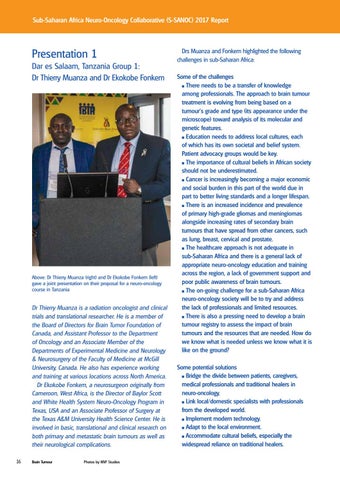
Above: Dr Thierry Muanza (right) and Dr Ekokobe Fonkem (left) gave a joint presentation on their proposal for a neuro-oncology course in Tanzania
Dr Thierry Muanza is a radiation oncologist and clinical trials and translational researcher. He is a member of the Board of Directors for Brain Tumor Foundation of Canada, and Assistant Professor to the Department of Oncology and an Associate Member of the Departments of Experimental Medicine and Neurology & Neurosurgery of the Faculty of Medicine at McGill University, Canada. He also has experience working and training at various locations across North America. Dr Ekokobe Fonkem, a neurosurgeon originally from Cameroon, West Africa, is the Director of Baylor Scott and White Health System Neuro-Oncology Program in Texas, USA and an Associate Professor of Surgery at the Texas A&M University Health Science Center. He is involved in basic, translational and clinical research on both primary and metastatic brain tumours as well as their neurological complications. 16
Brain Tumour
Photos by MVF Studios
Drs Muanza and Fonkem highlighted the following challenges in sub-Saharan Africa: Some of the challenges n There needs to be a transfer of knowledge among professionals. The approach to brain tumour treatment is evolving from being based on a tumour’s grade and type (its appearance under the microscope) toward analysis of its molecular and genetic features. n Education needs to address local cultures, each of which has its own societal and belief system. Patient advocacy groups would be key. n The importance of cultural beliefs in African society should not be underestimated. n Cancer is increasingly becoming a major economic and social burden in this part of the world due in part to better living standards and a longer lifespan. n There is an increased incidence and prevalence of primary high-grade gliomas and meningiomas alongside increasing rates of secondary brain tumours that have spread from other cancers, such as lung, breast, cervical and prostate. n The healthcare approach is not adequate in sub-Saharan Africa and there is a general lack of appropriate neuro-oncology education and training across the region, a lack of government support and poor public awareness of brain tumours. n The on-going challenge for a sub-Saharan Africa neuro-oncology society will be to try and address the lack of professionals and limited resources. n There is also a pressing need to develop a brain tumour registry to assess the impact of brain tumours and the resources that are needed. How do we know what is needed unless we know what it is like on the ground? Some potential solutions n Bridge the divide between patients, caregivers, medical professionals and traditional healers in neuro-oncology. n Link local/domestic specialists with professionals from the developed world. n Implement modern technology. n Adapt to the local environment. n Accommodate cultural beliefs, especially the widespread reliance on traditional healers.