The CERN Foundation Outcomes Project: impact of ependymoma in adults and children Alvina Acquaye, Research Associate National Institutes of Health, Bethesda, Maryland, United States
AN ependymoma is a rare type of primary brain or spinal cord tumor. It occurs in both adults and children. To better understand the impact of an ependymoma diagnosis and subsequent treatments on patients, their families and the community, Terri Armstrong, Ph.D., is leading the Ependymoma Outcomes Project for the CERN Foundation. I am also a team member for this project and am a Research Associate at the US National Institutes of Health. I fulfill the role of project coordinator for the Outcomes Project and have been involved since its inception. The Ependymoma Outcomes Project is an online survey for adult and pediatric ependymoma patients, and the parents of pediatric patients. The project, in its fourth year, has had 280 adults and 79 children and their parents participate. The project provides insight into what life is like for people with ependymoma before, during and after treatment. In a recent article titled, “Clinical Presentation and Outcomes for Adult Ependymoma Patients,� that was published in Cancer in the autumn of 2016, it was reported that there are significant symptoms and functional impairments as a result of the diagnosis. These symptoms and impairments occur even when the patient has completed active treatment and throughout the trajectory of the disease. This was the largest report to date of the impact of ependymoma in adults. Here are some of the most compelling results of our survey to date.
What we have learned about adult patients An ependymoma can occur anywhere in the brain or spine and can impact patients both physically and emotionally. In the survey, and surprisingly, 33% of patients were unsure of the grade of their tumor, highlighting the potential lack of education 50
Brain Tumour
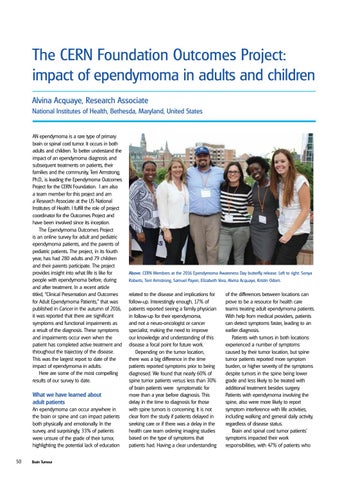
Above: CERN Members at the 2016 Ependymoma Awareness Day butterfly release. Left to right: Sonya Roberts, Terri Armstrong, Samuel Payen, Elizabeth Vera, Alvina Acquaye, Kristin Odom.
related to the disease and implications for follow-up. Interestingly enough, 17% of patients reported seeing a family physician in follow-up for their ependymoma, and not a neuro-oncologist or cancer specialist, making the need to improve our knowledge and understanding of this disease a focal point for future work. Depending on the tumor location, there was a big difference in the time patients reported symptoms prior to being diagnosed. We found that nearly 60% of spine tumor patients versus less than 30% of brain patients were symptomatic for more than a year before diagnosis. This delay in the time to diagnosis for those with spine tumors is concerning. It is not clear from the study if patients delayed in seeking care or if there was a delay in the health care team ordering imaging studies based on the type of symptoms that patients had. Having a clear understanding
of the differences between locations can prove to be a resource for health care teams treating adult ependymoma patients. With help from medical providers, patients can detect symptoms faster, leading to an earlier diagnosis. Patients with tumors in both locations experienced a number of symptoms caused by their tumor location, but spine tumor patients reported more symptom burden, or higher severity of the symptoms despite tumors in the spine being lower grade and less likely to be treated with additional treatment besides surgery. Patients with ependymoma involving the spine, also were more likely to report symptom interference with life activities, including walking and general daily activity, regardless of disease status. Brain and spinal cord tumor patients’ symptoms impacted their work responsibilities, with 47% of patients who