001-216 02210.qxd
Arrangement
11/24/10
11:06 AM
Entry points
Page 94
Pace
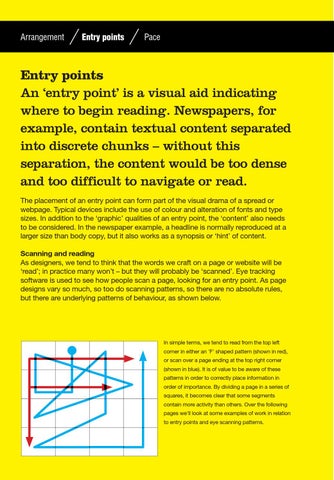
Entry points An ‘entry point’ is a visual aid indicating where to begin reading. Newspapers, for example, contain textual content separated into discrete chunks – without this separation, the content would be too dense and too difficult to navigate or read. The placement of an entry point can form part of the visual drama of a spread or webpage. Typical devices include the use of colour and alteration of fonts and type sizes. In addition to the ‘graphic’ qualities of an entry point, the ‘content’ also needs to be considered. In the newspaper example, a headline is normally reproduced at a larger size than body copy, but it also works as a synopsis or ‘hint’ of content. Scanning and reading As designers, we tend to think that the words we craft on a page or website will be ‘read’; in practice many won’t – but they will probably be ‘scanned’. Eye tracking software is used to see how people scan a page, looking for an entry point. As page designs vary so much, so too do scanning patterns, so there are no absolute rules, but there are underlying patterns of behaviour, as shown below.
In simple terms, we tend to read from the top left corner in either an 'F' shaped pattern (shown in red), or scan over a page ending at the top right corner (shown in blue). It is of value to be aware of these patterns in order to correctly place information in order of importance. By dividing a page in a series of squares, it becomes clear that some segments contain more activity than others. Over the following pages we'll look at some examples of work in relation to entry points and eye scanning patterns.
Job No:02210 Title:BD Layout (Second Edition) Page:94