
Hello and welcome to the first issue of IATEFL Voices for 2025. A very happy new year to you all from the IATEFL Voices team. I hope that the start of this new year has been a peaceful one. As I write this, I am reflecting on 2024, which is fast coming to a close, a year which has seen an increase in conflict around the world. In our first feature, Mohamed Yousif Abdalla and Lubna Hassan Elatta reflect on the war in the Sudan and what it is like to teach in a war zone. While our news is full of reports from The Palestinian Territories and Ukraine, little is reported about the ongoing war in the Republic of the Sudan. Thank you to both Mohamed and Lubna, and to Linda Ruas of the Global Issues SIG who helped put the article together, for providing this insight into what must be very difficult and harrowing conditions.

In our other feature articles, Meri Maroutian looks at the global phenomenon of the trafficking of native speaker English language teachers and asks when it will stop. Gillian Flaherty looks beyond the culture brief and discusses how to write materials for markets you have not worked in or visited before. Bruno Sousa returns to Voices to consider whether we still need to prevent taboo topics from being discussed in the classroom.
Jaber Kamali and Montaser Jassouma present research on what they learned about how to increase learning opportunities through group conferencing. Mark Nwaefido examines communicative language teaching from a critical perspective and considers whether it meets the needs of a typical language classroom in Kazakhstan.
Jack Hsiao returns to the theme of culture in his article, where he talks about including aspects of Chinese culture in his English language classroom. Finally, we hear from Terence McLean about the Flip and TILT teaching method, including examples of how this can be incorporated into your classroom.
And that leads nicely to our latest For the Classroom section, which includes two lesson plans. Elmira Shirinsokhan looks at sustainability using past modals, and Syed Naeem considers how songs can be used as a teaching tool.
Our regular Green IATEFL column is back and there is a double helping this issue. IATEFL President Aleksandra Popovski and Sabina Skenderovic report back on the recent ELT for Sustainability Conference they attended in Bosnia and Herzegovina. And Adrian Underhill provides advice on going public on your school’s green credentials.
The British Council is also back and we hear from Chris Cavey about the recent publication AI activities and resources for English language teachers, which looks at how teachers might use artificial intelligence in their classrooms.
We hear for the first time from Georgia Papamichailidou, the Chair of IATEFL’s Digital Committee on her experience of being Chair and a Trustee since taking over back in April. One thing that Georgia talks about is the IATEFL Live! shows, which you should definitely check out. There are reports from the Nationaal Congres Engels in the Netherlands, the Kazakhstani Association of English Language Teachers international conference, trauma-informed teaching from TESOL Türkiye and the IATEFL Poland international conference and webinar series, all in the From the Associates section.
With the IATEFL Conference in Edinburgh just around the corner, 2025 does have the potential to be a positive year, full of inclusion, peace and opportunity. I certainly hope it is wherever you may be. With best wishes,
Derek Philip-Xu Editor, IATEFL Voices editor@iatefl.org
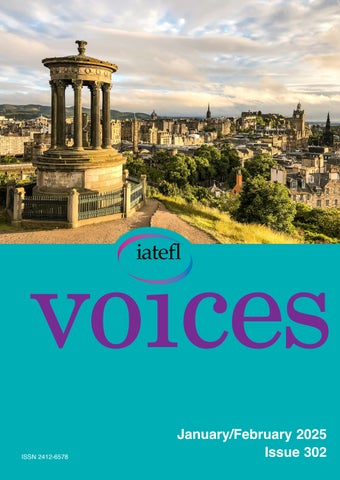
Cover image by Kate Bielinski on Unsplash
At the Brighton Conference, Georgia Papamichailidou took over as Chair of the Digital Committee. In this edition of From the Trustees, Georgia discusses her role to date and what’s coming up over the next few months.

Let’s set the
Back in 2017, I attended my very first IATEFL Conference in Glasgow. While taking a break in a quiet corner of the Clyde Auditorium and Scottish Event Campus, I reflected on the immense effort behind planning such an impressive event. Fast forward seven years, and here I am, writing this article while taking a break from planning the IATEFL Themes Conference. This time as an IATEFL Trustee and Chair of the Digital Committee.
As a newly elected Trustee, I’m filled with excitement, curiosity and a deep commitment to share the work my Digital Committee and I are doing to offer digital spaces for knowledge-sharing, collaboration and sustainability within our ELT community.
When I took over the reins from my mentor, Shaun Wilden, my first goal was to honour the digital legacy he had built within IATEFL and to expand that strong foundation. Since my appointment in April, here is what has been in the works.
Uplifting the IATEFL Live! shows The IATEFL Live! shows are monthly livestream episodes broadcast on YouTube, Facebook and LinkedIn, providing a dedicated space for educators and industry experts to come together and showcase their expertise. Through these shows, we aim to offer a platform to anyone with valuable insights. This year, I designed the Live! shows around our Special Interest Groups (SIGs), with each month featuring a new focus. This allows the SIGs to showcase their work and invite meaningful discussions. The interaction between the guests and the audience is truly inspiring and I love the IATEFL Live! shows for being accessible, enriching and open to all! Be
sure to stay tuned for updates and the IATEFL Live! calendar.
Expanding the IATEFL Themes Conference
For those who cannot attend our annual in-person Conference, the Themes Conference is our digital solution! This annual online event highlights the most talked-about sessions from the Conference, based on delegates’ feedback and our SIG coordinators’ selections, to reflect the core themes in ELT. Our aim is to bring this experience to every corner of our global community, ensuring that IATEFL remains accessible to all. This year, we’ve expanded the number of sessions, broadened the variety of the topics and increased the range of our speakers. As I am writing this article before this year’s IATEFL Themes Conference, I can’t yet share how it went but I’m confident it will be fantastic!
Building a team of moderators
For those familiar with the IATEFL Live! shows, the names Anca and Niki might ring a bell! The Digital Committee and its moderators are the backbone of our digital community. Each moderator brings a unique voice ensuring our digital events are well-run, welcoming and interactive. Over the past six months, I have connected and talked to various people from different time zones; people interested in volunteering their time to be part of our digital journey to provide our IATEFL members the opportunity to grow. So, if you would like to be involved, please feel free to reach out!

Our IATEFL Vice President, Chris Graham, and I share a passion: making our world and classrooms greener! By laying the foundations for Green IATEFL, we’re designing a resource set to help teachers promote environmental awareness in the classroom. As Chair of the Digital Committee, I’m thrilled to support this initiative. Watch this space! Planning the in-person IATEFL Live! show in Edinburgh
Let’s not forget that next year, we’ll be meeting at the IATEFL Conference in Edinburgh! During the IATEFL Live! show, our online audience will get to meet speakers, sponsors, delegates and all the brilliant individuals who make the IATEFL Conference what it is! I am designing shows that will be educational, informative and will give you a taste of the Conference.
With our efforts with the Digital Committee, IATEFL is not only responding to our members’ evolving needs but also shaping the future of learning and development. Looking ahead, I am focused on expanding these initiatives, setting high standards and deepening my commitment to accessibility, inclusivity and fostering a culture of sustainability. I can’t wait to see it all come together! See you all online!
georgia@iatefl.org
The International Association of Teachers of English as a Foreign Language was founded in 1967.
Registered as a Charity: 1090853 Registered as a Company in England: 2531041
Disclaimer
Views expressed in the articles in Voices are not necessarily those of the Editor, of IATEFL or its staff or trustees.
Copyright Notice
Copyright for whole issue IATEFL 2024. IATEFL retains the right to reproduce part or all of this publication in other publications, including retail and online editions as well as on our websites.
Contributions to this publication remain the intellectual property of the authors. Any requests to reproduce a particular article should be sent to the relevant contributor and not IATEFL.
Articles which have first appeared in IATEFL publications must acknowledge the IATEFL publication as the original source of the article if reprinted elsewhere.
Aleksandra Popovski and Sabina Skenderovic report on the ELT for Sustainability Conference that was recently held in Bosnia and Herzegovina
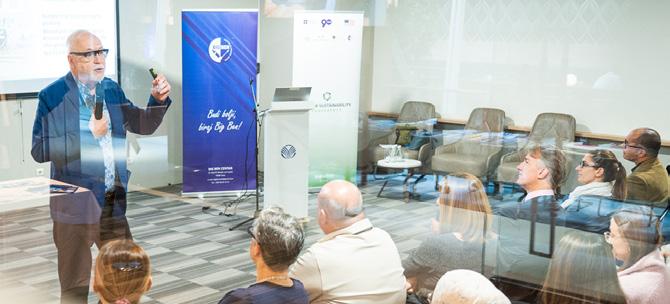
The ELT for Sustainability Conference was held on 12 October in Sarajevo, Bosnia and Herzegovina, with the aim to bring together teachers from Bosnia and Herzegovina and the region to explore the critical intersection of ELT and SDGs (Sustainable Development Goals). The conference was organised through a collaborative effort between Big Ben Centre from Tuzla and Symmetry Teacher Training from Skopje with the generous support of the British Council, Alfa d.d. and Alfa Naklada, exclusive distributors for Express Publishing, the US Embassy in Bosnia and Herzegovina, RELO Belgrade, SOL (Sharing One Language), and IATEFL as a strategic partner. The conference was opened by His Excellency, Julian Reilly, British Ambassador to Bosnia and Herzegovina.
The conference programme focused on several key SDGs, with particular emphasis on quality education, environment protection, climate change action, and peace promotion. These topics were carefully chosen to demonstrate how language teaching can serve as a vehicle for raising awareness about crucial global issues. Sponsored by the event’s Platinum Sponsor, the British Council, Christopher Graham kicked off the day with a plenary on climate change and the actions that we as educators can and should take. His question – What exactly is sustainability and what role does the ELT community have in developing and maintaining it? – led to some interesting questions and discussions from the audience. Ivana Bokavshek, Alfa Naklada, focused on teaching green to grow green, i.e. how to make students more environmentally sensitive, but also how to adjust our teaching-self to educate new generations of students to grow and

Aleksandra Popovski is a teacher and teacher trainer with a strong passion for language education. Her interests include multimodality, incorporating visual arts into language teaching (graphic novels, street art, tattoos), exploring effective reading comprehension strategies, and creating original readers for her students. She is particularly interested in reading as a tool for exploring and discussing issues such as social (in)justice, diversity and inclusion with learners of English.

Sabina Skenderovic was born in Bosnia and Herzegovina. She has been teaching for over 15 years. She has an MA in the English Language and Literature. She has won prizes for innovative use of technology, a Superwoman of Solidarity Prize and was selected the person of the year in the field of education.
maintain their ecological responsibility. Daniel Xerri, University of Malta, shared his ideas and views on how to reflect on sustainable development through a glocal perspective and the potential of reflective thinking as a catalyst for change. George Kokolas, Express Publishing, introduced the conference participants to the world of positive education, a scientific, longimplemented educational framework in which teachers and students can flourish and find encouragement when they feel stuck or demotivated. Larisa KasumagićKafedžić, University of Sarajevo, explored the intersection of the SDGs and the need for learning approaches in language and culture education that empower, transform and humanise learning. The US English Language Fellow, Marissa Foti, shared some engaging activities with the audience to help them integrate SDGs into their classroom practice. All the speakers emphasised the growing importance of addressing global sustainability challenges within language education.
The conference ended on a positive note with a prize draw generously sponsored by SOL – Sharing One Language, Devon, UK. Two teachers from Bosnia and Herzegovina will attend SOL teacher training courses in Devon and Serbia, respectively.
More than 100 participants created a vibrant atmosphere for knowledge exchange and professional development. Teachers from various backgrounds shared their experiences and challenges in implementing sustainability-focused teaching practices,
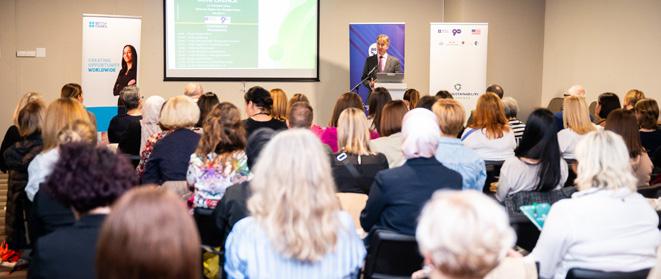
contributing to a rich dialogue about the future of ELT. What made this conference particularly impactful was its timing, as educational institutions and organisations worldwide are increasingly recognising the importance of integrating sustainability into their teaching practices. IATEFL, with its Green IATEFL initiative, is one of the organisations that is fully aware of and recognises the urgent need for creating a space for discussing sustainability in language education, what opportunities and challenges lie ahead, and how we can approach and address them.
Looking ahead, the ELT for Sustainability Conference has laid foundations for future initiatives in sustainable language education in the region. While formal resolutions were not made (and that was not the purpose of the event), the conference established important connections between ELT professionals committed to incorporating sustainability principles into their teaching methods.
This professional development event, first of its kind in the region, highlighted how English language instruction can be enhanced to address current global challenges. The conference demonstrated that ELT professionals are increasingly ready to accept their role in promoting sustainable development through language education, and they are willing to become part of the movement for more sustainable practices in ELT and language education in general.
We hope that the ELT for Sustainability Conference will become a regular event in the region that would bring together English language teachers from around the world to share their experiences and expertise in sustainability in (English) language education.
We do not inherit the earth from our ancestors, we borrow it from our children.
Indigenous American proverb
aleksandra@iatefl.org
Adrian Underhill talks about how to achieve green credentials for your school in an edited version of an article that first appeared in Humanising Language Teaching (HLT) in December 2024
The school scene
The leadership of most schools want to act on climate change and wider issues of sustainability. They know their business has leverage and can make a difference, and that their staff and school community will support the school championing eco values.
Schools that do this visibly will command attention and allegiance, grow their community, draw in parents, sponsors, kids, local networks, influence teaching materials, and gradually influence syllabuses and exams, and eventually even ministries (!). Such schools gain fans not just customers, and act as compelling thought leaders for others.
Green content for learners
Much progress has been made on classroom resources, lesson plans, teacher strategies and a green learner syllabus. There is lively discussion through media and publications. IATEFL has launched Green IATEFL and the September/October 2024 issue of Voices (issue 300) is packed with ideas for action and reflection. Yes teachers need to act, and they are. But what about the schools they work for? It is not enough to encourage greening the class, that should be a natural outcome of a wider greening across the school, organisation or association.
Green content for the behaviour of schools themselves?
Well, schools face a real problem here, which is where to start, how to selfmeasure, what can be improved and how, how to prioritise, how to benchmark against standards, how to compare with others,

Adrian Underhill is a consultant to schools, and offers one- or two-week face-to-face teachers’ courses at Oxford University, IH London and Bell Cambridge, as well as online. His video series is available at www. macmillanenglish.com/pronunciationskills/, his blog at https://adrianunderhill. com/, and demonstration videos at www. macmillanenglish.com/pronunciationskills/ and on YouTube.
and how to make credible and audited claims through their school’s media that will turn heads, win hearts and promote reputational advantage. It is not enough to sit down and make lists of actions like paper saving, doing digital, cycling to work, recycling, power reduction, etc. though these are part of it. Nor is it enough for schools to rely on worthy environmental self-claims which are haphazard, unreliable and subjective, limited by your time constraints and blind spots. Just as schools cannot make serious claims to pedagogic excellence without an evidence-based audit from an external inspection scheme, so too the claims of impact reduction have little credibility unless backed by a recognised external auditor.
Most language organisations deal with learners in their local communities. Some especially in the UK, Australia, New Zealand, the US, etc. are study abroad institutions. The latter have the additional carbon impact of international travel, and since impact reduction of air travel is as yet unresolved, you have to keep that question boldly open, while forging ahead systematically and visibly on tracking and reducing impact across all the categories where you can make a difference, picking the low-hanging fruit immediately, and working toward the more challenging impacts as you develop the skills, momentum and a framework. And how do you do this?
The simple answer is to use one of the growing number of ready-made online frameworks designed for small organisations who want to act sustainably
and to demonstrate that they are doing so. These frameworks tell you what to measure, how to score yourself, how to make your improvements visible, and how to show the outside world your credible, benchmarked and objective scores. Using a ready-made measuring system is simpler and more robust than trying to invent a system yourself.
In this article, I introduce you to three such ready-made, online, sustainability auditing systems, in the hope of inspiring you to examine them and commit to working with one of them, or with something similar. I also reference two further schemes.
Two of these three ready-made frameworks are specifically for ELT schools, and one is for any small- or medium-sized enterprise. The first two are free to use and if later you want to join, there is a cost. The third is designed for an international organisation of schools, and though only members have access to it, I describe it here so you see how it works, and if you are part of a chain or association of schools, you might consider developing your own membership auditing system. But make sure it is measurable, credible, audited, and above all made public so that you too exert thought leadership throughout the industry community.
1 Green Standard Schools for ELT schools
2 BCorp for any small enterprise including schools
3 Environmental Sustainability Review for members of the International House World Organisation.
Overview of the three impact audit schemes
Green Standard Schools (GSS) greenstandardschools.org/ GSS includes guidelines to help ELT schools become more environmentally
sustainable. There are tools to measure the environmental impact of your school. Evaluation involves self-assessing but is accredited by an external panel. There is an option to join the GSS Association. Green Standard Schools has three aims: Provide policies
The first is to provide a set of policies and practices that schools can adopt and adhere to. You work through a selfassessment form consisting of 50 yes/ no questions covering language school activities that have environmental impact, such as energy and water consumption, purchasing, recycling, accommodation, food, travel, teaching, training, social activities, etc. You provide evidence to verify your answers and submit this for a free audit of your current policies and practices.
Award accreditation
Assessors award points for the answers given and for the evidence provided. They also give feedback on questions answered, including suggestions on how schools can improve their performance. Schools gaining 130/200 points can become members of the GSS association Those that don’t make it first time, which is quite natural, learn from the tailored feedback how to measure more accurately and credibly, and resubmit when ready. Develop pedagogical resources
The third aim is to design and provide materials to encourage integration of environmental content in language teaching and learning. These materials consist of lesson plans, videos, reading and other study resources, all provided free on the GSS website, app. greenstandardschools.org/public-lessonplans See the August 2024 issue of HLT for a full description Green Standard Schools.
bcorporation.uk/b-corp-certification/ BCorp measures social and environmental impact, since they are connected. There is a comprehensive matrix of specific points to work on, and guidance on how to measure and how to self-award points for measures (already) taken. Points are intended here as an objective measure of impact reduction and can be used for comparison or to show progress. The BCorp route map is about assessing your impact, comparing and improving.
Social and environmental impact is measured across these five interconnected impact areas.
Governance
Example: What portion of your
management job descriptions include evaluation on their performance with regard to corporate, social and environmental targets?
Workers
Example: What say do full-time workers have in the school’s company impact?
Community
Example: What percentage of management is from underrepresented populations? (plus diversity, equity, inclusion)
Environment
Example: Does your company monitor and record its universal waste production?
Customers
Example: How can customers verify that your school is improving its impact?
When you sign in to your dashboard, you’ll see the impact assessment page, showing these five categories, the number of questions in each and your current score. Choose those questions you are ready to work with. The question guides you as to how to measure. Your responses yield your baseline score against which to improve and see your progress, and to compare yourself and others.
This reveals actions with zero cost attached, i.e. quick wins with immediate score improvement to be gained, actions that are doable but need budgeting, actions you’ll leave for the moment, and those which do not apply. So, you quite quickly see the big picture of your impact, a baseline score which you can use internally or in promotion and planning.
When ready, you can evaluate your performance compared to the thousands of other businesses that use the impact assessment platform to identify, track and improve week by week.
Environmental Sustainability Review
ihworld.com/about/environmentalsustainability/
This consists of twelve self-review criteria, six things to do more of, and six to do less of (see below). You complete a guided self-review and submit for assessment, followed by further exploration of actions taken. The resulting audit is time-dated, and schools would repeat every two years to show further action and commitment to continuous improvement.
The six things you need to do more of include: educating students, encouraging sustainable behaviour, increasing community involvement, setting a food supply policy, setting sustainability requirements for suppliers, and
managing your sustainability strategy. The six things you need to do less of include: travel-related and negative impacts, energy consumption, singleuse consumables, waste and re-cycle, water consumption, and environmental footprint of new premises.
Against each of these twelve criteria, you state what actions you are taking, at which of these four stages you are currently, and:
❚ how you intend to act;
❚ how you are currently acting;
❚ how you have committed to quantifiable actions and measures; and
❚ how you have in place a total school strategy for documenting measures and effectiveness.
Then, you complete the online self-evaluation and submit. Staff at International House World Organisation assess the responses and then follow up with stakeholders in your school, developing evidence through interview/ discussion, documents, photos, videos and so on. When all this is completed, a short video or blog highlighting points of excellence is made and used to champion the school’s achievements within the industry and as widely as possible. Demonstrating significant action on eight of the criteria gains you a badge to use on media and communications
UNESCO www.unesco.org/en/educationsustainable-development/greeningfuture/schools
❚ a Green School Quality Standard covering School governance, Teaching and learning, Facilities and operation, and Community engagement;
❚ shows what a climate-ready green learning environment should offer; ❚ a useful thinking and planning tool; ❚ particular focus is on the school community and engagement.
If you want an audited impact rating, you can refer to their list of accreditation schemes aligned with this standard, or find your own. Certainly, you could use this in conjunction with any of the three audit schemes above.
Eco-schools
www.eco-schools.org.uk/
This has an early years focus and is UK-based, with activities and checklists for getting everyone involved. It has very
useful starting ideas and action checklists. It includes a simple ‘Count Your Carbon’ calculator. It is designed for nurseries, schools and colleges. It helps calculate, understand, reduce and track your carbon emissions. There is no external audit.
Note that some items in these impact audits will overlap with legal compliance (maybe 15 per cent?), which may be worth prioritising as they are (becoming) legal requirements.
Once you’ve looked at the five schemes listed here you will be better placed to discern between audit schemes, to see what help and guidance is available out there, what your own impact measurement
needs are, and which scheme can best walk you through the steps, help you make visible your school impact, measure improvements and make upbeat credible claims to the world.
The schemes differ in the detail they go into, the number of guiding steps they offer for measuring and for reducing impact, and the control you have over scoring points that will be meaningful to you, your staff and the community. That’s why I think it is important to look at several audit schemes prior to launching out.
This is a journey not only for school leaders but for an entire school staff and its community. When the organisation itself takes ongoing conspicuous and measurable action on its own behaviour, the entire staff can feel the encouragement of collective
commitment across the piece, and a worthwhile venture takes on a life of its own, offering some counterbalance to feelings of powerlessness. Be sure to engage staff from the first moments in an inclusive strategy rather than presenting a ready made plan. Ultimately, you will have a school with good transparent governance, an engaged staff, a higher purpose that brings people together in a unified endeavour, and something to show the world.
In a nutshell: engage school and community, make a verifiable difference, tell the world… and be part of the change.
adrian@aunderhill.co.uk
Chris Cavey is Broadcast and Media Lead, English and School Education at the British Council. Here he introduces AI activities and resources for English language teachers, a new publication helping teachers incorporate AI into their practice.

Among the many interesting findings in the British Council’s landmark 2023 report, Artificial intelligence and English language teaching: preparing for the future was evidence that English language teachers were enthusiastically embracing AI and using AI-powered tools for a range of tasks. Almost 80 per cent of teachers agreed that AI can help learners improve their skills and 65 per cent of teachers agreed that AI can plan effective lessons. Equally clear however, was the feeling that teachers have not received enough training, with only 20 per cent of teachers feeling sufficiently trained.
The report concluded that it would be useful to have a breakdown of language teacher activities and examine the ways that AI might be used to help teachers in each of those activities.
AI activities and resources
AI activities and resources for English language teachers is a response to this need. It identifies ten areas where teachers might use AI. These include:
❚ helping learners evaluate AI output;
❚ personalising and adapting materials;
❚ acting as a collaborator and mentor; and ❚ supporting teachers’ professional development.
For each of these ten areas, there is a choice of activities that teachers can try or adapt to their context. The activities are linked to the eleven professional practices of the British Council Teaching for Success CPD framework so that teachers can contextualise their AI use with their other CPD activity.
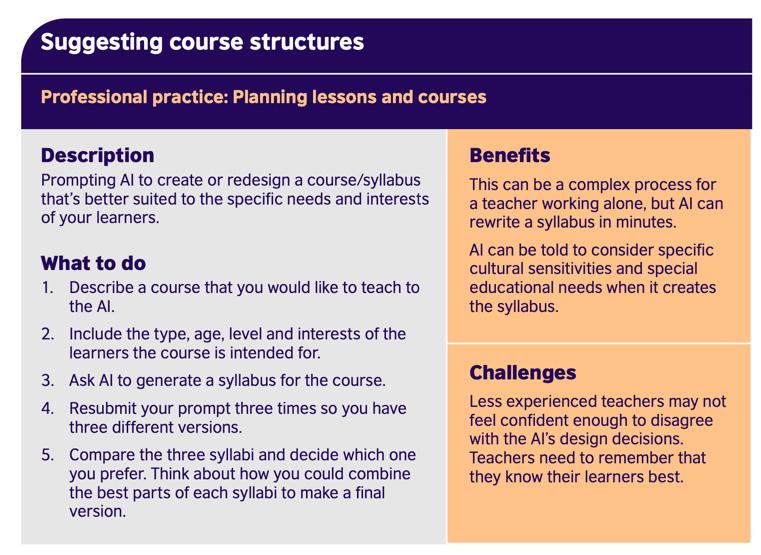
Each of the 43 activities includes stepby-step instructions to guide teachers but also includes sections on both benefits – a rationale for the use of AI in the context –
and challenges – a summary of potential risks for teachers to consider before using the activity (see, for example, Figure 1). These sections reinforce the importance of a considered approach to the use of AI tools by weighing up the advantages and mitigating against potential pitfalls.
Benefits
❚ AI’s capacity to generate lots of ideas, examples and text types in a fraction of a second can save teachers and learners time and help them focus.
❚ As a speaking partner, AI can be less stressful than speaking to another person – and will never get tired of interacting.
❚ AI enables teachers to personalise and localise content to match the culture and interests of their students.
Challenges
❚ Information generated by AI may not be factually accurate. Teachers should always check AI-generated text before sharing it with students.
❚ AI may have limited knowledge of some cultures and may produce material that is biased toward a particular culture, class or ideology. Again, teachers always need to check and select carefully.
❚ AI may not be culturally sensitive, for example in producing discussion questions on topics that may upset or cause offence.
❚ There may be a temptation for learners to over-rely on AI for producing language.
❚ Teachers must always be aware of which data should not be shared with AI – both in terms of any personal, identifying data and the use of copyright material.
To reinforce this idea that AI is not itself an expert teacher but a tool for teachers to use, AI Activities and Resources for English language teachers includes other sections to broaden teachers’ engagement with AI.
Guiding principles: There are five guiding principles that provide teachers with a checklist to refer to when considering their own use of AI.
Writing effective prompts: The right prompts are essential in getting the best outcomes from an AI tool. The more information you give about style, audience, length, format, context, etc., the better the results will be. A prompt template and a range of example prompts are provided to help teachers.
Further resources: A final section compiles a range of British Council reports, articles and resources from the TeachingEnglish website and elsewhere with further advice and guidance on risks and how to mitigate them.
The pace of development and the range of AI tools available can seem dizzying but English language teachers have proved to be among the most enthusiastic adopters of AI in education. AI Activities and Resources for English language teachers is another step from the British Council towards providing teachers with the knowledge and tools they need to ensure the best outcomes for their students.
TeachingEnglish@britishcouncil.org
Mohamed Yousif Abdalla and Lubna Hassan Elatta wrote this article to show how teachers are teaching, in very challenging circumstances, during the war in the Sudan. It summarises the situation now, what teachers are doing, and how they are getting support. It has been put together with the help of Linda Ruas, joint coordinator of the Global Issues SIG, from WhatsApp messages and photos sent by Mohamed.
The bomb alert sounded. We knew the bombing would start again at any moment. My students immediately slid under the tables, a practised routine, which did not have much chance of protecting them from a direct hit. Suddenly, one of them started singing:Ten green bottles, sitting on the wall… The others joined in, one by one. It was all I could do to stop myself from crying. Another day, they started singing London’s burning, and soon changed this to ‘Khartoum’s burning’.
I have been teaching and training teachers for many years, and this is one of the most challenging, upsetting circumstances that I have ever found myself in. When the war started in April 2023 in Khartoum, many families were able to leave, by crowding onto buses, walking very long distances, risking being attacked on their way, queuing at the borders for many hours. I was not able to leave, as I needed to look after my parents who could not travel, and my area is one part of Khartoum where the fighting has been constant since the start of the war.


Mohamed Yousif Abdalla is Deputy Director of the Sudanese English Language Teaching Institute (SELTI) and has over 20 years’ experience of teaching in Sudan, the Kingdom of Saudi Arabia and the United Arab Emirates. He is also a social and education activist and interpreter, and is on the board of the Sudan English Language Development Association (ELDA).
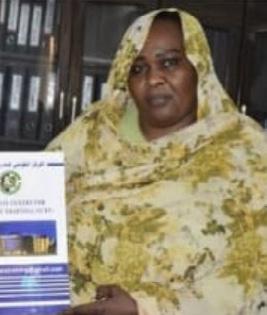
With a comprehensive skill set that encompasses language instruction, translation, leadership and community outreach through being President of the Sudan ELDA, Lubna Hassan Elatta continues to make a significant impact in the field of education, empowering individuals to reach their full potential and contributing to positive social change.
Sudan has been in a state of political instability for many years, and this affected its educational policies in a significant way. The Sudanese December 2018 revolution was the beginning of great political stability that could have advanced the country, especially education. Sadly, war broke out again in April 2023 and stopped all the progress.
Now, about 19 million children in Sudan are out of school. 10,400 schools have been closed completely in conflict-affected areas. All language teaching centres, educational institutes, universities, colleges and private and public schools have been affected and English language teachers suffer a lot.
Khartoum is far from safe. Many civilians have been killed, even inside their homes. My area is controlled by the rebels, and the army are trying to push them out. The rebels robbed our house, our vehicles, our money, our jewellery, banks, electronics – everything. They live by robbing, by threatening people at gun-point. If any civilian tries to defend their property, they are shot.
At first, we had no electricity. Food and water were very difficult to come by, and people risked their lives leaving their homes to search for some. There was little or no aid from international agencies as it was too dangerous for them to come to the city.
Everything stopped in the first two or three months. Then, little by little, over the past nine months, we have organised ourselves to help and support each other in the most terrible of circumstances. In times like these we have in Sudan a concept called ‘Takiyya’. It’s simply that people put all the money they have on the table, no matter how much it is. All the food is stored in one place. Then people form a committee to be responsible for managing all these resources. Food is cooked in one place and distributed fairly, based on the number of people in respective families. We have a group responsible for bringing water from the river by big tanks, directly to the houses. Another group goes shopping. There’s also a finance group, a medicine group, etc. We receive money from our relatives and friends who live and work abroad. These are the real backbone of the Takiyya.
In our schools, we don’t only teach academic subjects, but we also run group therapy sessions, as the children have been traumatised and experience nightmares due to the long period of the war. We hope this works. The children are really broken and scared all day. By attending our classes, especially English lessons, they have become less worried, at least during class.
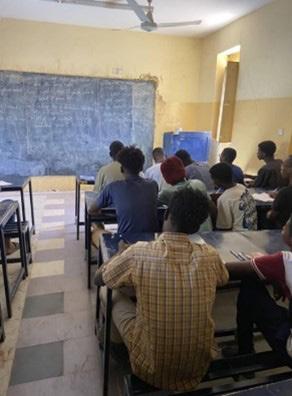
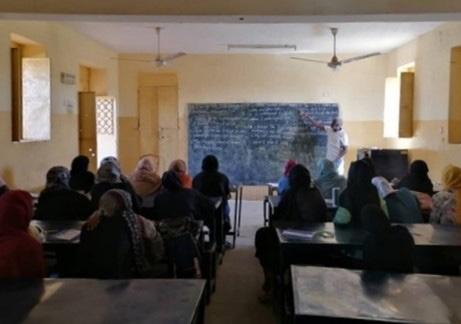
English language classes re-started with three learners under the shade of a tree at my front gate. Now we have more than 200 students at different levels. I am now working with high school boys and
2023
Issue 290 2022
2022 2019 girls, and there are also ladies coming to the classes who are not students. They really like the idea of coming to class and learning English, as they have been locked at home doing nothing, and they call it ‘Time for a peaceful mind’. Recently, some of my students’ elder brothers and sisters have been coming to the classes too.
Some of our activities are related to the war. For example, we have been working on conditional grammar, but practising it by applying it to our hopes and plans, for example:
❚ When this war ends, I’ll live in a peaceful place.
❚ When this war ends, we’ll be happy with our family.
❚ When this war ends, I’ll live in a quiet place.
This helps with positive thinking.

One of the big challenges in teaching is not just convincing the parents to send their boys and girls to us at the school but how to overcome our own fears as teachers having to walk to the school (maybe only 7 minutes) – with the constant risks of being shot at or stopped and frisked by armed men.
One solution is for teachers to come together and support each other. The Sudan English Language Development Association (ELDA) is attempting to do this – again, in very difficult circumstances.
The situation changes daily; the Internet is very often cut off completely, teachers need to move anywhere they can find work to support their families, who are often suffering from trauma.
The British Council is helping with some online courses for teachers. Africa ELTA is helping, with the offer of webinars and free entrance to the Africa ELTA conference for Sudanese refugee teachers. We are very grateful to them and anyone else who can support us.
We do have some ongoing support in our Sudan ELDA WhatsApp group for members, with discussions about, for example, how to motivate learners and teachers, and presentations on understanding and helping learners with trauma, problem solving and requests for help. Finally, we are now putting together a simple online publication: Teaching in times of conflict, with articles from around the world, to support and help everyone.
lubnulia@gmail.com
Meri Maroutian outlines the ‘trafficking’ of native speaker English language teachers and asks when this practice will stop
Introduction
In the context provided in the article, the term ‘trafficking’ pertains to the systematic preference for English language teachers primarily from English-speaking or ‘inner circle’ countries – as defined by Kachru (2005) – being flown over to ‘outer circle’ countries to meet the market’s high demand of native speaker teachers. This practice underscores the belief that native speakers of English, particularly those from countries like the United States, the United Kingdom, Canada, Australia, New Zealand, and sometimes Ireland and South Africa, are inherently superior

Meri Maroutian is the founding member of The Non Native Speaker. As an Armenian who has lived and studied mostly in Malaysia, America and Italy, Meri has become increasingly aware of the social injustices reserved for those who are forever perceived as ‘nonnative’ speakers of any given language.
teachers. Consequently, individuals from these countries are often favoured for teaching positions over candidates from other linguistic backgrounds or local teachers.
The English language teaching industry is growing exponentially as there is still a high demand for English teachers in both the
public and private sector worldwide, and it is showing no signs of slowing down. It is definitely a very competitive market, with teachers honing their niches and offering their expertise for business English classes, exam prep, young learners or English for advanced levels. This has opened a whole new job prospect for those teachers who want to work remotely or make ends meet with online classes, which allows them to be more flexible, teaching from anywhere in the world and at any hour.
In such a competitive and lucrative market, it is no wonder that so many are interested in creating a career for themselves or seeking new work opportunities that take them across land and seas. But what are the requirements for English language teachers nowadays? And who has the upper hand when it comes to getting picked for a job?
The allure of native speaker teachers: a deeper look
Rather than give a list of requirements for English language teachers in the current industry, we should take a step back and look at what is being advertised in the global market. Specifically, we should be paying more attention to teachers being advertised for the nationality that they hold, rather than their years of training and qualifications.
The high demand for native-speaking teachers who constitute a minority, is still being played as a competitive advantage for learners. Countless articles are being written with the sole purpose of recruiting native speakers for teaching jobs, promising a legitimate income source that can easily pay bills while providing free accommodation and a nomadic lifestyle. It all sounds extremely enticing and adventurous and with very little investment as no prior teaching experience is required apart from a level 5 TEFL certificate, in some cases.
The TEFL Academy is currently offering their online course at a discounted rate of €215 to complete in 168 hours, self-paced and with support from tutors. These courses are easily accessible to the public but are more advantageous for some than for others. No mention of nationality or place of birth up until this point, but when we look at the job search and availabilities posted on the same website, here’s what it can look like. This one is from Seoul ESL Consulting, Korea, dated 2023.
You must have citizenship and a valid passport from one of the following English-speaking countries: Australia, Britain, Canada, Ireland, New Zealand, South Africa, United States. You must have a bachelor’s level degree, or greater, from an accredited university or college-all majors and disciplines are accepted but two year college graduates are not allowed to obtain a work visa. (http://www.seoulesl.com/ teachinkorea/qualification.asp) They continue as follows:
Our schools and academies have solid curriculums and offer well-organized teaching materials as well. Due to these curriculums, teaching materials, and teacher training programs, even teachers with little or no experience will be able to adapt quickly to the life of an English teacher. We have placed
numerous native English teachers in schools all around Korea for the past ten years, and have developed a network of excellent schools through years of experience.
The ideology of the native speaker teacher model being superior is still being perpetuated through these job ads, and what is worse is that with respected organisations allowing this to happen and promoting it on their websites, it comes as no surprise that many people from the right anglophone countries are using these schemes to their advantage.
addressing
The message is clear, and these global organisations are not doing much to prevent stereotypical biases from coming in the way of professional teachers, with master’s degrees in education and certificates for teaching English to speakers of other languages, to find their place in the market.
This was also confirmed by English language teacher (ELT) professionals from Ireland, Canada, Vietnam, Guatemala, Australia, Poland, France, Scotland, Argentina and Italy, with whom I had the pleasure of recording a live series of interviews on the topic of native speakerism and its repercussions. The ‘Native Speakerism, Undone’ series was broadcasted live on LinkedIn and YouTube as a shy attempt to raise awareness of the prejudice non-native teachers face, and where both native and non-native speaker teachers alike unanimously confirmed and condoned native speakerism, as they too had witnessed it first-hand in their own cities, throughout their teaching careers.
The local market of available and qualified teachers has no appeal for most language schools as they all seem to claim their customers want native speaker teachers imported from inner circle countries (US, UK, Canada, Australia, New Zealand, and in some cases Ireland and South Africa). And so, the vicious circle repeats itself with no roadblocks for these misconceptions perpetuating among learners of English worldwide. What makes matters worse is that the stakeholders of the industry are unwilling to admit to having any fault in creating these fallacies. They have turned a deaf ear to the appeals of non-native
English-speaking teachers worldwide and their repeated calls for justice in the ELT industry.
Trafficking ‘native speaker’ teachers with the minimum requirements has become the norm. Within institutions in Italy, it’s easy to overhear chatter about a friend or distant relative of a native speaker, maybe visiting from overseas, who could just be the right fit for a new experience as a ‘teacher of English’. Jobs are handed out to backpackers and tourists who are not even actively looking to be teachers but who will not turn down paid classes that make ends meet, where they can have a friendly conversation and be treated with undeserved authority and respect, they might even start considering the career. Meanwhile, the blame is put on the public system, where local English teachers are metaphorically lynched for shortcomings in language instruction because of their bad accents and for not having experience living abroad – abroad meaning anglophone countries – again assuming all skills are inherently learnt from being born a native speaker or from proximity to native speakers.
When will we take ownership for what is happening? When will we stop trafficking native speaker teachers where clearly there are enough competent teachers, anywhere in the world, in the first place?
Kachru, B. (2005). Whose English is it? Asian Englishes: Beyond the Canon. Hong Kong University Press.
The Non Native Speaker. (2024, January 19). Native Speakerism, undone [Video]. YouTube. www.youtube.com/ watch?v=lW39zloFgKQ
The TEFL Academy: www. theteflacademy.com/eu/online-tefl-course/? gadsource=1&gclid=CjwKCAjwkuqvBhAQE iwA65XxQHCBDNPXYSI3eJplJojD9qXZeA a7yjiGS3hfnY1aHiVWTGWaChnNDhoCmv QQAvD_BwE
thenonnativespeaker.meri@gmail.com

Gillian Flaherty gives advice for materials writers on how to write for markets you have not lived in or visited
It’s fair to say that nothing can replace local experience and knowledge. However, at some point, most ELT authors write for countries they haven’t taught or lived in. My writing experience includes China, Thailand, Japan, South Korea, Pakistan, the Middle East and North Africa, and Latin America. Over the years, I have taught many students from these countries in private colleges, community programmes and university settings in Australia, but I have not lived and worked in all of these countries. So, there is a potential gap for ELT writers in terms of understanding enough about the target student to create materials that melt seamlessly into the local market.
Writers usually receive a culture brief, but this often doesn’t go beyond a list of dos and don’ts, including the muchdiscussed PARSNIPs (politics, alcohol, religion, sex, narcotics, ‘isms’, pork). But is this enough input for the writer? And what if they are relatively inexperienced or haven’t written for a particular country before? I have been able to develop a deep knowledge of my target students and teachers over a long period of time, using a range of approaches. I think it is a useful exercise to examine what writers can do to develop their understanding beyond the culture brief, so the aim of this article is to educate ELT writers in how they can build the habits they need to make this a reality.
Find out about the education system
Ministry of Education websites are an extremely useful source of information. The news, media and press release sections are an effective way to find useful information quickly. This is particularly helpful if you want to read a little about the educational setting in general. But these pages are also useful when looking for specific information. For example, you might be able to find out how digital education is used in the classroom, whether there are initiatives to encourage girls to study STEM, or what kinds of interschool competitions exist. Ministry websites will also usually have the academic calendar, which can be useful as writing about the school experience is a popular
Gillian Flaherty has been in ELT for 30 years as a writer and teacher. She has written for a wide range of countries including China, Japan, the Middle East and North Africa, and Latin America. Gillian holds an MA in Linguistics and an MA in Applied Linguistics and TESOL.
theme. Other interesting and useful topics include school health programmes, global partnership programmes and of course, how the school system is organised. One of my favourite ways to gain insight into the school system is by investigating individual school websites. They are a treasure trove of the nitty gritty information that helps make materials highly relevant and relatable. You can learn about the shape of the school day, special days that are celebrated, and important events like high-stakes exams or sporting events. You can also read about school facilities, which is especially useful when considering what kinds of extra-curricular activities your target students may take part in. The school policies page can be illuminating as well, as it gives you a glimpse into some of the kinds of issues that are prevalent. I also take a look at the staff page when I want to get a handle on the subjects on offer.
Find local publishers or international publishers that have published in the country or region and examine their materials. This is a good way of understanding appropriate pedagogy and topics. Publishers’ websites will have a catalogue of their ELT list, from which you can often find detailed contents pages, spreads from books and even downloadable samples. These are a great resource when getting to know a new market. It’s helpful to see which exercise types are used as this tells you a lot about the likely teaching pedagogy. It’s important to emphasise that I’m not suggesting you stray from your writing brief. But it is useful to know, for example, that open, unstructured speaking activities are common in popular local coursebooks, as it may inform how you tackle speaking activities. Or it may inform the questions you ask if you need to seek clarity of aspects of the brief. Sometimes you can even learn from the covers of local ELT
titles, as they can illuminate what kinds of themes and topics are popular. Local publishers’ websites also provide useful information about the market. You can see how it is segmented, what kinds of skills books are available and, importantly, which exams are common.
Different regions favour different examinations; IELTS, TOEIC, TOEFL, Cambridge Certificates, etc. Having this knowledge can enhance your understanding of the educational landscape, learner motivations and English pathways. Common exam question types are often used in review pages and unit tests. Understanding the origins of these questions helps you create meaningful and effective material. There are many resources available that focus on specific exams, their question types, how to write them and how to answer them.
Many countries have English language news sites which are a great way to learn more about a place. Reading local news will help you increase cultural understanding, learn about recent history, and build awareness of topics and issues of importance. Examining local news and the local take on international news is a fascinating exercise that can blow apart the Global North perspective that many take for granted. If you have already been provided with specific topics for texts, or if you are looking for them, local news sites are a wonderful resource. They often have sections that are more topical, rather than news-oriented. You may be asked to write a text about an interesting technological development from a countryspecific perspective. Local news sites are likely to have feature articles about exactly this topic. Many cover topics such as technology, culture, sport and travel – all potentially useful topics for the ELT writer. Reading these kinds of articles will fast-track your understanding of the target culture, even if you don’t use any of the content directly.
It’s important to be open to the fact that an activity that works well in a mixed L1 classroom in the UK or a summer school in
Spain, might not work in a different context. A willingness to compromise is an essential part of ELT writing. If you can truly engage with feedback as soon as you start to receive it, it will make your job a lot easier. I recommend creating a project-specific checklist based on editorial comments. It will inform your writing and act as a useful self-editing tool, and greatly add to your understanding of ELT in each country. It may also be the basis of a useful resource for other projects.
In my experience, if a question is brewing, it is always a good idea to ask it. A decision you make today in how you interpret an element of the brief, will continue to pop up for the duration of the project. The people who have developed the brief are the experts and you should take advantage of their understanding of the teachers and students you are writing for.
Reframe feedback as collaboration
If you cannot picture yourself in front of the class the materials are for, you will
benefit from all the guidance and input you can get. In some of the countries I’ve written for, I’ve been assigned a monitor, usually a teacher or university professor, to comment on the first draft of the manuscript. Sometimes this happens before the manuscript goes to the editor, sometimes after, and sometimes they collaborate on the feedback. This process is invaluable. It’s a rigorous and thorough business and can feel tough at times, but is so very helpful. It is easy to become disheartened as a writer if you receive a huge amount of feedback that leads to a lot of rewriting. However, it is useful to reframe this as an opportunity to collaborate, and remember that it helps you develop your skills and adds to your understanding of the target audience. That may sound a little trite, but it is a helpful thing to remember throughout your writing career. There is almost always a gap between what the publishing team want, what is in the brief and what is understood by the writer. So, it should be no surprise that some degree of collaboration in the form of editing and rewriting is part of the process.
As a final note, perhaps ELT writers
should consider the development of awareness beyond the culture brief as part of their CPD responsibilities. Sandy Millin has developed an excellent resource, A competency framework for language learning materials writing, and I hope that this article complements some aspects of the framework – namely, Section 1: Background knowledge; Section 2: Creating materials, 2.1 Meeting learners’ needs and 2.2 Activity design. Hopefully, my article provides some effective ways to achieve these competencies and will also inspire ELT writers to come up with their own ideas.
Reference
Millin, S. (2023). A competency framework for language learning materials writing, Version 1.0 https://sandymillin.wordpress. com/2023/12/12/a-competency-frameworkfor-language-learning-materials-writingversion-1-0/
gillian@eltwriting.com
Bruno Sousa looks into taboo issues in the classroom and considers whether or not they should be addressed in the classroom
Introduction
Being a teacher of English for almost fifteen years, I have come across countless concepts taken at face value: from Multiple Intelligences to native-speakerism. A few of these concepts seem to be unchallenged truths that (many) EFL practitioners simply abide by without further analysis. Not only do I believe these should not be unchallenged truths, but I also think some of these concepts may be harmful at the end of the day. In this article, I will go over the concept stating that teachers of EFL should not address taboo issues in the classroom and provide a few reasons why, in my opinion, this ought not to be the case.
What is PARSNIP?
The acronym PARSNIP has been a staple in the EFL industry for a few decades.

Summing up issues that should not be addressed in the classroom, PARSNIP stands for politics, alcohol, religion, sex, narcotics, -isms, and pork. These add to topics we should not address in the classroom for different reasons. Insofar as it may seem like a way of being sensitive in the classroom, I do not believe this is the case. The road to hell is paved with good intentions, is it not? We shelter learners from having to tackle issues of relevance to their lives and create an environment of relaxation and comfort where they can forget all that is going on with their lives and society that surrounds them. But what type of change do we foster by doing so?
Teaching learners to talk about exotic places to travel is the norm, but how useful is that to their lives? Coming from a country in the Global South, using most of a lesson’s time to talk about the lyrics from a certain foreign band or technology can become numbing to our learners. Why are they learning a foreign language? Why are we, teachers, teaching that foreign language?
Language learning is ‘locally situated, personal, socio-historical, and political’ (Jeyaraj & Harland, 2016, p. 589). Many EFL teachers, institutions and materials appear to forget the ‘locally situated’ aspect of language learning. There has been plenty of research on evasion of language courses and why a great percentage of language learners fail to reach advanced levels. All issues seem to be tackled in these surveys, except how learners can integrate English into their real lives, and not only watching yet another episode of a given sitcom or relocating to a new country. In the past few years, we have faced issues such as a global pandemic, racial
Issue 290 2022
2022 2019rights movements, identity politics, misinformation and innumerable others. Yet, it seems that using emphatic language to talk about architecture is the goal when teaching a foreign language. The status quo and colonialism are likely to thrive from these ideals (Grilli, 2020). Why is talking about last week’s political scandal a no-go zone when this is exactly what may be of relevance to our students? Why do we keep saying that education can change the world if we do not foster this change?
The so-called neutrality used to teach English nowadays has shown to be another manner of keeping the status quo and colonialism safe and sound (Pennycook, 2007). Teachers from countries which play a subordinate role in the world’s economy and politics seem to have accepted such a fact. Thus, reflecting upon the use of taboo issues in the classroom should be a common practice for all teachers.
‘Language that is meaningful to the learners supports the learning process. Learning activities are consequently selected according to how well they engage the learner in meaningful and authentic language use’ (Richards & Rodgers, 1986, p. 161).
Even if we should forget political issues related to the use of taboo topics in the classroom, the truth is that some of these issues are the ones which really appeal to learners and, because of that, they will be, inevitably, more cognitively engaged in our lessons.
It is often said that when we do tackle taboo issues in the classroom, this may lead to conflict. In my opinion, this should be both true and welcomed in the classroom. Our job as teachers is to help learners cope with different contexts from their real lives. If learners do engage in conflict, we must be ready to teach – and practice – the use of intonation, the choice of vocabulary, and even self-regulation. This is what we (are supposed to) do, and not simply make English lessons a detached entity from the world where learners talk only about what is pleasant. This is not the real world. Throwing yet another pair/trio task at students does not make it a lifelike task, does it? Content, not only linguistic, also makes up what student-centredness really is. There has been an over-reliance on the communicative aspect of language to the detriment of what learners may really want to express, not only communicate. Talking about your favourite albums with advanced vocabulary, using the right intonation in
certain transactions, or even writing an opinion essay for the university are likely to be far from the only goals our learners really have.
It could be said that skills are transferable, and learners will be able to decide if and when to use language when handling controversial topics. However, as a reflection from the real world, our lessons must provide learners with the opportunity to reflect on their use and power of language and how important it is to use language as a tool of social change.
Even though it may seem like I believe anything goes in the classroom, nothing could be further from the truth. There are issues that should not be addressed in the classroom, but these should not come from prescribed guidelines. How can we know what to address in our lessons? Knowing our learners is key. As with everything, we must know our students well enough in order to understand whether a certain issue can or cannot be dealt with in the classroom. Better yet, understand how we should go about a certain issue in the classroom.
Our usual needs analysis questionnaires, on the other hand, are not close to enough. Of course, these are needed and should be used from the get-go. Other than that, observation and getting to know our learners to comprehend where they are coming from (both literally and metaphorically) is an ongoing job. I do understand we will never be able to know all there is to know about our learners. Yet, I do also understand that we can do a good job knowing them well enough not to bring up issues that may trigger or even cause them some trauma during our lessons. Moreover, we must deepen our understanding of the context in which we (teachers and learners) are set: social, personal, geographical and economic. This is part of the job that seems to be forgotten by a few of us.
If a lesson or material deals with the use of emphatic language to discuss architecture, why can’t we also handle homelessness, rent prices, gentrification and property speculation? Is it because there is a general belief that teachers shouldn’t mention these issues? I do refuse to accept this as an educator. A sentence such as Not only have rent prices skyrocketed, but new flats have been shrinking in size! is way more likely than Not only are gothic churches beautiful, but they are also so detailed! in real life (provided that you are not an architect or architecture connoisseur).
As a Brazilian educator, I have obviously been highly influenced by the teachings from Paulo Freire. One can understand,
then, how hard it is for me to simply ignore what goes on around me because it might be, for some, controversial. Neutrality (as in not addressing controversial issues, but not related to giving our personal opinions) in the classroom is another tool of keeping things as they are since it contributes to the maintenance of injustice (Freire, 1996).
It may be argued that teachers of a foreign language have little power over education as a whole. I surely do not think this is the case. Language is not only a powerful tool, but probably the most powerful of all. From the Bible to speeches and declarations of war, language permeates everything that happens around the world. Knowing a language of prestige (in this case, the language of prestige, English) is probably one of the greatest opportunities our learners have in order to change the world somehow. We must strike a balance between teaching the language, its skills and systems, and finding the relevance to our students’ lives. However, the relevance cannot be limited only to trips, favourite movies, or exotic features of a distant culture.
This is a difficult task. Tackling controversial and even polemical issues may bring a sentiment of unease over learners and teachers. We have been raised and even trained to feel this way. On the other hand, our role as educators should go beyond helping our learners reach different CEFR bands or knowing how to communicate in ways that will not foster social and personal development. If we want our learners to achieve these, we cannot just turn a blind eye to issues of relevance, can we?
Freire, P. (1996). Pedagogia da autonomia Paz e Terra.
Grilli, M. (2020). Por uma educação linguística Translíngue e Decolonial: questões para o ensino de alemão. Revista Iniciação e Formação Docente, 7(4). seer. uftm.edu.br/revistaeletronica/index.php/ revistagepadle/article/view/5200
Jeyaraj, J. J. & Harland, T. (2016). Teaching with critical pedagogy in ELT: the problems of indoctrination and risk. Pedagogy, Culture & Society, 24(4), 587–598. doi.org/10.1080/14681366.2016 .1196722
Pennycook, A. (2007). The myth of English as an international language. In S. Makoni & A. Pennycook (Eds.), Disinventing and reconstituting languages (pp. 90–115). Multilingual Matters. Richards, J., & Rodgers, T. (1986). Approaches and methods in language teaching (2nd ed.). CUP.
bgsousa87@hotmail.com
Jaber Kamali and Montaser Jassouma present their research on the concept of the classroom as an ecosystem, applying a framework as a way to increase learning opportunities through group conferencing
Introduction
Ecology is originally the study of the environment or specific ecosystems and it has long been investigated in social sciences such as language education. Earlier, the introduction of ecology into education was marked by Bronfenbrenner (1979), as he conceptualised a classroom as an ecosystem with distinct layers. Bronfenbrenner (1979) argued that within the context, there exists a series of ecosystems, each nested within the next. According to his model, these can be categorised into different hierarchical layers. In this study, we adapted a three-layered ecological framework, namely microsystem, mesosystem and macrosystem, to discuss the considerations for group conferencing as a way to increase learning opportunities for language learners in our language school, Ibn Haldun University School of Languages, Istanbul, Turkey.
One of the aspects of education in which ecology can play a role is group conferencing. The term ‘group conferencing’ has received various interpretations in academic literature. Originating from criminology, Family Group Conferencing applies to situations where the community directly impacted by a crime – including the victim, offender, family, friends and key supporters of both parties – collaboratively determine the resolution of a criminal incident. In an educational context, there are also different definitions that involve a more straightforward scenario, such as an instructor meeting with two or more students to offer feedback and engage in discussions about a writing project draft. However, we extended the concept into a type of ritual for our school on Monday mornings, in which our learners attend a 30 to 50-minute session to learn some study skills and share their experiences and challenges about language learning.
Jaber Kamali, PhD, is a lecturer at Ibn Haldun University in Istanbul, Turkey. He is serving as an Ibn Haldun University Teacher Training Centre Coordinator where he leads and manages different second language teacher training courses including the Trinity CertTESOL and DipTESOL.

Montaser Jassouma is an experienced ESL/EAP instructor and teacher trainer with over 12 years of expertise. Holding an MA in TESOL, a DELTA Diploma, and certifications in education and training, he specialises in learner-centred, techintegrated teaching. Currently, he is a lecturer at Qatar University.
The idea of group conferencing emerged after observing our students for a few years as teachers, before we got into managerial positions, and we realised that those students:
❚ mostly came from the eastern part or less improved areas of Turkey, where online learning resources/tools were limited;
❚ were programmed to nail certain national exams that may have conflicted with what we teach and test;
❚ were not equipped with the right study habits and time management skills;
❚ needed support outside of learning, e.g. emotional support and guidance; and
❚ were usually afraid/not open to communication with management in general. Such sessions bring us together and soften this type of relationship.
Such things may or may not be covered directly by the teacher in class due to many variables; therefore, we came up with this idea to maximise their learning journey at our school.
The topics of these sessions came from various sources. The first source was our observation and monitoring of the students during the semesters. The second was the teachers’ opinions gathered from sources such as the end-of-the-term questionnaire, one-to-one conferencing, and informal chats. The third source was
students’ opinions from questionnaires and interviews. Some of the topics we ran were ‘loneliness in academia’, ‘time management and prioritising’, ‘public speaking and presentation skills’, ‘how to improve speaking skills with some strategies and apps’, and ‘how to build vocabulary’.
After a year of running such events, there were some learned lessons that we thought might help other teachers, Directors of Studies or managers to run these sessions. We will discuss them in relation to the three levels of educational ecology in turn.
The microsystem in educational ecology refers to the immediate and direct interactions within a specific environment, such as a classroom, school, or self, where students and teachers engage in daily interactions. What we learn in this layer of educational ecology is that students prefer topics that have a clear connection with their immediate life and needs. For example, from the topics presented, public speaking, speaking skills strategies and apps, and time management skills, which have a close connection with students’ academic life, were the most popular sessions. Therefore, we concluded that choosing topics should take a bottom-up approach, i.e. asking students to suggest topics, and then prioritising these based on the elicited and perceived needs of the students.
We also discovered that different types of student knowledge should be taken into consideration. For example, lowerlevel students need more linguistic help, so translanguaging can be a practical solution here. This can be done by providing subtitles for multimedia used in the session or in some instances using L1.
The mesosystem involves the connections and relationships between various microsystems, highlighting the interplay between different settings within the educational system, like the collaboration between peers, teachers, etc. to support a student’s learning experience. In this layer, institutional considerations are discussed. Raising teachers’ awareness of the importance of these sessions
Issue 290 2022 2022
2019 seems to be necessary to encourage them to take a more active part in these events, and help students benefit from their experience and expertise in language learning. For example, one of the participating teachers stated:
… Teachers should be aware that their contribution may have a great impact on students’ academic/nonacademic lives. Unfortunately, some teachers perceive this as a burden; they are unaware that doing such things (reflecting on their journey when they were learners, sharing their experiences and personal encounters) will make their job more meaningful and rewarding.
The teachers’ participation becomes more important knowing that they are mostly non-native teachers who have themselves experienced language learning and are familiar with its ups and downs. The support students can get from their teachers in these events is immense and it can act as an extracurricular benefit.
The macrosystem encompasses the broader cultural, societal and institutional influences that shape the overall
educational environment. These include policies, ideologies and social norms that impact education on a larger scale. The biggest advantage of group conferencing on learning lies in the sociocultural aspect, which brings all the students into a community in which they can freely ask questions and find people with common goals and difficulties, helping them to feel more comfortable. These sessions provide a supportive and non-judgmental environment, placing an emphasis on creating a safe space for individuals to share their challenges. Group conferencing encourages peer connections, allowing students to share experiences, learn from one another and build a sense of community. The sessions promote empathy and understanding, reflecting Rogers’ belief in the importance of these qualities for personal growth. The role of the facilitator in guiding discussions and providing support mirrors the facilitator’s role in Rogers’ group therapy. Overall, these sessions contribute to academic development and holistic growth, fostering a community where students can collectively thrive academically and personally.
In summary, our exploration of the educational ecology of group conferencing at our school revealed valuable lessons across three layers: microsystem, mesosystem and macrosystem. Notably, we emphasise students’ involvement in selecting relevant topics, considering diverse knowledge levels, securing institutional support, and recognising the sociocultural benefits of communitybuilding. These insights highlight the importance of such sessions in the educational curriculum of language schools to build a sense of community in them.
Reference
Bronfenbrenner‚ U. (1979). The ecology of human development: Experiments by nature and design. Harvard University Press.
jaber.kamali@ihu.edu.tr

Introduction
Among the numerous approaches and methods in second and foreign language teaching, only a number stand out as able to meet the modern learner’s needs. Looking critically at an overview of instructional methods for more effective language classrooms with a focus on productive and receptive skills, learners need teaching based on research-based strategies while the instructor observes differentiated instruction and assessment to meet the needs of diverse learners. The aim of this article is to focus on the most effective language teaching method in the context of English as a foreign language (EFL) teaching, based on the typical language classroom situation seen in Kazakhstan and the challenges therein, consequently, proposing communicative language teaching (CLT) as the trendsetting approach to meet these challenges.
The Kazakhstani context
Kazakhstan is blessed with a multilingual environment which is championed by Russian language. This suggests that in a typical English language learning classroom there would be a diversity of learners. Furthermore, English being introduced through the trilingual policy in 2010 opened a new door for EFL. One could argue that it was practical to have English as part of the language policy along with Kazakh and Russian because it is the medium of instruction in many universities across the globe, coupled with the fact that most academic resources and research papers are in English.
Generally, an EFL environment is one in which the learning situation comprises learners learning English for the purpose of using it with other English speakers in the real world. The Kazakhstani scenario presents a unique scenario because building language teaching classrooms for its English learners, a foreign yet practical approach was needed, which was the adoption of the grammar translation method – ‘a method of foreign or second language teaching . . . makes use of translation and grammar study as the main teaching and learning activities’ (Richards & Schmidt, 2002, p. 231). The Kazakhstani English teaching classrooms used this method because it worked. But

Mark Nwaefido is an experienced and well-qualified English Language and Literature Teacher at the International School of Almaty, Kazakhstan. He has an MA in TESOL from Eton University, Delaware, USA; a Professional Certificate in Leadership and Management in Education from the University of Newcastle, Callaghan, Australia; a Doctorate in Education and a Diploma in TESL from the Canadian College of Educators. He also works with Webster University as an Adjunct Assistant Professor.
was it sustainable? Is it capable of meeting the skill development needs of today’s learners?
It soon became evident that there was need for a new and sustainable way. The needs of the 21st-century language learner to use English in thinking and communicating revealed the inadequacies of rote memorisation of grammar rules. One thing we can all agree on is that for a language to thrive and be sustainable, it needs an effective approach or method of dispensation and use among its learners. This is where CLT comes in to play a vital role.
The grammar translation method
Since in most English language classrooms, the grammar translation method prevailed, it is important to explore how this method is used. There is a set of principles involved in the grammartranslation method. Benati (2018) highlights these guiding principles as follows:
❚ It is important for teachers to be seen as authority figures because they are their to transmit knowledge. They decide what is right and wrong. This is primarily done in the students’ native language with very little use of the target language. This is a teachercentred classroom set up.
❚ The main focus is for students to read literature in the target language, including the relevant vocabulary and grammar. Students typically have a passive role in class with there being very little learner-learner interaction.
❚ Reading and writing is considered to be
much more important than speaking. Teaching, therefore, is focused on students developing and enhancing their reading, writing and translation skills. Spoken communication is less important.
❚ The key is accuracy rather than fluency, this being achieved through the teaching of grammar rules.
❚ Students learn vocabulary through separate word lists.
❚ Vocabulary is learned through translating from the students’ native language to the target language. Categorically, this demonstrates how English language learning takes place in a typical Kazakhstani language learning classroom, especially when it is not taught by a foreigner. The everyday classroom situation ranges from reading and translating literary texts or passages, reading with comprehension questions, deducing grammatical practice, gap-fill exercises and memorisation tasks for composition writing.
The critique here is whether this method produces language users who can function fluently to meet the needs of our time. Can this method give the assurance of real engagement in using the language? Can this method allow for true interaction synonymous with reallife situations where the learners are supposed to function in all varieties of the English language contexts?
Communicative language teaching (CLT)
Today, English language learners are no longer passive. Savignon (1991) sees them as active participants in the negotiation of meaning (p. 261). Further clarifying, he shows that ‘schemata, expectancies, and top-down/bottom-up processing are among the terms now used to capture the necessarily complex, interactive nature of this negotiation’ (p. 261). This clearly aligns with the 21st-century English language learner who believes that language learning opens the door for communication as ‘negotiation of meaning’ in EFL research (Kumaravadivelu, 2006).
An EFL classroom, therefore, exists for the purpose of communication and fostering the skills needed to engage in real-life communication – receptive and productive. With the grammar translation
Issue 290 2022 2022 2019 method, the question of whether the learners have communicative competence is obvious because for participation in English language communication, learners not only need grammatical competence but need to be pragmatically competent. The inadequacy of these skills can be seen with this model of language teaching and learning. Hence, which other method can serve as a more effective substitute?
What does CLT involve? Besides the use of innovative classroom activities (such as games, role plays and scenarios) and aiming at creating and sustaining learner motivation, CLT was built of three essential elements – authenticity, acceptability and adaptability, without which CLT cannot be implemented in the classroom (Kumaravadivelu, 2006).
First, by authenticity, CLT actually promotes real engagement with meaningful negotiation, interpretation and expression in the language classroom. Thus, reverberating with authentic communication that characterises interaction in the outside world. Second, by acceptability, CLT marks a revolutionary step in the chronicles of language teaching. Lastly, adaptability means that the principles and practices of CLT can be adapted to suit various contexts of language teaching across the
world and across time (Kumaravadivelu, 2006). A plan for designing an appropriate methodology, a modified CLT that is sensitive to different sociocultural demands is suggested by Kumaravadivelu (2006), taking his cue from other scholars and identifying five components of a communicative curriculum.
This article reflects a series of observations made over an eightyear period across various classroom set-ups in Kazakhstan. It presents a comprehensive starting point but there is room for further exploration. It would be valuable to do deductive data-building in English language learning classrooms to build a holistic picture. This can be done with actual qualitative data collection to better reflect the limitations of the grammar translation method in being sustainable towards meeting the needs of the 21st-century language learner. Furthermore, this would allow for constant customisation of the curriculum and teaching strategies required for flexibility in meeting authentic needs of English language learners in Kazakhstan and beyond. Language classroom stakeholders should seek the outcome of such studies
for collaborations that enable language teachers and learners to create learning opportunities for students that fit the need. These learning opportunities give learners the opportunity to target 21st-century skills and lifelong learning. All in all, more research is needed to better understand how teachers can adapt to the new circumstances and how the language curriculum can be customised.
Benati, A. (2018). Grammar-Translation Method. In J. I. Liontas (Ed.), The TESOL Encyclopedia of English Language Teaching. Wiley. Kumaravadivelu, B. (2006). TESOL methods: Changing tracks, challenging trends. TESOL Quarterly, 40(1), 59–81. Richards, J. C., & Schmidt, R. (2002). Longman dictionary of language teaching and applied linguistics. Pearson Education. Savignon, S. J. (1991). Communicative language teaching: State of the art. TESOL Quarterly, 25(2), 261–277.
marcocinqo@gmail.com
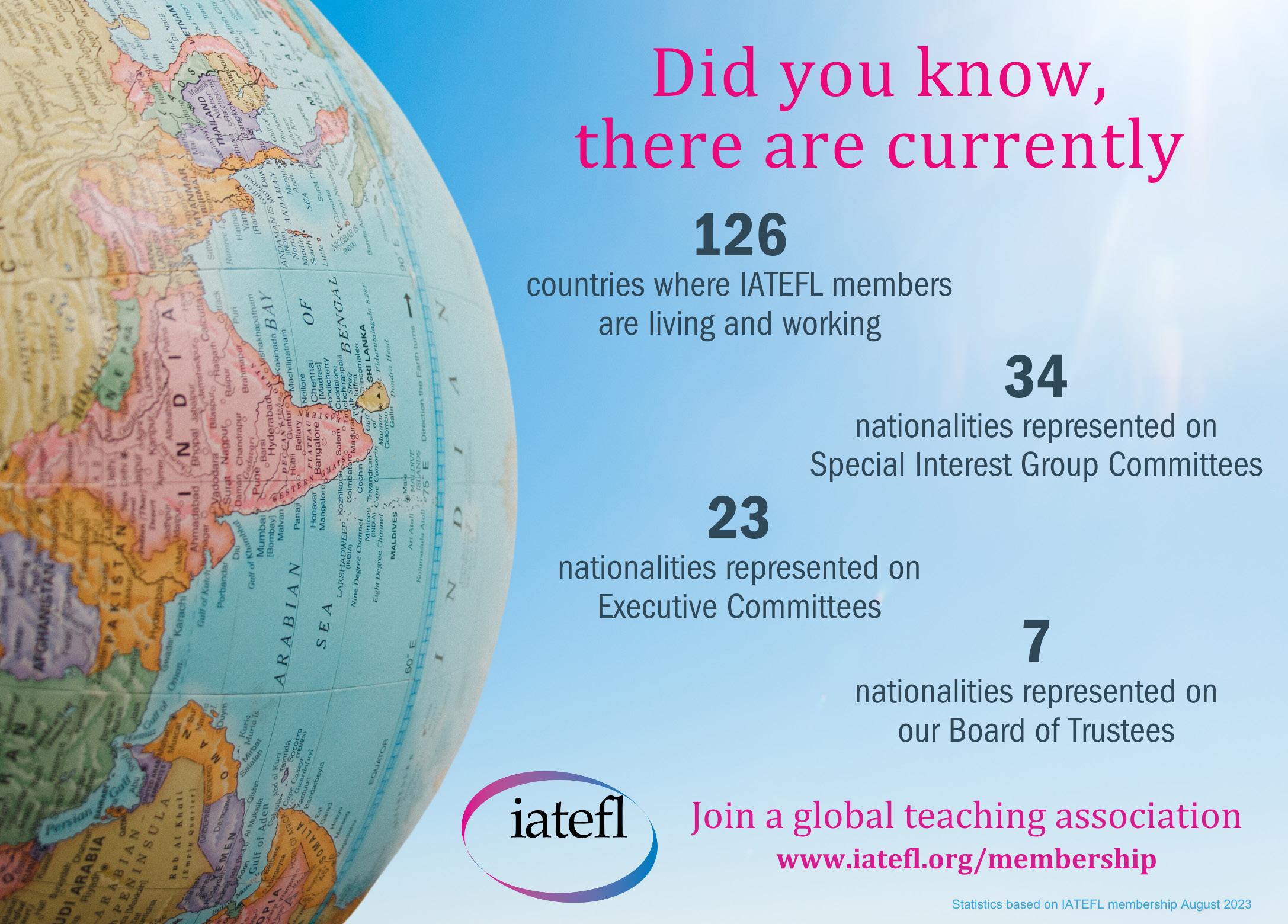
Jack Hsiao examines the integration of Chinese culture into the English language classroom as a way of enriching the student experience
In the realm of English as a foreign language (EFL) education, where language acquisition intertwines with cultural immersion, it is crucial to recognise the significance of incorporating students’ own cultural heritage, particularly Chinese culture, into the instructional framework. While anglophone culture forms the backdrop for English language learning, the integration of Chinese traditions and customs enriches the educational experience for young learners in China, bridging the gap between their native culture and the target language. By fostering a deeper understanding of linguistic and cultural nuances, this inclusive approach enhances language proficiency, fosters pride and strengthens students’ connection to their own identity. In a bold and innovative initiative, the affiliated primary school of Xi’an JiaotongLiverpool University in Suzhou, Jiangsu Province, embarked on a pioneering project supported by the Child Development and Education Division. This project infuses EFL lessons with topics related to students’ own cultural heritage, exploring the intersection of Chinese and anglophone cultures within the EFL classroom. Departing from conventional EFL curricula, this project creates a space where students engage with culturally resonant topics, fostering an authentic and meaningful learning experience. The classroom transforms into a dynamic meeting point between Chinese and anglophone cultures, revealing the transformative power of integrating students’ cultural identities into the language learning process.
Culturally-responsive practices in EFL education play a crucial role in creating an inclusive and engaging learning environment for young learners. While Western holidays like Christmas and Halloween, along with food items from Western eating habits, are often featured in EFL materials, these may not align with the lived experiences of EFL young learners,

Jack Hsiao, with a diverse global background, possesses dual bachelor’s degrees in primary and early childhood education, an MA in TESOL, and is pursuing doctoral studies at the University of St Andrews. With over twenty years in ELT, Jack is a Senior Lecturer at the University of Saint Joseph, focusing on meaningful communication and multicultural learning.
particularly in a cultural context like China. As practicing teachers, it is essential to recognise and honour the cultural backgrounds of our students to foster a more meaningful and effective language learning experience.
The motive behind the piloting project was to integrate Project-Based Learning (PBL) centred on Chinese cultural topics. The HQPBL Framework (2018) emphasises the importance of engaging students in projects that are personally meaningful and relevant to their culture, daily lives and future aspirations. By immersing students in such, we create a dynamic learning environment that encourages active participation and deeper learning.
In the context of EFL learners in China, where Chinese culture holds significant sway in family and school settings, it is crucial to balance the promotion of anglophone culture, inherent in the EFL curriculum, with an appreciation for students’ native culture. Some EFL classrooms may adopt restrictive measures, like banning the use of students’ first language (L1) and excluding local culture to prioritise the target language, inadvertently undermining students’ language development and identity formation, as studies by Espinosa (2005) indicate. Creating a culturally-responsive environment in an EFL classroom demands a strategic and deliberate approach that integrates students’ values, beliefs, histories and experiences. Educators should construct the curriculum around principles of mutual respect and trust, acknowledging and honouring diverse cultural backgrounds, incorporating insights into students’ home culture, family values and parental expectations. Embracing materials that resonate with students’ languages and cultures is essential for building an inclusive classroom that validates each student’s identity and experiences.
The practical application of these principles is vividly demonstrated in the project. For example, in one engaging activity, first-grade students participated in a hands-on exercise where they crafted their unique dishes using playdough, inspired by their own ‘recipes’ derived from the captivating story Dumpling Dreams (Wu, 2017). This project not only served as a platform for unleashing students’ creativity but also facilitated the authentic use of the English language as they enthusiastically shared their creations during the culminating ‘Show-n-Tell’ activity.
Within the same educational initiative, fourth-grade students immersed themselves in the world of Chinese opera, embarking on a project that involved the design of masks reflective of the distinct personalities of various characters. Through this hands-on endeavour, children utilised their artistic ingenuity to visually capture the essence of the opera personas, signalling engagement with the cultural nuances being explored. By involving students in creative projects that draw from their cultural heritage, educators not only enhance their comprehension of the subject matter but also foster a profound sense of pride and connection to their cultural roots.
The ‘funds of knowledge’ concept underscores the richness of children’s multi-generational interactions, shaping their interests and perspectives. Educators leveraging these experiences gain insights into cultural and cognitive foundations, enriching the educational landscape. Integrating this approach into curriculum recognises students’ diverse experiences and cultures, fostering deep connections between personal and formal education realms.
The captivating vignette of students delving into the nuances of Chinese opera underscores the potency of leveraging children’s funds of knowledge. Witnessing students surpass expectations with their in-depth knowledge and impassioned discussions on regional opera elements, such as the intricate design of costumes like the iconic water-wave sleeves, underscores the wealth of cultural insights and expertise residing within the student body. The revelation of a student’s parent being a seasoned researcher of Chinese opera further accentuates the untapped reservoir of familial funds of knowledge
2019that can be harnessed to enrich the educational landscape and deepen students’ understanding of their cultural heritage.
Additionally, the innovative practice of ‘Flips and Flaps’ exemplifies how integrating funds of knowledge can enrich the educational experience. By capturing each student’s unique ideas and voices through creative writing accompanied by expressive drawings, educators not only honour students’ diverse perspectives but also foster integrated language use experiences that bridge the gap between personal expression and linguistic development. This immersive approach not only cultivates a culture of inclusivity and appreciation for diverse voices but also amplifies the transformative power of integrating students’ funds of knowledge into the fabric of educational practices.
New experiences of language learning
In this experiment, we have witnessed the opportunities for a wealth of experience in language use, marking a significant breakthrough in language learning methodologies. The inclusion of Dumpling Dreams (Wu, 2017) in the curriculum has not only enriched students’ cultural understanding but also unlocked translanguaging opportunities, allowing them to seamlessly navigate between languages. By reading the storybook in English with some Chinese characters and engaging in communicative activities that incorporate multiple languages within a single sentence, students have honed their language skills and developed the ability to fluidly move between linguistic systems. This practice has empowered students to think in multiple languages simultaneously, showcasing the value of recognising and embracing students’ first language and cultural background in an EFL setting.
The creation of graded reading material, like two versions of the Great Wall story for varying proficiency levels, enhances students’ comprehension of complex historical concepts in English. Tailored language aids young learners in grasping main ideas and deciphering abstract terms within the narrative context, such as ‘Mongols’ and ‘Qin’. This connection between known and content-related vocabulary deepens comprehension, emphasising contextual learning in language acquisition. Moreover, the project nurtures essential reading strategies, guiding students to predict word meanings and extract
key information from texts to improve reading and comprehension skills. Prior knowledge supports understanding, highlighting the importance of activating background knowledge for reading comprehension. By instilling reading strategies and fostering deeper engagement with textual content, the project empowers students with confidence and critical thinking skills, building a strong foundation for language learning.
In addition to the enriching language learning experiences described, the project has introduced innovative approaches to integrating language use within a culturally immersive context. By incorporating learned vocabulary related to colours and emotions into the exploration of Chinese opera masks, students were able to fuse language skills with cultural understanding seamlessly. This unconventional approach diverges from traditional language instruction methods that often compartmentalise language topics, such as colours and emotions, in isolated contexts. Through PBL, students have been provided with the opportunity to utilise language skills organically, allowing for a more integrated and authentic language learning experience. Using colours and emotions in Chinese opera masks deepens linguistic understanding, promoting a holistic language approach. Connecting vocabulary to mask symbolism allows practical application, fostering experiential learning. This immersive experience surpasses traditional methods, offering students a comprehensive language acquisition journey.
Learning becomes more significant and authentic for learners when it incorporates home values and practices (Souto-Manning & Mitchell, 2009).
Aligning the pedagogical framework with students’ cultural richness, educators should integrate diverse cultural heritage into the EFL classroom. By engaging with topics reflecting students’ experiences and identity, teachers foster an inclusive environment promoting exchange, understanding and appreciation of diverse traditions. In grade-level meetings, educators can discuss suitable cultural integration topics, drawing from students’ wealth of heritage. Welcoming parents and families as experts enriches the learning process, especially for teachers of different cultural backgrounds.
Leveraging community knowledge creates authentic learning opportunities like making rice dumplings or exploring regional customs, deepening students’ connection to their roots.
Incorporating diverse cultural topics like festivals, cuisine, art, etiquette, folklore and values into the EFL curriculum fosters exchange and appreciation. The ‘When East Meets West’ framework encourages crosscultural dialogues, creating an inclusive learning environment. Critical thinking skills are honed through engaging with complex issues, while student choice in cultural topics enhances agency and ownership in the learning process, promoting deep cultural understanding and academic engagement (HQPBL, 2018).
In bringing these strategies and frameworks into practice, educators are encouraged to not only envision but also act upon creating culturally-responsive and inclusive learning environments for their students. By embracing cultural diversity, promoting critical thinking and celebrating the richness of students’ heritage, teachers can facilitate authentic language learning experiences that nurture respect, empathy and mutual understanding among learners from diverse cultural backgrounds. Through these efforts, educators can inspire meaningful engagement, foster a sense of cultural pride and cultivate a community of learners who value and appreciate the assorted ethnic heritage that shapes their collective identity.
Espinosa, L. M. (2005). Curriculum and Assessment Considerations for Young Children from Culturally, Linguistically, and Economically Diverse Backgrounds. Psychology in the Schools, 42(8), 837–853. https://doi.org/10.1002/pits.20115 HQPBL. (2018). A Framework for High Quality Project Based Learning. www. hqpbl.org/wp-content/uploads/2018/03/ FrameworkforHQPBL.pdf
Souto-Manning, M., & Mitchell, C. H. (2009). The Role of Action Research in Fostering Culturally-Responsive Practices in a Preschool Classroom. Early Childhood Education Journal, 37(4), 269–277. https://doi.org/10.1007/ s10643-009-0345-9
Wu, C. (2017). Dumpling Dreams Simon & Schuster.
hsiao_jack@hotmail.com
Terence McLean presents some examples of the Flip and TILT method he has employed in his classroom
I have been teaching English as an additional language (EAL) for quite a spell, and in the BC (Before Covid) days, I used to get students to do online assignments in a computer lab once a week. Then, the dastardly pandemic stormed in, thereby forcing me, well, everybody, to move online and develop both synchronous and asynchronous lessons. Mission accomplished.
Now, back in the classroom, I find myself happy to be interacting with students as we get to know one another better in person. Moreover, I am also fortunate because my school has allowed me to use one day a week as an online teaching and learning day (Flex Friday), which has turned what I do into a hybrid situation (with an emphasis on the face-to-face experience, Monday–Thursday). This shift has been fantastic for both me and the students because we are still able to engage in meaningful activities while taking a day at home to work in a comfortable, self-paced environment. A win-win in my books.
So, the challenge that I have embraced is to develop learning activities for the students to tackle on the days on which I do not teach online. I sometimes get the students to do asynchronous work, about which they make online posts and/or bring notes to class on Monday for group discussion. This is where ‘Flip and TILT’ comes into play.
Be it understood – there is nothing novel in the flipped classroom approach as teachers have been utilising this strategy for many years. In fact, I suppose I was doing this 20 years ago without thinking about nomenclature or sobriquet. Nevertheless, whatever the handle, giving students the task of doing work in preparation for upcoming lessons does, in fact, work. Well, it does as long as the teacher applies Transparency in Learning and Teaching (TILT).
Essentially, through the TILT strategy, the teacher endeavours to explain with transparency what the task is and how doing it can lead to student success. In my case, I tell the students that they are going to improve their listening and speaking skills (with a boost in academic

Terence (Terry) McLean teaches English as an additional language at MacEwan University in Edmonton, Alberta, Canada. He has been teaching for over 30 years and now loves cask ales.
vocabulary, to boot). I also clearly describe the task and the potential homework points that are associated. In this way, students are assured that the work that they do will help them both succeed in the course and develop essential skills.
Regarding actual activities, I utilise videos such as TED Talks (I know – some are good and some are clunkers – I look for the good ones). At first, I ask the students to watch a presentation (an asynchronous task) and take notes while answering questions that I have prepared. Here are a few examples of TED Talks that consistently gain student approval.
4 reasons to learn a new language – John McWhorter (10:00)
Write down your answers so that we can share them.
1 Where is English?
2 What language is spoken more than English?
3 What are 24 universities in China doing now?
4 What is getting better every year?
5 How would a French or Spanish speaker say a table would talk?
6 What do you think ‘fraught’ means?
7 What is an ‘anglophone’ hospital?
8 What can learning another language be a ticket to?
9 If you speak two languages, what is less likely to set in?
10 What do you think ‘a baker’s dozen’ means?
11 Learning another language won’t _____ your mind, but it will _____ your mind.
12 Post an answer to this question: Do you agree with the speaker? Why or why not? (and/or: Are there any other reasons to learn a new language?)
Don’t insist on English! –Patricia Ryan (10:35)
1 For how long has Patricia been living in the Gulf?
2 How many world languages are there today? In 90 years?
3 What is the main topic?
4 What happens every 14 days?
5 According to Patricia, who are the gatekeepers?
6 What is Patricia against?
7 Why did people laugh when they saw the picture of George Bush?
8 What problem did Einstein have?
9 What did the boy in Africa invent?
10 What should we celebrate?
11 What should we use language for?
Txtng is killing language. JK!!! – John McWhorter (13:48)
1 What is a ‘scourge’?
2 For how long has language existed?
3 What do linguists say about the way we speak?
4 Give three ways how speech is different from writing.
5 Why/How can we now write like we speak?
6 How does the speaker define texting?
7 What is one convention in texting?
8 What has ‘lol’ evolved into?
9 What does the slash indicate?
10 Why did the speaker show quotations from history about complaints about how people write?
How to speak so that people want to listen – Julian Treasure (9:54)
1 Julian talks about seven deadly sins of speaking. What are they?
2 According to Julian, what is the national art/sport of the UK?
3 Julian made up the term: ‘blamethrower’. What is the word that he used to make this pun?
4 ‘…embroidery, exaggeration. It demeans our language, actually, sometimes. For example, if I see something that really is awesome, what do I call it?’ Do you understand this point? Explain it to your group.
5 What is ‘dogmatism’?
6 What does ‘HAIL’ stand for?
7 Have you ever ‘rummaged’? Why?
8 What is ‘register’?
9 Who do we vote for?
10 What is ‘timbre’?
11 If you do not use effective ‘prosody’, what do you sound like?
12 When thinking about ‘pace’, what can be powerful?
13 How can we get someone to really pay attention (2 ways)?
14 Can you roll an ‘r’? Try!
1 What phrase does the speaker think is wrong?
2 According to CNN, what do people think when they win the lottery?
3 What could happen if friends and family bother you for money?
4 According to what some people said they would do if they won the lottery, it seems that money can make people _____.
5 What did the researchers make people do?
6 What happened to people who spent money on others?
7 Did the people who spent $20 on others get happier than those who spent $5?
8 Where did the researchers go to try the experiment again?
9 In the world, people who _____ are _____ than people who _____.
10 In which country was this not true?
11 What teams sell more?
12 The speaker says that ‘if you think money can’t buy happiness, you’re not spending it right’. What can you infer about how he thinks we should spend money?
1 What type of accent do you think Sarah has at the beginning?
2 What is her real accent?
3 What is the theme of the session?
4 What is Sarah interested in?
5 Who did Sarah bring with her?
6 What does the first character think about some of the presentations?
7 What is Noraida?
8 What is she not used to doing?
9 What is her organisation called?
10 What does the organisation do?
11 What does she think will happen in two weeks?
12 Who are Sarah’s characters based on?
13 Who is Alexandre?
14 What did Sarah study for three years?
15 Where is Praveen from?
16 What do politicians do in Georgetown?
17 Where is Pauline from?
18 Why didn’t she like to give speeches?
19 What did her daughter tell her?
20 What doesn’t her daughter like?
21 Who is she in love with?
22 Where is Habbi from?
23 How does she feel?
24 Who did she listen to?
The links and questions above are all included in activities that I use in both the classroom and asynchronous lessons. The students eventually get into groups and discuss the answers with the goal of completing the questions together. Time-tested and successful –but – this is teacher driven.
So, to flip the roles, I now sometimes

ask the students to watch the videos (asynchronously), take notes and make questions that they will bring to class. In groups, the students then test one another with their personalised questions and, in the process, consolidate their learning while developing speaking skills (asking and answering questions). This activity can also be turned into a competitive game in which groups develop questions that other groups need to answer. The group with the best/hardest questions win. Overall, as teachers, we want to give students authentic language learning opportunities, and the usual Watch this video and answer the questions works. However, what also works is getting students to take the responsibility for making the questions with which they will challenge their classmates in the classroom. With Flip and TILT in mind, teachers and students can create engaging and interesting activities that promote language learning with purpose.
mcleant@macewan.ca

Elmira Shirinsokhan presents a lesson focused on sustainability using past modals to express regrets and alternatives
Elmira Shirinsokhan is an accomplished Cambridge-certified educator and examiner specialising in language teaching, assessment and educational leadership. With a strong focus on innovation and collaboration, she has successfully trained teachers, guided learners and supported academic excellence in diverse educational settings.
Lesson objectives
By the end of the lesson, students will be able to use past modals to make guesses about the past, and to express regrets or alternatives.
Student profile
❚ CEFR B2 (Upper-Intermediate)
Materials needed
❚ picture of a destroyed and contaminated Earth
❚ whiteboard and markers
❚ worksheet with controlled and semi-controlled activities.
Lesson plan
Introduction (5 mins)
1 Show students the picture of the destroyed and contaminated Earth.
2 Ask students to describe what they see in the picture and discuss their thoughts on why the Earth might look like that.
3 Expose them to the concept of past modals: must/may/could/ might/can’t + have for making guesses about the past.
4 The students brainstorm and note down their ideas. The teacher can write key ideas and themes on the board while monitoring the brainstorming activity.
5 The teacher discusses with the class the common themes from their ideas and then writes a class definition of productivity on the board, which the students copy onto their handouts.
Presentation of grammar (15 mins)
1 Elicit some sentences from the previous task. For example:
❚ We could have used fewer plastic products to help protect the environment.
❚ People might have saved more energy by turning off lights when not in use.
2 Convey the meaning of the modal verbs.
3 Work on the pronunciation, intonation and stress pattern. (Different forms of drilling can be used.)
4 Write the examples on the whiteboard.
5 Ask concept-checking questions to make sure students understand the key points.
Controlled activity (10 mins)
1 Work on the controlled practice from the worksheet.
2 Monitor students.
3 Work on the feedback and provide explanations if needed.
Sample task for worksheet
The river is polluted. Someone _________ have dumped waste into it.
a) would
b) should
c) could (correct)
d) can’t have
Present and teach other modal verbs and their functions (10 minutes)
1 Teach should have, could have and would have + past participle.
2 Work on meaning, pronunciation and form.
3 Ask concept-checking questions to clarify understanding.
Semi-controlled activity (10 mins)
1 Group students and give each group a scenario.
2 Students should discuss the situations and use the grammar to make guesses about them or to criticise them and to say what else could have been done differently. For example:
❚ People should have recycled more to reduce waste and pollution.
❚ We should have taken the warnings about pollution more seriously.
Sample scenario
Renewable energy transition: a community or country is successfully transitioning to renewable energy sources like solar, wind or hydroelectric power to reduce reliance on fossil fuels and combat climate change.
Free practice (15–20 mins)
1 Students work in four groups.
2 Each group will be given a role: environmental activist, government official, a scientist, and a citizen. (You could also allocate countries, e.g. China.)
3 Students in each group talk together about their role in sustainability and saving the planet: they brainstorm ideas, make a list, and prepare themselves for a class discussion. They also prepare some questions or arguments for the debate. They can use the ideas and modelled sentences that they have learned in class up to this point to make their arguments.
4 The teacher starts the discussion and acts as moderator. (This task can also be assigned to one student if appropriate/in case of an odd number of students.)
5 Groups discuss their views and challenge each other by asking questions or asking for more clarification.
The teacher provides feedback on the task and language.
elmirashirinsokhan1368@gmail.com
How can songs be used as a teaching tool?
Syed Naeem shows how songs can be used as a valuable teaching and learning tool. Using songs can help learners improve their listening skills and pronunciation; they can also be useful for vocabulary building and understanding sentence structures. This lesson is a part of his classroom instructions for post-secondary Technical English learners.

Dr Syed Naeem is a professor of language and education at the Royal Commission Colleges and Institutes in Saudi Arabia. Aside from his research and academic work, he is involved in instructional design and reviews curriculum.
Aims and objectives
For this lesson, my goal was to use a song to teach imperatives, continuous and perfect tenses (usually a daunting task due to dry grammar rules). Dua Lipa’s song Levitating solved my problem.
Student profile
❚ Any age group; CEFR A2
Materials needed
❚ computer or laptop with Internet access
❚ access to Dua Lipa’s song Levitating along with other songs the students are familiar with. If Dua Lipa’s song is not available, choose any popular English language song.
❚ projector and screen
❚ speakers
❚ plain paper.
Lesson plan
Warm-up activity (build interest)
Start with a song in L1 (in my case Arabic) that the students are already familiar with and sing together. This will get them
motivated to the idea of listening to English (L2) songs.
Review
Write four sentences on the board exemplifying the simple present, imperative, present continuous and present perfect. Then, ask students to identify each type of sentence. You may use examples of how each tense is used in daily life to explain further.
Present
1 Introduce Dua Lipa and play her song Levitating at normal speed (1.0) twice.
2 Ask students to identify any words or expressions they heard and understood. Write those words/expressions on the board and discuss their meaning and use in daily life. You may use Google translate to show students the meaning of those words in L1.
Practice
3 Divide students into four groups. Play the song again at a reduced speed (0.75).
4 Play the song for the third time at a low speed (0.5) to make the lyrics clear.
5 Asked each group to identify imperatives (for example, ‘dance with me’), simple present (‘you are my starlight’), continuous (‘I am levitating’), etc.
6 In addition, you can talk about rhythm and rhyme in the lyrics. Group assignment
7 Ask the groups to write a simple song or poem using familiar words, expressions and the four types of sentences (simple present, imperative, present continuous and present perfect). They may choose the melody and rhythm, and then share their songs. This activity will help show their creativity and help them to understand tenses in an enjoyable manner. Throughout the 2-hour session (without a break), it is intended to be learning with fun. The greatest benefit of using songs in the classroom is that they are enjoyable. The lesson plan combines music, vocabulary, creativity and an engaging and effective way of teaching grammar.
Would you like to try this idea in your classroom? If so, please share your feedback after you have tried it with your class.
nahmed@rcjy.edu.sa

Tony Penston
TP Publications, 2024
184 pages
ISBN: 9780953132386
A Concise Grammar for English Language Teachers (second edition) breaks down the fundamentals of English grammar and is meant to be used as a coursebook for new teachers in training, or as a grammar resource book for more seasoned teachers. As such, it can support whatever student coursebook or approach a teacher chooses to use, and is organised so that grammar topics can be quickly and easily referenced.
Edited by Ruby Vurdien and Wendy Chambers
IGI Global, 2024 417 pages
ISBN: 9798369326879
There are several things that make this text both unique and appealing. First, this text not only provides the expected break down of different grammar topics, but it also includes practical teaching notes which give insight into an authentic ELT classroom context; for example, tips about dealing with mobile phone use in class, or how to cope with limited resources. In addition, without explicitly outlining how to teach grammar, the author pulls from a vast range of reputable grammar and student coursebooks to provide the reader with examples of tried-andtrue activities a teacher could use to teach particular grammar points.
In the same way, the author provides the reader with meaningful tasks that not only help deepen their understanding of the grammar points presented, but also highlight the types of real-life questions that often arise in class. For example, tasks may include correcting common grammatical errors made by speakers of different languages, which is very useful and relevant for a new teacher. Finally, one of my favourite features of this text is the inclusion of what a whiteboard might look like to explain a particular grammar point. These were snapshots of roughly drawn (stick-figure) depictions of timelines or stories to illustrate various grammar points. Although I might choose to depict things differently on my whiteboard, I appreciate the creative invitation this inspires and how having a good whiteboard can be so effective for learners, both in person and online.
All in all, this text would be ideal for any ELT training course as it provides the reader with relevant tasks throughout to further understanding of the grammar, gives examples of activities from well-known sources for teachers to use with their students, and presents practical teaching tips. All of this is presented in 184 pages. Concise!
Hilary Livingston Curriculum Studies/TESL, Chignecto Central Regional Centre for Education, Canada hilarylivingston@hotmail.com
Of all the times to write about technology in language education, now must surely be the most daunting. Not only is everything moving so fast, but the direction it’s moving in – we teachers are routinely reminded – is towards our own redundancy and replacement by one particular technology, artificial intelligence (AI). And yet, the contributors to this edited volume have managed both to illuminate current practices and, perhaps not altogether inadvertently, to offer a sliver of hope for our continued employment.
Each of the twelve chapters in the book reports on a research project and, generally speaking, follows the classic structure of literature review, methodology, findings and discussion. The book is replete with statistics, tables and charts, with the vast majority of the contributors being employed at universities around the world. This is a scholarly work aimed at an academic audience. But not only.
The technologies under investigation range from augmented reality (AR) to the popular mobile app Duolingo, to, in its own way, the even more popular Spellchecker. Geographically, the scope is just as wide: North America, Europe and East Asia are all represented. As are educational levels from primary through to tertiary. The effect of all of this is something akin to a teacher’s dream or fantasy: at the turn of a page, you can find yourself quietly sitting at the back of a classroom on the other side of the world, observing how a new tool is being used and, frankly, whether it works or not.
To the editors’ credit, although the individual chapters have the potential to pull the reader in multiple different directions, over the course of the book as a whole several themes emerge. The one that especially resonated with me (and kindled the hope mentioned above) relates to common misconceptions about students’ levels of digital literacy. In chapter after chapter, the point is made that, as educators, we cannot simply assume that students have the competencies they need to get the most out of the technology. They may be younger than us and they may be more active than us on social media, but that does not automatically translate into knowing, for example, how to write an effective AI prompt or how to configure corpus linguistic tools.
Teachers, with their facilitator hats on and a copy of Technology-Mediated Language Learning and Teaching under their arms, may not be so easily replaced after all.
Jonathan Culbert Xi’an Jiaotong-Liverpool University jonathan.culbert@xjtlu.edu.cn
Here at IATEFL, we have an amazing Head Office team who are responsible for the day-to-day running of IATEFL, which is a massive and complex teaching association (TA). Without them and their hard work, IATEFL would not be what it is today. However, it is good to also note that, just like most TAs, the IATEFL Board of Trustees and Committee members are all volunteers. We know how much dedication, time and effort it takes to organise and manage a TA over and above the other aspects of our lives. So, I would just like to take a few lines to recognise and thank all the many volunteers around the world who give freely of their energy and time to enrich the communities of educators in their areas. Thank you for creating spaces for teachers, educators and associated professionals to build their knowledge and skills, share and develop their ideas and feel part of the wider profession. Thank you for donating your free time to enable those around you to benefit from the opportunity to interact with others in the same situation as themselves. And most of all, thank you for being part of IATEFL!

founders of our national conference. He had an international vision and recognised the central importance of responsible and exciting journalism in sharing insight and understanding between cultures. Before his early death in 1997, he was very active among English language scholars, teachers and writers in the Netherlands, and it was he who conceived the idea of this award, an award which, over the years, has become widely appreciated among journalists in our country. You can find the list of winners to date at nl.wikipedia.org/wiki/Herman_Wekker_ Prijs.
who is a foreign correspondent in the United States for De Volkskrant, one of our main national newspapers. Motivation of the jury:
Christien van Gool, Chair of the Nationaal Congres Engels in the Netherlands, reports on their conference earlier this year
Since 1995, our committee has been organising national conferences in the Netherlands for teachers of English in our country. It is a biennial conference, and we do this as teachers for teachers. See our website here: nationaalcongresengels.nl/. We have a liaison with our national teachers’ association Levende Talen.
One of the plenary sessions is devoted to awarding a prize for an outstanding journalist, called the Professor Herman Wekker Prize. The prize is awarded during our conference to a journalist from the Netherlands who has given outstanding service to the spread of information about English-speaking countries and cultures among the Dutch public. The prize is named in honour of the late Herman Wekker, former Professor of English language at the University of Groningen and one of the
This part of our opening plenary is always a great success: the journalists who receive the prize are always enthusiastic to come and give a speech or, if they cannot be present (as they are often foreign correspondents), we arrange a live online meeting, and being journalists they can always tell something special about the country they live in, the educational system or whatever is in the news in that country, be it South Africa, America or Australia. They often have books published that they are happy to sell and sign. Furthermore, it generates news about our conference: as we have had quite a few renowned journalists who received the prize over the years (or journalists who have become renowned since), our press release is picked up by most news agencies and main national newspapers.
In 2024, the prize was awarded to a young journalist, Maral Noshad Sharifi,
Through more than 300 articles in the past two and a half years in the press, she has shown us new, exciting and interesting stories coming from America. From profiling a transgender politician in the cowboy state of Montana, to interviewing the firefighters who were in New York during 9/11 about the consequences they still suffer 20 years later, to talking to the teachers and authors who have to deal with book bans and by writing a lot about different art forms, from music to art exhibitions and film, she brings the story of America to life in a way that is fresh, inspiring and inclusive.
When she was four, Maral fled Iran with her mother and landed in a small Dutch village. Recently her autobiography, Citroeninkt (Lemon ink), was published about an Iranian girl growing up in the Netherlands. This book could be bought after her talk and she happily signed them all. She felt very honoured to receive the prize.
Why am I writing this piece? Well, perhaps it inspires you to do something similar at your conferences. I can certainly recommend it!
Christien van Gool Chair Nationaal Congres Engels, The Netherlands

An unforgettable two days in Almaty Assiya Zhangabay, founder of the Kazakhstani Association of English Language Teachers (KazAELT), reports on their recent international conference
In August, we wrapped up our 2024 international conference, and it was truly something special. With around 460 attendees, 45 amazing volunteers, and 12 hardworking organising committee members, the energy and passion in the room was incredible.
Over 80 sessions were held, featuring speakers and delegates from 14 countries, including Kazakhstan, Tajikistan, Karakalpakstan, Kyrgyzstan, Uzbekistan, Russia, Turkey, UAE, Austria, Ukraine, the US, South Africa, Serbia and the UK. From discussions on teacher wellbeing to the latest in artificial intelligence, the insights shared were inspiring. The pre-conference events brought together coordinators from our 18 regions, setting the tone for an impactful experience. Our keynote speakers were Jonathan Coxall, Professor Christopher Korten, John Shakelton, Tatiana Slipcevic and Anna Hasper
We also had the privilege of presenting the very first special edition of our magazine – Kazakhstan’s first dedicated publication for teachers of English – during this conference.
A special thanks to the incredible IATEFL team, without whom this would not have been possible. Without IATEFL’s support, our association wouldn’t have existed in the first place.
To everyone who believed in us, chose to be part of this journey, and supported us along the way – thank you from the bottom of our hearts. We also wish to thank our sponsors, without whom we could not have organised this wonderful event. More information about the sponsors can be found on our website and you can learn about which companies and institutions supported and believed in us.
Looking forward to seeing you all in the historic city of Turkestan in June 2025. Can’t wait to do it all over again!
Assiya Zhangabay Founder, KazAELT
Report by Sinem Atamsoy Koşar (former President of TESOL Türkiye) TESOL Türkiye are proud to present a digital handbook from the TESOL Türkiye Affiliate Summit, held in İzmir on 2–3 May 2024. This collaborative work, published by Black Swan Publishing, brings together the expertise and insights of TESOL Türkiye and its affiliates, including TESOL Ukraine, TESOL Spain, Nile TESOL Egypt, Kuwait TEFL, HUPE Croatia, NELTA Nepal, ELTA Serbia, CETE/TESOL Georgia and BETA Bulgaria.
The handbook focuses on traumainformed teaching in the EFL context, offering practical strategies and approaches for supporting students who have experienced trauma. It tackles key questions, such as how to identify trauma in the classroom, how to create safe and supportive learning environments, and how teachers can care for their own wellbeing while working with traumaaffected students.
This publication is the result of a yearlong collaboration, involving webinars, research and discussions with affiliates, and finally the international summit in İzmir, which was made possible with the generous support of RELO Ankara. We are proud to share the outcomes of this collective effort, which aims to guide and inform best practices in trauma-sensitive education globally.
We hope this work will inspire positive change and foster a more supportive and inclusive approach to teaching across the global ELT community. We invite all IATEFL members to explore this important resource and join the conversation on the future of traumainformed language teaching.
The publication is free and can be accessed via the TESOL Türkiye website. Sinem Atamsoy Koşar Former President, TESOL Türkiye
The 33rd IATEFL Poland International Conference, held in September in Gdańsk, Poland, marked a significant milestone in the field of language education, attracting 650 attendees from over 30 countries. This year’s conference was a vibrant gathering of educators, researchers and language enthusiasts, all eager to share insights and innovations in teaching methodologies.
The event featured an impressive
line-up of 20 plenaries, 50 talks and 50 workshops, showcasing a diverse range of topics relevant to contemporary language teaching. With 125 speakers contributing their expertise, participants had the opportunity to engage in discussions that spanned various aspects of language education, from innovative teaching practices to the integration of technology in the classroom.
One of the highlights of the conference was the assessment panel discussion, where experts shared their perspectives on the future of assessment in language learning. Additionally, attendees enjoyed live and advanced lessons, providing practical demonstrations of teaching techniques that can be implemented in their own classrooms.
The conference also embraced cultural elements, featuring Shakespeare night. This event was surprise entertainment as the ‘actors’ were some of our main conference speakers, some with a twist on the Bard’s words and intention. It made for a wonderful wrap-up to a full day and a welcome lead-in to our dinner. The gala dinner served as a perfect opportunity for networking, allowing attendees to forge connections and collaborate on future projects.
Overall, the 33rd IATEFL Poland International Conference was a resounding success, providing a platform for professional development and community building among language educators. The enthusiasm and engagement of the participants underscored the importance of such gatherings in advancing the field of language education and fostering international collaboration.
IATEFL Poland 2024–25 webinar series is underway
On the first Wednesday evening in September, from 8.30 pm to 9.30 pm CET, IATEFL Poland proudly inaugurated its 24/25 webinar series. The opening session, led by Dr Urszula Kropaczewska, focused on ‘Methods and techniques to make the lesson successful’. These free webinars, held every Wednesday at the same time, attract a diverse audience of English language teachers, educators and enthusiasts from around the globe. Each participant receives a certificate detailing the speaker, topic and key issues discussed. With a central theme of ‘Continuous improvement of teaching and learning quality’, the series showcases an impressive line-up of speakers and topics that address the latest trends and challenges in English language teaching (ELT).
The IATEFL Poland September and
Issue 290 2022
2019 October webinar series featured a compelling array of topics designed to enhance teaching practices. On 11 September, David Fisher led a session titled ‘How do you relate to your students? And to your school?’, prompting educators to reflect on their relationships within the educational environment. This was followed by Tamari Dolidze and Natia Vasadze on 18 September, who discussed ‘Empowering ESP learners to think
deeper’, focusing on strategies for enhancing critical thinking among English for Specific Purposes students. On 25 September, Maria-Araxi Sachpazian addressed the challenges of engaging teenagers.
As the series moved into October, participants explored Anna Sołtyska’s insights into AI tools, Marianna Goral’s examination of curriculum relevance, Agnieszka Burzyńska’s perspectives on visual aids, and Dorota Neal’s focus on AI
IATEFL 2025 Conference scholarship winners
To find out more about the Conference in Edinburgh, go to www.iateflconference.org
as an ESL teacher assistant.
In conclusion, the IATEFL Poland webinar series not only provides valuable insights and professional development opportunities but also fosters a global community of educators dedicated to continuous improvement in teaching and learning.
Link to webinars: https://iatefl.org.pl/ webinars/
Rob Howard President, IATEFL Poland
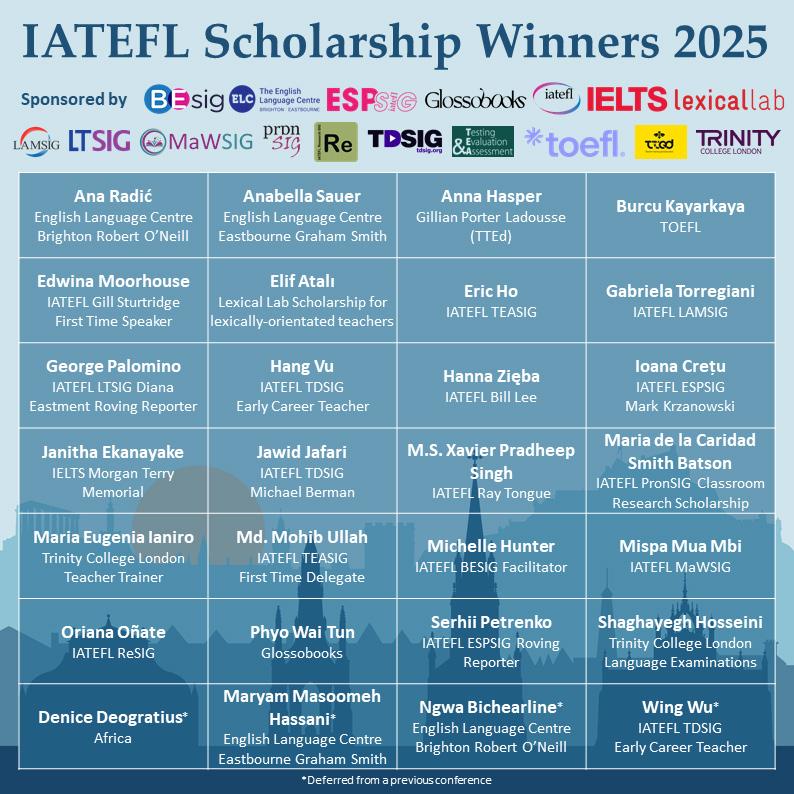
In this issue’s From the SIGs, we hear from both BESIG and TEASIG about what they have planned for 2025
IATEFL BESIG
Objectives for 2025: strengthening our business English community
As we look toward forty years of BESIG in 2025, our group is committed to further building and strengthening the business English community. Our members are at the heart of everything we do, and we aim to foster a supportive and engaging network that inspires both professional growth and personal connections. With face-to-face events and a diverse online programme, we strive to create an environment where everyone feels a sense of belonging. For the coming year, we would like to focus on the following.
Enhancing professional development opportunities
We know that continuous professional development is vital for our members. Therefore, we are excited to announce that, in keeping with the new IATEFL initiative Green IATEFL, IATEFL BESIG has created a plan to concentrate on sustainability and the UN’s Sustainable Development Goals (SDGs) for our preConference Event (PCE) on Monday, 7 April 2025 at the IATEFL Annual Conference in Edinburgh. The event, titled ‘Greening Business English: Practical Activities for Sustainability and CSR to Future-Proof Your Teaching’, will offer business English educators innovative strategies to integrate sustainability into the materials they create and their courses. Participants will not only have the chance to work with the SDGs, but also learn how to use them to create engaging and relevant content. There will be ample opportunity to work on tools and skills for the classroom using these goals as well as a collaborative roundtable discussion to prepare educators for the future. As sustainability is often a major topic for our corporate clients, we feel that a PCE concentrating on this issue will help our members when they return to their teaching situations.
Face-to-face events are invaluable for building strong relationships within our community. This commitment includes the IATEFL BESIG Showcase Day on Thursday, 10 April 2025, featuring talks on business English covering a wide range of topics and experiences as well as plans for the 38th Annual IATEFL BESIG Conference.
In 2025, we aim to keep up our digital presence with the support of our social media and online teams. We also plan on growing our blog to create a space where members can share teaching resources, discuss challenges and celebrate successes. By investing in our online community, we hope to create a year-round, interactive experience that complements our face-to-face events. Our monthly weekend webinars and workshops have become a fixture in the IATEFL BESIG calendar and are the perfect opportunity to meet like-minded people while learning about new trends in our industry.
Our goals as a SIG include providing a space for business English teachers around the globe to exchange ideas, support each other, access teaching materials, discuss current business world topics and foster a true community of practice. We plan to achieve these goals through our events and by collaborating with teacher associations and other SIGs to explore common areas of interest.
Marjorie Rosenberg and Sarah Plochl BESIG Joint Coordinators
The IATEFL Testing, Evaluation and Assessment Special Interest Group (TEASIG) is gearing up for an exciting year in 2025, concentrating on innovative approaches to language assessment. With a series of engaging webinars planned, TEASIG aims to support educators in enhancing their assessment practices in increasingly diverse and dynamic learning
environments. TEASIG’s primary objectives include:
Promoting best practices
TEASIG seeks to disseminate best practices in testing, evaluation and assessment within English language teaching (ELT).
Professional development
The group offers resources and opportunities for professional development, enabling educators to refine their assessment strategies.
Research dissemination
TEASIG promotes the sharing of research findings related to assessment, fostering a community of practice that values evidence-based approaches.
Collaboration
By hosting webinars and events, TEASIG encourages collaboration among educators, researchers and practitioners to improve assessment quality.
In 2025, TEASIG will host a dynamic line-up of webinars aimed at addressing the diverse needs of teacher educators worldwide. These online sessions will cover a wide array of topics, including innovative teaching methodologies, assessment strategies, and the integration of technology in teacher education.
Each webinar will feature expert speakers from around the world, offering insights and practical tips that teachers can immediately implement in their practice. The interactive nature of these sessions will encourage engagement and discussion, allowing participants to share their experiences and strategies. This collaborative approach is central to TEASIG’s mission of building a supportive community for teacher educators.
Multimodal assessments for L2 contexts
Date: 8 February 2025
Time: 5 pm GMT
Speakers: Tineke Brunfaut and Judit Kormos, UK
This webinar will delve into multimodal assessments, which incorporate various modes of communication beyond traditional text. Brunfaut and Kormos will explore how these assessments can be effectively applied in second language contexts, enriching the evaluation process by acknowledging
the diverse ways students demonstrate their knowledge and skills. This session promises to be a valuable opportunity for educators looking to innovate their assessment methods.
Designing AI-powered assessments
Date: 27 March 2025
Time: 5 pm GMT
Speaker: Ayşegül Salli, Türkiye
In collaboration with the English for Specific Purposes (ESP) SIG, this joint webinar will focus on the integration of artificial intelligence in assessment design. Salli will provide insights from her work with pre-service ELT teachers, discussing how AI can enhance the assessment landscape. This timely topic addresses the intersection of technology and education, offering practical strategies for leveraging AI tools to create more efficient and effective assessments.
In addition to the webinars, TEASIG will be hosting a pre-Conference event (PCE) in Edinburgh. The theme, ‘Putting the Heart at the Heart of Assessment’, will inspire discussions on creating assessments that are not only effective but also empathetic and learner-centred. This PCE will be an excellent opportunity for educators to network and exchange ideas on prioritising the emotional and psychological aspects of assessment in their practices.
With a rich line-up of webinars and a significant PCE in 2025, IATEFL TEASIG is set to provide valuable resources and insights into language testing, evaluation and assessment. Educators are encouraged to participate, reflect on their practices, and embrace new methodologies that enhance the teaching and learning
19 January Online event
LASIG, Autonomy exchange: insights and practice for English teachers https://www.iatefl.org/events/637
25 January Online event
BESIG, Point of information! Using debate for pre-service learners https://www.iatefl.org/events/629
30 January–1 February Barcelona, Spain
APAC’s ELT Convention 2025
‘Taking things one step further: fostering a culture of innovation in the ELT world’
https://www.iatefl.org/iatefl-associatesevents/apacs-elt-convention-2025
FEBRUARY
1 February Luzern, Switzerland
41st ETAS Annual Conference
‘Innovative approaches to assessment in education’
https://www.e-tas.ch/events/event/41st-etasannual-conference-2025/
15 February Kuwait
TEFL Kuwait Spring Conference 2025 (In Person)
‘21st century language teaching: challenges, opportunities and solutions’ https://teflkuwait.com/
27 February–1 March Kathmandu, Nepal 29th NELTA International Conference 2025
‘Machine, humanity and language: navigating the uncharted frontiers of ELT’
https://www.iatefl.org/iatefl-associates-events/29thnelta-international-conference-2025
MARCH
14–16 Burgos, Spain
TESOL Spain 48th Annual National Convention
https://www.iatefl.org/iatefl-associates-events/tesolspain-2025
APRIL
8–11 Edinburgh, UK
58th IATEFL International Conference https://www.iateflconference.org/home
26 Brussels, Belgium
BELTA Day 2025
https://www.iatefl.org/iatefl-associates-events/beltaday-2025
experience. Keep an eye out for the event pages launching mid-November for more detailed information!
As the landscape of English language teaching continues to evolve, TEASIG’s initiatives for 2025 reflect a commitment to innovation and inclusivity in professional development. By offering accessible webinars and a PCE in Edinburgh, TEASIG aims to empower people involved in assessment to enhance their skills and effectiveness.
Maria Davou and Joanna Wrzesinska TEASIG Joint Coordinators
MAY
16–17 Belgrade, Serbia
23rd ELTA Serbia International Conference
Theme: ‘It always seems impossible until it’s done’ – Nelson Mandela https://www.iatefl.org/iatefl-associatesevents/23rd-elta-serbia-internationalconference
If you’ve missed any of our IATEFL Live shows, you can now watch the recorded sessions at your convenience. Check them out on YouTube or LinkedIn
IATEFL Patron
Jan Blake
IATEFL Ambassadors
Evan Frendo, Sarah Mercer, Sandy Millin, George Pickering, Syke Annamma Kumaran and Harry Kuchah Kuchah
Find out more at https://www.iatefl.org/about/whoswho-iatefl
Advisory Council
As Editor of the ELTJ: Dr Alessia Cogo
As representative of the British Council: Mike Solly
Individual members: Amos Paran Catherine Walter, Fabian Kaslin and Jameela Mohamed
Board of Trustees
President: Aleksandra Popovski president@iatefl.org
Vice President: Christopher Graham vp@iatefl.org
Treasurer: Bethany Cagnol treasurer@iatefl.org
Secretary: Maria-Araxi Sachpazian secretary@iatefl.org
Membership Committee Chair: Gerhard Erasmus memcom@iatefl.org
Special Interest Group (SIG) Representative: Andy Hockley andy@iatefl.org
Associates Representative: Jean Theuma associaterep@iatefl.org
Digital Committee Chair: Georgia K. Papamichailidou georgia@iatefl.org
Executive Committee Members
Associates: Jean Theuma (Chair), Beatrix Price, Mirela Cristina Manea Gültekin, Freya Rutt and Ewa Minkowska (Head Office representatives)
Conference: Aleksandra Popovski (Chair), Sanja Bozinovic, Colm Downes and Metin Esen. Head Office representatives: Alex Waller (maternity cover), Sarah Ward, Louise Atkins, Jon Burton and Laura Creed
Digital: Georgia K. Papamichailidou (Chair), Sanja Bozinovic, Marcio Oliveira, Pola Papadopoulou and Louise Atkins (Head Office representative)
Membership: Gerhard Erasmus (Chair), Syke Annamma Kumaran, Khanh-Duc Kuttig, Anju Moses, Freya Rutt and Ewa Minkowska (Head Office representatives)
Publications: Christopher Graham (Chair), Marina Gonzalez, Vicky Papageorgiou, Arum Perwitasari and Ewa Minkowska (Head Office representative)
Other committees and roles
Scholarship Committee: Christian Ludwig (Chair), Wiktoria Allan, Ben Beaumont, Laura Creed, Blerta Mustafa and Nora Tartsay-Nemeth
Voices Editor: Derek Philip-Xu editor@iatefl.org
Conference Selections Editor: Deborah Bullock cseditor@iatefl.org
IATEFL Representative on the ELTJ Editorial panel: Shelagh Rixon
IATEFL Representative on the ELTJ Advisory Board: Richard Smith
Please visit the individual SIG website for a list of current committee members
Business English (BE) www.besig.org
Joint Coordinators: Marjorie Rosenberg & Silke Riegler besig@iatefl.org
English for Speakers of Other Languages (ES(O)L) https://iateflesolsig.wordpress.com
Coordinator: Vivi Bairami esolsig@iatefl.org
English for Specific Purposes (ESP) https://espsig.iatefl.org
Coordinator: Caroline Hyde-Simon espsig@iatefl.org
Global Issues (GI) https://gisig.iatefl.org
Coordinator: Varinder Unlu gisig@iatefl.org
Inclusive Practices & SEN (IP&SEN) https://ipsen.iatefl.org
Joint Coordinators: Aysen Deger and Giovanni Licata ipsensig@iatefl.org
Learner Autonomy (LA) https://lasig.iatefl.org
Joint Coordinators: Lawrie Moore-Walter and Giovanna Tassinari lasig@iatefl.org
Leadership and Management (LAM)
Coordinator: Barbara Craig and Josh Round lamsig@iatefl.org
Literature (Lit) https://www.iatefllitsig.org/ Coordinator: Gerhard Finster litsig@iatefl.org
Learning Technologies (LT) https://ltsig.iatefl.org Coordinator: Maria Diakou ltsig@iatefl.org
Materials Writing (MaW) https://mawsig.iatefl.org
Coordinator: Heather Buchanan mawsig@iatefl. org
Pronunciation (Pron) https://pronsig.iatefl.org
Joint Coordinators: Gemma Archer and Adam Scott pronsig@iatefl.org
Research (Res) https://resig.weebly.com Coordinator: Ernesto Vargas Gil resig@iatefl.org
Teacher Development (TD) https://tdsig.org
Coordinator: Cecilia Lemos and James Taylor tdsig@iatefl.org
Testing Evaluation and Assessment (TEA) https://tea.iatefl.org
Joint Coordinators: Maria Davou and Joanna Wrzesinska teasig@iatefl.org
Teacher Training and Education (TTEd) https://ttedsig.iatefl.org
Joint Coordinators: Jim Fuller & Clare Hayward ttedsig@iatefl.org
Young Learners and Teenagers (YLT) https://yltsig.iatefl.org
Coordinator: Laura McWilliams yltsig@iatefl.org
ACPI (Costa Rica) http://www.acpi-tesol.com
ACTA (Australia) http://www.tesol.org.au
ANELTA (Angola)
APC-ELI (Cuba)
APPI (Portugal) (Portugal) http://www.appi.pt
ATECR (Czech Republic) http://www.atecr.weebly.com
ATEF (Finland) http://www.suomenenglanninopettajat.fi
ATEL (Lebanon) http://www.atel-lb.org
ATES (Senegal)
ATETE (Denmark)
AzerELTA (Iran, Islamic Republic of) http://www.eltanet.org
AzETA (Azerbaijan) http://www.azeta.az
BELTA (Bangladesh) http://www.belta-bd.org
BELTA (Belgium) http://www.beltabelgium.com
BETA (Bolivia)
BETA Bulgaria (Bulgaria) http://www.beta-iatefl.org
CAMELTA (Cameroon) http://www.cameltacameroon.weebly.com
CINELTA (Formerly CI-ATEFL) (Côte d’Ivoire) https://www.facebook.com/cinelta/about
E and M - GATE (Germany) http://englisch-und-mehr.de
EATE (Estonia) (Estonia)
EELPA (Ethiopia)
ELTA (Serbia) (Serbia) http://elta.org.rs
ELTA Albania (English Language Teachers Association of Albania) (Albania)
ELTA Rhine (Germany) http://www.elta-rhine.de
ELTABB (Germany) http://www.eltabb.com
ELTAF (Germany) https://eltaf.de/
ELTAI (India) http://www.eltai.in
ELTAM (Macedonia) (North Macedonia) http://www.eltam.org.mk
ELTAM Mongolia (Mongolia) http://www. mongoliatesol.com
ELTAM Montenegro (Montenegro) https://www.eltam.me/
ELTAN (Nigeria)
ELTAS (Germany) www.eltas.de
ELTAU (Germany) http://www.eltau.de
ETAG (Georgia) www.etag.ge
ETAI (Israel) http://www.etai.org.il
ETAS (Switzerland) http://www.e-tas.ch
FAAPI (Argentina) www.faapi.org.ar
FEELTA (Russian Federation) www.feelta.wl.dvgu.ru
FORTELL (India) www.fortell.org
GEN TEFL (Thailand) www.gentefl.org
HELTA eV (Germany) www.helta.de
HUPE (Croatia) http://www.hupe.hr
Chief Executive: Jon Burton
Deputy Chief Executive: Louise Atkins
Senior Bookkeeper: Iwona Minkowska
Conference Programme Coordinator: Sarah Ward
Conference Planning Officer: Laura Creed
Exhibition, Sponsorship and Advertising Officer: Alex Waller
Volunteer Support Officer: Charlotte Burton
Membership and Careers Officer: Freya Rutt
Membership and Publications Officer: Ewa Minkowska
Finance Administrator: Linda James
The IATEFL Head Office team are happy to help members or non-members with their questions and requests.
Membership enquiries: membership@iatefl.org
Finance and payment enquiries: finance@iatefl.org
Conference enquiries: conference@iatefl.org
Advertising, sponsorship and exhibition: marketing@iatefl.org
General enquiries: info@iatefl.org
Or call in office hours UK time: +44 (0)1795 591414.
(as of December 2024)
IATEFL Poland (Poland) https://iatefl.org.pl/en/
IATEFL Slovenia (Slovenia) http://www.iatefl.si
IndiaCALL (India)
JALT (Japan) http://jalt.org
KazAELT (Kazakhstan) http://kazaelt.kz
KOMELTA (Russian Federation) https://vk.com/komelta
KOTESOL (Korea, Republic of) http://www.koreatesol.org/
KSAALT TESOL (Saudi Arabia) http://www.ksaalttesol.org
LAKMA (Lithuania) http://lakmaonline.lt/
LATAZ (Zambia)
LATE (Latvia) http://www.late.lv
LEND - Lingua e nuova didattica (Italy) https://www.lend.it/ MATEFL (Malta) http://www.matefl.org
MELTA (Germany) https://melta.de/
MEXTESOL (Mexico) http://mextesol.org.mx
NATECLA (United Kingdom) http://www.natecla.org.uk NileTESOL (Egypt) http://www.niletesol.org
Panama TESOL (United States) https://panamatesol.com/
PATEFL (Palestine, State of) https://www.facebook. com/groups/156197438167251
Public Association of teachers of English; Belarus (Was BelNATE) (Belarus) http://belnate.www.by/ RATE (Romania) www.rate.org.ro
SATEFL (United Kingdom) http://www.satefl.co.uk
SEELPA (Ethiopia)
SELTA (Senegal) www.selta.sites.google.com/site/ englishlanguagecell
SLTA (Sweden) www.spraklararna.se
SPELT (Pakistan) http://www.spelt.org.pk
Sudan ELDA (Sudan) Sudan ELDA (Sudan)
TATE (Tunisia) tate.tn/
TEFL (China) http://www.telf-china.net
TELTA (Tanzania, United Republic of)
TESOL Canada (Canada) https://tesolcanada.org/
TESOL (France) http://www.tesol-france.org
TESOL (Greece) www.tesolgreece.org
TESOL Macedonia-Thrace N. Greece (Greece) http://www.tesolmacedoniathrace.org
TESOL (Spain) www.tesol-spain.org
TESOL (Turkey) http://www.tesolinturkey.org
TESOL-Ukraine (Ukraine) http://www.tesol-ukraine.com/
UALTA (Ukraine) http://ualta.in.ua
UzTEA (Uzbekistan) http://www.uztea.uz
WITESOL (United States) http://witesol.com
YALS (Serbia) http://www.yals.rs