IAFOR Journal of Ethics, Religion & Philosophy
Volume 3 – Issue 2 – Autumn 2017
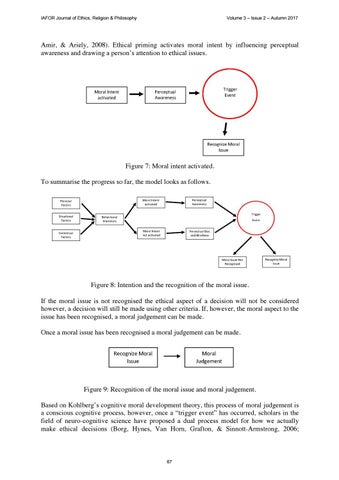
Amir, & Ariely, 2008). Ethical priming activates moral intent by influencing perceptual awareness and drawing a person’s attention to ethical issues.
Figure 7: Moral intent activated. To summarise the progress so far, the model looks as follows.
Figure 8: Intention and the recognition of the moral issue. If the moral issue is not recognised the ethical aspect of a decision will not be considered however, a decision will still be made using other criteria. If, however, the moral aspect to the issue has been recognised, a moral judgement can be made. Once a moral issue has been recognised a moral judgement can be made.
Figure 9: Recognition of the moral issue and moral judgement. Based on Kohlberg’s cognitive moral development theory, this process of moral judgement is a conscious cognitive process, however, once a “trigger event” has occurred, scholars in the field of neuro-cognitive science have proposed a dual process model for how we actually make ethical decisions (Borg, Hynes, Van Horn, Grafton, & Sinnott-Armstrong, 2006;
67