IAFOR Journal of Ethics, Religion & Philosophy
Volume 3 – Issue 2 – Autumn 2017
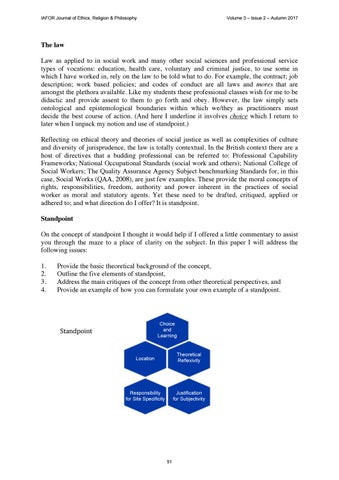
The law Law as applied to in social work and many other social sciences and professional service types of vocations: education, health care, voluntary and criminal justice, to use some in which I have worked in, rely on the law to be told what to do. For example, the contract; job description; work based policies; and codes of conduct are all laws and mores that are amongst the plethora available. Like my students these professional classes wish for me to be didactic and provide assent to them to go forth and obey. However, the law simply sets ontological and epistemological boundaries within which we/they as practitioners must decide the best course of action. (And here I underline it involves choice which I return to later when I unpack my notion and use of standpoint.) Reflecting on ethical theory and theories of social justice as well as complexities of culture and diversity of jurisprudence, the law is totally contextual. In the British context there are a host of directives that a budding professional can be referred to: Professional Capability Frameworks; National Occupational Standards (social work and others); National College of Social Workers; The Quality Assurance Agency Subject benchmarking Standards for, in this case, Social Works (QAA, 2008), are just few examples. These provide the moral concepts of rights, responsibilities, freedom, authority and power inherent in the practices of social worker as moral and statutory agents. Yet these need to be drafted, critiqued, applied or adhered to; and what direction do I offer? It is standpoint. Standpoint On the concept of standpoint I thought it would help if I offered a little commentary to assist you through the maze to a place of clarity on the subject. In this paper I will address the following issues: 1. 2. 3. 4.
Provide the basic theoretical background of the concept, Outline the five elements of standpoint, Address the main critiques of the concept from other theoretical perspectives, and Provide an example of how you can formulate your own example of a standpoint.
Standpoint
51