con’t from page 23 What sets “Welcoming Schools” apart from other initiatives? It’s unique in that it gives schools a comprehensive, “whole school” approach to improving school climate for all students and families, noted Kahn. “While there is an emphasis on LGBT inclusion, it also addresses diversity and bias very broadly and doesn’t leave anyone or any community out of the conversation,” she says. It looks at all types of family diversity — from single-parent families, families who recently came to the United States from other countries, families with different cultural and religious traditions, blended families, two-mom and twodad families, and all others — with the goal of ensuring that all students see themselves and their families reflected and represented within the school community, she said.
con’t from page 15 oldest buddies and told them I was gay, they hugged me and they said. ‘This doesn’t change anything.’ When I choked out the words, ‘I’m gay,’ to my mom and dad, the first thing they said was ‘We love you.’ And then my mother told me that she still expected grandkids from me! [Laughter.]
photo: Ann Johansson / Corbis
“Any difficulties I had in coming out were internal. My struggles were mostly within myself. The immediate world around me was incredibly supportive; it couldn’t have been more supportive. I was raised and educated in a place where I felt safe and secure, I was never bullied, and my family encouraged me to self investigation. What was shocking about that lie that I told that night in Hollywood Hills was how easily I could take all the steps I had made toward making the best and open version of myself back. Because in that moment, in a few words, I slipped back into the closet.
Similarly, Welcoming Schools’ anti-bullying component covers all types of bias, including race and ethnicity, learning ability, size, family structure and anti-LGBT bias. While it improves the experience of students with LGBT parents and young children who may have an emerging LGBT identity, it goes much further. “That’s why so many educators and administrators are responding positively and finding value in many aspects of the program,” Kahn said. “One of the key features of Welcoming Schools that makes it tremendously valuable as a resource is flexibility,” says Christopher McGinley, superintendent of the Lower Merion School District in Ardmore, Penn. “Our community is diverse in language, race, culture and family identity. Welcoming Schools give us a framework to having meaningful discussions with our teachers and staff members.” Consequently, teachers and staff members can focus more on “supporting children for who
they are as we help them to grow and learn,” McGinley noted. “Learning more about identity and family diversity has helped us to more effectively engage families and support children.” One important strength is the staff development component, the pilot data shows. In each pilot site, the educators and support professionals in the schools felt much more prepared to answer questions, to intervene effectively and to “model” inclusion after our training sessions. “If the adults in the school community don’t have the skills, the language, the tools to address bias and create ‘teachable moments’ with their students, nothing will change,” noted Kahn. “By engaging everyone — the principal, the cafeteria staff, the teachers and the librarians — the overall climate of the school begins to shift.” Gelnaw, an early childhood educator, is a member of HRC’s Welcoming Schools National Advisory Council.
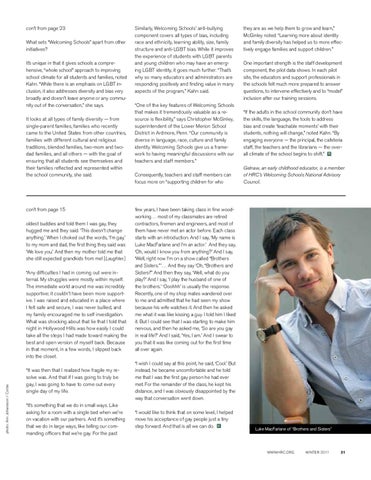
few years, I have been taking class in fine woodworking… most of my classmates are retired contractors, firemen and engineers, and most of them have never met an actor before. Each class starts with an introduction. And I say, ‘My name is Luke MacFarlane and I’m an actor.’ And they say, ‘Oh, would I know you from anything?’ And I say, ‘Well, right now I’m on a show called “Brothers and Sisters.”’… And they say ‘Oh, “Brothers and Sisters!”’ And then they say, ‘Well, what do you play?’ And I say, ‘I play the husband of one of the brothers.’ ‘Ooohhh’ is usually the response. Recently, one of my shop mates wandered over to me and admitted that he had seen my show because his wife watches it. And then he asked me what it was like kissing a guy. I told him I liked it. But I could see that I was starting to make him nervous, and then he asked me, ‘So are you gay in real life?’ And I said, ‘Yes, I am.’ And I swear to you that it was like coming out for the first time all over again.
“It was then that I realized how fragile my resolve was. And that if I was going to truly be gay, I was going to have to come out every single day of my life.
“I wish I could say at this point, he said, ‘Cool.’ But instead, he became uncomfortable and he told me that I was the first gay person he had ever met. For the remainder of the class, he kept his distance, and I was obviously disappointed by the way that conversation went down.
“It’s something that we do in small ways. Like asking for a room with a single bed when we’re on vacation with our partners. And it’s something that we do in large ways, like telling our commanding officers that we’re gay. For the past
“I would like to think that on some level, I helped move his acceptance of gay people just a tiny step forward. And that is all we can do.
Luke MacFarlane of “Brothers and Sisters”
WWW.HRC.ORG
winter 2011
31