“I have always believed that the Republican Party must be an inclusive, big-tent party that will always stand for fairness over discrimination, equality over bigotry, and freedom over fear.”
photo: Alex Brandon / AP
con’t from p.13 Senator Lieberman is the true champion. He and I had no intention of giving up, and it was there, on the Senate floor, that we decided we would introduce a standalone bill to repeal “Don’t Ask, Don’t Tell.” We drafted the bill that afternoon and introduced it. That bill provided the pathway to a vote on repeal the next week. What prompted you to be so engaged on this issue? I attended many hearings and heard testimony from many officials, including the secretary of defense and the chairman of the Joint Chiefs of Staff, our nation’s highest military officer, who agreed that Congress should repeal “Don’t Ask, Don’t Tell” with adequate time given for careful preparation, education and training. My decision to lead the effort to repeal “Don’t Ask, Don’t Tell,” along with Senator Lieberman, was based not only on their strong recommendations, but also on the powerful testimony I heard from service members who served honorably but were discharged simply because they are gay. Their experiences were deeply troubling to me. I also had conversations with a retired Navy rear admiral in my state of Maine and the retired admiral and former president of Bath Iron Works, who both gave me compelling first-hand knowledge that dismissing brave, dedicated and skilled service men and women because they are gay is simply wrong. I was also influenced by the experience of our allies. At least 35 nations, including our closest allies, welcome the military service of all qualified persons regardless of sexual orientation, and I believe it was time for the United States to do the same. The bottom line is we, too, should welcome the service of any qualified individual who is willing and capable of serving our country.
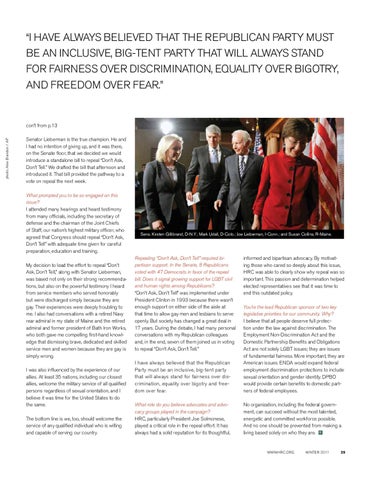
Sens. Kirsten Gillibrand, D-N.Y.; Mark Udall, D-Colo.; Joe Lieberman, I-Conn.; and Susan Collins, R-Maine.
Repealing “Don’t Ask, Don’t Tell” required bipartisan support. In the Senate, 8 Republicans voted with 47 Democrats in favor of the repeal bill. Does it signal growing support for LGBT civil and human rights among Republicans? “Don’t Ask, Don’t Tell” was implemented under President Clinton in 1993 because there wasn’t enough support on either side of the aisle at that time to allow gay men and lesbians to serve openly. But society has changed a great deal in 17 years. During the debate, I had many personal conversations with my Republican colleagues and, in the end, seven of them joined us in voting to repeal “Don’t Ask, Don’t Tell.”
informed and bipartisan advocacy. By motivating those who cared so deeply about this issue, HRC was able to clearly show why repeal was so important. This passion and determination helped elected representatives see that it was time to end this outdated policy.
I have always believed that the Republican Party must be an inclusive, big-tent party that will always stand for fairness over discrimination, equality over bigotry and freedom over fear.
You’re the lead Republican sponsor of two key legislative priorities for our community. Why? I believe that all people deserve full protection under the law against discrimination. The Employment Non-Discrimination Act and the Domestic Partnership Benefits and Obligations Act are not solely LGBT issues; they are issues of fundamental fairness. More important, they are American issues. ENDA would expand federal employment discrimination protections to include sexual orientation and gender identity. DPBO would provide certain benefits to domestic partners of federal employees.
What role do you believe advocates and advocacy groups played in the campaign? HRC, particularly President Joe Solmonese, played a critical role in the repeal effort. It has always had a solid reputation for its thoughtful,
No organization, including the federal government, can succeed without the most talented, energetic and committed workforce possible. And no one should be prevented from making a living based solely on who they are.
WWW.HRC.ORG
winter 2011
29