very timid, if any, and where levels of homophobia and hate crimes are high relative to other democracies. Equality: Who knew that as far back as 1821, Brazil created laws that decriminalized homosexuality … followed in the 1880s by four other Latin American countries? And yet, Mexico City shut down every gay bar in 1959, Cuba incarcerated gay people in the mid-1960s and so on. Was there a “Stonewall” moment in Latin America? Corrales: In the 1970s, when the time would
have been right for a Latin Stonewall to happen, most social movements were perhaps concerned with other, arguably more urgent matters — fighting repression by autocratic governments or fighting poverty. However, one could argue that most countries have had an LGBT pride march at some point in the 1990s. These marches start out small, but they are very visible and generate enormous public debate, often for the first time ever in that particular country. One could argue that these gay marches, the initial ones, are proxy Stonewalls. Or some might argue that the onslaught of the AIDS epidemic in the 1980s, which affected the region profoundly and led to some of the most visible forms of political activism by LGBT or LGBT-friendly groups, constituted the region’s real Stonewalls.
photo: Samuel Masinter for HRC
Equality: Argentina permits both marriage
equality and same-sex adoptions. One reason it was able to do so, you say, is due to separation of church and state — unlike Mexico and Colombia, where there are strong links between the ruling party and the ultra-conservative Opus Dei, or unlike the connections between the Republican Party and far-right evangelical groups in the United States. Can you talk about that? Corrales: Most importantly, there is separation
of state and party. This latter point is what distinguishes Argentina from so many other countries in Western democracies, where there usually is
a party or a set of parties with strong links with a church or church group. In Latin America, some of these church–party links date back to the 19th century, such as the Conservative parties in Colombia and Uruguay. Other links date back to the mid-20th century, such as the Christian Democrats in Chile, Venezuela or Costa Rica. In Central America and the Caribbean, parties have developed strong links with evangelical groups, as has the Republican Party in the United States. Parties that have strong links with churches, or which try to draw support from church groups, tend to be unwilling to challenge the churches on the issue of LGBT rights. Argentina is relatively exceptional for Latin America in that its largest parties have had a long tradition of secularism. Equality: Marriage equality in Argentina
was also made possible by President Cristina Fernandez’s decision to take the risk of backing the bill. And while there may be different reasons why she did so, she did it. A historic and gutsy move. Will we see more of that? Corrales: I hope we do, but I’m not too opti-
mistic about it. The reason is that the churches’ officialdom, in most countries now, has decided to fight LGBT marriage and adoption rights with renewed vigor, and it’s not clear to me that there will be many presidents out there willing to take on the churches on this issue. The political gain, in terms of votes gained, seem miniscule relative to the immensity of the fight with the churches. Perhaps I’m wrong, but even the most left-wing presidents in the region have ultimately been hesitant on this topic, bowing to religious pressure.
cially in the middle and upper classes, men and women are socially allowed to stay in the closet — double lives are tolerated by peers, as long as a minimum degree of discretion is observed. Many members of the professional class stay in the closet, depriving LBGT movements of both visible members and potential leaders. The more celebrities and professionals come out in any given society, the more a country can become used to the idea that being LBGT is neither freaky nor dysfunctional. Equality: Are young people getting involved in
pushing for change? Corrales: LGBT movements in Latin America,
as everywhere, are populated by many young people. Are the region’s LGBT movements attracting as many young people as one would expect, given levels of economic development, schooling and urbanization? No. One reason is that many young folks in Latin America, those in the 18–24 age group, still live in their original households …. Having such a large percentage of young people living at home, sometimes as high as 90 percent, is a problem because homophobia begins at home in all societies. And Latin America is no exception.
Equality: In your book, you underscore how
the closet remains a very comfortable place to be in Latin America, particularly for many in the upper-income brackets — much more so than in the United States. Corrales: This is a serious political problem.
Many studies show that in Latin America, espe-
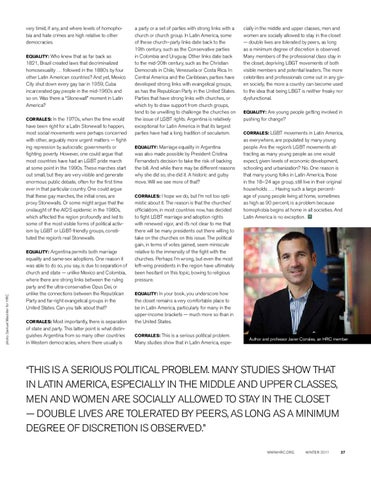
Author and professor Javier Corrales, an HRC member
“This is a serious political problem. Many studies show that in Latin America, especially in the middle and upper classes, men and women are socially allowed to stay in the closet — double lives are tolerated by peers, as long as a minimum degree of discretion is observed.” WWW.HRC.ORG
winter 2011
27