photo: Natacha Pisarenko
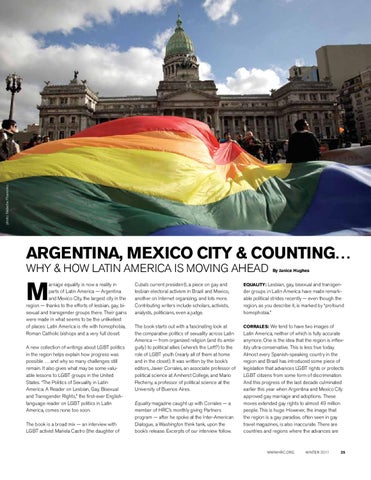
Argentina, Mexico City & counting… Why & How Latin America Is Moving Ahead
M
arriage equality is now a reality in parts of Latin America — Argentina and Mexico City, the largest city in the region — thanks to the efforts of lesbian, gay, bisexual and transgender groups there. Their gains were made in what seems to be the unlikeliest of places: Latin America is rife with homophobia, Roman Catholic bishops and a very full closet. A new collection of writings about LGBT politics in the region helps explain how progress was possible … and why so many challenges still remain. It also gives what may be some valuable lessons to LGBT groups in the United States. “The Politics of Sexuality in Latin America: A Reader on Lesbian, Gay, Bisexual and Transgender Rights,” the first-ever Englishlanguage reader on LGBT politics in Latin America, comes none too soon. The book is a broad mix — an interview with LGBT activist Mariela Castro (the daughter of
By Janice Hughes
Cuba’s current president), a piece on gay and lesbian electoral activism in Brazil and Mexico, another on Internet organizing, and lots more. Contributing writers include scholars, activists, analysts, politicians, even a judge.
Equality: Lesbian, gay, bisexual and transgen-
The book starts out with a fascinating look at the comparative politics of sexuality across Latin America — from organized religion (and its ambiguity) to political allies (where’s the Left?) to the role of LGBT youth (nearly all of them at home and in the closet). It was written by the book’s editors, Javier Corrales, an associate professor of political science at Amherst College, and Mario Pecheny, a professor of political science at the University of Buenos Aires.
Corrales: We tend to have two images of
Equality magazine caught up with Corrales — a member of HRC’s monthly giving Partners program — after he spoke at the Inter-American Dialogue, a Washington think tank, upon the book’s release. Excerpts of our interview follow.
der groups in Latin America have made remarkable political strides recently — even though the region, as you describe it, is marked by “profound homophobia.”
Latin America, neither of which is fully accurate anymore. One is the idea that the region is inflexibly ultra-conservative. This is less true today. Almost every Spanish-speaking country in the region and Brazil has introduced some piece of legislation that advances LGBT rights or protects LGBT citizens from some form of discrimination. And this progress of the last decade culminated earlier this year when Argentina and Mexico City approved gay marriage and adoptions. These moves extended gay rights to almost 49 million people. This is huge. However, the image that the region is a gay paradise, often seen in gay travel magazines, is also inaccurate. There are countries and regions where the advances are
WWW.HRC.ORG
winter 2011
25