While LGBT parenting has proliferated across the United States, the issues that strike fear into the hearts of LGBT parents have not grown any less prevalent. One of the worst things any parent can hear is that their child is being picked on or bullied at school. And other problems emerge when these families are ignored as part of the fabric of the community. When children of LGBT parents feel invisible in their school community, their well-being and potential for success in school is undermined, experts say. Five years ago, the HRC Foundation hired Kahn, a social worker with several years of experience in LGBT parent organizing and support, to head its Family Project. As she thought about the direction of the project, Kahn took a telephone call from a distraught mom in Washington state. The woman, a lesbian, and her family had just transferred from one school to another within the state. But while she had felt safe and welcome in her previous school, she had promptly been rejected from appearing on a family panel at the new school because of her “kind of family.” With that call, Kahn says, she understood more clearly what kind of family advocacy was needed. And as a lesbian parent of young children, Kahn was interested in creating tools and resources that could help schools support students with LGBT parents starting in the earliest grades. The Family Project began doing an informal audit of anti-bullying and anti-bias curricula and programs used in elementary schools. It found that the vast majority did not address LGBT issues at all, and those that did had very little content.
To better understand how HRC could fill this gap, Kahn convened a meeting at HRC with educators and leaders in safe-schools work to share ideas about an elementary-school solution. Among the attendees was a parent from Boston who had been working with a group of other parents and educators on a “Welcoming Schools” guide, still a work in progress. It was designed to do two things: to meet the needs of children in kindergarten to fifth grade (K–5) whose family structures were not being represented or included in the schools, and to help educators who were asking for tools to address bias-based name-calling and bullying. It also offered a wide range of resources for school administrators and educators to support students who don’t conform to gender norms. Kahn started to work closely with the “Welcoming Schools” leaders and set up a national advisory council. Later, HRC assumed stewardship of the initiative for development, piloting, further research and distribution. The initiative, fine-tuned over the last few years, offers tools, lessons and resources on family diversity and gender stereotyping as well as bullying and name-calling. It also provides resources to parents and guardians as well as educators and administrators for the K–5 grades. It has now been piloted and evaluated in 12 schools across five districts in California, Massachusetts and Minnesota. Upon completion, Kahn and her team will distribute the “Welcoming Schools” tools further. continued on p. 31
Some key outcomes from the pilot evaluation, based on pre- and post-pilot surveys of administrators, found:
• A positive improvement in school diversity climate. Almost 60 percent of educators indicated their school’s climate around diversity was different in May than it was in the prior September • Reduction in teachers’ concerns about their own lack of training or resources, from 54 percent to 30 percent • Reduction in teachers’ fears of parental dissatisfaction, from 52 percent to 28 percent • Positive difference in believing that children of every age could benefit from discussing gender roles and expression and families with LGBT parents • Growth in positive intentions to address topics of diversity, including families with LGBT parents and gender roles/expression in their classrooms and schools
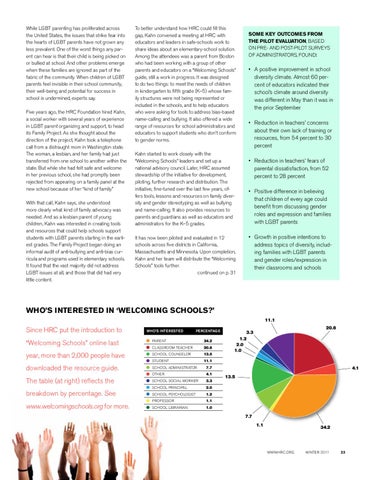
Who’s Interested in ‘Welcoming Schools?’ 11.1
Since HRC put the introduction to
who’s interested percentage
“Welcoming Schools” online last
Parent
34.2
Classroom Teacher
20.8
year, more than 2,000 people have
School Counselor
13.5
Student
11.1
downloaded the resource guide.
School Administrator
7.7
Other
4.1
School Social Worker
3.3
School Principal
2.0
The table (at right) reflects the breakdown by percentage. See www.welcomingschools.org for more.
School Psychologist
1.2
Professor
1.1
School Librarian
1.0
20.8
3.3 1.2 2.0 1.0
4.1 13.5
7.7 1.1
WWW.HRC.ORG
34.2
winter 2011
23