What’s crucial to note, says HRC’s Smith, is that the gears to repeal started rolling intensively in November 2009. That’s when Solmonese, along with Smith, met with Jim Messina, one of President Obama’s deputy chiefs of staff, in his White House office. Solmonese stressed to Messina that HRC was ready to mount a massive campaign to get “Don’t Ask, Don’t Tell” repealed in 2010. It was after this meeting that things began to move, said Smith.
Already, a confluence of events was happening. On Capitol Hill, Murphy had taken over as lead sponsor of the repeal bill, the Military Readiness Enhancement Act. Advocacy groups were keeping the topic in the public eye. Earlier in 2009, HRC had launched a “Voices of Honor” Tour, in partnership with Servicemembers United, to help straight, lesbian, gay and bisexual military veterans speak out for repeal. After four months and 18 stops, it helped bring on board 30 new congressional co-sponsors. HRC worked closely on strategy with the Servicemembers Legal Defense Network and the Center for American Progress. On March 3, Lieberman unveiled the first-ever Senate bill to repeal “Don’t Ask, Don’t Tell.” A
authorization bill that would repeal the ban — the first time in history that Congress had ever taken a vote to repeal the ban. Later that same day, the House voted 234-194 to adopt the Murphy Amendment to repeal “Don’t Ask, Don’t Tell” in the defense bill. Committee Chairman Levin, Lieberman, and Murphy, in the House, worked with the White House to set the stage for the votes. But the measure did not come to the Senate floor until September. And of course, by early summer, it was increasingly clear that the Democratic control of the House and maybe even the Senate was in jeopardy. Consequently, there “was a brand new sense of urgency in
Solmonese, Smith and Herwitt had vigorously worked with top White House officials and others, urging them to commit to move forward. It was a matter of “putting all of the right pieces in place,” Solmonese noted.
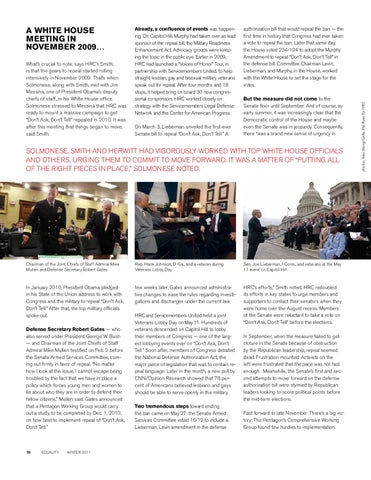
Chairman of the Joint Chiefs of Staff Admiral Mike Mullen and Defense Secretary Robert Gates
Rep. Hank Johnson, D-Ga., and a veteran during Veterans Lobby Day
Sen. Joe Lieberman, I-Conn., and veterans at the May 11 event on Capitol Hill
In January 2010, President Obama pledged in his State of the Union address to work with Congress and the military to repeal “Don’t Ask, Don’t Tell.” After that, the top military officials spoke out.
few weeks later, Gates announced administrative changes to ease the rules regarding investigations and discharges under the current law.
HRC’s efforts,” Smith noted. HRC redoubled its efforts in key states to urge members and supporters to contact their senators when they were home over the August recess. Members of the Senate were reluctant to take a vote on “Don’t Ask, Don’t Tell” before the elections.
Defense Secretary Robert Gates — who also served under President George W. Bush — and Chairman of the Joint Chiefs of Staff Admiral Mike Mullen testified on Feb. 2 before the Senate Armed Services Committee, coming out firmly in favor of repeal. “No matter how I look at the issue, I cannot escape being troubled by the fact that we have in place a policy which forces young men and women to lie about who they are in order to defend their fellow citizens,” Mullen said. Gates announced that a Pentagon Working Group would carry out a study, to be completed by Dec. 1, 2010, on how best to implement repeal of “Don’t Ask, Don’t Tell.”
10
EQUALITY
winter 2011
HRC and Servicemembers United held a joint Veterans Lobby Day on May 11. Hundreds of veterans descended on Capitol Hill to lobby their members of Congress — one of the largest lobbying events ever on “Don’t Ask, Don’t Tell.” Soon after, members of Congress debated the National Defense Authorization Act, the major piece of legislation that was to contain repeal language. Later in the month, a new poll by CNN/Opinion Research showed that 78 percent of Americans believed lesbians and gays should be able to serve openly in the military. Two tremendous steps toward ending the ban came on May 27: the Senate Armed Services Committee voted 16-12 to include a Lieberman, Levin amendment in the defense
In September, when the measure failed to get cloture in the Senate because of obstruction by the Republican leadership, repeal seemed dead. Frustration mounted. Activists on the left were frustrated that the pace was not fast enough. Meanwhile, the Senate’s first and second attempts to move forward on the defense authorization bill were stymied by Republican leaders looking to score political points before the mid-term elections. Fast forward to late November. There’s a big victory: The Pentagon’s Comprehensive Working Group found few hurdles to implementation.
photos: Alex Wong/Getty, Pat Ryan for HRC
A White House Meeting in November 2009…