photos: Alex Wong/Getty, Chip Somodevilla/Getty
But Human Rights Campaign Legislative Director Allison Herwitt and key allies on the Hill had an idea. Why not try a different route: a stand-alone bill, distinct from the defense bill. Sens. Joe Lieberman, I-Ct., and Susan Collins, R-Maine, announced the stand-alone repeal bill at a news conference Dec. 9 and Herwitt raised the idea, at a gathering later that evening, with then-Majority Leader Steny Hoyer, D-Md., and members of his staff. The key to success? Convince the House to vote on the stand-alone bill first and send it over to the Senate as a “privileged” bill, thus eliminating critically challenging procedural votes. Clearly, it was no easy task as the House, in May, had already voted on the Murphy
Ask, Don’t Tell” repeal bill. And as planned, it went to the Senate as a “privileged” bill. Senate Majority Leader Harry Reid, with the leadership of Lieberman and Collins, then passed the stand-alone repeal bill, by a 65 to 31 vote. Eight Republicans joined 57 Democrats to end the discriminatory law. Herwitt, with her team of lobbyists, had been largely driving HRC’s legislative strategy, and this was one last maneuver. For more than a year, Herwitt had worked closely with Murphy, a veteran of the Iraq War; Hoyer; Sens. Lieberman; Collins; Carl Levin, D-Mich.; Mark Udall, D-Colo.; Kirsten Gillibrand, D-N.Y.; and Reid and their staffs, charting strategy through both chambers, working with lawmakers and
make the difference,” Solmonese said. “It came down to the often unglamorous work of moving six senators to vote the right way.” HRC’s goal, across the organization, was “getting it done, and never losing sight of the end goal — and it was respectful, more carrot than stick,” he said. Smith agreed. “HRC was singularly responsible for the field effort that resulted in getting the key Committee votes,” he said. HRC succeeded in its full-court press on Democratic Sens. Ben Nelson in Nebraska, Robert Byrd in West Virginia, and others. HRC organizers worked hard to identify and activate supporters to contact their lawmakers on repeal, even going to such lengths as getting
the path to repealing One of the Most important Pieces of Civil Rights Legislation in our time By Janice Hughes
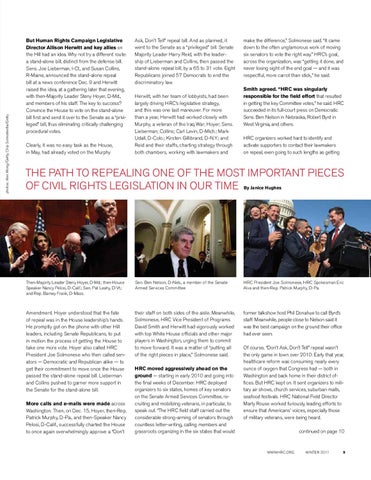
Then-Majority Leader Steny Hoyer, D-Md.; then-House Speaker Nancy Pelosi, D-Calif.; Sen. Pat Leahy, D-Vt.; and Rep. Barney Frank, D-Mass.
Sen. Ben Nelson, D-Neb., a member of the Senate Armed Services Committee
HRC President Joe Solmonese, HRC Spokesman Eric Alva and then-Rep. Patrick Murphy, D-Pa.
Amendment. Hoyer understood that the fate of repeal was in the House leadership’s hands. He promptly got on the phone with other Hill leaders, including Senate Republicans, to put in motion the process of getting the House to take one more vote. Hoyer also called HRC President Joe Solmonese who then called senators — Democratic and Republican alike — to get their commitment to move once the House passed the stand-alone repeal bill. Lieberman and Collins pushed to garner more support in the Senate for the stand-alone bill.
their staff on both sides of the aisle. Meanwhile, Solmonese, HRC Vice President of Programs David Smith and Herwitt had vigorously worked with top White House officials and other major players in Washington, urging them to commit to move forward. It was a matter of “putting all of the right pieces in place,” Solmonese said.
former talkshow host Phil Donahue to call Byrd’s staff. Meanwhile, people close to Nelson said it was the best campaign on the ground their office had ever seen.
More calls and e-mails were made across Washington. Then, on Dec. 15, Hoyer, then-Rep. Patrick Murphy, D-Pa., and then-Speaker Nancy Pelosi, D-Calif., successfully charted the House to once again overwhelmingly approve a “Don’t
HRC moved aggressively ahead on the ground — starting in early 2010 and going into the final weeks of December. HRC deployed organizers to six states, homes of key senators on the Senate Armed Services Committee, recruiting and mobilizing veterans, in particular, to speak out. “The HRC field staff carried out the considerable strong-arming of senators through countless letter-writing, calling members and grassroots organizing in the six states that would
Of course, “Don’t Ask, Don’t Tell” repeal wasn’t the only game in town over 2010: Early that year, healthcare reform was consuming nearly every ounce of oxygen that Congress had — both in Washington and back home in their district offices. But HRC kept on. It sent organizers to military air shows, church services, suburban malls, seafood festivals. HRC National Field Director Marty Rouse worked furiously, leading efforts to ensure that Americans’ voices, especially those of military veterans, were being heard. continued on page 10
WWW.HRC.ORG
winter 2011
9