YOUR VOTE MATTERS Photo: Susan Walsh / AP
You grew up during the ‘50s and ‘60s — a momentous time for the civil rights movement. I was helping my mom organize for her labor union. … My scope was limited, being the child handing out pamphlets and leaflets, but the impression it had on me lasted a lifetime. My mom’s activism helped me understand the importance of speaking up and the value of representing the American people.
O
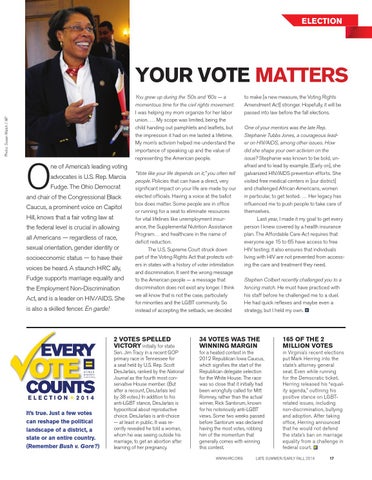
ne of America’s leading voting advocates is U.S. Rep. Marcia Fudge. The Ohio Democrat
and chair of the Congressional Black Caucus, a prominent voice on Capitol Hill, knows that a fair voting law at the federal level is crucial in allowing all Americans — regardless of race, sexual orientation, gender identity or socioeconomic status — to have their voices be heard. A staunch HRC ally, Fudge supports marriage equality and the Employment Non-Discrimination Act, and is a leader on HIV/AIDS. She is also a skilled fencer. En garde!
It’s true. Just a few votes can reshape the political landscape of a district, a state or an entire country. (Remember Bush v. Gore?)
“Vote like your life depends on it,” you often tell people. Policies that can have a direct, very significant impact on your life are made by our elected officials. Having a voice at the ballot box does matter. Some people are in office or running for a seat to eliminate resources for vital lifelines like unemployment insurance, the Supplemental Nutrition Assistance Program… and healthcare in the name of deficit reduction. The U.S. Supreme Court struck down part of the Voting Rights Act that protects voters in states with a history of voter intimidation and discrimination. It sent the wrong message to the American people — a message that discrimination does not exist any longer. I think we all know that is not the case, particularly for minorities and the LGBT community. So instead of accepting the setback, we decided
to make [a new measure, the Voting Rights Amendment Act] stronger. Hopefully, it will be passed into law before the fall elections. One of your mentors was the late Rep. Stephanie Tubbs Jones, a courageous leader on HIV/AIDS, among other issues. How did she shape your own activism on the issue? Stephanie was known to be bold, unafraid and to lead by example. [Early on], she galvanized HIV/AIDS prevention efforts. She visited free medical centers in [our district] and challenged African Americans, women in particular, to get tested. … Her legacy has influenced me to push people to take care of themselves. Last year, I made it my goal to get every person I knew covered by a health insurance plan. The Affordable Care Act requires that everyone age 15 to 65 have access to free HIV testing; it also ensures that individuals living with HIV are not prevented from accessing the care and treatment they need. Stephen Colbert recently challenged you to a fencing match. He must have practiced with his staff before he challenged me to a duel. He had quick reflexes and maybe even a strategy, but I held my own.
2 VOTES SPELLED VICTORY initially for state
34 VOTES WAS THE WINNING MARGIN
165 OF THE 2 MILLION VOTES
Sen. Jim Tracy in a recent GOP primary race in Tennessee for a seat held by U.S. Rep. Scott DesJarlais, ranked by the National Journal as the fourth most conservative House member. (But after a recount, DesJarlais led by 38 votes.) In addition to his anti-LGBT stance, DesJarlais is hypocritical about reproductive choice. DesJarlais is anti-choice — at least in public. It was recently revealed he told a woman, whom he was seeing outside his marriage, to get an abortion after learning of her pregnancy.
for a heated contest in the 2012 Republican Iowa Caucus, which signifies the start of the Republican delegate selection for the White House. The race was so close that it initially had been wrongfully called for Mitt Romney, rather than the actual winner, Rick Santorum, known for his notoriously anti-LGBT views. Some two weeks passed before Santorum was declared having the most votes, robbing him of the momentum that generally comes with winning this contest.
in Virginia’s recent elections put Mark Herring into the state’s attorney general seat. Even while running for the Democratic ticket, Herring released his “equality agenda,” outlining his positive stance on LGBTrelated issues, including non-discrimination, bullying and adoption. After taking office, Herring announced that he would not defend the state’s ban on marriage equality from a challenge in federal court.
WWW.HRC.ORG
LATE SUMMER/EARLY FALL 2014
17