FEARLESS
Photo: Dave Anderson
IN ALABAMA By Janice Hughes
Birmingham, Ala.
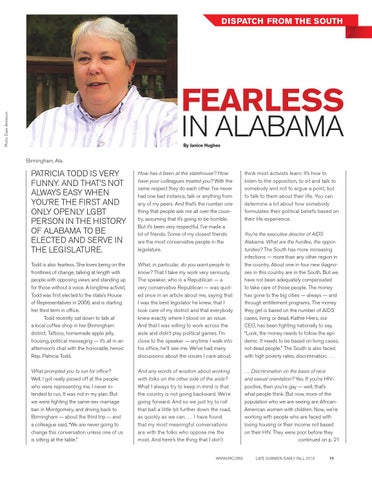
PATRICIA TODD IS VERY FUNNY. AND THAT’S NOT ALWAYS EASY WHEN YOU’RE THE FIRST AND ONLY OPENLY LGBT PERSON IN THE HISTORY OF ALABAMA TO BE ELECTED AND SERVE IN THE LEGISLATURE.
How has it been at the statehouse? How have your colleagues treated you? With the same respect they do each other. I’ve never had one bad instance, talk or anything from any of my peers. And that’s the number one thing that people ask me all over the country, assuming that it’s going to be horrible. But it’s been very respectful. I’ve made a lot of friends. Some of my closest friends are the most conservative people in the legislature.
Todd is also fearless. She loves being on the frontlines of change, talking at length with people with opposing views and standing up for those without a voice. A longtime activist, Todd was first elected to the state’s House of Representatives in 2006, and is starting her third term in office. Todd recently sat down to talk at a local coffee shop in her Birmingham district. Tattoos, homemade apple jelly, housing, political messaging — it’s all in an afternoon’s chat with the honorable, heroic Rep. Patricia Todd.
What, in particular, do you want people to know? That I take my work very seriously. The speaker, who is a Republican — a very conservative Republican — was quoted once in an article about me, saying that I was the best legislator he knew, that I took care of my district and that everybody knew exactly where I stood on an issue. And that I was willing to work across the aisle and didn’t play political games. I’m close to the speaker — anytime I walk into his office, he’ll see me. We’ve had many discussions about the issues I care about.
You’re the executive director of AIDS Alabama. What are the hurdles, the opportunities? The South has more increasing infections — more than any other region in the country. About one in four new diagnoses in this country are in the South. But we have not been adequately compensated to take care of those people. The money has gone to the big cities — always — and through entitlement programs. The money they get is based on the number of AIDS cases, living or dead. Kathie Hiers, our CEO, has been fighting nationally to say, “Look, the money needs to follow the epidemic. It needs to be based on living cases, not dead people.” The South is also faced with high poverty rates, discrimination. …
What prompted you to run for office? Well, I got really pissed off at the people who were representing me. I never intended to run. It was not in my plan. But we were fighting the same-sex marriage ban in Montgomery, and driving back to Birmingham — about the third trip — and a colleague said, “We are never going to change this conversation unless one of us is sitting at the table.”
And any words of wisdom about working with folks on the other side of the aisle? What I always try to keep in mind is that the country is not going backward. We’re going forward. And so we just try to roll that ball a little bit further down the road, as quickly as we can. … I have found that my most meaningful conversations are with the folks who oppose me the most. And here’s the thing that I don’t
… Discrimination on the basis of race and sexual orientation? Yes. If you’re HIVpositive, then you’re gay — well, that’s what people think. But now, more of the population who we are seeing are AfricanAmerican women with children. Now, we’re working with people who are faced with losing housing or their income not based on their HIV. They were poor before they continued on p. 21
WWW.HRC.ORG
think most activists learn: It’s how to listen to the opposition, to sit and talk to somebody and not to argue a point, but to talk to them about their life. You can determine a lot about how somebody formulates their political beliefs based on their life experience.
LATE SUMMER/EARLY FALL 2014
11