Citation: Alshahrani FS, Stapleton F, Golebiowski B, Gibson E, Boga A (2022) Validation of a New Meibomian Gland Dysfunction (MGD) Grading Scale for Rapid Assessment of MGD in Clinical Practice. J Ophthalmic Clin Res 9: 094.
• Page 4 of 5 •
Grade 0 = no drop out of MG
Grade ≥ 1
Grade 0
Signs and symptoms
Mean ± SD
Telangiectasia (T)
0.25 ± 0.66
Expressibility (E)
0.20 ± 0.66
T+E combination
0.45 ± 1.33
Grade 1 ≤ 33% drop out of MG Non-contact meibography [14,21]
Grade 2 = 34%66% drop out of MG Grade 3 = 67%100% drop out of MG Grade 0 = Clear with light pressure
Grade ≥ 1
Grade 0 = Clear with light pressure
Grade 1 = Cloudy with mild pressure Expressibility [20,21]
Grade 2 = Cloudy with more than moderate pressure
(Count)
1.18 ± 1.01
MGD14
26.10 ± 27.73
OSDI
20.17 ± 14.84
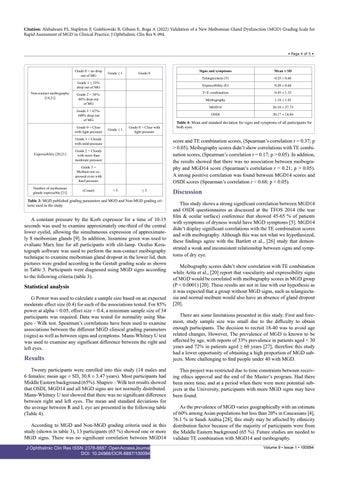
Table 4: Mean and standard deviation for signs and symptoms of all participants for both eyes.
score and TE combination scores, (Spearman’s correlation r = 0.37; p > 0.05). Meibography scores didn’t show correlations with TE combination scores, (Spearman’s correlation r = 0.17; p > 0.05). In addition, the results showed that there was no association between meibography and MGD14 score (Spearman’s correlation r = 0.21; p > 0.05). A strong positive correlation was found between MGD14 scores and OSDI scores (Spearman’s correlation r = 0.68; p < 0.05).
Grade 3 = Meibum not expressed even with hard pressure Number of meibomian glands expressible [21]
Meibography
<5
≥5
Table 3: MGD published grading parameters and MGD and Non-MGD grading criteria used in the study.
A constant pressure by the Korb expressor for a time of 10-15 seconds was used to examine approximately one-third of the central lower eyelid, allowing the simultaneous expression of approximately 8 meibomian glands [9]. In addition, lissamine green was used to evaluate Marx line for all participants with slit-lamp. Oculus Keratograph software was used to perform the non-contact meibography technique to examine meibomian gland dropout in the lower lid, then pictures were graded according to the Gestalt grading scale as shown in Table 3. Participants were diagnosed using MGD signs according to the following criteria (table 3).
Statistical analysis G Power was used to calculate a sample size based on an expected moderate effect size (0.4) for each of the associations tested. For 85% power at alpha = 0.05, effect size = 0.4, a minimum sample size of 34 participants was required. Data was tested for normality using Shapiro - Wilk test. Spearman’s correlations have been used to examine associations between the different MGD clinical grading parameters (signs) as well as between signs and symptoms. Mann-Whitney U test was used to examine any significant difference between the right and left eyes.
Results Twenty participants were enrolled into this study (14 males and 6 females; mean age ± SD, 30.8 ± 3.47 years). Most participants had Middle Eastern background (65%). Shapiro – Wilk test results showed that OSDI, MGD14 and all MGD signs are not normally distributed. Mann-Whitney U test showed that there was no significant difference between right and left eyes. The mean and standard deviations for the average between R and L eye are presented in the following table (Table 4). According to MGD and Non-MGD grading criteria used in this study (shown in table 3), 13 participants (65 %) showed one or more MGD signs. There was no significant correlation between MGD14 J Ophthalmic Clin Res ISSN: 2378-8887, Open Access Journal DOI: 10.24966/OCR-8887/100094
Discussion This study shows a strong significant correlation between MGD14 and OSDI questionnaires as discussed at the TFOS 2014 (the tear film & ocular surface) conference that showed 45-65 % of patients with symptoms of dryness would have MGD symptoms [5]. MGD14 didn’t display significant correlations with the TE combination scores and with meibography. Although this was not what we hypothesized, these findings agree with the Bartlett et al., [26] study that demonstrated a weak and inconsistent relationship between signs and symptoms of dry eye. Meibography scores didn’t show correlation with TE combination while Arita et al., [20] report that vascularity and expressibility signs of MGD would be correlated with meibography scores in MGD group (P < 0.0001) [20]. These results are not in line with our hypothesis as it was expected that a group without MGD signs, such as telangiectasia and normal meibum would also have an absence of gland dropout [20]. There are some limitations presented in this study. First and foremost, study sample size was small due to the difficulty to obtain enough participants. The decision to recruit 18-40 was to avoid age related changes. However, The prevalence of MGD is known to be affected by age, with reports of 33% prevalence in patients aged < 30 years and 72% in patients aged ≥ 60 years [27], therefore this study had a lower opportunity of obtaining a high proportion of MGD subjects. More challenging to find people under 40 with MGD. This project was restricted due to time constraints between receiving ethics approval and the end of the Master’s program. Had there been more time, and at a period when there were more potential subjects at the University, participants with more MGD signs may have been found. As the prevalence of MGD varies geographically with an estimate of 60% among Asian populations but less than 20% in Caucasians [4], 76.1 % in Saudi Arabia [28], this study may be affected by ethnicity distribution factor because of the majority of participants were from the Middle Eastern background (65 %). Future studies are needed to validate TE combination with MGD14 and meibography. Volume 9 • Issue 1 • 100094