HOMEWORKS
HISTORY OF COLOUR THEORY The first colour wheel was invented by Sir Isaac Newton. He split white sunlight into red, orange, yellow, green, cyan, and blue beams; then he joined the two ends of the colour spectrum together to show the natural progression of colours. Newton associated each colour with a note of a musical scale. A century after Newton, Johann Wolfgang Goethe began studying the psychological effect of colours. He noticed that blue gives a feeling of coolness and yellow has a warming effect. Goethe created a colour wheel showing the psychological effect of each colour. He divided all the colours into two groups – the plus side (from red through orange to yellow) and the minus side (from green through violet to blue). Colours of the plus side produce excitement and cheerfulness. Colours of the minus side are associated with weakness and unsettled feelings. The current form of colour theory was developed by Johannes Itten, a Swiss colour and art theorist who was teaching at the School of Applied Arts in Weimar, Germany. This school is also known as ‘Bauhaus’. Johannes Itten developed ‘colour chords’ and modified the colour wheel. Itten’s colour wheel is based on red, yellow, and blue colours as the primary triad and includes twelve hues.
COLOUR SCHEMES Related Schemes Monochromatic - This colour scheme uses a single hue. (example: red and its varying tints and shades) Analogous - This scheme uses adjacent hues. (example: red, redorange, and red-violet) Contrasting Schemes Complementary - If two hues are opposite each other on the colour wheel they are considered to be complementary colours. When used together in a design they make each other seem brighter and more intense. (example: red and green).
COOL
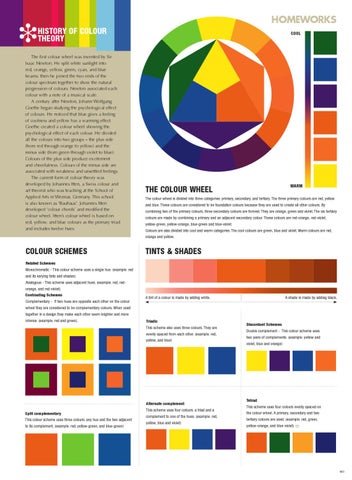
THE COLOUR WHEEL
The colour wheel is divided into three categories: primary, secondary, and tertiary. The three primary colours are red, yellow and blue. These colours are considered to be foundation colours because they are used to create all other colours. By combining two of the primary colours, three secondary colours are formed. They are orange, green and violet. The six tertiary colours are made by combining a primary and an adjacent secondary colour. These colours are red-orange, red-violet, yellow-green, yellow-orange, blue-green and blue-violet. Colours are also divided into cool and warm categories. The cool colours are green, blue and violet. Warm colours are red, orange and yellow.
TINTS & SHADES
A tint of a colour is made by adding white.
Triadic This scheme also uses three colours. They are evenly spaced from each other. (example: red,
Split complementary This colour scheme uses three colours: any hue and the two adjacent to its complement. (example: red, yellow-green, and blue-green)
WARM
A shade is made by adding black.
Discordant Schemes Double complement - This colour scheme uses
yellow, and blue)
two pairs of complements. (example: yellow and violet, blue and orange)
Alternate complement This scheme uses four colours: a triad and a complement to one of the hues. (example: red, yellow, blue and violet)
Tetrad This scheme uses four colours evenly spaced on the colour wheel. A primary, secondary and two tertiary colours are used. (example: red, green, yellow-orange, and blue-violet) HW
083
Homeworks12 Book.indb 83
4/6/05 1:15:07 AM