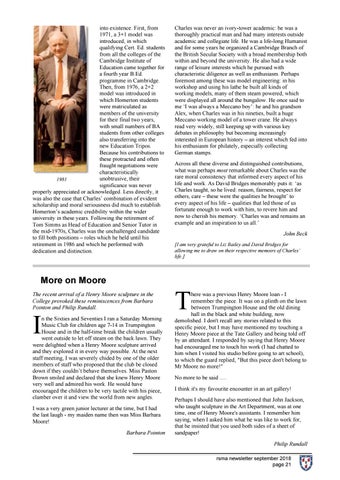
into existence. First, from 1971, a 3+1 model was introduced, in which qualifying Cert. Ed. students from all the colleges of the Cambridge Institute of Education came together for a fourth year B.Ed. programme in Cambridge. Then, from 1976, a 2+2 model was introduced in which Homerton students were matriculated as members of the university for their final two years, with small numbers of BA students from other colleges also transferring into the new Education Tripos. Because his contributions to these protracted and often fraught negotiations were characteristically unobtrusive, their 1981 significance was never properly appreciated or acknowledged. Less directly, it was also the case that Charles’ combination of evident scholarship and moral seriousness did much to establish Homerton’s academic credibility within the wider university in these years. Following the retirement of Tom Simms as Head of Education and Senior Tutor in the mid-1970s, Charles was the unchallenged candidate to fill both positions – roles which he held until his retirement in 1986 and which he performed with dedication and distinction.
More on Moore
The recent arrival of a Henry Moore sculpture in the College provoked these reminiscences from Barbara Pointon and Philip Rundall.
I
n the Sixties and Seventies I ran a Saturday Morning Music Club for children age 7-14 in Trumpington House and in the half-time break the children usually went outside to let off steam on the back lawn. They were delighted when a Henry Moore sculpture arrived and they explored it in every way possible. At the next staff meeting, I was severely chided by one of the older members of staff who proposed that the club be closed down if they couldn’t behave themselves. Miss Paston Brown smiled and declared that she knew Henry Moore very well and admired his work. He would have encouraged the children to be very tactile with his piece, clamber over it and view the world from new angles. I was a very green junior lecturer at the time, but I had the last laugh - my maiden name then was Miss Barbara Moore! Barbara Pointon
Charles was never an ivory-tower academic: he was a thoroughly practical man and had many interests outside academic and collegiate life. He was a life-long Humanist and for some years he organized a Cambridge Branch of the British Secular Society with a broad membership both within and beyond the university. He also had a wide range of leisure interests which he pursued with characteristic diligence as well as enthusiasm. Perhaps foremost among these was model engineering: in his workshop and using his lathe he built all kinds of working models, many of them steam powered, which were displayed all around the bungalow. He once said to me ‘I was always a Meccano boy’: he and his grandson Alex, when Charles was in his nineties, built a huge Meccano working model of a tower crane. He always read very widely, still keeping up with various key debates in philosophy but becoming increasingly interested in European history – an interest which fed into his enthusiasm for philately, especially collecting German stamps. Across all these diverse and distinguished contributions, what was perhaps most remarkable about Charles was the rare moral consistency that informed every aspect of his life and work. As David Bridges memorably puts it: ‘as Charles taught, so he lived: reason, fairness, respect for others, care – these were the qualities he brought’ to every aspect of his life – qualities that led those of us fortunate enough to work with him, to revere him and now to cherish his memory. ‘Charles was and remains an example and an inspiration to us all.’ John Beck [I am very grateful to Liz Bailey and David Bridges for allowing me to draw on their respective memoirs of Charles’ life.]
T
here was a previous Henry Moore loan - I remember the piece. It was on a plinth on the lawn between Trumpington House and the old dining hall in the black and white building, now demolished. I don't recall any stories related to this specific piece, but I may have mentioned my touching a Henry Moore piece at the Tate Gallery and being told off by an attendant. I responded by saying that Henry Moore had encouraged me to touch his work (I had chatted to him when I visited his studio before going to art school), to which the guard replied, "But this piece don't belong to Mr Moore no more!" No more to be said ..... I think it's my favourite encounter in an art gallery! Perhaps I should have also mentioned that John Jackson, who taught sculpture in the Art Department, was at one time, one of Henry Moore's assistants. I remember him saying, when I asked him what he was like to work for, that he insisted that you used both sides of a sheet of sandpaper! Philip Rundall rsma newsletter september 2018 page 21