OBITUARIES Jessie Ball Former Head of English until 1981 Died 2011 When Jessie Ball arrived as Head of the English Department, she brought more than a touch of the satirical to academic life at Homerton. Her down-to-earth personal integrity, toughened by her solid anti-hierarchical convictions and a robust sense of humour, was outraged by some of the practices and assumptions both of Homerton and of the English Faculty. She did not suffer fools gladly and always spoke her mind. She was abrasive, sharpwitted, and occasionally bawdy. Students adored her. When she arrived, she found the English Department fraught with tensions, dislikes and mutual distrust. She did not succeed in resolving these difficulties, but she contained them with a characteristic mixture of humour and sheer force of personality. She enjoyed – and taught her colleagues to enjoy – various kinds of collaborative teaching. Her sessions were vigorous and alive, and always unpredictable. I recall with affection that she and I often teamtaught the poetry of William Blake, and this invariably led to strong and articulate
Alan George Bamford CBE 1930–2011 Principal 1985–1991
knew they could count on her support. But she was not a push-over. Students quickly learned that where professional and academic standards were concerned there would be no compromising.
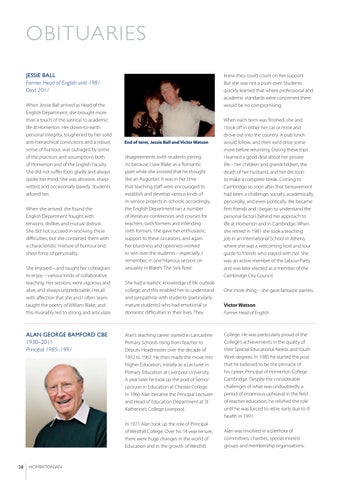
End of term, Jessie Ball and Victor Watson
disagreements (with students joining in) because I saw Blake as a Romantic poet while she insisted that he thought like an Augustan. It was in her time that teaching staff were encouraged to establish and develop various kinds of in-service projects in schools: accordingly, the English Department ran a number of literature conferences and courses for teachers, sixth formers and intending sixth formers. She gave her enthusiastic support to these occasions, and again her bluntness and openness worked to win over the students – especially, I remember, in one hilarious session on sexuality in Blake’s ‘The Sick Rose’. She had a realistic knowledge of life outside college, and this enabled her to understand and sympathise with students (particularly mature students) who had emotional or domestic difficulties in their lives. They
Alan’s teaching career started in Lancashire Primary Schools rising from Teacher to Deputy Headmaster over the decade of 1952 to 1962. He then made the move into Higher Education, initially as a Lecturer in Primary Education at Liverpool University. A year later he took up the post of Senior Lecturer in Education at Chester College. In 1966 Alan became the Principal Lecturer and Head of Education Department at St Katherine’s College Liverpool. In 1971 Alan took up the role of Principal of Westhill College. Over his 14 year tenure, there were huge changes in the world of Education and in the growth of Westhill
28
Homertonian
When each term was finished, she and I took off in either her car or mine and drove out into the country. A pub lunch would follow, and then we’d drive some more before returning. During these trips I learned a good deal about her private life – her children and grandchildren, the death of her husband, and her decision to make a complete break. Coming to Cambridge so soon after that bereavement had been a challenge, socially, academically, personally, and even politically. We became firm friends and I began to understand the personal factors behind her approach to life at Homerton and in Cambridge. When she retired in 1981 she took a teaching job in an International School in Athens, where she was a welcoming host and tour guide to friends who stayed with her. She was an active member of the Labour Party and was later elected as a member of the Cambridge City Council. One more thing – she gave fantastic parties. Victor Watson Former Head of English
College. He was particularly proud of the College’s achievements in the quality of their Special Educational Needs and Youth Work degrees. In 1985 he started the post that he believed to be the pinnacle of his career, Principal of Homerton College Cambridge. Despite the considerable challenges of what was undoubtedly a period of enormous upheaval in the field of teacher education, he relished the role until he was forced to retire early due to ill health in 1991. Alan was involved in a plethora of committees, charities, special interest groups and membership organisations.