Beaux-Arts Splendor • 93
Ornament in Bronze and Stone “[Salières carvings] are notable on account of their departure from the conventional ornamentation of buildings and their appropriateness to a railway station. They are handled with admirable restraint and sense of composition, although in places they fairly seem to spill from the stone of the building. In an original way they symbolize commerce and its consequent abundance. The pine, the oak, the olive, corn, the grape, the fruits of the American subtropics, are interwound with the serpent, taken from Mercury’s wand and emblematic of commerce, together with the winged wheel, representing speed, the signal flags typifying safety, and the trumpet emblematic of progress, all appear in the carvings.”
45
—CHRISTIAN SCIENCE MONITOR, AUGUST 8, 1914
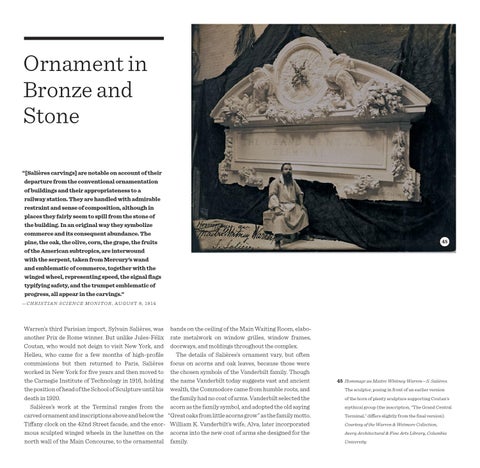
Warren’s third Parisian import, Sylvain Salières, was another Prix de Rome winner. But unlike Jules-Félix Coutan, who would not deign to visit New York, and Helleu, who came for a few months of high-profile commissions but then returned to Paris, Salières worked in New York for five years and then moved to the Carnegie Institute of Technology in 1916, holding the position of head of the School of Sculpture until his death in 1920. Salières’s work at the Terminal ranges from the carved ornament and inscriptions above and below the Tiffany clock on the 42nd Street facade, and the enormous sculpted winged wheels in the lunettes on the north wall of the Main Concourse, to the ornamental
HNA6723r1+GCT_FA_dy_CX_9_6.indd 93
bands on the ceiling of the Main Waiting Room, elaborate metalwork on window grilles, window frames, doorways, and moldings throughout the complex. The details of Salières’s ornament vary, but often focus on acorns and oak leaves, because those were the chosen symbols of the Vanderbilt family. Though the name Vanderbilt today suggests vast and ancient wealth, the Commodore came from humble roots, and the family had no coat of arms. Vanderbilt selected the acorn as the family symbol, and adopted the old saying “Great oaks from little acorns grow” as the family motto. William K. Vanderbilt’s wife, Alva, later incorporated acorns into the new coat of arms she designed for the family.
175L
45 Hommage au Maitre Whitney Warren—S. Salières. The sculptor, posing in front of an earlier version of the horn of plenty sculpture supporting Coutan’s mythical group (the inscription, “The Grand Central Terminal,” differs slightly from the final version). Courtesy of the Warren & Wetmore Collection, Avery Architectural & Fine Arts Library, Columbia University
07/09/2012 12:56 PM