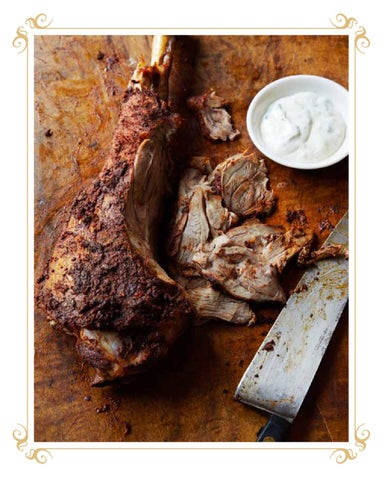
schwarma you’ll get a main course for six to eight—or stuffed pita pocket sandwiches for many more. When I was in graduate school and still a weekend foodie, there were several places along State Street in Madison, Wisconsin, that had schwarma in their windows: hunks of processed and extruded meat, heavily spiced, gray but somehow livid, turning slowly on big silver sabers. The guys at the counter hacked off pieces and put them in sandwiches. Or I think they did, because I never tried the stuff. I don’t eat street food. I don’t care how many food writers promise it’s the only way to know a culture. I don’t eat it. Plus, I wasn’t sure I needed to know any more about Madison culture, besides the patchouli and Birkenstocks. The long and the short of all this? I moved to New York, found Bruce, who is the master of long roasts with delicately sweet rubs, and now understand the pleasure of schwarma. At home.
go all out 6 medium garlic cloves, peeled, then mashed with the side of a heavy knife or put through a garlic press 2 tablespoons olive oil 2 teaspoons salt 1½ teaspoons ground mace
1½ teaspoons mild paprika 1 teaspoon ground cinnamon 1 teaspoon ground cumin ½ teaspoon cayenne pepper One 4-pound leg of goat
1½ teaspoons ground cardamom
1.
Mix the garlic, olive oil, salt, mace, cardamom, paprika, cinnamon, cumin, and cayenne in a small bowl. Smear it all over the goat leg and set the leg in a big, heavy roasting pan.
2.
Set the rack in the oven’s middle and crank the oven up to 350 F. It’ll take about 15 minutes.
Once you slice the meat into bits, you’ll want a flavorful sauce—either to ladle over it on the plate or to drizzle on it in pita pockets before you add some chopped tomato and shredded lettuce. An easy lemon tahini sauce is best: Mix 1 cup strained goat yogurt (see page 000) or Greek-style yogurt, ¼ cup tahini, ¼ cup lemon juice, ¼ cup minced fresh cilantro, 1 crushed large garlic clove, 1 teaspoon salt, ½ teaspoon ground cumin, and ½ teaspoon freshly ground black pepper in a bowl until smooth. You can make the sauce up to 3 days in advance; store it, covered, in the refrigerator, but let it sit out on the counter for 10 minutes or so before serving so that it’s not ice-cold.
3. Roast the leg in its pan until an instant-read meat thermometer inserted into the thickest part of the meat without touching bone registers 160 F, about 2 hours. Transfer the leg to a carving board and leave it alone for 10 minutes. 4.
Now you’ll need to carve it. Position the leg on your carving board with the meatier side up. Starting at the fatter end of the leg, slice the meat off against the grain. If you take a thin slice off the top, you’ll see which way the meat’s fibers are running, sort of like the grain in wood. Now, position the leg so that you’re slicing at a 90-degree angle from the way the “grain” is running. But here’s the tricky part: There are several muscle groups in a leg. Once you get through one, the grain will change and go a different direction in another part. So you’ll have to keep turning the leg to slice thin strips against the grain.
goat
3