April 1973
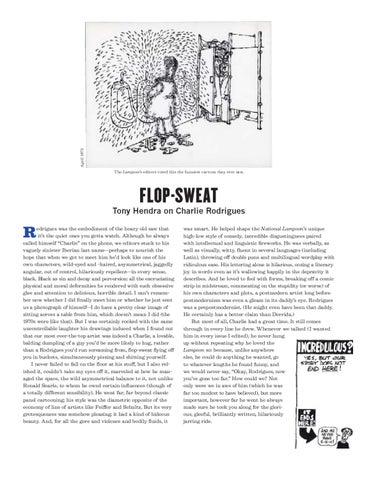
The Lampoon’s editors voted this the funniest cartoon they ever saw.
FLOP-SWEAT
Tony Hendra on Charlie Rodrigues
R
odrigues was the embodiment of the hoary old saw that it’s the quiet ones you gotta watch. Although he always
was smart. He helped shape the National Lampoon’s unique high-low style of comedy, incredible disgustingness paired
called himself “Charlie” on the phone, we editors stuck to his
with intellectual and linguistic fireworks. He was verbally, as
vaguely sinister Iberian last name—perhaps to nourish the
well as visually, witty, fluent in several languages (including
hope that when we got to meet him he’d look like one of his
Latin), throwing off double puns and multilingual wordplay with
own characters, wild-eyed and -haired, asymmetrical, jaggedly
ridiculous ease. His lettering alone is hilarious, oozing a literary
angular, out of control, hilariously repellent—in every sense,
joy in words even as it’s wallowing happily in the depravity it
black. Black as sin and decay and perversion: all the excruciating
describes. And he loved to fool with forms, breaking off a comic
physical and moral deformities he rendered with such obsessive
strip in midstream, commenting on the stupidity (or worse) of
glee and attention to delicious, horrible detail. I can’t remem-
his own characters and plots, a postmodern artist long before
ber now whether I did finally meet him or whether he just sent
postmodernism was even a gleam in its daddy’s eye. Rodrigues
us a photograph of himself—I do have a pretty clear image of
was a prepostmodernist. (He might even have been that daddy.
sitting across a table from him, which doesn’t mean I did (the
He certainly has a better claim than Derrida.)
1970s were like that). But I was certainly rocked with the same
But most of all, Charlie had a great time. It still comes
uncontrollable laughter his drawings induced when I found out
through in every line he drew. Whenever we talked (I wanted
that our most over-the-top artist was indeed a Charlie, a lovable,
him in every issue I edited), he never hung
balding dumpling of a guy you’d be more likely to hug, rather
up without repeating why he loved the
than a Rodrigues you’d run screaming from, flop-sweat flying off
Lampoon so: because, unlike anywhere
you in buckets, simultaneously pissing and shitting yourself.
else, he could do anything he wanted, go
I never failed to fall on the floor at his stuff, but I also rel-
to whatever lengths he found funny, and
ished it, couldn’t take my eyes off it, marveled at how he man-
we would never say, “Okay, Rodrigues, now
aged the space, the wild asymmetrical balance to it, not unlike
you’ve gone too far.” How could we? Not
Ronald Searle, to whom he owed certain influences (though of
only were we in awe of him (which he was
a totally different sensibility). He went far, far beyond classic
far too modest to have believed), but more
panel cartooning; his style was the diametric opposite of the
important, however far he went he always
economy of line of artists like Feiffer and Schultz. But its very
made sure he took you along for the glori-
grotesqueness was somehow pleasing; it had a kind of hideous
ous, gleeful, brilliantly written, hilariously
beauty. And, for all the gore and violence and bodily fluids, it
jarring ride.